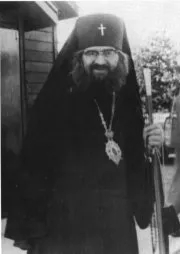
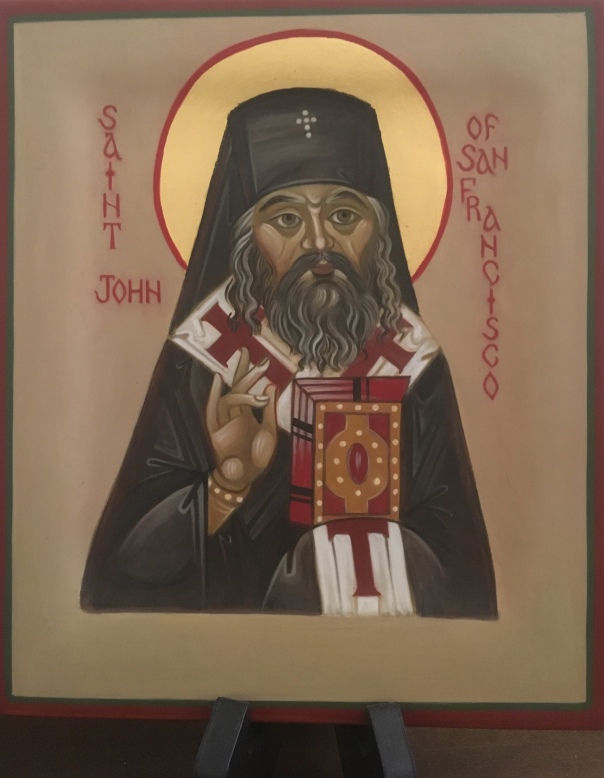
It is the 30th anniversary of the canonization of St. John (Maximovitch), Archbishop of Shanghai and San Francisco. At Holy Virgin Cathedral, “Joy of All Who Sorrow,” the celebration of the feast will spread over three days this week, and members of my parish expect to travel there to participate.
You can read the life of St. John and why he is called “The Wonderworker” – here.
On this joyous occasion I want to share this exhortation from the saint:
Though a man may be found in a weak state, that does not at all mean that he has been abandoned by God. On the cross, the Lord Jesus Christ was in trouble, as the world sees things. But when the sinful world considered Him to be completely destroyed, in fact He was victorious over death and hades. The Lord did not promise us positions as victors as a reward for righteousness, but told us, “In the world you will have tribulation – but be of good cheer, for I have overcome the world”.
Lord, I know that even my asking for spiritual enlightenment is mostly a lie, as my motivations are so mixed….
Nevertheless, hear my words, O Lord, divorced from all the falseness with which I say them.
And Lord, I am not closing my eyes as I pray this, nor scrunching up my face and emotions with spirituality,
as if on my own I could change myself, or as if, having made this awesome scrunchy-faced effort, it won’t be my fault when you don’t answer this prayer for my renewal.
Rather, I am genuinely accepting that I don’t know what precisely would have to change in me for me to love you more.
This unknown change, which you do know, is what I pray for: I pray against myself. Amen.
Back in 2016 I removed my two olive trees from their pots, trimmed their roots, and installed them in larger, matching white (and lightweight) fiberglass pots. I seem to have never written about the process here or posted photos; I wish I had, because I couldn’t remember the specifics, and had to consult YouTube when yesterday I decided to tackle the root-trimming job again.
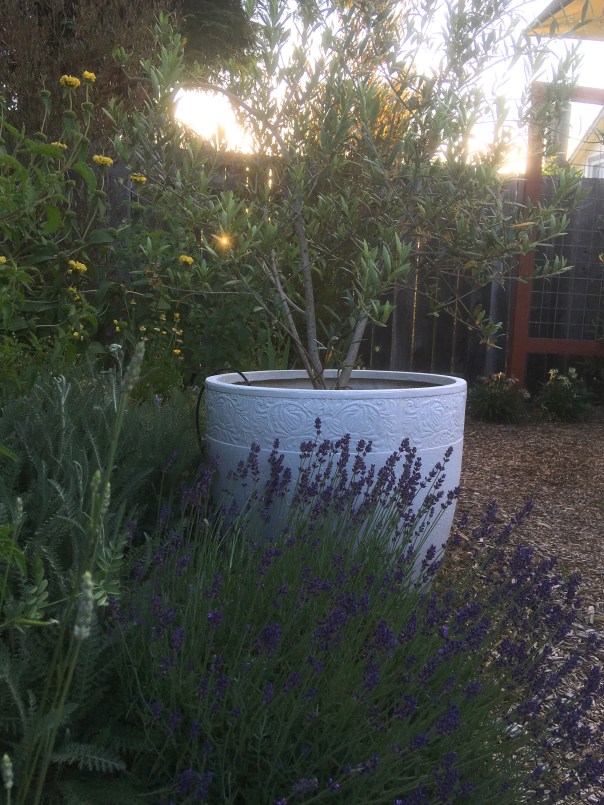
Olive Junior, June 2020
The landscape designer who advised me back then not to plant an olive tree in the ground, because it would grow out of scale and become overbearing in my little garden, suggested I keep the ones I already had and just put them in larger containers; she added that I would need to trim the roots every couple of years to keep them healthy in the confined space.
That was eight years ago this month, and one of the trees by its yellowing leaves has been signalling me that my procrastinating was costing it its health. The task had become more daunting with every year added to my age. Those pots may be easy to move around when they are empty, but with all that moist dirt and biomass in them, I could barely tip one over on to a tarp.
When I did, I found a couple dozen salamanders of all sizes under there. They weren’t happy to feel the sun on their cool and moist bodies, and they writhed and slithered away into the mulch.
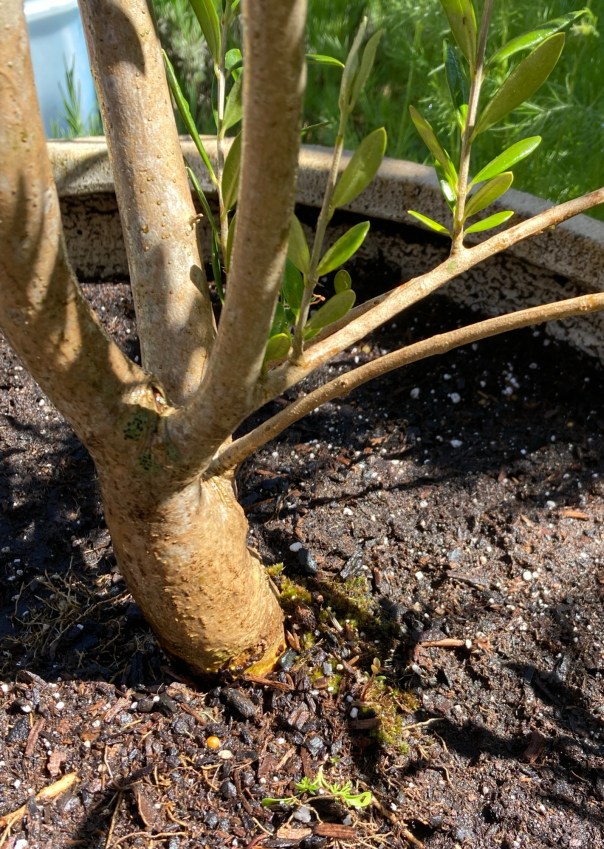
Getting the root ball out of the pot was the hardest part of the whole job. My back didn’t suffer any lasting effects, but my arm muscles are complaining. We were stuck in the situation pictured above no matter how I yanked and rolled things around; I really could have used a helper (with long arms) at this point just to pull on the pot while I pulled on the tree. But inch by slow inch — and it was finally out.
After I loosened the snarled roots, and shook off the old soil, it dawned on me that I didn’t have enough new soil to replace it, so I covered the root ball against the sun and took a half hour to go to the store for a few bags of potting soil.
Olive Senior, May 2020
After trimming the roots I put the pot back in place and leveled it using two flat stones from the mountains, then put the tree back in, with the new dirt, and a little fruit tree food. I trimmed the branches a bit, too. I think this tree, whom I’ll call “Olive Junior,” will be happier now.
What about the other one? It seems pretty healthy, so I’m putting off dealing with it for now. The two trees have different history. Olive Senior was given to me as a birthday present by my son “Pathfinder” and his family more than ten years ago. I kept it in a roomy pot but didn’t water it very much; its form was lacking but it didn’t occur to me to try to improve on it.
A few years later I saw little olive saplings at the grocery store half-off, that is, $7.50. They were very healthy and more shapely than my olive tree, and I brought one home. I began to shape Olive Senior with my pruners. When it came time to put them in matching pots, O.S.’s roots weren’t crowded in the pot and there wasn’t much to trim off. Olive Junior’s roots were extensive and needed a lot of trimming, even though it was much younger. So… I’m guessing each is still following its pattern, and I can wait a bit, and tackle Olive Senior with a little more forethought, and with a helper.
It’s a great blessing to own not just one, but two olive trees, even if I do have to give them the bonsai treatment. They like the Mediterranean climate. I will close my olive report with this Bible verse that I took many years ago as a poem-prayer expressing my heart’s vision:
But as for me, I am like a fruitful olive tree in the house of the Lord; I have hoped in the mercy of God for ever, and unto the ages of ages.
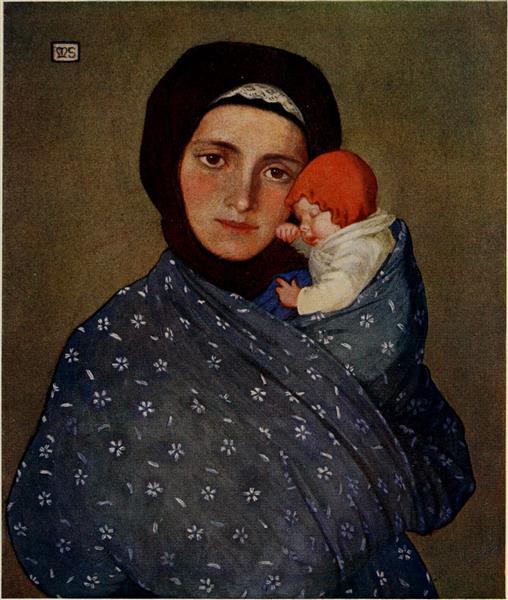
“After birth, the child further develops this primal resonance. This doesn’t happen haphazardly. The child achieves a kind of symbiosis with the mother through its creative imitations of her sounds and facial expressions; in this way, it will feel what she feels. As it takes on its mother’s happy expression, it also feels her joy; if it takes on her sad expression, it shares in her unhappiness.
“Something similar applies to the exchange of sounds: In the clinking and clanging of the mother’s language trembles the well and woe of her being, and the child who imitates that language resonates with it on the same psychological wavelength. This early resonance between child and its (social) environment leads to a unique phenomenon: The young child’s body gets ‘loaded’ with a series of vibrations and tensions that become embedded in the deepest and finest fibers of its body. They form a kind of ‘body memory’ that not only programs the function of the musculature, glands, nerves, and organs, but also predisposes the child to certain psychological conditions, or disorders.
“The human body is, in the most literal sense, a stringed instrument. The muscles that span the skeleton, and the body’s other fibers, are put on a certain tension in early childhood through imitative language exchanges. This tension determines with which (social) phenomena one will resonate; it determines the frequencies to which one will be sensitive in later life. That’s why certain people and certain events can literally strike a chord; they touch the body and, as such, touch the soul. It is for this reason that the voice can make the body ill. Or, conversely, heal it. That is why the voice is of vital importance, especially at an early age. Lack of a voice is fatal to the young child.”




 Gladsome Lights