The uses and abuses of architecture, that subject that interests me but which I barely dabble in, got my attention again recently through an article by George Packer in the Feb 1, 2010 issue of The New Yorker. In his “Letter from Dresden: Embers,” Packer writes that the German city “has the unstable character of a place with a romantic self-image and a past that it would rather not discuss.” But we will discuss Dresden’s past, and ask also, if its latest building project in present time is vandalism, or an enlightening statement.
Before reading Packer’s piece I was fairly ignorant about this city, but as is often the case with New Yorker articles, this one led me on several tangents. The gist of Packer’s thesis is that Dresden is well served by having a gutsy architect like Daniel Libeskind to design its new national military museum, because the artistic violence of his plan is exactly what Dresdeners need to shake them out of their nostalgia and set their view of history straight.
Since reading that article I’ve gone on to learn a little more about the architect, the city, and what took place there toward the end of World War II. I also happened to read a novel that ties in to the reluctance of Germans to talk about the war and come to grips with that painful history. Of course, I haven’t taken my own photos. But if I do get to Germany I’ll be sure to visit these buildings and write another more personal blog post. For now, I want to set down what little I learned–I should say, the questions that have been raised–and if I put it here it’s available for anyone else who might like to know.
It was on February 13, 1945 that the Allies bombed Dresden, an event that some say resembled the horror of Hiroshima, and that the Neo-Nazis brand as equal to the Holocaust. What troubles people about the Dresden of today is the city’s selective reporting of its history, the portrayal of its wartime past as only victimization.

Matthias Neutzner is a local historian interviewed for the New Yorker article: “Neutzner said that Dresdeners remained unusually resistant to the past: ‘The city was erased in one night, and it was very easy for German propaganda to transform this city of art into a city of innocence which had nothing to do with the crimes of war.’
“In Dresden, Neutzner said, the story of the war has effectively been reduced to just one day: ‘It started and it ended on February 13, 1945.’ Neutzner’s aim is to get the city’s residents to remember ‘that this was the sixth year of a huge war, that there were twelve years of Nazi crimes, there were eight small concentration camps in Dresden with three thousand prisoners. All this is completely unknown in Dresden.'”
The diaries of Victor Klemperer are held up as an essential source text for those who want the whole story. He was one of the fewer than 200 Jews who remained in the city on that day of destruction in 1945, out of more than six thousand prewar. Published in the 1990’s, the three volumes in English are I Will Bear Witness, To the Bitter End, and The Lesser Evil. Packer writes that they tell “in mundane and relentless detail how the humanistic city of his youth turned into a place of terror that ostracized, humiliated, warehoused, tortured, and, finally, annihilated its Jews.”

Since the war the city has been busy rebuilding, trying to restore architectural Dresden as much as possible to its lovely pre-war state by recreating buildings like the Frauenkirche cathedral. This activity contrasts with the attitude of another war-torn city, Berlin, where the “new architecture often has the quality of what Bertolt Brecht called Verfremdung, or the V-effect–estrangement, distancing. Berlin makes little attempt to hide the worst decades in German history. After 1989, the city placed its vanished Jews near the center of its collective consciousness, understanding that this was part of the price of reclaiming its international status.”
It was the Jewish Museum in Berlin, shaped, as one person said, “like a deconstructed Star of David,” that in 2001 made a name for Polish-American architect Daniel Libeskind, the one chosen to design the Military History Museum in Dresden, a renovation of the former military arsenal building that has been serving as a museum since 1897.

Not everyone likes this architect’s style. Back in 2003 Deroy Murdock cautioned against Libeskind and his art in a National Review article quoting heavily from the architect’s own words, poetic and otherwise, calling his poetry grotesque and his Berlin museum ghoulish. Murdock was lobbying against Libeskind as a contestant in the running to design the new World Trade Center in New York, and in fact, he did end up designing the overall site plan.
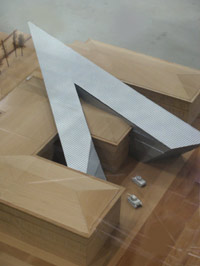
I must admit that Libeskind’s poetry strikes me as twisted and broken, not lovely. But history shows mankind to be perverse as well, and Libeskind thinks it’s healthy to face one’s past and its ugliness, so that you can get a more balanced and true understanding of reality from which to make progress. The arrow-shaped addition to the old museum, cutting through the building just as the Holocaust made a gash through the 20th Century and human history, nonetheless rises to a higher elevation where visitors will get a broad and fresh perspective on the whole city, a view that wasn’t possible from the former museum.
Spiegel Online quotes Libeskind as saying, “…sentimentality is not a foundation on which you can build a new city.” To make a sure foundation, it would be necessary to know where the bedrock is, and where the sand. The architect has built in a degree of disorienting experience a step above the mere visual. Packer writes, “The effect of these [oddly angled] inclinations, Libeskind said, should be above all physical: ‘It’s like a collapse, isn’t it? You feel it in your knees….You can’t be neutral in these spaces.'”
He goes on to say, “The triangular structure on the front of the arsenal points to the direction from which Dresden was bombed. It also interrupts the smooth flow of that big arsenal. It creates a question mark about the continuity of history and what it means. It gives people a point of reflection.”
It’s these philosophical question marks that get my mind’s wheels turning. I can see how trying to recreate the city as it was in the 1930’s would convey that you want to go back to that better time. But was it any better, the society and people who participated in the extermination of their fellow humans? Even if it were, going back is not an option. We need to live where we are now, and go forward, trying to learn from the past, even though it speaks to us of our failings.
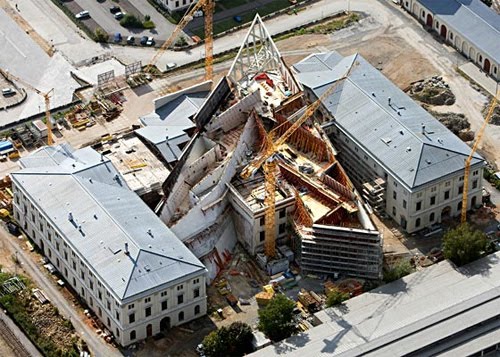
The new military history museum is scheduled to be completed this year and to open in 2013. Studio Daniel Libeskind’s statement about the project explains: “The central theme of the Military History Museum is the human being: those who went into the war and those who have remained at home; people of different eras and people of different generations.”
As the facade of the old building “represents the severity of the authoritarian past in which it was built, the other [new “arrow” facade] reflects the openness of a democratic society and the changed role of its military. In the new elevation of the Museum both are visible at the same time and one through the other.”
Packer concludes: “…though the museum is crude architecture, its bluntness should give it power as a civic institution: nothing more subtle than this could offer Dresden the possibility to break from its self-delusions.”
Update: Comments generated a Part II to this discussion, here: Architecture of War and History, Part II