Category Archives: quotes

Up and Down the Mountain

Last week was the occasion of a blessed excursion to my family’s mountain cabin, and this time I shared the time with my dear friend Mrs. Bread.
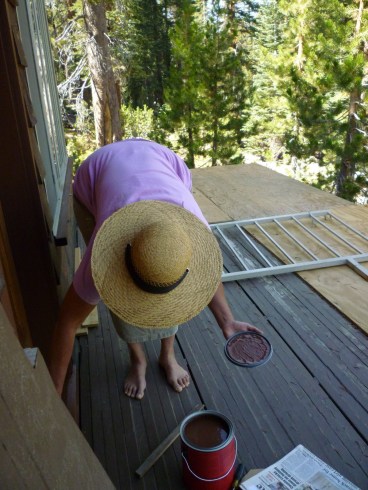
I’ve blogged about the cabin and lake before, here and here. The last two years I went mostly for time alone with God in His Creation. This time I enjoyed plenty of that experience, plus deepening of friendship, and working on improving or maintaining the house and property. Now that my father has passed, I am part owner of this place, and I happily but more intensely feel the responsibility to do my part, though I’m afraid I’ll never match the hardworking devotion of my siblings who live closer; some of them can dash up just for the day if they need to.

Here I am painting the threshold and doorjamb against the elements of winter. One year–or maybe more than one–the whole cabin was buried in snow, just a lump in the white landscape.

The drive took me ten hours, what with a leisurely detour to pick up Mrs. Bread on the way. So we stayed four nights so as to have three whole days for taking pictures, cooking, reading together, cleaning, admiring giant boulders and listening to the silence of the forest.
How can it be so awe-fully quiet? There are birds flitting and chipmunks scampering, breezes blowing and even the occasional chain saw in the village. But the earth feels peacefully serene up there, weighted with quiet, heavy with a silence that speaks of God’s presence. I seem to soak up contentedness and rest.

I needed the rest, as I had come down with a cough and cold in the two days before. The altitude gave me a headache the first night, and we both suffered from the reduced oxygen, our legs uncooperative and slow when we dragged back up the hill after a walk down to the lake.

It’s the High Sierra, and up there the mornings start out below freezing this time of year, making you want to lie abed and watch the sky lighten out the window. By midday it can be sunburning hot out on the deck, so we sat in the shade of the umbrella to peruse the several tree guides that have found their way to the cabin’s bookshelf.

At first we limited ourselves to studying the general shapes and angles of branches, focusing in on the cones with binoculars. Eventually we walked among the trees below the cabin and noticed where cones had fallen underneath their mother trees.

The pines in the neighborhood are mostly Lodgepole, as illustrated by the picture here. But to be truthful, it took Pippin’s later confirmation of that suspicion to make me believe it.

As we walked together marveling at the various beautiful flowers, berries, and stones, Mrs. Bread said, “These little trees grab at my heart!” See why I love her?
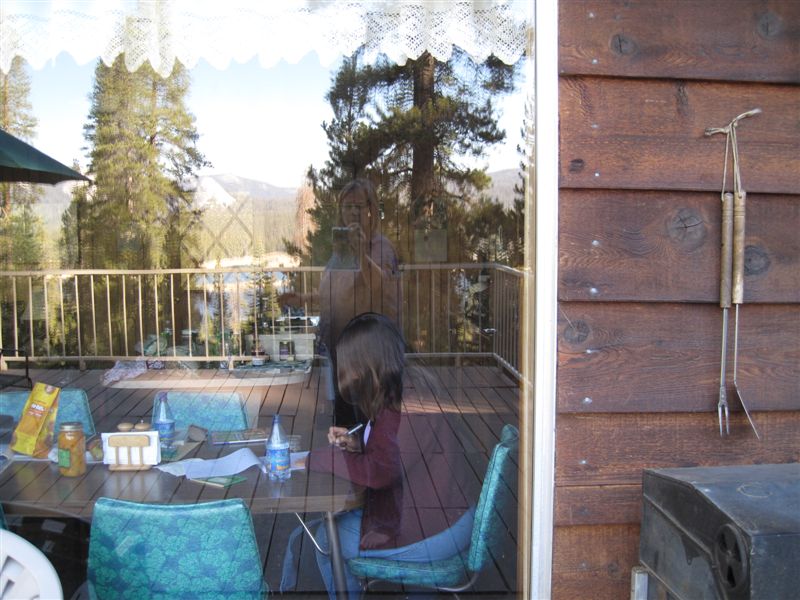
  

What a lot can be seen in this photograph, taken from outside the picture window, while I was sitting at the table inside writing a letter to a grandson. You can see the kitchen behind me, and the lake reflected behind Mrs. Bread’s reflection.

I like having these pictures of myself at the lake, something besides the ones of my feet that I took last year when solitary. Thanks, my friend!
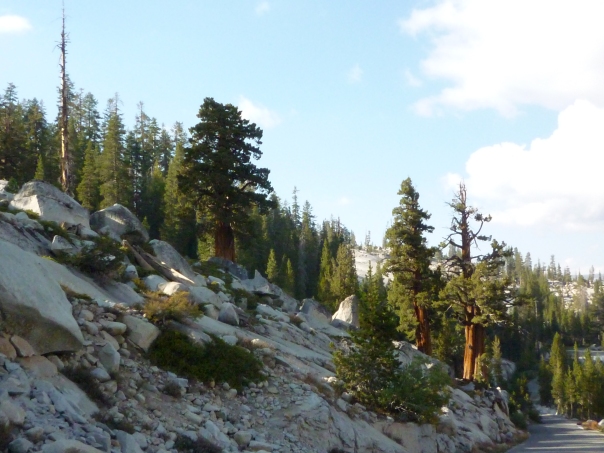
P1030772

These three trees stood out from the pines with their trunks shown off by the granite slabs.  Mr. Glad thinks they might be red cedars.

The first morning at the cabin I read in the Psalter, “For Thou hast said: Mercy shall be built up for ever,” (Ps. 88) and was musing about the image that phrase conjured in my mind, of an edifice being constructed. And why not the image of towers of clouds, that often rain down showers of blessing? From now on, when I see cloud skyscrapers rising fast, piling layer upon layer, I will think of the way God’s mercies do the same, every morning.

Someone brought this small remembrance of our father up to put on the bedroom wall. If you click on it a couple of times you can read the labels. I love seeing my father’s handwriting, which didn’t change in all the years since this collection was made when he was in college.

Mrs. Bread helped me firm up my resolve to try really hard to come up to this beloved place more next year. It’s not available for very long, though: This week shutters will be put up, water turned off, chimney covered, to mention only a few of the many tasks to protect the house from blizzards–and if we can get through the snow to open it up before the first of July we’ll be happy.

I’ve never been up more than twice in a summer; I wonder if I really do have the liberty to even dream of spending a week, or visiting twice or three times. I’ll pray for a miracle, and wait to see how the Lord chooses to pile up His mercies next year.

War and Architecture – Part 2

My recent posting about how cities memorialize their history in the buildings they renovate or build from scratch generated comments that added a great deal to the discussion going on in my own mind.

Emily at Back Bay View is “suspicious of postmodernists like Libeskind who want to make their patrons uncomfortable and to force them to think. Granted, trying to recreate the past too precisely sometimes results in a sentimental/themepark like effect. But, on the other hand, for how many years can you exist in/with a building that is a criticism of the human person? At some point, I would think, the discomfort will fade and the intended self-conscious effect won’t take place.

“Wouldn’t it be more healing to build structures that promote healing, rather than criticism? Couldn’t you say that the old building doesn’t represent a severe authoritarian past, so much as an orderly past, a past that preceded the Nazis by centuries, and an attempt to restore order is an act of hope? Whereas the architect who intends to break self-delusions promotes a discomfort with the self that leads not to hope but to melancholy?”

Frances informed me that Kurt Vonnegut’s novel Slaughterhouse-5 is about the bombing of Dresden, and also shared her experience of living and traveling in Germany: “I’ll always remember Freiburg, which was heavily bombed during WWII. When they rebuilt it, they used the original, medieval plans, so that it was exactly the same as before.”

Emily’s comments sent me back to the review I wrote of Architecture of Happiness, and I figured out that one basic reason I couldn’t like the new military museum was its failure to abide by the first principle of good architecture laid down in that philosophical book:
“Order. But not over-simplified. We like to see complex elements arranged in a regular pattern. What the author calls the ‘perverse dogma’ from the Romantic Period, that all edifices must be of original design, led to chaos in the landscape. ‘Architecture should have the confidence and the kindness to be a little boring.’

“I was wondering if perhaps a museum might get away with such a brash statement, where being made to think isn’t a bad thing, but you are probably right, the statement will lose its effect. (I hope in the meantime it squelches those Neo-Nazis a bit)…and yes, the jarring buildings fail to offer hope or show harmony. But without reference to or undergirding by the Christian gospel, an artist is unlikely to find those elements, and will drift from melancholy right on to nihilism.”

We have to ask, as Jody did, “If you were to rebuild Dresden and not look back, but forward, how would you go about it? I agree that “onward and forward” is the best, but would there not be little bits of the past that one would want to honor, I wonder? (not the ugly, of course)”

Emily also “…went to the Marine Corps Museum in Quantico, VA, which has a very similar slanted pyramid design which is supposed to recall the photo of marines raising the flag at Iwo Jima. (and a statue is right in front of the museum so that reference isn’t missed). But in the case of the MCM, the glass pyramid doesn’t interrupt another building like Libeskind’s design, since it’s located outside the city and rises above the treeline and catches the sunshine. So a very similar design in a different context has a completely different effect.

“Likewise, I couldn’t help thinking of another glass pyramid, the one designed by IM Pei as an additional entrance to the Louvre. I don’t know the philosophy behind it, but it just strikes me as out of context and so a little silly, like a non sequitur comment. Maybe there is some reason for its being, but it was lost on me, your average tourist.”

Kari hopes that “we can find a way to heal the past without forgetting, and to go forward in peace, love, harmony. The Holocaust brings us face to face with forgiveness and with how to forgive in the face of the unforgivable.”

I wanted to share this discussion with anyone who might have been interested in the topic but who didn’t get in on the ensuing and improving thoughts. Since I wrote the original post we had the anniversary of the bombing of Hiroshima, which got me thinking about further aspects.The Witherspoon Institute’s Public Discourse page now has an article on the subject, wherein the author points out links to the whole Allied strategy. Consequentialism is a word that was new to me, discussed here on the Witherspoon page and on Touchstone’s Mere Comments. The Ochlophobist questions our utilitarian mindset that can’t tolerate the absolute moral principle.

I’m in over my head as usual, but it’s obvious that some of my readers are good at this kind of swimming. I hope I am learning something from them as I flail about.

We Need Food of All Kinds

Soldier’s wedding will take place in a few days.  Mr. Glad and I are just trying to get ourselves and the house and my father-in-law ready for the Joyous Event–and trying at the same time to get over our summer colds. I was pleased to pick the first lemon cucumber and add it with our arugula and the multi-colored cherry tomatoes to some lettuce last night, to fortify us for the work, and for the happy busyness ahead.

This morning I was well enough and eager to get back to church, where we remembered the life of St. Lawrence of Rome. God has filled my cup with delights like this–how many parishes are able to celebrate on a Tuesday morning?

St. Lawrence was a deacon serving with Pope Sixtus in the third century; his life and martyrdom are peppered with several encouraging stories. He seems to have had a good sense of humor, and among the various groups who call him patron are comedians.

G. K. Chesterton said it is the test of a good religion, whether you can joke about it. I’m sure he didn’t mean anything like mocking God or His salvation. But being able to laugh at oneself is a sign of humility, and I think it might be a collective form of this humor he is talking about. The whole subject of humor is something mysterious to me, and I would do well to study Chesterton’s other writings about it. For now I will change the subject after my favorite pertinent quote, also from him: “Angels can fly because they take themselves lightly.”

I came home from the feast and noticed the hyssop flowers having grown taller and taller. Bees were drinking nectar from the blooms, but bees are hard to photograph–one has to take time and a couple dozen pictures in hopes of getting one without a blur of bee, and I have lots of housework yet to do.

My life is like my garden. It’s full of beautiful and colorful things and events, ever changing, and I notice so few of them. Fewer still can I pick and show anyone else. My sociable or communicative side I find is always writing script in my mind, for how to tell other people about my discoveries and joys. But when the foliage and flowers grow so fast, events tumbling and intertwining with each other like a jungle, the feeling of not keeping up has been a gift in itself. From a feeling of helplessness, God has given me grace to just stop that script-writing for a few minutes at a time and direct my noticing and my thanks only to Him. Let me be like the bee, blurry if need be, but doing my job of imbibing the sweetness.

Responding to Unpleasantness

Posted on The Morning Offering, this from St. Symeon the New Theologian:

“Faith in Christ is… a good and patient disposition of the soul in enduring all temptations, whether griefs, sorrows or unpleasant happenings, until God’s favour looks down upon us; thus we would imitate David who says: ‘I waited patiently for the Lord; and He inclined to me and heard my cry’ (Ps. 40:1).”

Unpleasant happenings are my excuse for many kinds of sins, from overeating to speaking quickly and unkindly. If I would, at the first notice of unpleasantness, direct my soul to wait on God, wait to speak, wait to eat, etc., I would be enduring temptation. It appears that not all temptations are of the type from which one can flee, or that can be actively resisted. But in any circumstance we can rest in Christ. I don’t write from much experience.

On the other hand, St. Symeon did. He was abbot of a monastery when the monks attacked and nearly killed him. Don’t be confused by his title; his theology was not new, but he was younger than another man with the same name, hence the clarifier.

The Orthodox Church has given only three saints the title of Theologian. I love that the quote above hearkens back to old theology, that of a man whose tradition was of the school My Soul Follows Hard After Thee.