Category Archives: quotes

A new nose and backbone.

Soldier both picked me up from the Denver airport two weeks ago, and dropped me off for my return flight. He drove his truck, which seats four, so each time, in addition to me, he could accommodate two passengers. For the first trip that was Liam and Laddie, and Brodie stayed home with Clara.

Brodie therefore was automatically put on the passenger list for the drop-off yesterday, New Year’s Eve, and the other boys drew lots for second place, the lot falling to Liam. On the way up the highway we got to talking about the new year, and how it is a time when many people resolve to improve themselves in the coming year. Boys of ten and six aren’t likely to set overlarge goals for themselves, so they didn’t really need the cautionary words of their father and me, but we reminded them and ourselves that every day of the year provides the opportunity to pray, and to present ourselves to the Lord as His servants. That’s not a big resolution, but it is a powerful daily orientation.

If you do have a goal you want to work toward, Soldier explained, it must be measurable, so that you will know when you have achieved it. And it needs to be a realistic, reasonably achievable goal (Not of the sort “You can be and do anything you set your mind to!”). I added that it’s good to break such a project into small parts, and figure out what the first step is. If it’s a worthy goal, you probably won’t get it done in one day, or one week.

“The object of a New Year is not that we should have a new year.
It is that we should have a new soul and a new nose;
new feet, a new backbone, new ears, and new eyes.”

-G.K. Chesterton

I think of the command of the Lord, first spoken in Leviticus, of which the Apostle Peter reminds us, to be holy:
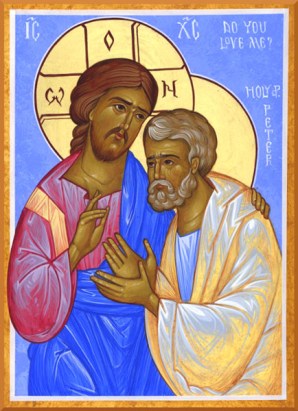
Christ and Peter

“Therefore prepare your minds for action. Be sober-minded. Set your hope fully on the grace to be given you at the revelation of Jesus Christ. As obedient children, do not conform to the passions of your former ignorance. But just as He who called you is holy, so be holy in all you do, for it is written: ‘Be holy, because I am holy.'” –I Peter 1

Now that is a large and worthy goal, which one might feel is not in the least achievable… but since it is the will of the Lord God, we have to take it seriously. And not as a rash New Year’s resolution, like: “This year, I am turning over a new leaf, and I will be a saint by 2024!” No, it will have to be sober-mindedness every morning, and setting our hope every evening. St. Peter continues:

“Since you call on a Father who judges each one’s work impartially, conduct yourselves in reverent fear during your stay as foreigners. For you know that it was not with perishable things such as silver or gold that you were redeemed from the empty way of life you inherited from your forefathers, but with the precious blood of Christ, a lamb without blemish or spot. He was known before the foundation of the world, but was revealed in the last times for your sake. Through Him you believe in God, who raised Him from the dead and glorified Him; and so your faith and hope are in God.”
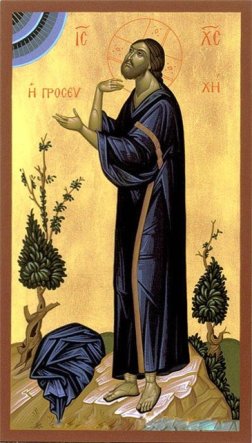
Christ praying in Gethsemane

How does “Conduct yourselves in reverent fear” fit into an outline according to our modern, systematic way of thinking? I suppose it might serve as Plan 1 under the Goal of Be Holy…. followed by those small steps I advised the boys about. But really, God doesn’t want us to come up with our own system to work toward “goals” that He has set for us. That kind of thing can be a big distraction from His true plan, that we would walk moment-by-moment with Him, and be changed by the Holy Spirit’s work. Improving ourselves by our own devices will ultimately get us nowhere; “…your faith and hope are in God.”

Today is not only New Year’s Day, but being the eighth day after Christ’s birth, it is the day we remember that his parents brought Him to be circumcised according to the law. This sermon on the feast day by Fr. Philip LeMasters on “Purifying the Heart” expresses the mind of the apostles on these same matters:

“Christ’s circumcision is a sign that He fulfilled the requirements of the law and enabled all with faith in Him to find a righteousness that exceeds that of the scribes and Pharisees because it extends to the very depths of our existence, to our hearts.

“Consequently, the only way worthily to celebrate His circumcision is for us to perfect the circumcision of our hearts.  That means purifying them, cutting off their corruption by uniting ourselves to the God-Man from the depths of our souls.  And there is no upward limit to this calling.”

“If we reduce our high calling to legalism or a simple list of deeds to perform, we will have missed the point.  For being united with Christ in holiness is not a matter of simply doing this or that by our own will power.  As St. Paul reminded the Colossians, ‘you were buried with Him in baptism, in which you were also raised with Him through faith in the working of God, Who raised Him from the dead.’  We obviously cannot conquer sin and death by even our best actions or thoughts.  As St. Paul taught, ‘By grace you have been saved through faith, and that not of yourselves; it is the gift of God.’ (Eph. 2.:8.)”

You can read the whole sermon: here.
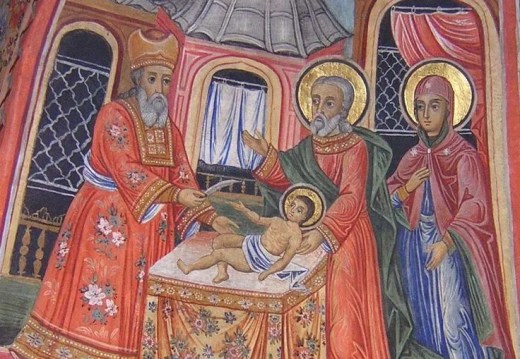
Returning to the Chesterton quote above, I pray that our souls would truly be “new,” along with our eyes, etc., in these first days of 2023, by God’s ever-present gift of grace. If my spiritual “nose” is refreshed by the Lord, it will be better able to detect the sweetness of His mercies every morning, and continuing.

In-between December days.

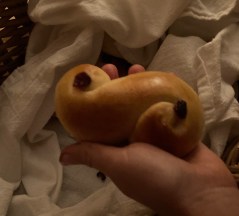
The first half of the week was a flurry of activity: First a Santa Lucia Eve procession that I was invited to, with a few families I have been getting to know because of my involvement in a homeschool group. With the eldest girl wearing a wreath studded with candles, we processed through the neighborhood singing “Santa Lucia” in Italian — I admit I was only humming the tune because I haven’t become that involved to have learned the words in Italian or even English. Then back at the house, we added “Stille Nacht” (Silent Night) in the original German. Tea and Santa Lucia buns in their delicious quintessential selves finished out the evening’s simple program. I took the picture three days later so the greenery is a bit dried out.

The next night our women’s book group at church got together. Originally that meeting was to be a soup dinner for 10 at my house, but the time and place got changed because of a funeral; it was a big relief for me, because as soon as December arrived, I couldn’t imagine getting ready for a party at the same time I was getting ready for a trip, which this year is the case: I’m headed to Soldier and Joy’s for Christmas.

At the first part of the funeral, in the evening.

I made split pea soup, and we had a very festive group and evening, eating fish chowder, pumpkin soup and lentil tomato soups as well — plus accompaniments. Of course, cookies and vegan brownies, too! I don’t think I mentioned before what books we have been reading this time. They were Strength in Weakness by Archbishop Irenei Steenberg, and The Secret Garden by Frances Hodgson Burnett. I’d been wanting to gather my thoughts on The Secret Garden for about five years, so this was the impetus I needed to buckle down. I’ll share more about my resulting amateur analysis in the new year.

By Julia Morgan

Thursday I attended a tea party of about a dozen ladies and girls, several of whom I was meeting for the first time. Many of them are very accomplished, cultured and educated, and there was lots of fascinating conversation about our personal histories, world events, information about our local towns and the architecture of particular houses that were built by a relation of the woman sitting next to me. She was the only one there who is older than I, and she has been involved in our town’s history from way back, and continuing.

It was while this talk was flowing around me that the name of Julia Morgan, architect, made me pay closer attention; a bit more information about the time frame in which she worked, and I began to wonder if my grandfather was one of the contractors that she worked with in the San Francisco Bay Area; she designed more than 700 houses in California. I will be doing more research on that, but in the meantime I show you these photos of the Berkeley City Women’s Club building, in which my grandmother (on the other side of the family) was very active, and where she took us swimming when we visited her. That building has been called a “little Hearst Castle,” referring to the real (huge) Hearst Castle in San Simeon, California, the estate that Morgan designed with William Randolph Hearst.

Since the tea party I have switched gears and stayed home, slowly working on wrapping presents, packing bags and organizing my thoughts in preparation for my departure. One by one little things that need to be done come to mind and I do them, or write them down. It is not very systematic, and the whole process seems to require frequent attention to everyday tasks like building the fire and tending the frozen fountain. I guess it’s because I’m not systematic that I require banks of time for the creative flow to happen. As I am fond of quoting G.K. Chesterton:

“I am not absentminded. It is the presence of mind
that makes me unaware of everything else.”

Even things I’ve been procrastinating on for months must be put off no longer, whether or not they have anything to do with the trip — like making a phone call. My daughter Kate says everyone does the same at the end of the year, finally sending in reports or contacting loved ones, I guess because they don’t want to come back from Christmas break with “old business,” whether it’s work or family related, dutiful or joyful.

Now that I’ve procrastinated enough to get another unnecessary thing done, the writing of this post, I will have to hustle a little bit and fold the clothes I laundered, to figure out what to take with me. Before I know it, these in-between days will have ended and I’ll be boarding an airplane and on my way to a happy reunion with several of my dear family. I hope that on Christmas Eve we will sing “Stille Nacht.”

Jesse — root and windows.

Today is the Sunday of the Forefathers of Christ, His ancestors according to the flesh. We remember these who lived “before the Law and under the Law,” especially the Patriarch Abraham, to whom God said, “In thy seed shall all of the nations of the earth be blessed” (Gen. 12:3, 22:18).

I brought an icon of the Prophet David to stand up on the table in my church school class, and we talked about David as a shepherd boy, his killing of a lion who was threatening the sheep, his composing songs, and his anointing by the Prophet Samuel. (But first, we must chat about St. Nicholas and Santa, because he was strongly on the minds of the four- and five-year-olds.)

When I took the icon out of my bag again at home, I set it up downstairs, and lit a candle to help me keep remembering for the remainder of today. Maybe I will leave it here through next Sunday, when we remember more of these saints; the next church school lesson will focus on the Hebrew Children in the Fiery Furnace.

One thing I didn’t discuss with the children, but would be fun to teach older students about, is the Tree of Jesse, a visual depiction of the genealogy of Jesus Christ. Jesse was the father of King David; his roots extend down and back to his own forefathers including  Abraham, the Father of the Faithful; and Jesse was himself the root, or progenitor, of David’s line, which culminated in Christ the Messiah.

Jesse Tree icons must necessarily include so much information, they somewhat overwhelm me. When looking at them I tend to concentrate on Jesse himself, lying at the base of the tree, with its trunk growing out his very body.

Jesse Window detail, Dorchester Abbey
Wells Cathedral Jesse Window

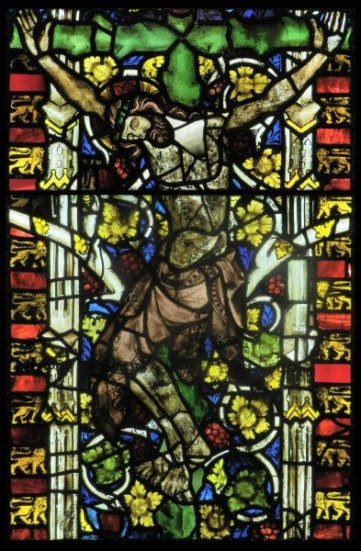
Stained glass windows portraying the Jesse tree, which abound in Britain, are also a bit much for me to take in. Often they are in tall cathedrals and extend up a whole wall, the figures distant and their names unreadable. As I was looking at some online I was happy to find Val Stevens talking about the Jesse Window at Wells Cathedral, which I no doubt saw when I visited there with daughter Pippin, but I don’t remember.

It’s a very short video (which ends with a request for contributions which are no longer needed, because the repairs have been completed), and she speaks for only two minutes, but she made me laugh with joy when she began to speak about the rare crucifixion scene that is in that window, which dates from the 14th century. The stem turns green, and takes the form of a cross, on which the Savior hangs. When she got to the part about the meaning of the green wood, or what it meant to the medieval mind, my heart leapt to hear it, and to see the change in her body language as she moved from purely artistic ideas, to the more compelling realities of the heart: Jesse Window of Wells Cathedral

Ansgar Holmberg

Also I want to share a quote I have posted before, more than once, because it pulls together several of these images, metaphors, and real people in our salvation history, in our cultural tradition. This is about a different sort of tree, the more familiar and ubiquitous Christmas tree! From Metropolitan Hierotheos Vlachos:

“I suspect that the custom of decorating a tree at Christmas time is not simply a custom which came to us from the West and which we should replace with other more Orthodox customs. To be sure, I have not gone into the history of the Christmas tree and where it originated, but I think that it is connected with the Christmas feast and its true meaning.

“First, it is not unrelated to the prophecy of the Prophet Isaiah: ‘There shall come forth a Rod from the stem of Jesse, and a Branch shall grow out of his roots’ (Is. 11:1). St. Cosmas the poet had this prophecy in mind when he wrote of Christ as the blossom which rose up out of the Virgin stem from the stump of Jesse. The root is Jesse, David’s father, the rod is King David, the flower which came from the root and the rod is Theotokos. And the fruit which came forth from the flower of the Panagia is Christ. Holy Scripture presents this wonderfully.

“Thus the Christmas tree can remind us of the genealogical tree of Christ as Man, the love of God, but also the successive purifications of the Forefathers of Christ. At the top is the star which is the God-Man (Theanthropos) Christ. Then, the Christmas tree reminds us of the tree of knowledge as well as the tree of life, but especially the latter. It underlines clearly the truth that Christ is the tree of life and that we cannot live or fulfill the purpose of our existence unless we taste of this tree, ‘the producer of life.’

“Christmas cannot be conceived without Holy Communion. And of course as for Holy Communion it is not possible to partake of deification in Christ without having conquered the devil, when we found ourselves faced with temptation relative to the tree of the knowledge of good and evil, where our freedom is tried. We rejoice and celebrate, because ‘the tree of life blossomed from the Virgin in the cave’.”
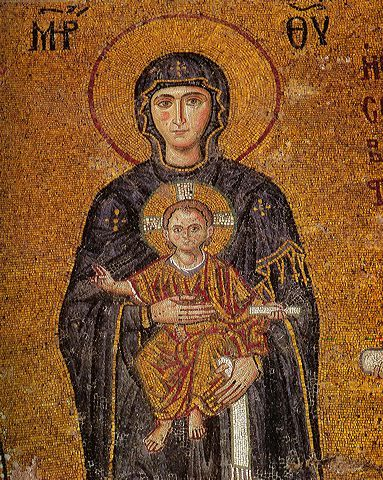
-Excerpt from: “The Feasts of the Lord: An Introduction to the 12 Feasts and Orthodox Christology” by Metropolitan of Nafpatkos Hierotheos Vlachos – November 1993. 

I’ve known families who used a Jesse Tree along with their Advent wreath as helps in Advent. But oh, my, out of curiosity I just looked at some current Pinterest-era examples, and had to abort that browsing quick; it was plenty for a Sunday afternoon to look at stained glass windows.

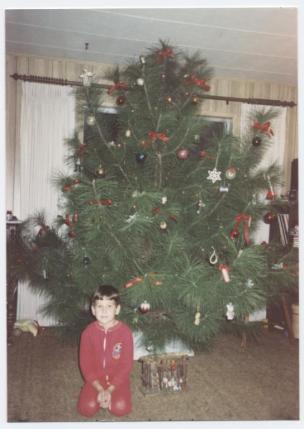
My daughters and I have been sharing memories this month, from our homes scattered across the country; posting photos of past and current Christmas trees, reminiscing about Christmas caroling, and recalling their father’s voice and his Christmas joy. This year I will have neither a Jesse nor a Christmas tree, but I feel rich with history and symbols and family. There’s my earthly family, and there is the heavenly family into which I’ve been adopted by the Father. Today I’m especially grateful for all those patriarchs and prophets who have gone before and who encourage me by their lives of faith.

By faith You justified the Forefathers,
when through them You betrothed Yourself beforehand
to the Church of the Gentiles.
The saints boast in glory,
that from their seed there is a glorious fruit:
she who bore You without seed.
By their prayers, O Christ God, save our souls.

-Hymn for the Feast