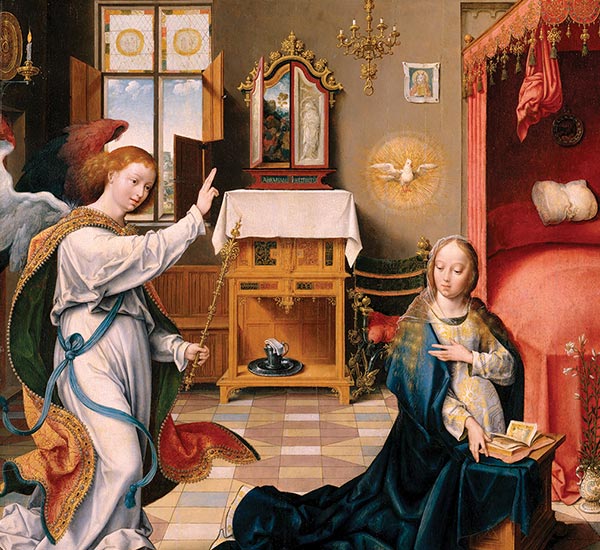
“Artists in the Christian tradition have been inspired by the New Testament stories, and one story in particular has prompted them to reflect on the nature of beauty and its place in our lives: the story of the Annunciation. In this story we encounter a moment of interaction between the human and the divine, when an angel appears in the most private and protected part of a woman’s home.
“The light that radiates from the angel falls not only on Mary but on all the objects that surround her, showing the fitness of the woman for her holy task in the order and beauty of her room. The Annunciation by the Dutch master Joos van Cleve (1485–1540) illustrates the point. None of the objects among which Mary sits is purely functional: everything has an edge, an embellishment, a kind of gentle excess. The furnishings are not just accidentally there: they are there because they are also owned, shaped, and cherished. Mary has arranged the room with beauty in mind, so as to be a fit welcome for an angel.”
The quote above is the first paragraph (divided by me into two) in an article
by the late Roger Scruton, “The Beauty of Belonging”,
published several years ago in Plough magazine.
“Books you have read share a deep ontological similarity with books you haven’t: both can be profoundly fuzzy. At times books you haven’t read shine more brightly than those you have, and often reading part of a book will shape your mind more decisively than reading all of it; there is no inherent epistemic superiority to having read a book or not having read it.”
-John Durham Peters, The Marvelous Clouds
After my first and second postings of quotes from this book that I still haven’t read, I found this declaration from the author quite generous, even if he does use both ontological and epistemic in one paragraph. In 2016 and 2019, which seems ages ago now, several of my readers said that they had been prompted to order the book, or at least put it on their TBR list. Did any of you pursue it further?
The Artist’s Wife by Henry Lamb
I know very well by experience what he is talking about here, how impactful books can be just by their presence on my shelves. I read the intro to The Marvelous Clouds twice already, and it evidently did not shine brightly enough in my mind for me to remember anything of it, or to continue.
I found the quote above on Goodreads, where I do quite a bit of mining from time to time. Reading a few quotes from a book is certainly a very small part, but these bits can provide a lot to chew on. Here is another thought provoking passage from the book that I also got by cheating:
“Schopenhauer remarked that buying books would be better if you could also buy the time to read them. Books are different from natural objects in that they can overwhelm us in a way that nature’s abundance rarely does. There has always been too much to know; the universe is thoroughly baffling. When we walk into a bookstore, it is easy to feel oppressed by the amount of knowledge on tap. Why don’t we have the same feeling in a forest, at the beach, in a big city, or simply in breathing? There is more going on in our body every second than we will ever understand, and yet we rarely feel bothered by our inability to know it all. Books, however, are designed to make demands on our attention and time: they hail us in ways that nature rarely does. A thing is what Heidegger calls zunichtsgedrängt, relaxed and bothered about nothing. A plant or stone is as self-sufficient as the Aristotelian god or Heidegger’s slacker things, but books are needy. They cry out for readers as devils hunger for souls.”
It could be that somewhere else in the book Peters mentions the different kinds of knowledge. When you are walking in a forest you are getting to know the trees and the air in a non-intellectual way, and that makes all the difference. It would be a shame to know rocks and trees and clouds only by reading about them.
A man may as well expect to grow stronger by always eating as wiser by always reading. ~Jeremy Collier
I had intended to think and write more about all of this, but just now ditched that plan and am headed out to see the clouds with my own eyes. It might happen that while I am gazing up there, the contents of the cloud will empty on my bare head and give me an even more intimate knowledge of its wet self. I’d rather not get experiential knowledge of the rocks along the path by tripping on them, but you never know what might happen when you get your nose out of a book.
“… for dear to our hearts is our home, although it be the humblest cottage, or the scantiest garret; and dearer far is our blessed God, in whom we live, and move, and have our being. It is at home that we feel safe: we shut the world out and dwell in quiet security. So when we are with our God we ‘fear no evil.’ He is our shelter and retreat, our abiding refuge. At home, we take our rest; it is there we find repose after the fatigue and toil of the day.”
When a reader falls in love with a book, it leaves its essence inside him, like radioactive fallout in an arable field, and after that there are certain crops that will no longer grow in him, while other, stranger, more fantastic growths may occasionally be produced.
-Salmon Rushdie
Addendum from Vicky’s comment below, which helpfully develops Rushdie’s thought for those who want to deliberately cultivate “certain crops”:
Beautiful… as well as quite the vivid warning.
Matthew 6:22-23 “The lamp of the body is the eye. If therefore your eye is good, your whole body will be full of light. But if your eye is bad, your whole body will be full of darkness. If therefore the light that is in you is darkness, how great is that darkness!”
Commentary from the Orthodox Study Bible: “The mind (Gr. nous) is the spiritual eye of the soul; it illuminates the inner man and governs the will. Keeping the mind wholesome and pure is fundamental to the Christian life.“
 “Books you have read share a deep ontological similarity with books you haven’t: both can be profoundly fuzzy. At times books you haven’t read shine more brightly than those you have, and often reading part of a book will shape your mind more decisively than reading all of it; there is no inherent epistemic superiority to having read a book or not having read it.”
 we have the same feeling in a forest, at the beach, in a big city, or simply in breathing? There is more going on in our body every second than we will ever understand, and yet we rarely feel bothered by our inability to know it all. Books, however, are designed to make demands on our attention and time: they hail us in ways that nature rarely does. A thing is what Heidegger calls zunichtsgedrängt, relaxed and bothered about nothing. A plant or stone is as self-sufficient as the Aristotelian god or Heidegger’s slacker things, but books are needy. They cry out for readers as devils hunger for souls.”


