Category Archives: quotes

We are destined for higher things.

“If life always went well, would we not become so attached to our present state, even though we know it will not last, and by deception become enslaved to pleasure? In the end we would think that our present life is the best and noblest, and forget that, being made in the image of God, we are destined for higher things.”

-St. Maximus the Confessor, On The Cosmic Mystery of Jesus Christ

“Maximus the Confessor (580–662) lived, historically and to some extent geographically, betwixt and between. Historically, he lived in the indefinite transition between ‘early’ and ‘medieval’ Christianity: after the downfall of the Western Roman Empire and the zenith of the Byzantine Christian Empire under Justinian, but before the schism of Byzantine and Roman Churches had reached the point of no return; after the crucial Councils of Nicea (325), Constantinople (381), and Chalcedon (451), but before the age of the Ecumenical Councils had ended; after the most creative epoch in patristic thought, stretching from Origen to the Cappadocian Fathers and Augustine, but before the tendency toward theological scholasticism East or West had fully gained momentum.”

-Fr. John Behr, Editor of On the Cosmic Mystery of Jesus Christ

I very much enjoyed this video interview with a St. Maximus scholar, Fr. Maximos Constas: “The Relevance of St. Maximus Today.” And you can read more about St. Maximus HERE. Today we commemorate the translation of his relics, and sing this hymn:

Champion of Orthodoxy, teacher of purity and of true worship,
enlightener of the universe and adornment of hierarchs:
All-wise father Maximus, your teachings have gleamed with light upon all things.
Intercede before Christ God to save our souls.

A dream of walking.

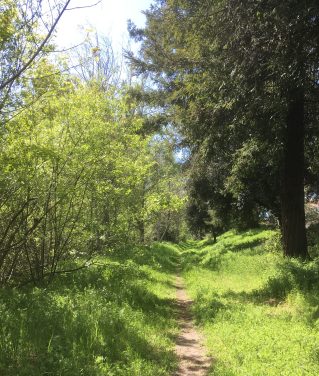
“My dream, even now, is to walk for weeks with some friend that I love, leisurely wandering from place to place, with no route arranged and no object in view, with liberty to go on all day or to linger all day, as we choose; but the question of luggage, unknown to the simple pilgrim, is one of the rocks on which my plans have been shipwrecked, and the other is the certain censure of relatives, who, not fond of walking themselves, and having no taste for noonday naps under hedges, would be sure to paralyse my plans before they had grown to maturity by the honest horror of their cry, ‘How very unpleasant if you were to meet any one you know!’ The relative of five hundred years back would have said ‘How Holy!’”

― Elizabeth von Arnim, Elizabeth and Her German Garden

To profane money.

“The ultimate expression of this Christian attitude toward the power of money is what we will call profanation. To profane money, like all other powers, is to take away its sacred character…. Giving to God is the act of profanation par excellence…. We need to regain an appreciation of gifts that are not utilitarian.

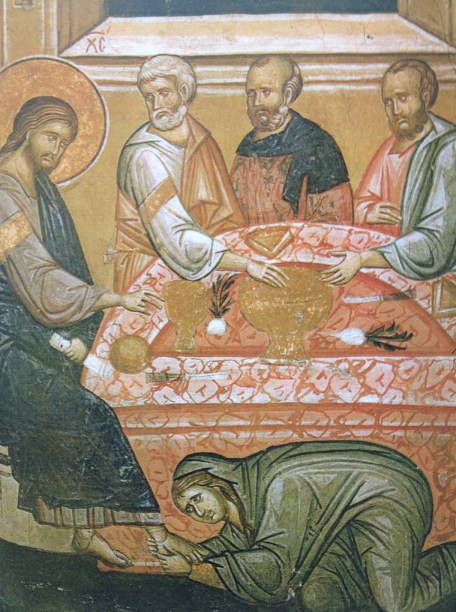
“We should meditate on the story in the Gospel of John where Mary wastes precious ointment on Jesus. The one who protests against this free gift is Judas. He would have preferred it to be used for good works, for the poor. He wanted such an enormous sum of money to be spent usefully. Giving to God introduces the useless into the world of efficiency, and this is an essential witness to faith in today’s world.”

― Jacques Ellul, Money and Power

Six days before the Passover, Jesus therefore came to Bethany, where Lazarus was, whom Jesus had raised from the dead. So they gave a dinner for him there. Martha served, and Lazarus was one of those reclining with him at table. Mary therefore took a pound of expensive ointment made from pure nard, and anointed the feet of Jesus and wiped his feet with her hair. The house was filled with the fragrance of the perfume.

But Judas Iscariot, one of his disciples (he who was about to betray him), said, “Why was this ointment not sold for three hundred denarii and given to the poor?” He said this, not because he cared about the poor, but because he was a thief, and having charge of the moneybag he used to help himself to what was put into it. Jesus said, “Leave her alone, so that she may keep it for the day of my burial. For the poor you always have with you, but you do not always have me.”

-From John 12

A word from one of the Leaders.

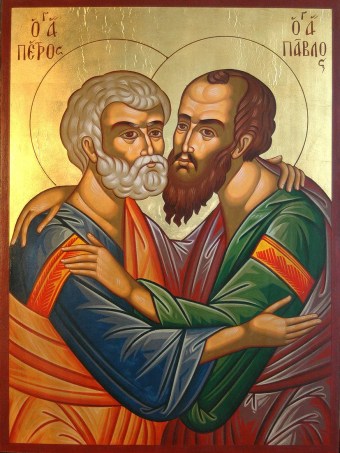
Today we celebrated the Feast of the Holy, Glorious and All-Praised Leaders of the Apostles, Peter and Paul. As it was a weekday, the church was not full, but there were half a dozen strong choir singers and beautiful hymns to sing along with them. During the short Apostles’ Fast beforehand I read the epistles of St. Peter, and I wanted to share a passage here, one that I find especially encouraging.

Humble yourselves under the mighty hand of God, that He may exalt you in due time,  casting all your care upon Him, for He cares for you.

Be sober, be vigilant; because your adversary the devil walks about like a roaring lion, seeking whom he may devour. Resist him, steadfast in the faith, knowing that the same sufferings are experienced by your brotherhood in the world.

But may the God of all grace, who called us to His eternal glory by Christ Jesus, after you have suffered a while, perfect, establish, strengthen, and settle you. To Him be the glory and the dominion forever and ever. Amen.

-From the First Epistle of St. Peter