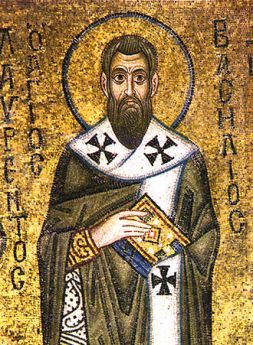
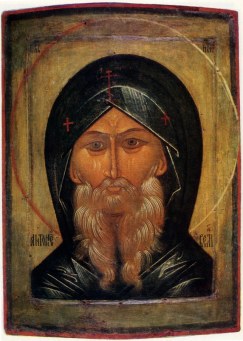
 “The truly intelligent man pursues one sole objective: to obey and to conform to the God of all. With this single aim in view, he disciplines his soul, and whatever he may encounter in the course of his life, he gives thanks to God for the compass and depth of His providential ordering of all things.
“For it is absurd to be grateful to doctors who give us bitter and unpleasant medicines to cure our bodies, and yet to be ungrateful to God for what appears to us to be harsh, not grasping that all we encounter is for our benefit and in accordance with His providence. For knowledge of God and faith in Him is the salvation and perfection of the soul.”
-St. Anthony the Great, 251-356
We are commemorating St. Anthony today, which prompted me to read a little about him. I learned about this book that looks like basic reading:
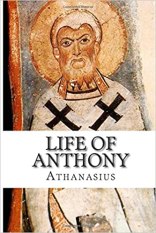 “The Life of the famed ascetic Saint Anthony the Great was written by Saint Athanasius of Alexandria. This is the first biography of a saint who was not a martyr, and is considered to be one of the finest of Saint Athanasius’ writings. Saint John Chrysostom recommends that this Life be read by every Christian.”
And one sentence from the story of his life jumped out at me:
“Saint Anthony spent twenty years in complete isolation
and constant struggle with the demons,
and he finally achieved perfect calm.”
Pray for us, Holy Father Anthony!
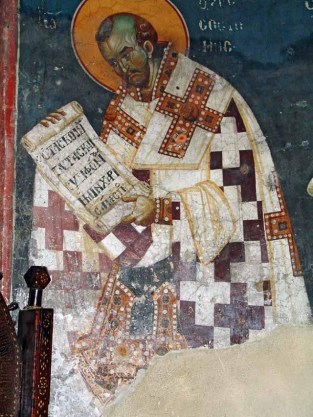 I can think of no Church Father who spoke more forcefully or critically about the moral failings of his time than St. John Chrysostom. He did not hesitate to call out the Emperor, or problems within the larger Church. Eventually, his words brought about his exile. Banished to the very edge of the empire, he died in isolation. Writing to the Deaconness Olympia, his closest friend and confidant, he expressed the very heart of Orthodoxy in troubled times: