Category Archives: saints

He was a divinely good person.

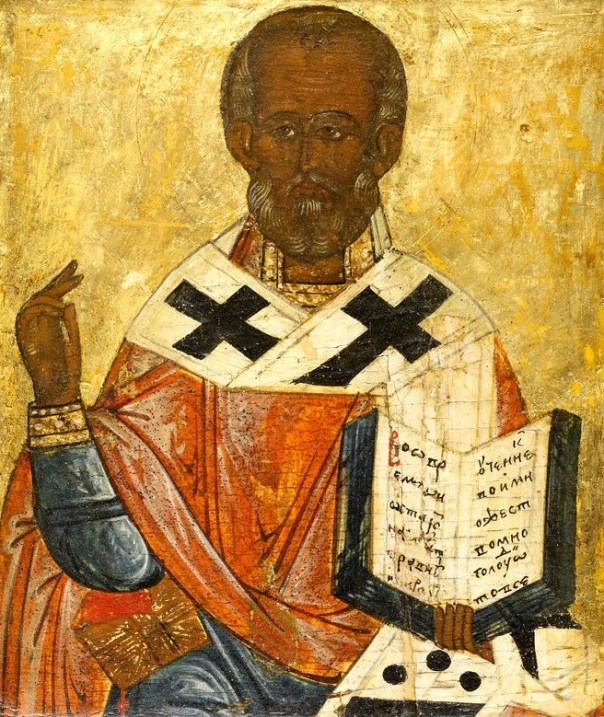
On the Feast of Saint Nicholas, I give you once more the words of Fr. Thomas Hopko from The Winter Pascha:

“The extraordinary thing about the image of St. Nicholas in the Church is that he is not known for anything extraordinary. He was not a theologian and never wrote a word, yet he is famous in the memory of believers as a zealot for orthodoxy, allegedly accosting the heretic Arius at the first ecumenical council in Nicaea for denying the divinity of God’s son. He was not an ascetic and did no outstanding feats of fasting and vigils, yet he is praised for his possession of the “fruit of the Holy Spirit…love, joy, peace, patience, kindness, goodness, faithfulness, gentleness, self-control” (Gal. 5:22-23). He was not a mystic in our present meaning of the term but he lived daily with the Lord and was godly in all his words and deeds. He was not a prophet in the technical sense, yet he proclaimed the Word of God, exposed the sins of the wicked, defended the rights of the oppressed and afflicted, and battled against every form of injustice with supernatural compassion and mercy. In a word, he was a good pastor, father, and bishop to his flock, known especially for his love and care for the poor. Most simply put, he was a divinely good person.”

Happy Saint Nicholas Day!

St. Nicholas Orthodox Church in San Anselmo, California

Venerable Paisios Velichkovsky

Today is the feast day of St. Paisus Velichkovsky, whose story you can read on the website of the monastery founded in his honor, St. Paisius Monastery, where I went on pilgrimage two years ago: “The Life and Mission of St. Paisius Velichkovsky.”

A quote from the saint for contemplation:

“One must clean the royal house from every impurity and adorn it with every beauty, then the king may enter into it. In a similar way one must first cleanse the earth of the heart and uproot the weeds of sin and the passionate deeds, and soften it with sorrows and the narrow way of life, sow in it the seed of virtue, water it with lamentation and tears, and only then does the fruit of dispassion and eternal life grow. For the Holy Spirit does not dwell in a man until he has been cleansed from passions of the soul and body.”
+ St. Paisius Velichkovsky, “Field Flowers”

The dark is bright.

Malcolm Guite has given us a sonnet to turn our remembrance to the origin and meaning of Hallowe’en, and to the saints, known and unknown, those “steady lights undimmed” who are commemorated in the next days. If you go to his site, “Malcolm Guite,” you can read a little related history, and hear him reading his own poem. It’s worth a click.

ALL SAINTS

Though Satan breaks our dark glass into shards
Each shard still shines with Christ’s reflected light,
It glances from the eyes, kindles the words
Of all his unknown saints. The dark is bright
With quiet lives and steady lights undimmed,
The witness of the ones we shunned and shamed.
Plain in our sight and far beyond our seeing
He weaves them with us in the web of being
They stand beside us even as we grieve,
The lone and left behind whom no one claimed,
Unnumbered multitudes, he lifts above
The shadow of the gibbet and the grave,
To triumph where all saints are known and named;
The gathered glories of His wounded love.

-Malcolm Guite

A preacher in plazas and fields.

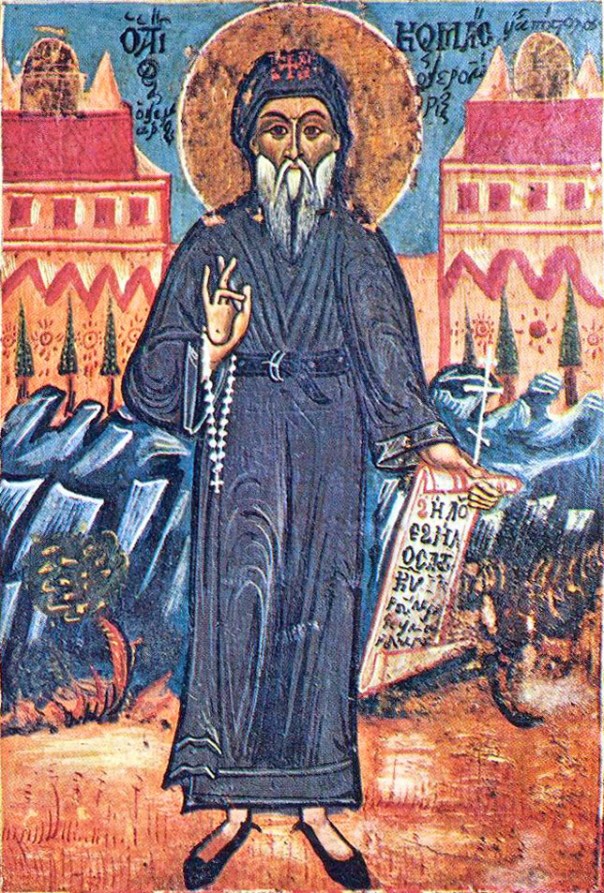
St. Kosmas is commemorated on August 24th.

“Since the churches could not accommodate everyone wanting to hear the wise preacher, Saint Cosmas with forty or fifty priests served the Vigil in the fields, and in city squares, where thousands of people prayed for the living and for the dead, and were edified by his preaching. Everywhere that Saint Cosmas halted and preached, the grateful listeners set up a large wooden cross, which remained thereafter in memory of this.

“The apostolic service of Saint Cosmas was brought to a close by his martyric death in the year 1779. At 65 years of age, he was seized by the Turks and strangled. His body was thrown into a river, and after three days, was found by the priest Mark and buried near the village of Kolikontasi at the monastery of the Entrance into the Temple of the Most Holy Theotokos. Afterwards, parts of his relics were transferred to various places as a blessing.”

Source