On the tail of my recent mention of trees and their strength, I was impressed by the tree roots in this collection of photos in The Guardian, “Root Force.” My wandering mind led me from there down this bloggy path to make the kind of word-thing that is too long because I didn’t have time to make it shorter.
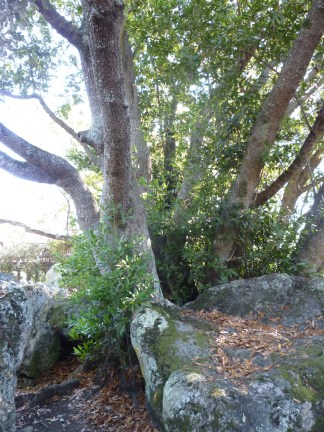
Italian cypresses and giant oaks, pine trees with thick trunks arching over lawns — the neighborhood in which I’ve been walking the last few days is a good one for a tree-lover, but it’s fairly new (not 50 years old yet) and manicured, not the kind of place where one is likely to see trees who have managed to exert their wills in the way of this example from the article.

This photo is compelling, and led me to search and find online many more cases of invasive tree roots, and I also know one firsthand. At my husband’s childhood home a steel post had been stuck in the earth to stake a young tree that, presumably while everyone was watching (whether out of the corners of their eyes, or faster than they could blink their eyes, I can’t say), grew up and around to swallow its supporting rod. But not completely; the top of the stake appeared to grow ungracefully out of the huge trunk.
Does it seem off topic, my telling you about the tree trunk, not the root? We must remember that all the parts are connected.
What occurs to me is that to live on a piece of land, to have a house or gate or sidewalk which you essentially give over to a living plant, is to show a deference to nature or at least a willingness to co-exist even in the likelihood that you, the human, will be the one to relinquish something. Or does it show that everyone was too busy or lazy to care? Many times I have let smaller plants in my garden have their way, but I somewhat regret that I haven’t had enough trees in my life, or lived ages in one place, for this to happen with great woody specimens.
All the roots and trees passing by my eyes and through my mind this week bring me around to the Incarnation, the birth of Christ which we are celebrating. That’s because the most persistent and enduring life system, if you will, is the Root of Jesse, and the Branch that sprouted, mentioned in Isaiah 11. Iconographers have painted this flowing of our salvation history, and it is the inspiration for many other types of illustrations, like this dramatic interpretation by Ansgar Holmberg:
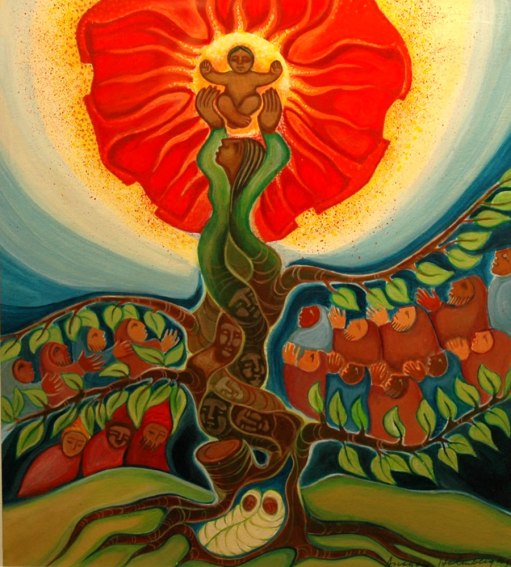
Some excerpts from the passage in Isaiah:
A shoot will come up from the stump of Jesse; from his roots a Branch will bear fruit.
The wolf will live with the lamb, the leopard will lie down with the goat, the calf and the lion and the yearling together; and a little child will lead them.
They shall not hurt nor destroy in all my holy mountain: for the earth shall be full of the knowledge of the Lord, as the waters cover the sea.
And in that day there shall be a root of Jesse, which shall stand for an ensign of the people; to it shall the Gentiles seek: and his rest shall be glorious.
I am pleased to have arrived at a Christmastime theme, a history and reality that leads many of my friends to put up a Jesse Tree decoration during Advent. Christ is somehow the Root and the Branch and the whole Tree of Life. It’s just one of the ways that the metaphor of trees and roots and branches is used in the Bible to reveal God’s plans and ways to us. No wonder I love trees: I admire them for their strength and grace, but I am myself alive with the same sap that is the Source of all root and tree life.
My own preference for letting trees take over is a romantic and privileged one; I don’t live where hardwood forests perennially compete with farmers for every plot of soil, or where such things as Weed Trees can be talked about knowingly. We were told via Adam and Eve to have dominion over nature, which at the least means conserving it and managing it. A gate that can’t function as a gate because some roots have essentially ruined it is not a sign of good husbandry after all, though it makes a pretty picture. Other clashes that come to mind involve roots doing bad things to pipes; the play of humankind with trees is not always artistic, because the design elements are always in flux.
Time is a factor you don’t want to ignore in this sort of interplay. So many people disregard it, not imagining what a nursery sapling might become in 20 years, roots and branches reaching out and down and to the sky. Living in the moment doesn’t excuse us from the responsibility to plan for the future, taking into account the nature of living things to change and grow.
Even God plans, and caused His good will to be planted especially in the family of Jesse, the father of King David, from whose tribe our Savior blossomed forth. He had a very long-range perspective and intention, and we haven’t seen the end of it.
The imagery in The Guardian, and the language that connotes for me destruction and relinquishment, seem to contrast with the words of Isaiah quoted above. Nature will be at peace in the day of which the prophet speaks, and a great order will prevail because of the knowledge of the Lord. It will be a large space where all of God’s creation can function as intended, with plenty of room for partnership and concord between mankind and the rest of creation. What struck me most was that last line above: “His rest shall be glorious.”
I’ve been wanting to post again a link to the carol Jesus Christ the Apple Tree, in which we are appropriately encouraged in Christ to “sit and rest awhile.” I think it’s what I’ve been longing to say — and for that we don’t have to wait until Christmas.

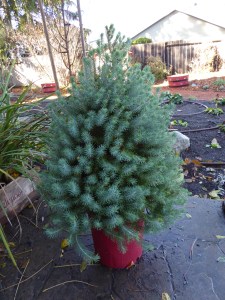
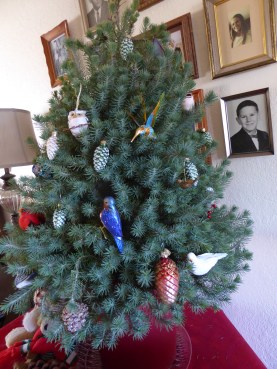 ee, so when I brought it indoors on to the doormat it was heavy and drippy. I dried the dear but very prickly thing with a towel and later on Kit trimmed it with all of the appropriate ornaments. That photo on the wall behind is of my late husband when he was a boy.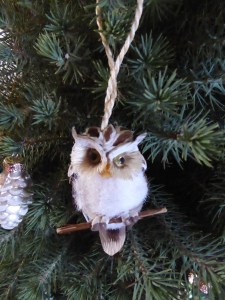


 Gladsome Lights