Category Archives: women

The Lord in the guise of a woman.

THE TEN DRACHMAS:
The Lord in the Guise of a Woman
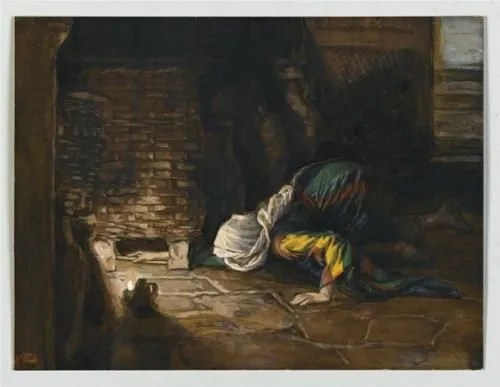

“Can you believe that Christ the Saviour portrayed Himself in the guise of a woman in two of His parables? One is that of the woman who took three measures of flour and made dough. But first let us speak of the other one where the Lord tells us about the woman who had ten drachmas and lost one. These are the most mysterious of all the Saviour’s parables. As the parable of the lost drachma is short, we quote it in full.”

“Or what woman, having ten drachmas, if she lose one, does not light a candle and sweep the house and look diligently till she finds it? And after she has found it, she calls in her friends and neighbors and says, Rejoice with me, for I have found the drachma that I lost (Luke 15:8-9).”

“At first glance this parable seems so simple, or even naive, that it does not impress the reader of the Gospel. In fact, however, the mystery of the universe is revealed in this simple parable.”
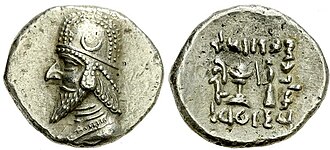
Drachma of Darius King of Persia, 1st century.

The paragraphs above are the first part of an article by St. Nikolai Velimirovich, which I’m happy to bring to your attention. From his statement about the mystery of the universe, the author goes on to point out the puzzling elements in this very short story, and to explain two interpretations, both of which he says are correct. I will let you read the whole exposition at your leisure: “The Ten Drachmas” (in which he also treats the second story, the “Three Measures of Flour,” in detail). But I want to share one more excerpt, which returns to the question of why the protagonist in “The Ten Drachmas” must be a woman:

“Our Lord described Himself as a woman because women are more careful than men in looking after property, in keeping the house in order and in receiving guests. If this short parable, which consists of only two sentences, is explained in this way, whose heart will not tremble? for it contains the whole tragedy of the world, visible and invisible. It explains why the Son of God came to earth. It sheds a bright ray of light on the history of mankind and the tragedy of each individual’s existence.

“It confronts us with an urgent decision, because our life is swiftly passing — a decision as to whether we want to be the lost drachma found by Christ or not. Christ is looking for us. Are we going to hide from him, or let ourselves be found by Him before death hides us from Him, from the world and from life?”

-St. Nikolai Velimirovich
“The Ten Drachmas”

Closest to the child comes the woman.

I’ve long been familiar with the thing that G.K. Chesterton is reported to have said, that if a thing is worth doing, it is worth doing poorly… “While you practice” was the explanatory clause to tack on if necessary; but it doesn’t seem to me likely that Chesterton would have added it. Because it makes a false distinction between the present and some future time, assumed to be qualitatively different… But who decides if you’re doing the thing for real or just practicing?

My son’s Suzuki violin teacher used to beg us not to use the word practice at all. She would ask her students, “Did you play your violin every day?” and we parents were supposed to speak after the same fashion. Even if no one saw evidence of improvement in musicianship on a given day, we were all  encouraged to be satisfied nonetheless, because “You played. That’s good.”

What Chesterton did say, which is included in the whole article linked at bottom, is that “Somebody must renounce all specialist conquests, that she may conquer all the conquerors.” He calls the uproarious amateurishness of the universe “true sanity,” which sounds good, because it’s essentially how I myself approach life.

His hearty approval of what he sees as the way of women confirms to me that G.K. and I have the same personality style. But I’m not sure all of us women are alike in this… Do you think that some women actually prefer to be more focused, or specialized, in their pursuits? To the women reading this, I wonder if you feel that his statements below ring true of you. Chesterton has a very high opinion of the female sex, but how many women did he really know that well?

“There was a time when you and I and all of us were all very close to God; so that even now the color of a pebble (or a paint), the smell of a flower (or a firework), comes to our hearts with a kind of authority and certainty; as if they were fragments of a muddled message, or features of a forgotten face. To pour that fiery simplicity upon the whole of life is the only real aim of education; and closest to the child comes the woman—she understands. To say what she understands is beyond me; save only this, that it is not a solemnity. Rather it is a towering levity, an uproarious amateurishness of the universe, such as we felt when we were little, and would as soon sing as garden, as soon paint as run.

“To smatter the tongues of men and angels, to dabble in the dreadful sciences, to juggle with pillars and pyramids and toss up the planets like balls, this is that inner audacity and indifference which the human soul, like a conjurer catching oranges, must keep up forever. This is that insanely frivolous thing we call sanity. And the elegant female, drooping her ringlets over her water-colors, knew it and acted on it. She was juggling with frantic and flaming suns. She was maintaining the bold equilibrium of inferiorities which is the most mysterious of superiorities and perhaps the most unattainable. She was maintaining the prime truth of woman, the universal mother: that if a thing is worth doing, it is worth doing badly.”

— G.K. Chesterton, from What’s Wrong with the World, the chapter on “Folly and Female Education.” 

Thinking about babies and Barbie.

As I may have said here before, I have probably watched fewer movies than anyone you know. So I don’t often mention them. The two I saw most recently were “My Octopus Teacher” and “Babies,” both of which I’ve enjoyed more than once. I watched “Babies,” a 2010 French documentary, with my four-year-old grandson just last month. Its subjects are four babies in their first year of life, in Namibia, Mongolia, Tokyo, and San Francisco.

I very much love that movie, for the meditative and close-up way it shows vastly different styles of mothering across cultures and around the world. I admit, my own style doesn’t exactly fit with any of those shown, but if I had to choose among the four, I feel most akin to the Mongolian way. In any case, all the families in the movie are pretty traditional for the local culture in which they are raising their children.

The contrast between that movie and the current one everyone is talking about, “Barbie,” didn’t cross my mind until I read this article in Salvo Magazine: “Existential Barbie: A World Without Love is Never Kenough,” by Annie Brownell Crawford. The author starts with a brief introduction:

“The plot begins when Barbie suddenly starts thinking about death, her feet fall flat, and she discovers cellulite on her thighs. To solve her existential crisis, Barbie travels to the real world with her unwanted Ken tagging along. When she arrives in California, Barbie is shocked to discover a world of exaggerated patriarchy where men think of her as an object and girls hate her for her beauty. Here, as the teen character Sasha explains, ‘Men hate women, and women hate women.’”

Crawford notes that “the film moves chaotically between satire and sincerity,” and she wouldn’t be quick to draw conclusions from the above statement alone, but there are reasons to think it was meant seriously. So she responds,

“Modern feminists seem to hate women as much as they believe men do, for the female body confronts all of us with our intrinsic dependence on one another and ultimately upon God. As the apostle Paul reminds us, ‘woman is not independent of man, nor is man independent of woman. For as woman came from man, so also man is born of woman. But everything comes from God.’ (I Corinthians 11)  We only know ourselves as women and as men through our relationship with each other, and we only know ourselves as humans in relationship to the God we image. The female body reminds us of this interdependence and the givenness of our existence, for our mothers literally gave us life.”

Of course the biggest difference between these two movies is that one is all about babies, and the other one lacks babies entirely, except for the unfortunate baby dolls:

“The film opens with an origin story wherein the newly created Barbie rescues little girls from being forced to play with baby dolls. After independent, infertile Barbie arrives, the young girls of the world celebrate their liberation from motherhood by smashing their babies to bits.”

I’m not enough of a movie buff that I am likely ever to see “Barbie,” but if I did, I might afterward go on to read some of the critics who are saying that if you dig deep through those layers of irony and satire, it’s actually anti-feminist and conservative in its message. Maybe how you feel about that depends partly on what you think The Patriarchy is. Is Ken in or out of it?

I wonder if Kimberly Ells has seen “Barbie”…. She attended the Commission on the Status of Women at the United Nations this spring and heard much about the desire to “smash” and “eradicate” the patriarchy; so she started asking around at the event, What is The Patriarchy, exactly? She wrote succinctly about the answers she got in this article: “In Praise of Men.”

I’d be interested to hear if any of my readers has thoughts about these movies or the questions raised by “Barbie.” And if you haven’t seen “My Octopus Teacher” or “Babies,” I definitely recommend those!

A Mongolian mother and child.

Saving the mystery women.

Last year I spent quite a few hours sorting through photos of several generations of ancestors, my late husband’s family and mine, plus those of our own immediate family, children and grandchildren. I barely made a dent in the collections!
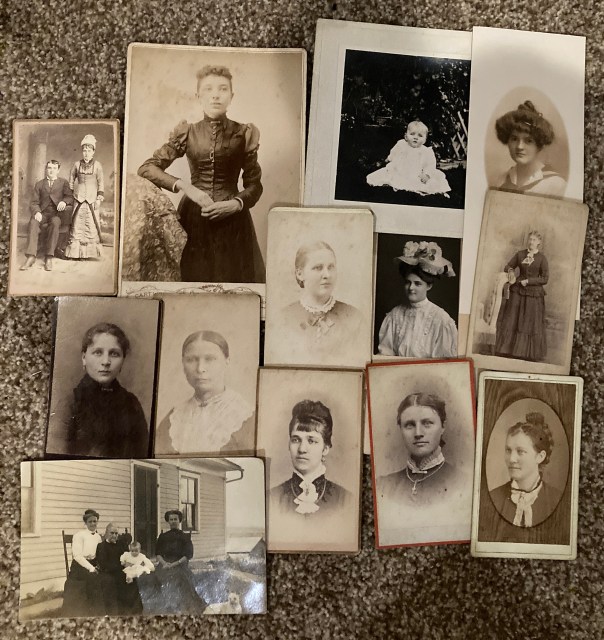
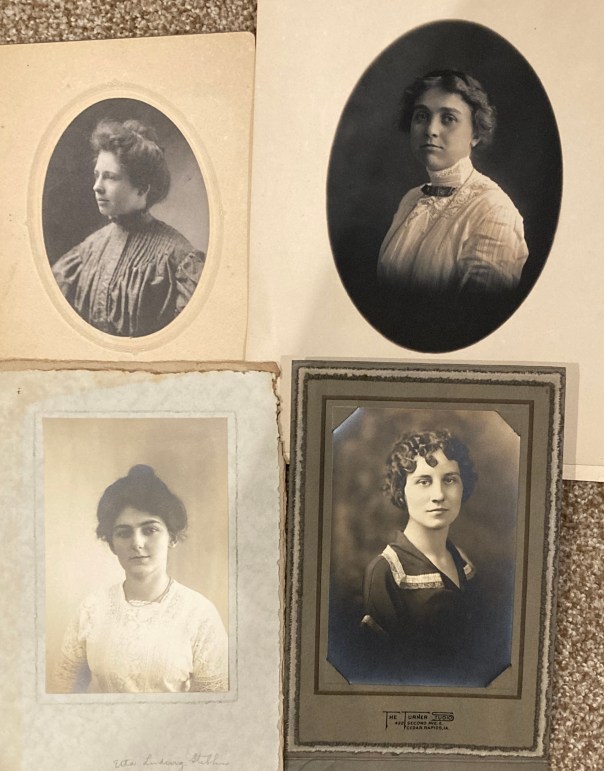
My husband’s family seems to have taken more photographs of their relations, and saved many more than people on my side have done. And while my siblings keep and store some of our relatives’ pictures, I am the sole curator of those that were passed to us from my in-laws and their in-laws, and so forth.

It wasn’t too hard to find at least a thousand pictures that could be put in the trash. It pains me to say that, because an image of a human made in the image of God feels like it retains something of the holiness of that connection, and it doesn’t seem right to be disrespectful of it. That shows that I come from a generation before digital images. I discard those with abandon.

Many that I tossed, however, were of such poor quality that I couldn’t see the faces, and quite a few were superfluous, because of there being much better or identical pictures of those people in existence. I have many more to purge, hopefully this year, but I have sifted through the oldest ones.

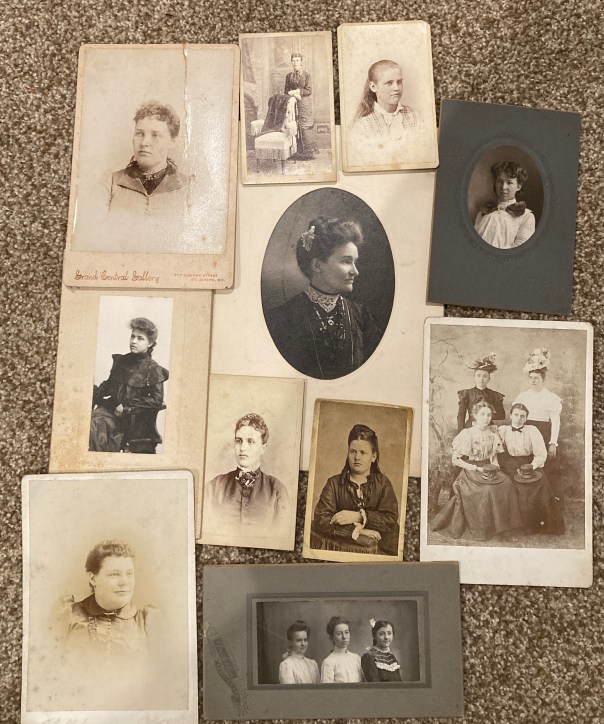
Among the boxes of pictures coming from my husband’s family, the third category that I needed to discard was this: Women who were unidentified, and did not match any pictures of known relations. Yes, there were also some mystery men, but they did not impress me in any way. Most didn’t look composed, or handsome. I felt differently about the women, I suppose because I am a woman.

Were they distant cousins? College friends? Maiden aunts? No one in my family knew them, no one cares about them. They all sleep in death. But — I did care about them. A hundred years ago they meant something to someone in our family, and since it is so easy to save digital images, I laid their paper pictures out on the carpet and took group photos.

I hope that each of them is known by name by someone somewhere, friends or descendants who have copies of these photos that that they won’t throw in the trash for a while yet. My curiosity about them is curious, these who represent thousands and billions who no longer walk the earth, most of whom never had their picture taken. But even if they are all forgotten by us living humans, God does know about them. And I, briefly, knew them ever so slightly….