Category Archives: women

Bird’s Open Heart

I am taking a tutorial from Bird on aging gracefully; she is graceful and gracious both. The two of us were talking about how we both are forgetful hostesses, never remembering to offer our guests so much as a glass of water, much less tea and cookies. But my friend never locks her door, and usually doesn’t even shut it all the way, because she wants visitors to come in without knocking; she doesn’t always hear a knock or the doorbell.

She is always so glad for company, and rarely talks about herself, preferring to ask about her younger friends and their families, and to hear other people’s stories. Her own stories are only told when they pertain to some matter that concerns her guest, or after emphatic prompting. Bird is almost 95 years old; is she ever going to become what I find to be the more typical elderly person, living in the past, and impatient with recent people and their doings?

When I had her for tea last week she was the guest of honor. I picked her up and drove her to my house, and on the way here in the car I showed her a list of topics we wouldn’t mind her talking about. She started laughing — I don’t know at which question — and said teasingly, “I am not going to come to any more of your tea parties!” But when the guests had all arrived she was willing to share of her past and her tales with them, and entertain us all with her humor.

There is the story about her novel, written in high school, about the Spanish dancer Juanita. It was a love story, but Bird knew nothing about “the kind of love you have when you are married.” At the end of the romance, when Juanita and her suitor have progressed in their relationship to the point where the ardor is intense, the novel closes with the line, “Juanita leaned.”

The photo here was taken when her 11th child was a toddler and Bird was about 35 years old. She looks happy enough to burst—serene at the same time. I think she must have been the best wife for her husband; she was apparently not contrary, but neither was she wimpy. She had to be strong and steady when he was depressed and couldn’t work for — was it three years? The kind of person who would keep doing her own job of running the household, waiting and praying for things to change.

She told us over tea that decades ago, when some of us used to see the couple walking “together,” Bird ten yards behind, that Mr. Bird had needed long walks to help with his “emotional problems.” He would be in shirtsleeves, and she was wearing a sweater, and he told her he was embarrassed by her wearing the sweater, and asked her not to. She replied that she needed the sweater because she was cold, and suggested that he walk by himself if he was embarrassed. And he said, “But I need you to talk to!” This was funny because he was way too far ahead for them to be able to carry on a conversation. When one of their adult children later died, the priest told her husband, “Now today, you walk beside your wife.”

Bird seems to have walked as close to her husband as he allowed, as long as he lived. She has been a dear and encouraging companion to me, as we both try to walk with God. My prayer is that He would give me a measure of her spirit.

(I wrote the piece above several years ago; more recent posts in which Bird appears are here and here. Now she has reached 100 years, and is as young as ever. She still keeps her door unlocked and her smile bright.)
Journaling about footling

When I’m writing in Word, the program often tells me that I am spelling a word wrong, or that it doesn’t exist. So I head on over to dictionary.com and check it out for myself. Today it was journaling, which even they tell me doesn’t exist. Oh, yeah? Just look at my blog and you will see that it does indeed exist, though I of course did not invent it. Even dictionary.com can’t keep up on everything.

While I was on that page, I noticed their Word of the Day on the left sidebar, and footle seemed to me a curiously cute and appealing word (which Word also does not know), so I took the time to read about it. This is what I read:

footle \FOOT-l\ , verb: 1. To act or talk in a foolish or silly way. 

noun: 1. Nonsense; silliness.

Quotes:

Sometimes, on a good day, I would go upstairs with my duster and footle around the parlor, adjusting paintings and straightening cushions, knocking them into shape with such military precision that even my mother would have saluted them.
— Marion McGilvary, A Lost Wife’s Tale: A Novel 

“I say, Charlie, for any sake do play up tomorrow, and don’t footle.”
— Rose Macaulay, Abbots Verney; A Novel
Origin:
Footle has an uncertain origin. One candidate is the French se foutre, to care nothing.” Another possibility is the Dutch vochtig, “damp or musty.”

Not much to go on here, and it’s confusing. What the narrator in McGilvary’s book (I wonder if she is the Lost Wife…that might pertain to my discussion.) is doing doesn’t seem to me either silly or foolish. It just reads like housework, done with energy.

I don’t quite know what “play up” means, in the other quote given, so how am I to infer the meaning of what is given as the alternative behavior?

(One thing is clear, that people who add the subtitle “A Novel” to their book titles are more likely to use the word footle in the text.)

This all matters to me, because I’ve long been on a quest for a word for what some of us housewives do sometimes, on those days when I’m not under a deadline or working doggedly on a single big project. Instead, I do a little of this, a little of that, one thing leading to another; I am not in a rush, nor do I have urgent goals for the day, but I end up accomplishing quite a lot.

Do we just call this “housework”? I used to call it puttering, until I learned that there is too much of aimless, ineffective, and loiter in the definition of that word. When I am engaged in the behavior I am trying to find a word for, I am never aimless, and if I am not getting any physical work done for a few minutes, I am at least thinking hard or praying. And another question: As my computer and word processor are in my house, shouldn’t I consider the work I do using those tools “housework”?

It gets complicated. Keeping the housewife healthy and able is part of the maintenance of the house, just as taking care of tools is a necessary part of the work of a carpenter’s shop. So all those things I do that restore my soul are also housework. Voilà!

Once I was discussing this issue with my friend Herm, and told her about a word I coined to describe my style of puttering. It is serendipping. But it hasn’t proved terribly useful to me, since only two of us in the world know it. I don’t often need the word anyway, do I, if I am busy doing it?

Anyway, it appears that footle will not yet be of any help. Discovering it was part of my serendipping today, but did it accomplish anything? It gave me something to think and write about, and whether it was work or play, it was not aimless and it was fun!

Soul-nourishing gift from Mr Glad

A New Apron for Bird

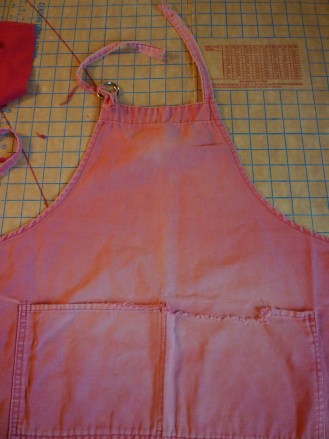
The beloved apron.

From about 1930 my friend Bird spent a lot of time in a closet turned into a sewing room, stitching away at shirts and dresses and whatever was needed to keep her twelve children clothed. All of them were born before I was, and Bird is now 99 years old. I didn’t get to see her on her birthday last September, but shortly before that I paid a visit and was concerned when I saw that Bird wasn’t wearing an apron.

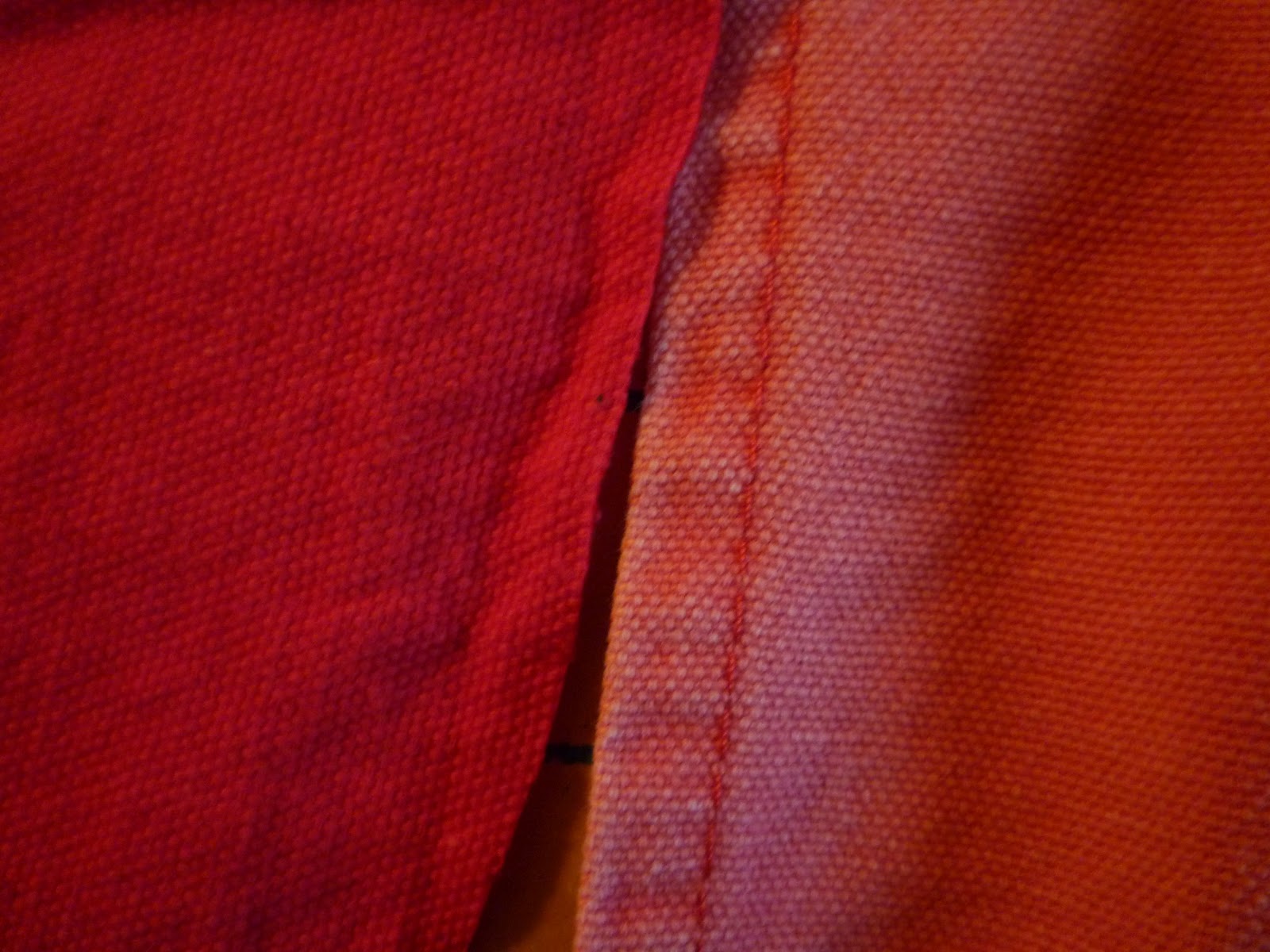
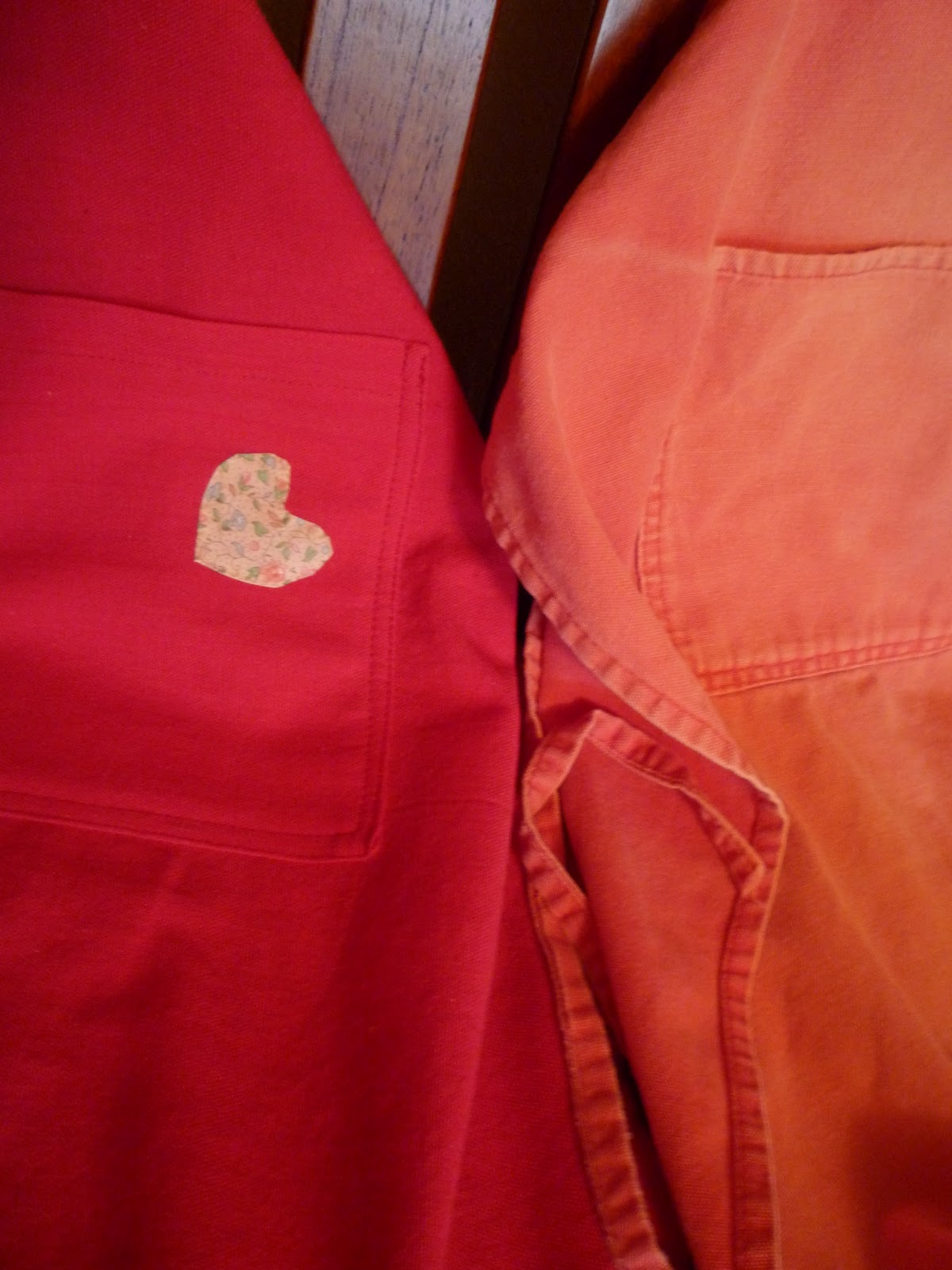
New and old fabric compared.

She doesn’t do much cooking or cleaning anymore, though she lives by herself in an apartment. She wears an apron because she has tied one on every morning for most of her life and she doesn’t feel right without that part of her attire. I knew all that, so when she was lacking the essential garment I asked what was wrong.

Her apron was so tattered, she said, she didn’t want to wear it when she was having company. Oh, yes, she did have a newer apron that her children had bought her, but it didn’t fit right. She brought it out of a drawer, and I could see that it was way too large, made to accommodate the great number of our generation who fill more of an apron than our grandmothers did. Though I didn’t have a measuring tape, I took some measurements from the old favorite, using a sheet of paper for the ruler, and when I went home I drew up a proper design, thinking I could make her one. But nothing came of my idea for a long time.

Without shame, I returned to visit last month and found Bird in the oversized apron. But knowing that I would be returning to her city in about three weeks, I asked if I could take her old apron with me this time, to use for a pattern. She took it out of a drawer, clean and neatly folded, though unusable, as the neck strap was broken through.

When I brought the old apron home, I looked among my stacks of fabrics and was amazed to find something that resembled what I imagined the old apron had looked like before it faded. My piece of Guatemalan fabric had been bought to fix a mistake I made in measuring for a tablecloth fifteen years ago, a tablecloth that never got made at all. So the fabric waited around, being the perfect replacement for the old apron, until all the parts of this story came together.

Today was the end of the story, or the beginning of the life of the new apron. I managed to meet my own deadline of this day, when I went to an appointment in her town and dropped the apron off beforehand. Bird was very pleased. She tied the apron on immediately and said that she felt properly put together again.

Quote of the Week – may be only fidgets


I haven’t kept up with my plan for a weekly quote, but it’s a practice worth reviving, especially for those ever-more-frequent periods when I have nothing to say. Today, from C.S. Lewis:

“Don’t be too easily convinced that God really wants you to do all sorts of work you needn’t do. Each must do his duty ‘in that state of life to which God has called him.’ Remember that a belief in the virtues of doing for doing’s sake is characteristically feminine, characteristically American, and characteristically modern: so that three veils may divide you from the correct view! There can be intemperance in work just as in drink. What feels like zeal may be only fidgets or even the flattering of one’s self-importance. As MacDonald says, ‘In holy things may be unholy greed!’ And by doing what ‘one’s station and its duties’ does not demand, one can make oneself less fit for the duties it does demand and so commit some injustice. Just you give Mary a chance as well as Martha!”

C.S. Lewis, Letters to An American Lady