Category Archives: writing

I take my quotes with breakfast.

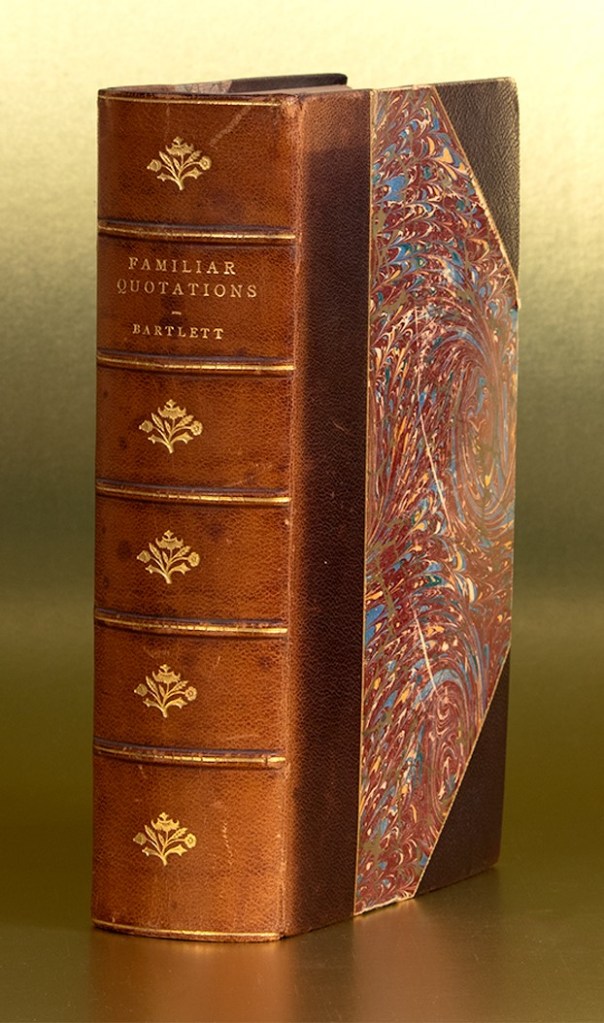
9th Edition, 1909

I read part of it all the way through.
     -Samuel Goldwyn

This morning when I sat down to eat my egg scramble, I opened the Fourteenth Edition of Bartlett’s Familiar Quotations, which some of my children thoughtfully gave me last Christmas. As I read some very pithy, humorous or wise sayings, I immediately began to think of how I might use them in a blog post sometime. One after another made me wonder this, and I soon realized that it’s not likely to happen. So I will just share a few random quotes here all at once, out of any context — that is, the context in which they first appeared.

Truth exists, only falsehood has to be invented.
     -Georges Braque

This “enlarged edition” I have before me is copyright 1968, so it includes many entries that I never saw in the older edition I owned for a brief while. The very first was published in 1855, and the current version is the 19th, from 2022.

Bartlett said, upon coming out with the 4th Edition, that “…it is not easy to determine in all cases the degree of familiarity that may belong to phrases and sentences which present themselves for admission; for what is familiar to one class of readers may be quite new to another.”

Shakespeare, by John Taylor

Indeed. I wonder what he would think of the challenge of assembling such a book in this era, when many people have not learned to appreciate the beauty of good writing, nor do they have a collective familiarity with a body of it, as previous generations might have had, as with the Bible or Shakespeare, for example.

Thus we play the fools with the time, and the spirits of the wise sit in the clouds and mock us.
     -William Shakespeare, Henry IV

John Bartlett began his project when he managed the University Book Store in Cambridge, Massachussetts, by writing quotations in a commonplace book. He oversaw the publication of nine editions before his death in 1905. The next editions, in the 20th century, had several different editors, but at first they continued in what was considered the “ideologically inclusive spirit of the first fifteen editions.”

It is a good thing for an uneducated man to read books of quotations. Bartlett’s Familiar Quotations is an admirable work, and I studied it intently. The quotations when engraved upon the memory give you good thoughts. They also make you anxious to read the authors and look for more.
     -Winston Churchill

Hearkening to a tradition that is no more, it is unsurprising that Bartlett’s could not endure as it was, and critics have pointed out the ways in which it has devolved, as the culture from which it draws has fragmented. My public library system has the latest edition, but I don’t plan to borrow it.

This be my pilgrimage and goal,
Daily to march and find
The secret phrases of the soul,
The evangels of the mind.
     -John Drinkwater

John Drinkwater

My breakfast is long over, and though I would like to keep leafing through Bartlett’s to share more quotes with you, I must go on to other things now. Whatever time of day it is that you are reading this, I hope something here has been a nourishing snack for your own soul.

Women are wiser than men because they know less and understand more.
     -James Stephens
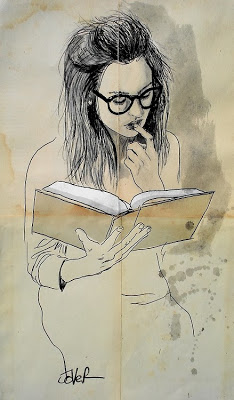
By Loui Jover

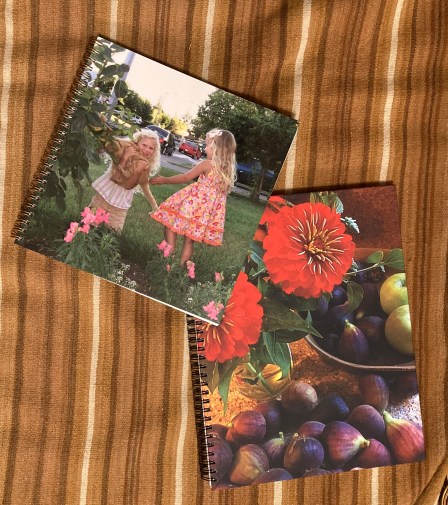
Pretty aids to journaling and hospitality.

Last Christmas my daughter Pearl gave me these journals with hardback covers featuring photographs I’d taken and used on my blog. I’m sure she carefully chose from among the hundreds of possibilities, and settled on these exemplary and evocative representatives, of Grandchildren and Fruits From the Garden.

The larger one I’ve been using as a regular journal, and the smaller one as a sort of hospitality journal, to keep track of guests and events, menus and food preferences. I try to write down how various dishes I served were received, and for whom I cooked them, so that I don’t repeat too often.

That makes it sound like I cook for people a lot; I really don’t, but for that reason I tend to fall back on the same dishes, not being in the habit anymore of spending hours planning and executing menus featuring new items. But even if I’m only having a friend over for coffee, I want to remember beforehand if it is coffee, or rather tea she will like to drink.

Jean Edouard Vuillard – In the Garden

Last week a friend and I sat on the patio and drank cold tea from jugs I had made beforehand. They were actually infusions, to be precise; her late husband, a connoisseur of true tea, made with leaves of the tea plant, would have wanted us to use the right word. The options at hand were ginger, rooibos and chicory. And I served a version of the old favorite Wacky Cake, that contains no eggs or dairy, and typically does include cocoa, vinegar, and oil. I was amazed at how many reviewers had altered the original recipe to jazz it up. I took the advice of several cooks and added salt, almond extract, almond flour, and a swirl of almond butter baked in. It was pretty tasty! We each had two pieces with our infusions. I still need to write in my Hospitality Journal that C. likes ginger tea, and Wacky Cake.

The soft and white sand.

My church friend Ana and I flew to Florida last week for the Symbolic World Summit in Tarpon Springs, and returned on Sunday. I am still processing all the quite stimulating and encouraging lectures and discussions we heard; Ana and I also enjoyed the extended time together over five days to talk about our loves and lives, including many books and ideas. We attended services at St. Nicholas Greek Cathedral in town after the event.

In the paragraph above I notice that I effortlessly included six noun or adjective conjunctions; does that habit flow from my general tendency to the “Yes, And” point of view, I wonder? I hope you don’t mind, because I’m not in the mood for polishing up my writing skills right now. It could be that the Summit increased my leanings toward expansiveness… but it’s an effort I am always making to keep the conjoined words to only two.

Orthodox Lent is almost here! And there is plenty for me to focus on, of the sort of things that help us on our Journey to Pascha. A few of the speakers at the conference gave us their unique short list of “action points,” for going forward in our personal lives on the theme of the event. That theme was Reclaiming the Cosmic Image, which right there seems a very Lenten goal. Maybe I will share about it in future posts.
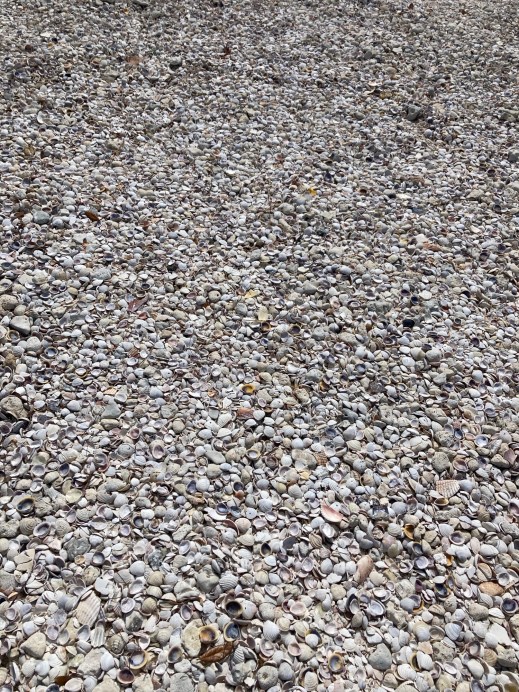
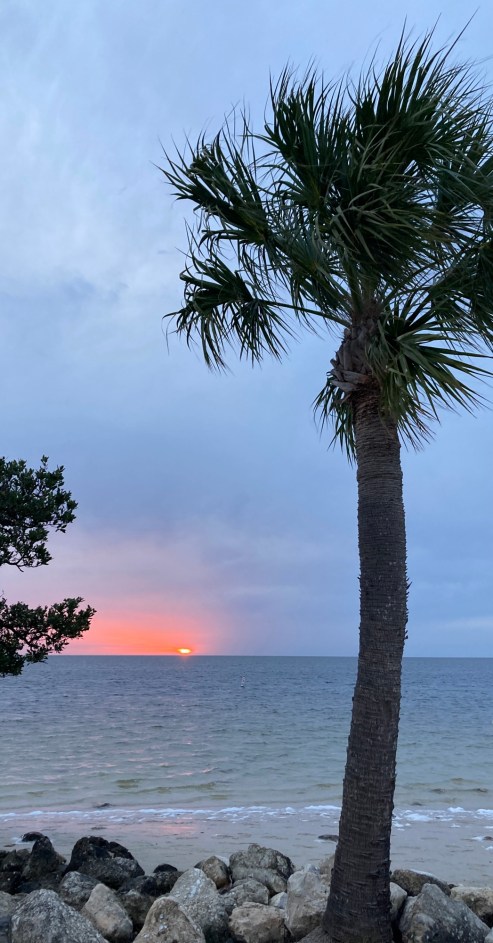

For now, I just wanted to document the Florida sands. I had never been in that part of the country before, or anywhere on the Gulf of Mexico. When we first walked from our car to the beach, the bright whiteness struck me first. And then, to walk barefoot on that soft, soft sand, everywhere full of broken pieces of shells, was such a different experience from California’s North Coast, which is my normal experience. We rarely see any but mussel shells on our beaches, but there in Florida intact shells were also in great abundance, and in places laid out in wide swaths. Of course, the air was balmy, but not hot.

Shells not yet made into sand, and therefore not soft.

We visited Sunset Beach on Friday (at sunset), and Honeymoon Island on our way to the airport Sunday. Both outings were fairly brief, because most of our weekend was at the conference venue.

We collected a few shells, and my purse collected a lot of the fine, glittery sand. I even carried a big handful back to the car, where Ana found a ziplock bag for me to put it in. I have been neglecting my sand collection in the last couple of years, but now I will get it going again, and will have added one little bottle of white sand to show that I truly was once upon a time in Florida.

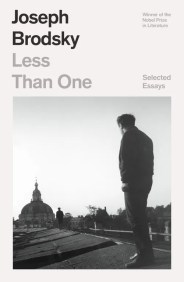
The voice of Joseph Brodsky.

When I am reading any sort of literature I often think of what fellow blogger M.K. has said, (forgive me, M.K., if I am distorting this) that when she finds someone whose writer’s voice she particularly appreciates, it doesn’t matter the topic of the writing, she enjoys reading everything he or she produces.

For me, the poet Joseph Brodsky is one of those writers. His intellect, his experience, his abilities, are so far removed from my own, it seems strange that I would feel the connection with him that I do. The attraction is there, but my time is limited, so I’ve actually read very little of his work. But this particular book, Less than One, got my attention recently, calling out from the mobile bookshelf that sits along the short path I often traverse, from the kitchen to the computer. I took it in hand and saw that it is a book of essays, but I didn’t remember why I had bought it.

Maybe it was after reading something like this, from the publisher:

This collection of essays thrusts Joseph Brodsky—previously known more for his poetry and translations—into the forefront of the “Third Wave” of Russian émigré writers. Originally published the year before Brodsky received the Nobel Prize in Literature, Less Than One includes intimate literary essays and autobiographical pieces that evoke the daily discomfort of living under tyranny. His insights into the works of Dostoevsky, Mandelstam, and Platonov, as well as the non-Russian poets Auden, Cavafy and Montale are brilliant; Seamus Heaney said of Brodsky’s treatment of one of Auden’s most famous poems, “There will be no greater paean to poetry as the breath and finer spirit of all human knowledge than Brodsky’s line-by-line commentary on ‘September 1, 1939.’”

Joseph Brodsky

That paragraph also made me interested to delve into Auden. But the first thing I read about the poem Heaney references, “September 1, 1939,” gave me pause. It was a blog post by Dr. Oliver Tearle, in which he points out that Auden disowned the poem and was “ashamed to have written” it.

When Brodsky was made unwelcome in the Soviet Union in 1972, W.H. Auden was one of the people who helped him to settle in the U.S. But long before that, as a young student, he was learning Polish and English with the goal of being able to translate poets like Czeslaw Milosz and John Donne. He said of his Jewish parentage, “While I am related to the Old Testament perhaps by ancestry, and certainly the spirit of justice, I consider myself a Christian. Not a good one but I try to be.”

When he was denounced and stood trial before a judge, the examination went like this:

Judge: And what is your occupation in general?
Brodsky: Poet, poet-translator.
Judge: And who recognized you to be a poet? Who put you in the ranks of poet?
Brodsky: No one. And who put me in the ranks of humanity?
Judge: Did you study it?…How to be a poet? Did you attempt to finish an institute of higher learning…where they prepare…teach…
Brodsky: I did not think that it is given to one by education.
Judge: By what then?
Brodsky: I think that it is from God.

I immediately thought of Milosz and in particular his book The Captive Mind, when I read this paragraph from Brodsky, quoted on The Poetry Foundation website:

 “Language and, presumably, literature are things that are more ancient and inevitable, more durable than any form of social organization. The revulsion, irony, or indifference often expressed by literature toward the state is essentially the reaction of the permanent—better yet, the infinite—against the temporary, against the finite. … The real danger for a writer is not so much the possibility (and often the certainty) of persecution on the part of the state, as it is the possibility of finding oneself mesmerized by the state’s features which, whether monstrous or undergoing changes for the better, are always temporary.”

No doubt one aspect of the poet’s voice I find compelling is this unwillingness to be captivated by things lesser than the infinite — anything less than the full expression of the human soul.

Czeslaw Milosz  became an admirer, writing: “Behind Brodsky’s poetry is the experience of political terror, the experience of the debasement of man and the growth of the totalitarian empire. … I find it fascinating to read his poems as part of his larger enterprise, which is no less than an attempt to fortify the place of man in a threatening world.”

I enjoyed seeing the poet on video in this very short clip of an interview, in which he is speaking about how he personally strives against this debasement, not just of his own person, but of his fellow humans. Even without knowing the context of his words, we get another glimpse of his own soul when he tells about his efforts not to reduce people in his mind to simple categories, but to see their complexity, and their bravery. He says this is how you “winnow their essence.”

My minimal encounters with Joseph Brodsky encourage me to resist my own reductionist, categorizing tendencies. His is a voice I will continue to listen to.

“By failing to read or listen to poets,
society dooms itself to inferior modes of articulation,
those of the politician, the salesman or the charlatan.”

-Joseph Brodsky