Mountains are giant, restful, absorbent. You can heave your spirit into a mountain, and the mountain will keep it, folded, and not throw it back as creeks will. The creeks are all the world with all its stimulus and beauty; I live there. But the mountains are home.
– Annie Dillard
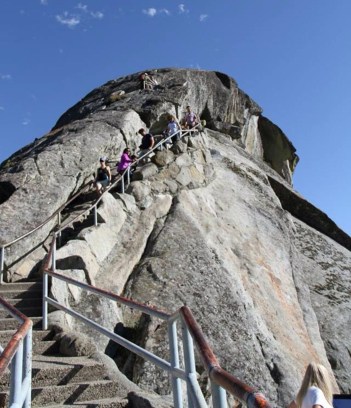
A granite dome was the focus of my mother’s most memorable hiking experience. She told me many times the story of how, at the urging of my father, she climbed Moro Rock when she was great with child (me). That is, so far, my only experience of it.
On our yearly camping trips decades later, my own children’s father would hike to the summits of other domes of rock with them, and a few of those times I was along. Lembert Dome was long my favorite, looming over Tuolumne Meadows on the Tioga Pass, in Yosemite National Park. Even at three years old Pippin could get to the top of it, with someone to hold her hand on the gradual ascent up the back slope.
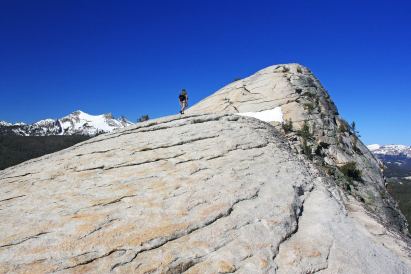
In the latter half of my life, my favorite dome is the one behind our mountain cabin. Several features of it make it accessible to me, the most important one being that I can walk to its base in a few minutes. I read recently that one summer, a small group of us climbed to the summit of this dome in the morning and again in the evening of the same day. My late husband took the picture below of our companions coming up behind him, about eight years ago. You can see why I wouldn’t want to try it alone.
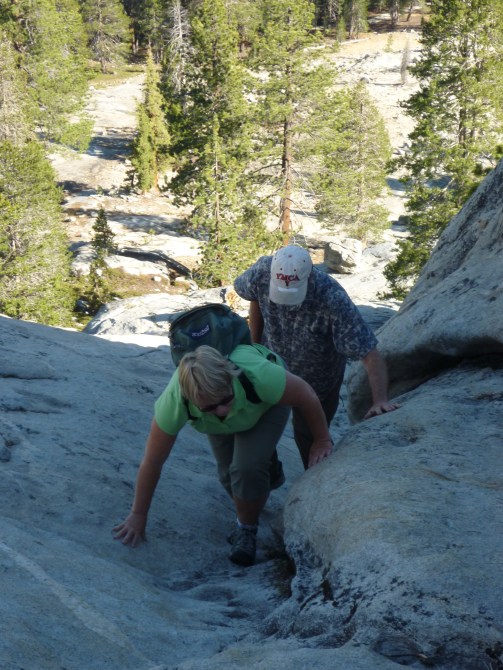
During my recent mountain retreat, I set out one morning before breakfast, thinking that I would just walk over that way to get a view of the lake from the other side of what we have nicknamed Gumdrop Dome. Within ten minutes I had changed course and decided to approach from a different direction and to do a new thing: walk all the way around the base. I came through the trees to the north side, and headed to my right, around the west side of the rock. That side is a steep wall, decorated by veins of different colored minerals, and by lichens.

I refreshed my memory just now about different types of clast, or broken rock. I think what lies there at the bottom of the wall would not be classified talus or scree, but is just plain clast. On this side you can clearly make out where the base of the dome is.

I walked along in the clast, it moved under me, and then — whoopsie! Down I went on my behind. While I sat, I thought I should take advantage of the camera angle:

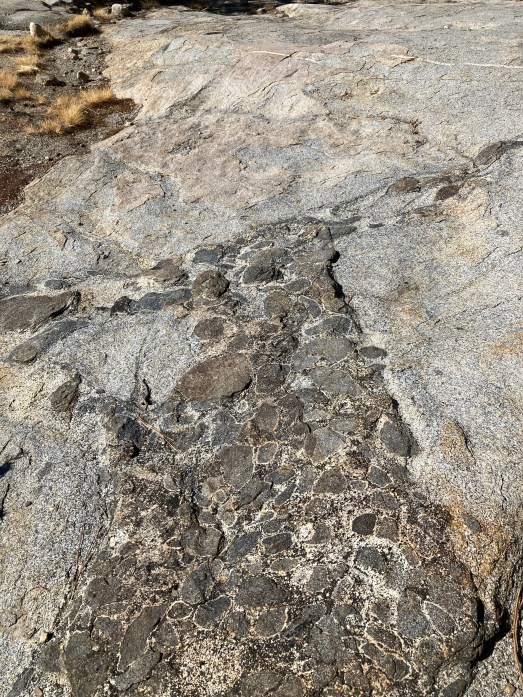
It wasn’t the only time I fell. A few minutes later I stumbled forward, and scraped my hand on some of that sharp granite. My euphoria was untouched; it was such incredible good fortune, that I should find myself completely alone, yet in rich company: God, and a friendly monster of a rock. Still, I navigated more carefully after that. The boulder to the right of the pine cones in the picture below is an example of the coarsest grit of granite imaginable; and the one below it, also.

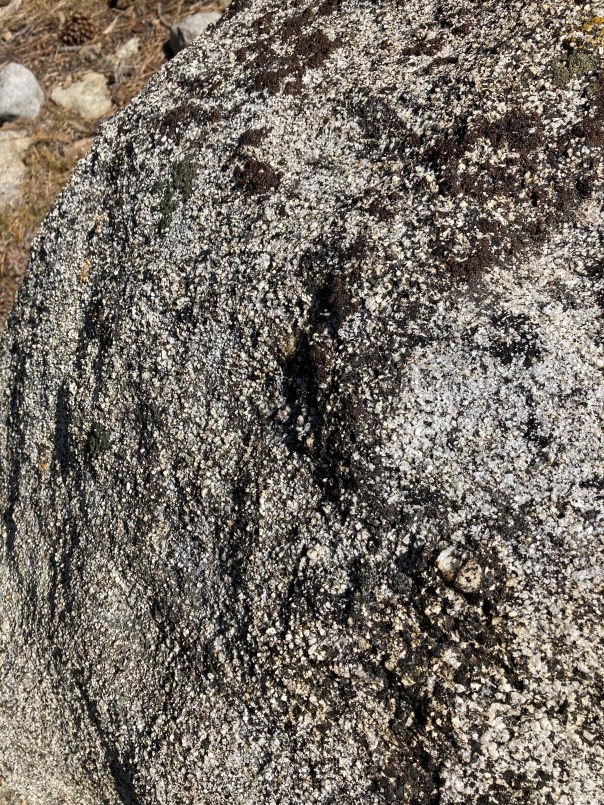
I began to search for stones, keepsakes of my solitary walk around “Gumdrop.”

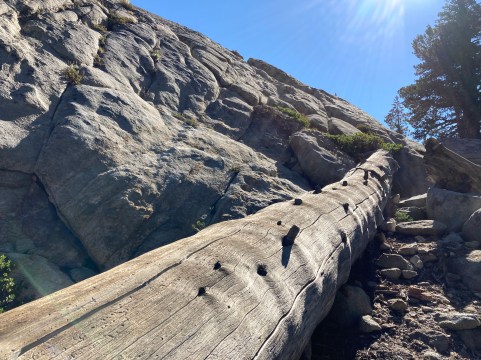


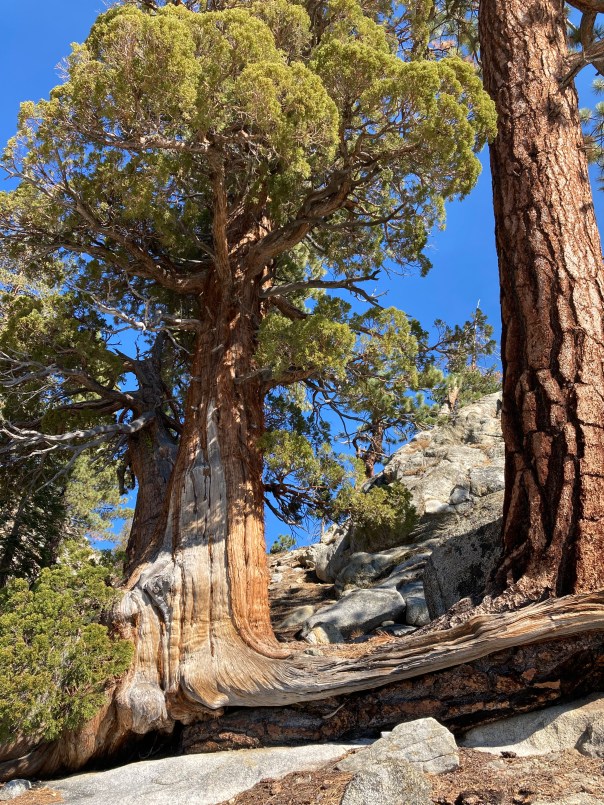
On the back side, the line between dome and not-dome is vague, as that granite face stretches away in an ever flattening grade, down into the trees. There is still lots of rock there, but giant conifers grow out of cracks in it, and their duff lies thickly on top. Granite domes like this are called bornhardts; there are several theories about how they form.
For a long time I gazed at the wide views from my high perch, a flattish boulder-bench, and felt the cool breeze growing warmer as the sun rose to my left.
“O, Lord, how manifold are Thy works! In wisdom hast Thou made them all.”


From here you can see other domes in the distance, but of course you can’t get a good idea of what the dome you are standing on looks like. The best vantage point I’ve ever had is from the lake, as in this picture that was taken some years ago:

This area below I call the amphitheater. It’s a good place from which to watch the show!

If I had brought a snack, I might have stayed hours longer. It was all delicious and satisfying as a feast for the soul, but pure bliss was not going to prevent me getting shaky (elevation about 8500′) if I kept putting off nourishment such as was waiting for me back at the cabin; so I stood up and continued my explorations.
This couplet below does not at all fit with the stones that I collected on the dome, as far as their smoothness, or the number of them. But the poet’s metaphor echoes somehow that of Annie Dillard at the top of this post, and they both understand what I left behind on that mountain dome, and what I brought home.
“may came home with a smooth round stone
as small as a world and as large as alone.”
-E.E. Cummings
Here is my last look at Gumdrop, when I had circled around to my starting place. From this angle it seems that it might not be impossible to climb that particular slope. I wonder…. Well, next time I have a companion, I’ll have to bring him or her to this place and give it a try! But for now, Good-bye Gumdrop! Good-bye mountains! Thank you for inviting me. I had a good time!


 Not only is my mind typically scattered to the four winds, but it is also buffeted and pushed down and downright dominated by currents of thought — and current events — that somehow turn into raging hurricanes. But in my daily life, they are only passing and mental hurricanes, so when I read this quote from my daughter Pearl, I was freshly encouraged to call frequent moratoriums on the practice of wondering whether it might be a Viking or a bomb or a car wreck that will eventually make my loved ones suffer.
 I also don’t need to spend (all my) time researching how bombs are made, or why the Vikings are so ruthless. Which is great, because it leaves more time for writing a chatty blog post to my friends, which is a very human thing to do, and I hope sensible as well.