A story I found in my files:
The Importance of Reading
the Gospels Every Day
A Monk’s Story
During my initial monastic service at the Donskoy Monastery in Moscow, there was a period when I stopped reading the Gospel. At that time I had a lot of work, and there was not enough time to concentrate, open the Holy Scriptures, plunge into the meaning of words. I did not attach much importance to this, but simply  continued to perform obediences, working from four in the morning until late at night. There were no external changes, but I gradually began to notice that I was more and more burdened by a feeling of strong spiritual and bodily fatigue, which I could not “throw off” neither with sleep, nor food, nor rest. I fell asleep and woke up, went to services, worked, but the feeling that someone seemed to be digging into my neck and sucking all the strength out of me did not leave. I walk – my legs buckle, I sit behind the wheel – my hands are shaking. Body and soul were exhausted every day, and I still could not understand the reason.
Once, in this state, I came to the office of the abbot, father Agaphodor, to discuss some labor issues. He, as an insightful person, as soon as I started a conversation, asks me: “What is happening to you?” In an almost exhausted voice, I quietly answer: “I don’t know … Something is wrong with me, it’s hard.” He fixed his gaze on me, as if in a couple of seconds he could see my soul and find the source of the disease, and suddenly asked the question: “Have you been reading the Gospel?” I began to think: indeed, I had stopped reading the Gospel. How could this have happened? How long have I been living without the main spiritual food? I began to remember and with horror discovered that I did not remember the last time I took the Bible in my hands.
With the strongest inner excitement, I ran to my cell, grabbed the Gospel and began to read. I opened it and, like a man dying of thirst, I read and read, read and read… An amazing impression: the more I read, the more acutely I felt that I was getting better. The teeth, which dug into my neck and sucked my strength, gradually unclenched, I breathed more freely. With each new chapter (and I read about ten at once) it became easier and easier. I turned page after page until I realized that I was completely free of the disease. The feeling of depression is gone. The enslavement that I was in all that time was a great lesson for me, which does not need to be repeated twice. Since then, I read 365 chapters a year – that is, I read one chapter every morning.
Man consists of two parts – soul and body. We saturate our flesh, but the soul remains hungry. The main food for the soul is the Gospel. We do not forget to charge our cell phone in the evening, but we forget about the soul. When we read the Gospel, we receive grace. In the morning we read the chapter – grace for the whole day. And the day will go in a completely different way – with grace. We will also reflect on what we have read, and some of this will come true, although the Gospel is not a fortune-telling book. This is the book of life that every Christian should live by.
We sometimes do not even think about what great power is hidden in this book. If we ever saw how the devil shies away, like from fire, when we take the Gospel in our hands, we would hug it and never let it go. For my confessor, Father Kirill (Pavlov), the Gospel has always been in the first place: he found it in the ruins of Stalingrad during the Great Patriotic War and went through the whole war with it. So I too, but much later, had to visit my battlefield to understand: without the Gospel you cannot win.
 more during Lent. He suggested the Psalms, because the use of them is a tradition that was without doubt handed down to us by the Apostles.
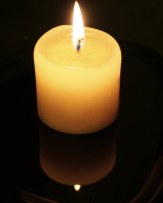 No man, when he hath lighted a candle, putteth it in a secret place, neither under a bushel, but on a candlestick, that they which come in may see the light. The light of the body is the eye: therefore when thine eye is single, thy whole body also is full of light; but when thine eye is evil, thy body also is full of darkness. Take heed therefore that the light which is in thee be not darkness. If thy whole body therefore be full of light, having no part dark, the whole shall be full of light, as when the bright shining of a candle doth give thee light.
 But though spiritual sight must be part of what Christ is talking about, twice He uses the words, “whole body full of light.” Pause and think on that! What can it even mean? We can theorize about it, but Christ, Who called Himself “The light of the world,” is not an idea or a theory or a spiritual practice. He will have to teach us what this means by experience. Our yearly Lenten effort is our effort to return again and again to that lifelong process. And He has many ways of opening our eyes and bringing us to Himself, customized to each person’s unique situation.
 is losing some of his youthful goodness. If our lives are like mirrors that are meant to reflect the glory of our Creator, his mirror is not doing that very well; it has gotten dirty by slow degrees and not even his parents understand why their son does not bring them joy as he used to.
 “It was indeed a lovely being, and Curdie thought how happy it must
 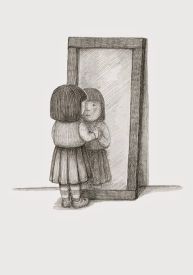 after an indefinable time out of time, which may be less than a minute, our boy comes through the storm with clarity, and proceeds with his repentance.
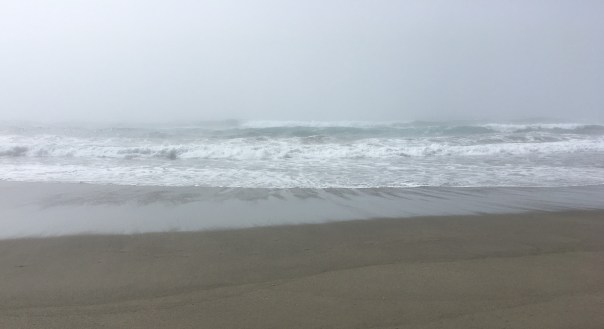
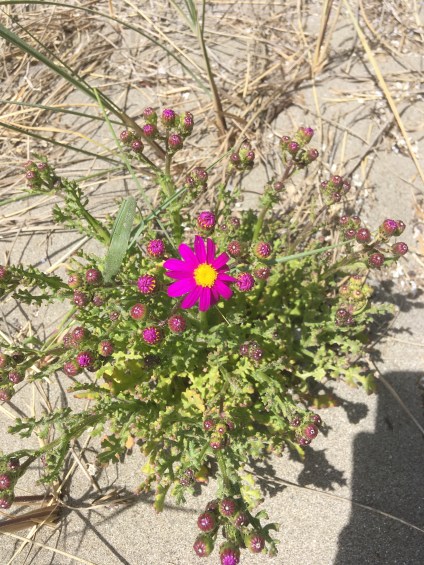
 Today’s beach trip kept getting put off, until by the time I got out to the coast it was already afternoon. These flowers had opened sometime in the last week; I don’t remember ever seeing them on the California coast before. The daisy flower looks like something that might have escaped a back yard, but the plant as a whole definitely does not.


 I saw this new sign, “Sensitive Wildlife Area: Do Not Enter,” one of many posted along the rope that surrounds an area not twice as large as what you can see in this picture. The dunes are of course always in flux from the changing winds. It seems odd to guard a relatively tiny spot, and also not to say what agency is forbidding the children to play there. [See more about this in the comments.]