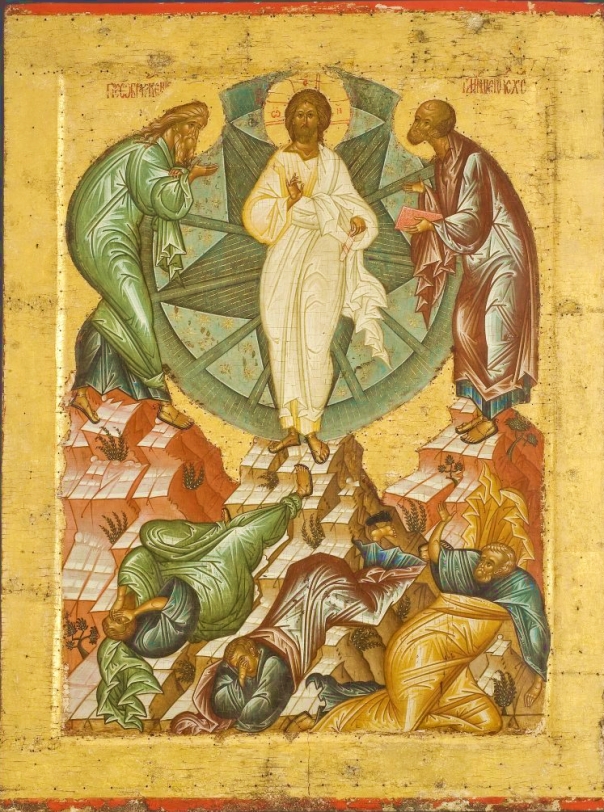
“The highest light is God, unapproachable and ineffable, neither grasped by the mind nor expressed in language. It illumines every reason-endowed nature. It is to intelligible realities what the sun is to sense-perceptible realities. To the extent that we are purified it appears, to the extent that it appears it is loved, to the extent that it is loved it is again known. It both contemplates and comprehends itself and is poured out but a little to those outside itself. I speak of the light contemplated in the Father and Son and Holy Spirit, whose wealth is the confluence and the leaping forth of this radiance.”
-St. Gregory of Nazianzus (The Theologian), Oration 40, on Baptism
Transfiguration of Christ, Kirillo-Belozersky Monastery, Russia, 1497
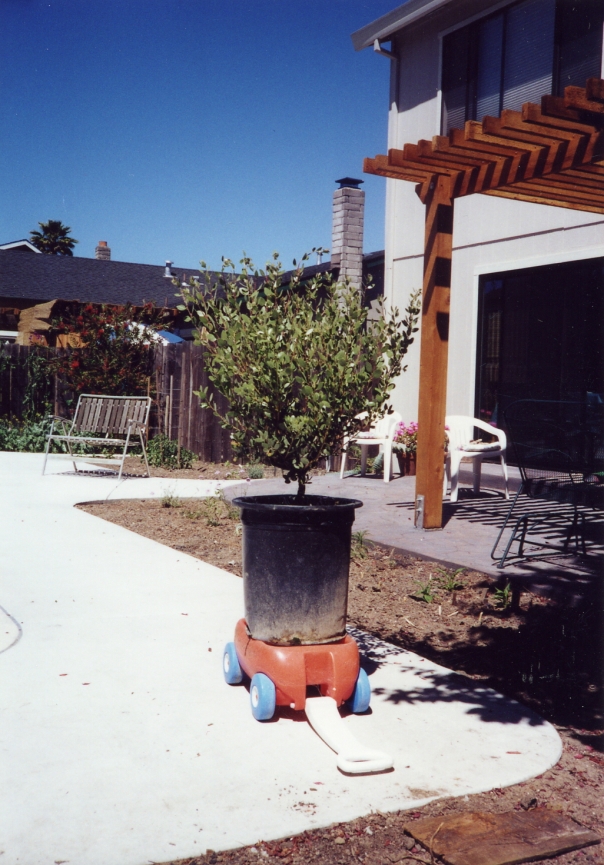
It’s a sad day here in the garden, as my dear manzanita bush is no more. Here is what she (I named her “Margarita” a few years ago) looked like when she first came into the garden in 2003:
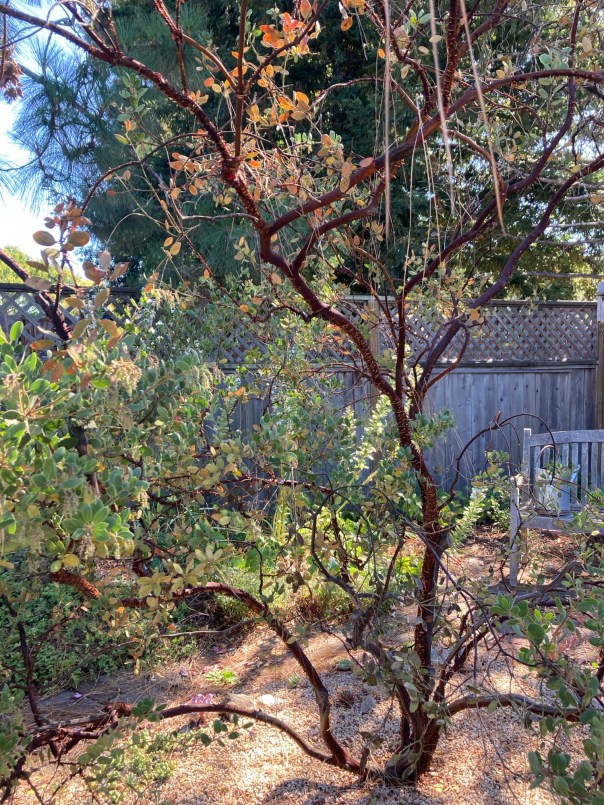
And this afternoon just before Alejandro cut off the branches:
She’s gotten leggy lately because I could not figure out how and where to prune, in the midst of her demise. And you can see the lack of green leaves in the main branch. But for most of her life, she has looked quite lovely through all seasons.
I have a new plant that will go in soon. I think it is a different variety. The leaves don’t look the same as the old plant, and I don’t know if I have the name of the previous one anywhere in my stacks of papers. This one is a boy, I guess, “Howard McMinn,” and it is famous for being the most adaptable type for growing “in captivity,” as one might say. It puts up with clay soils, and with more summer water — a typical garden condition — than would be tolerated by many species of Arctostaphylos.
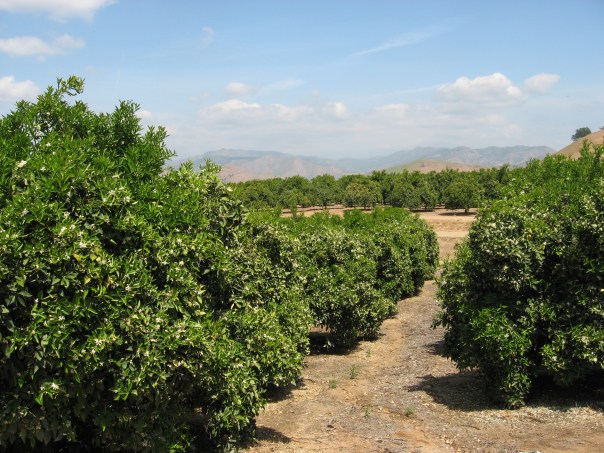
Back in the day when I lived with my family in farm country, in the midst of miles and miles of citrus orchards, my siblings and I would ramble through the groves, ours and our neighbors’, and along the private dirt roads dividing the properties from each another. All the kids did this, and no one ever suggested we were trespassing.
Once we came upon a small and shabby house with its doors and windows open, and obviously abandoned. We dared to go in, and walked through the rooms, which still contained furniture such as a kitchen table with dried up food on plates, other unwashed dishes in the sink, and personal belongings lying about. We didn’t stay long, it was too creepy, but my imagination was stirred from then until now, wondering what story lay behind the disorder. What would prompt the residents to leave without finishing dinner, and never come back? Why had no one bothered to come and clean up the mess, and make the place livable again?
That house didn’t show signs of having been beautiful at any time, but under different circumstances, it might have been. It remains for me a disturbing memory, for all the sad stories it might have been hinting at, but also because of the physical ugliness that stood as a witness to chaos. In all likelihood it has been leveled to the ground long since, and orange trees planted in its spot. I wonder if anyone else remembers it.
The poem below tells of a much richer and more nuanced experience and story. The poet Frederick Goddard Tuckerman was stricken when his wife died after the birth of their third child, and felt that as the father of the child he was somewhat guilty. Most of his poems after her death express these feelings of loss, loss of home and of the woman as the center of family life. One commentator suggests that the description of the mother, twice using the word “sat,” indicates her being frozen in time as a memory.
SONNET XVI (“Under the mountain”)
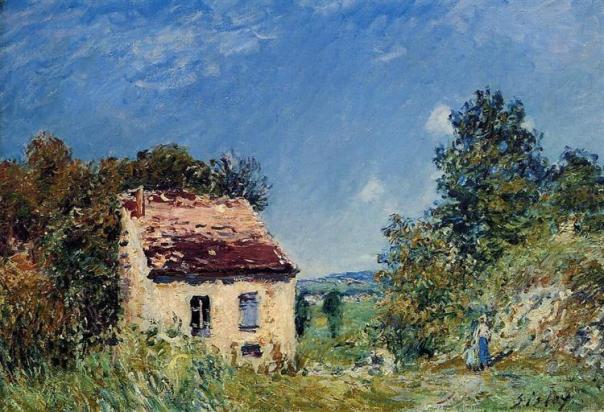
Under the mountain, as when first I knew Its low black roof, and chimney creeper-twined, The red house stands; and yet my footsteps find Vague in the walks, waste balm and feverfew. But they are gone; no soft-eyed sisters trip Across the porch or lintels; where, behind, The mother sat, — sat knitting with pursed lip. The house stands vacant in its green recess, Absent of beauty as a broken heart; The wild rain enters; and the sunset wind Sighs in the chambers of their loveliness, Or shakes the pane; and in the silent noons, The glass falls from the window, part by part, And ringeth in the grassy stones.
-Frederick Goddard Tuckerman
Alfred Sisley, Abandoned House
Thanks to Sally Thomas for sharing this poem on her Substack page last month.
Thy precious Cross, O Christ God, which Moses of old prefigured in his own person when he overthrew Amalek and put him to flight; which David commanded to be worshipped, calling it Thy footstool: this same Cross we sinners worship today with unworthy lips. We praise Thee Who wast pleased to be nailed upon it, and we cry to Thee:
“With the thief, make us worthy of Thy Kingdom, O Lord!”
Thy Cross, O Lord, is life and resurrection for Thy people. And we who put our trust in it praise Thee, our God crucified in the flesh. Have mercy on us!
Here is a good article by Patrick Henry Reardon about the Biblical passage referred to above, in which Moses interceded for the army of Israel as it did battle with the Amalekites: “The Best Intercessor in the Bible.”
“Moses conquered the Devil, wrote Gregory the Theologian, ‘by stretching out his hands upon the hill, in order that the Cross, thus symbolized and prefigured, might prevail.'”



 Gladsome Lights