She could not be negative or perfunctory.

I’m reading My Antonia again — actually listening for the second time, to the recording narrated by Jeff Cummings. Next time I’d like to hear a different narrator, because I think Cummings makes the adult narrator of the story, Jim Burden, sound like young Anne of Green Gables. And he reads too fast, which doesn’t suit the pace of life depicted in the novel, and does an injustice to Willa Cather’s evocative prose.

This may be the fifth time I’ve read the book, and every time is a fresh experience. A paragraph or a personality will jump out at me as though I’m encountering it for the first time. For example, the introduction to the Burdens’ Norwegian neighbors after they moved into town:

“Mrs. Harling was short and square and sturdy-looking, like her house. Every inch of her was charged with an energy that made itself felt the moment she entered a room. Her face was rosy and solid, with bright, twinkling eyes and a stubborn little chin. She was quick to anger, quick to laughter, and jolly from the depths of her soul. How well I remember her laugh; it had in it the same sudden recognition that flashed into her eyes, was a burst of humour, short and intelligent.

“Her rapid footsteps shook her own floors, and she routed lassitude and indifference wherever she came. She could not be negative or perfunctory about anything. Her enthusiasm, and her violent likes and dislikes, asserted themselves in all the everyday occupations of life. Wash-day was interesting, never dreary, at the Harlings’. Preserving-time was a prolonged festival, and house-cleaning was like a revolution. When Mrs. Harling made garden that spring, we could feel the stir of her undertaking through the willow hedge that separated our place from hers.”

The-Harling-House_Red-Cloud_1013763 (2)
The “Harling House” in Red Cloud, Nebraska

Let Evening Come

To me, this is the most famous of Jane Kenyon’s poems, my first acquaintance with her, which made me so happy, I immediately copied it by hand into a notebook. I think it was in a collection of writings lent to me by an acquaintance, Sabbath: Restoring the Sacred Rhythm of Rest, by Wayne Muller. In my notes I called this book a “syncretistic” gathering, but said that it still contained “lots of tidbits I wanted to record.”

In a review of a new book about poetry for those who “don’t see the point,” titled The Point of Poetry, by Joe Nutt, the reviewer Dr. Oliver Tearle says this about one use of poetry: “Many claim it has saved their life, or at least made them feel a little less low during dark times (Stephen Fry once picked Philip Larkin’s depressing poem ‘Aubade’ as one of the poems he turns to when feeling down, because simply seeing your own grim feelings expressed so deftly and movingly lifts the spirits by showing you what human beings can achieve with words).”

He well expresses one reason that I find some poems very nourishing. I’m surprised that I haven’t posted this favorite before; probably because one blogger or another over the years was sharing it already. But I found it again this evening in Poem a Day Volume 2, and I’ll just let my happiness spill over this time.

LET EVENING COME

Let the light of late afternoon
shine through chinks in the barn, moving
up the bales as the sun moves down.
Let the cricket take up chafing
as a woman takes up her needles
and her yarn. Let evening come.
Let dew collect on the hoe abandoned
in long grass. Let the stars appear
and the moon disclose her silver horn.
Let the fox go back to its sandy den.
Let the wind die down. Let the shed
go black inside. Let evening come.
To the bottle in the ditch, to the scoop
in the oats, to air in the lung
let evening come.
Let it come, as it will, and don’t
be afraid. God does not leave us

comfortless, so let evening come.

-Jane Kenyon

God bless the Ten Ren.

I’m home from Kate’s, and instead of sleeping in a room with Raj I will be conked out all alone in my quiet space tonight. While I was still in D.C./Arlington I wanted to write a little collage-y post about my last week with their family, but I was running out of steam. I haven’t really built up steam at this point, quite the opposite, but I do want to have blog closure on this, and I need a little time to wind down this evening, so…
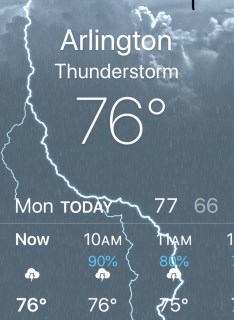
We had the 4th of July, when I stayed home with Raj who had gone to bed, but I saw the fireworks at the Capitol anyway, out our window. Only blocked a little, by a big building across the way. We had glorious thunderstorms, which were also fun to watch, with horizontal rain and dramatic electrical and sound displays — but one of them caused flash floods nearby, which I’m sure the people getting rescued didn’t feel glorious about.

We did lots of baby-rocking and smooching, cooking and eating. Later I will try to post some recipes of what I cooked. All the cooking required shopping, so we made a fun trip to Costco to make use of me having a card. It was a happy-family sort of outing such as I don’t think I’ve ever had at Costco 🙂 . Six of us including two boys under two and the nanny Kareena — and the adults were all jolly.

On the way I told Tom that he should sing a going-to-Costco song, because he is often singing through the days. He considered this idea for only a few seconds before it came to him that the tune should be something by John Philip Sousa, and he made us all laugh with his lyrics to a rousing number that fit our mood well. Walking through the store Rigo slept peacefully in a front pack, but Raj in the cart started to get a little antsy as our explorations were prolonged. I distracted him by means of the cut flower display which he really did admire, and some Pringle samples.

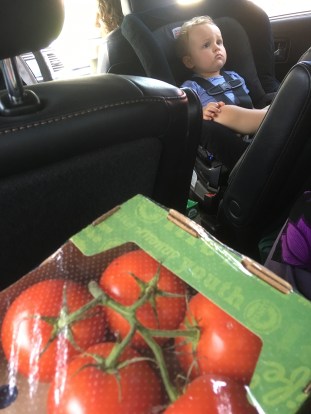
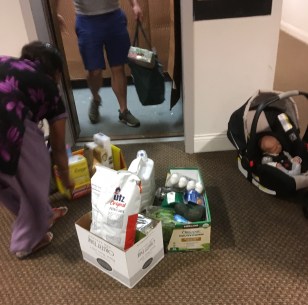
Fitting all those groceries into the not-huge SUV with all of us was a challenge; I protected the tomatoes on my lap. Getting so many boxes and bags, plus two babies, out of the car and into the elevator, then out of the elevator on our floor, was a creative logistical work; the elevator was determined to close on us, and some of our company were very scrappy in the skirmish.

Today I woke at 6:00, Eastern Time. Lately Raj had been waking me up with more babbling than crying. After a while he was ready to get up, and I started him on his morning routine of dressing, playing, breakfast, before the nanny came on duty and while his parents were catching up from nighttime with a newborn. Sometimes lying in bed with me was a changed aspect of the routine. I started this paragraph the past continuous tense and had to change it… 😦 I hope Raj will continue, though, to wake up a little later than he had been doing before I arrived.

Actual flight time from east to west was barely over five hours, but by the time I got to my house this evening I’d been traveling twelve hours. I walked around my gardens front and back, and everything looks so healthy and good! I drank my Ten Ren “Relaxing Tea,” and may God bless it to be so.

Love for an instant.

“It is true enough, of course, that a pungent happiness comes chiefly in certain passing moments; but it is not true that we should think of them as passing. . . To do this is to rationalize happiness, and therefore to destroy it. Happiness is a mystery like religion, and should never be rationalized. . .

“A man may have, for instance, a moment of ecstasy in first love, or a moment of victory in battle. . . The cause which the flag stands for may be foolish and fleeting; the love may be calf-love, and last a week. But the patriot thinks of the flag as eternal; the love thinks of his love as something that cannot end. These moments are filled with eternity; these moments are joyful because they do not seem momentary. . .  Man cannot love mortal things. He can only love immortal things for an instant.”

–G.K. Chesterton in Heretics (1905)

From G.K. Weekly