Walking Pennsylvania woods and gardens.

It was fun to be in a different climate zone with lots of plants I’m not used to. All my cousins appreciate my love for the flora of their world. Elise has this huge tree in her little back yard, a pawlonia or Japanese Empress tree, which I remembered from three years ago. I took a picture of a small portion through my bedroom window.

gle-p1050989-crp

Renée and I walked in the woods twice in two days. Even the rotting leaves smell different in her woods from the ones at home. A different recipe – and the aroma is delicious. p1060017-beeches-euonymous

There are also a greater quantity of leaves than I’m used to, what with all the deciduous hardwoods. In the middle of one woods our path ran alongside a clearing where leaves collected from neighborhoods are dumped into big piles for composting. In my part of California the disposal companies might make mulch from the contents of the green bin, but leaves are just a small part of the mix.

Many of the trees were already bare, but birches and Japanese maples were still colorful.

And an invasive species of euonymus that is pink right now. It’s called Winged Euonymus because of the little rectangles sticking out like flags along the stems.

gle-euonymus-alatus

gle-p1060039

gle-p1060054


Renée is such an accommodating host that she was willing to go down to her garden just to pick greens for our breakfast — in response to my answer about what I usually eat. We did this again for dinner, and I took pictures of her garden.

< One of the things she grows is Kalettes, a cross between Brussels sprouts and kale. We enjoyed lots of those in our stir-fry!


gle-p1060045

p1060066On my last day in Pennsylvania, my cousin drove me to Longwood Gardens, a property of over 1,000 acres with several conservatories that make it possible to grow exotic plants all year. Right now they are having an amazing chrysanthemum show.

It was novel, the propagating they do with mums, such as grafting 100 varieties on to one stem. That plant was more freakish than beautiful; maybe it had also passed its prime. The 100-bloom domed plants were prettier:

p1060069

They have an intricate system for supporting the flowers in such a strict form.

gle-2016-11-16-14-54-42

In 1906 Pierre du Pont purchased the land that has become Longwood Gardens. Previous owners had been farmers, and by 1850 the arboretum they planted had become an expansive collection covering 15 acres. Du Pont bought the 202-acre farm in 1906 to preserve trees that were in danger of being cut down. Then he proceeded to restore and develop the gardens, to grow fruit trees and plant a long Flower Walk, build a chimes tower, install fountains… many features that we didn’t have time to see on this visit, given the early sunset of November.

When Pierre du Pont died in 1954, the Longwood Foundation that he had put in place made possible a transition from private estate to international treasure. Trying to find if there was a connection between Kate’s Dupont Circle neighborhood in D.C. and this gardener, I did discover that Pierre was the grandfather of the Civil War soldier for whom the traffic circle was named. It is fascinating to read about this large and prosperous family through the generations.

p1060058
sea oats

gle-2016-11-16-14-49-27

I loved the orchids, and the mandarinquat tree, and hanging gardens and succulents. Of course I won’t show you pictures of everything. But this Silver Garden was an especially lovely and soothing display.

gle-img_3840

img_3838

I must end my travelogue; though it seems incomplete in that I have had to leave out lots of experiences I might ramble on about, it is also a little too delayed for me to want to delve any more into those events. Now the pink leaves are no doubt fallen, and soon snow will be covering them along the forest paths. I came home and have returned to my everyday life that is never the same from one day to the next, so I will get back to writing about that.

Happy December!

gle-japanese-maple-red-pa


Found Cousins and Founding Fathers

These men were the reason that Philadelphia became a place we visit for historic tours, and their life-size statues made me really glad I had come. However, if it weren’t for the fact that my cousins live here, I wouldn’t have made the trip.

2016-11-14-12-09-24

It was less than four years ago that I “found” my Pennsylvania cousins after losing contact with them for most of our lives. They were on the east coast, our family was on the west, and when we were children our parents didn’t have the means to get us all together. When my aunt died, I had the time and money to go to her memorial, and since then her three daughters and I have been getting to know each other.

Grace picked me up at the Philadelphia airport; we had made plans to visit some historic sites, so we did that right away. It was still less than one week since the national election, so our government and constitution and the events of our country’s founding were pertinent to all that was on our minds and hearts.

At the National Constitution Center we sat in a theater-in-the-round for a show called “We, the People,” which had rousing recorded music and multimedia images, but was focused on the live performance of a real human with a pleasant voice dramatizing the story of the Constitution of our nation. It was short enough for the shortest attention span, I think, and went by too fast, but I loved the presence and speech of that woman and was glad that our admission fee was contributing to a quality presentation about something fundamental and important to us all.2016-11-14-12-10-29

My favorite part of this place was the bronze statues. Being able to walk so intimately among them and look in their faces was very affecting. I admire those signers of the Constitution, and others of the Founding Fathers who weren’t there at the time, so much! I know, one isn’t supposed to say things like that without mentioning sins that we moderns judge them for. But I don’t think many of us could hold a candle to their bravery and principles, their intelligence, and the hard work they did to hash out the Constitution. I am supremely grateful to them, and I loved this exhibit for reminding me of that.

I like that they have Benjamin Franklin sitting down; he was over 80 at the time and it is said that “though he did not approve of many aspects of the finished document and was hampered by his age and ill-health, he missed few if any sessions, lent his prestige, soothed passions, and compromised disputes.“

gle-img_3775

Alexander Hamilton’s statue is standing alone, not in conversation with anyone. I would like to read more about the man and find out if there was an artistic reason for that attribution of body language in the placement of him. A day or two after this my cousin Renée played some music from the Broadway musical “Hamilton” for me, and I liked it a lot. If any of my readers has a book about Hamilton that you would recommend, please tell me.

Grace and I went next to Independence Hall, where the Constitution was actually signed, a 250-yr old building whose exterior is largely intact. It was built as the state house for the colony of Pennsylvania, the main part of the building completed in 1748.

gle-img_3781


The furniture in the Assembly Room where the signers met is mostly not the original pieces — in fact, the interior of the building itself is nearly all reconstructed/restored — except for two items: 1) the inkstand  used to sign the Declaration of Independence, and 2) the chair that George Washington sat in to preside over the Constitutional Convention in 1787.

“At the successful conclusion of the convention, Benjamin Franklin stated that he had looked at the carved sun at the top of the chair many times, but had never known whether it was rising or setting. With agreement on the Constitution, he announced that it was a rising sun, symbolic of the promising future of the United States.” That is why it is called The Rising Sun Chair (picture below).

gle-p1050970

Benjamin Franklin’s house used to stand a short walk from Independence Hall. Now its site is a historic exhibit; you can look down into a hole and see some of the brick of the original house, which was Franklin’s Philadelphia residence in the last decades of his life, and you can walk among the rooms that are no longer there.

I liked this exhibit, because of the quotes from his letters printed on floor plaques in the various “ghost rooms,” evidence that he was away a lot in those years. His wife had moved into the house in 1765, but he left for England that year and didn’t even see it until ten years later. He wrote lots of instructions about what he wanted done in and to it, though, plans for curtains and dishes and things. He wrote about his friends, and about building his library:

gle-quote-ed-franklin-better


Years ago I had turned down an offer from my husband to visit Philadelphia for a day; I told him I’d rather wait until we could stay three nights in the city, so that we’d have two whole days for touring places like this, and more. But now that I’ve had my brief walk-around, I feel satisfied for the time being. Maybe if I spent more time reading about the people and events who are memorialized here, I’d want to come back for longer. But on this trip I was ready to go home with the cousins, and for the remainder of my stay, to live in the present.

Last images of D.C….

gle-p1050914

I had spent five nights with Kate by the time she needed to return to work,
and I was ready to proceed on the next leg of my trip.
Many images of Washington, D.C. had been imprinted on my mind
and recorded by my camera.

p1050917
The Navy Memorial, showing western North America.

It looked like winter down by the Potomac, where in Georgetown
they were building up the ice rink for skating, “Coming Soon!”
A man was spreading the freezing water around with a sort of push broom.

gle-p1050918crp

We had been out for a yummy dinner in that neighborhood,
where I was surprised to see, next to buildings along broad sidewalks,
people bedding down for the night on the red bricks.

gle-2016-11-10-14-03-06
Unidentified building with square theme.

My time was up, I had my ticket in hand already, to depart on Train 86 – Northeast Regional Line, to visit my cousins in Philadelphia. Tom drove me to Union Station where I was immediately transported into a compartment of my mind where emotions linked to other train stations throughout my life seem to be stored all together.

My primary experiences of rail travel, thoroughly positive and exciting, were my childhood trips to see my grandmother. Then there was the year that I rode trains from Munich to Istanbul, and back to Amsterdam, young and alone and meeting strangers who were sometimes like angels. That was also my first experience of a huge railway depot like Victoria Station in London, where the first angels appeared.

Mr. Glad and I had a blissful train ride down the coast of California long ago, the day after becoming engaged…and with Pippin I experienced English railways in modern history. God only knows how to sort out all the train events, and speculate about what rivulets of that stream were running through my heart as I entered Union Station gawking. It was early enough that I could wander around a little and feel the vastness of space and excitement — though I think for most people it was routine, and for me the excitement was probably largely drawn from the well of memory.

gle-union-station

When I went through to my gate, I had some trouble finding the right queue to get into. I think I was just a little early, and after the earlier 8:10 boarded things were easier to figure out, partly because I asked people for help.

I should have put my suitcase in the floor-level storage area at the end of the car, but before thinking very long I just hefted it up, balancing it for a second on my head, and it landed in the overhead bin okay. Then I had two hours to look at the scenery, and to read or pray. I was a little downhearted for the first while – probably because I had left my dear daughter and son-in-law behind. Parting is the uncomfortable side of train-station drama.

Soon I was meeting more family and hugs at the other end of my ride and being taken care of again. And that will be the next happy chapter of my travel story.

The Library of Congress

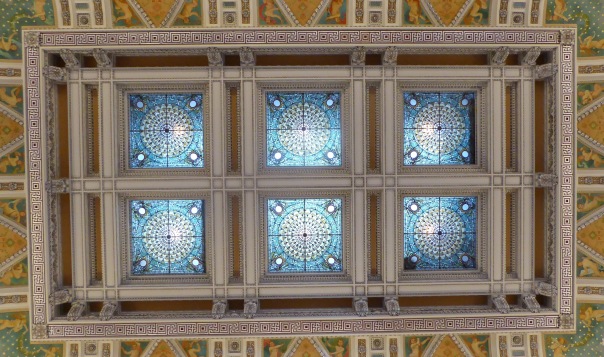
p1050884
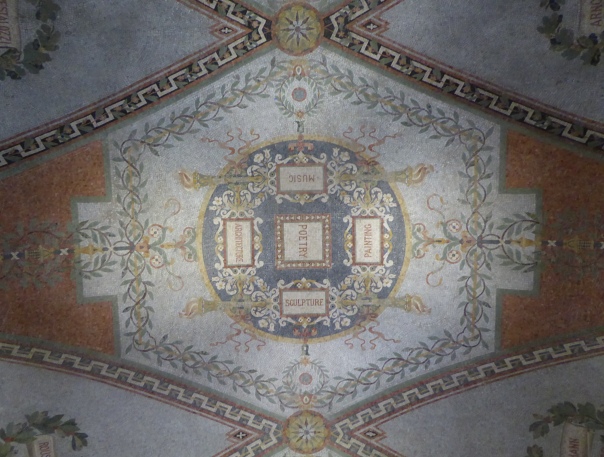
Ceiling of the Great Hall

The Library of Congress, the Thomas Jefferson Building, was a joy to visit, primarily for its architecture and design – which is not what I had anticipated. Before I had left home, when Kate suggested that we go there, I had naturally thought first of books, and exhibits about books.

We heard a story about how it ended up so beautiful: The first two construction attempts failed at the level of the foundation, and a third person was called in to complete the project. His son, who had recently graduated from the University of Beaux-Arts in Paris, took over the design and completion of the interior ornamentation. Or so our tour guide told us 🙂

When I was trying to review these facts online for this post, I discovered another version of the story in a book about “German Achievements in America.” That story does not mention any failure on the part of the original (German) architects, but rather emphasizes that they spent twenty years perfecting the design and were never given adequate credit for it.

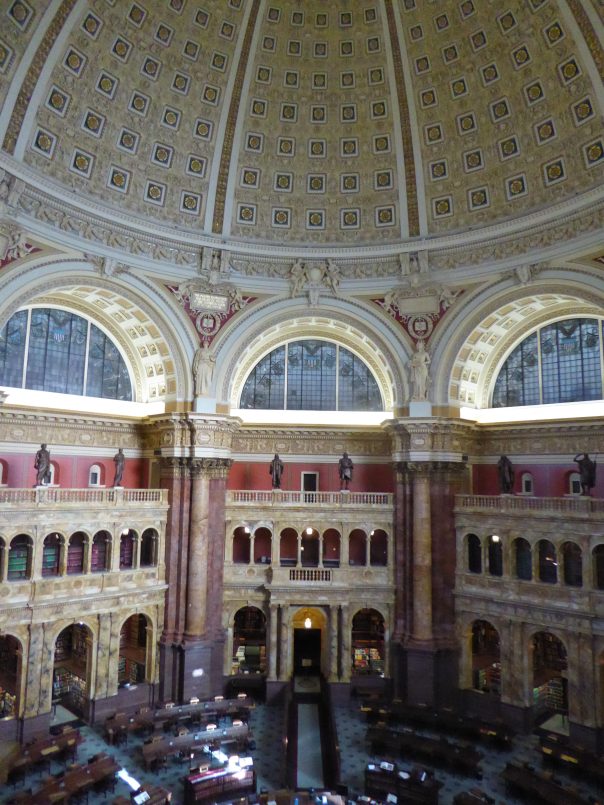
p1050894
Main Reading Room

This page on the LOC site gives broader detail about the drama of these events — involving “the selection of the proper cement for the foundation” — and eventual completion in 1897 of the main building of the library, which was not named for Jefferson until 1980.

p1050904

Thomas Jefferson deserved to be honored this way, because he offered to sell his whole personal library to Congress after their collection of books was destroyed by fire in the War of 1812; at that time the library was stored in the Capitol. He said he would accept whatever price they decided upon. Previously they had owned only law books, but Jefferson persuaded them that “…there is, in fact, no subject to which a Member of Congress may not have occasion to refer,” and they bought his 6,487 books for $23,950. That amount was based on the number and sizes of the books.

Jefferson’s generosity was not because he no longer needed what he named “unquestionably the choicest collection of books in the U.S.” He used the money gained to pay some of his debts, and began right away in a “frenzy” to assemble a replacement library for himself, saying, “I cannot live without books….”

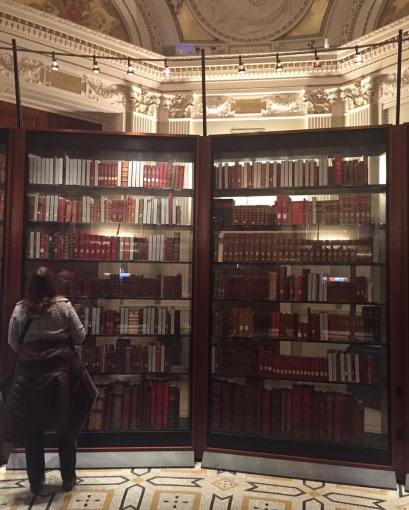
gle-g-at-thomas-jefferson-library-exhibit-loc
(A little part of) Thomas Jefferson’s Library exhibit

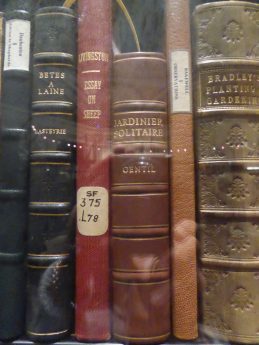
Two-thirds of the new Jefferson library was destroyed by another fire in the Capitol, in 1851. In the last decades efforts have been made to restore all the books that were in the original collection bought from Jefferson, and by 2008 replacements had been found for all but 300 of the original books; together with the volumes not destroyed by fire, these all comprise the exhibit of Thomas Jefferson’s Library which has been on display since then. Though we wandered through a couple of other exhibits in the building, this one is where Kate and I spent the most time. I had been to Jefferson’s home at Monticello ten years ago, but through this unhurried perusal of his books I felt more connection to him than ever before.

p1050890

Librarian of Congress Ainsworth Rand Spofford, an appointee of Abraham Lincoln, had wanted the Library of Congress to be not just a resource for legislators but a library for the whole nation, and he was responsible for the copyright law of 1870,  which required every author of any copyrighted map, book, piece of music, etc., to deposit two copies in the Library. This method of acquiring materials worked very well, and soon Spofford was pressuring Congress to approve a separate building dedicated to housing the collection, and to do it quickly, because books “were being piled on the floor” and he could see that his job would soon devolve into “presiding over the greatest chaos in America.” Though it took 25 more years before the new building was ready to store the books in a more orderly fashion, Librarian Spofford stayed on all that time, presumably presiding over chaos with hope.

In order to fully appreciate all of the art and architecture of the Library, someone who knows as little as I of fine arts and literature would need days of viewing and background studies. Many short quotes decorate the walls, without reference to the work quoted, and I was curious about these. I did look up this one that I liked (below), and found that it is from a Shakespeare play. Though it is a statement about what we can learn not from books but from nature, I will close with it, as I myself must leave the Library and go now to explore some other good things.

gle-quote-crop
Tongues in trees, books in the running brooks, sermons in stones,
and good in everything.

-William Shakespeare, “As You Like It”