While it is still this week in chronos, I must tell about the several ways kairos has made its impression on my heart and mind.
Last Sunday when I was zooming with my friends up the Nevada highway to church, we passed a car whose license plate read “Kairos.” We knew that Greek word from its use at the beginning of Orthodox Divine Liturgy, when the Deacon proclaims, “It is time (kairos) for the Lord to act,” so it seemed to us a fundamentally theological word, and with the aid of my phone we researched and discussed the concept as we rolled along, and wondered if the vehicle belonged to someone we would be worshiping with in a few minutes.
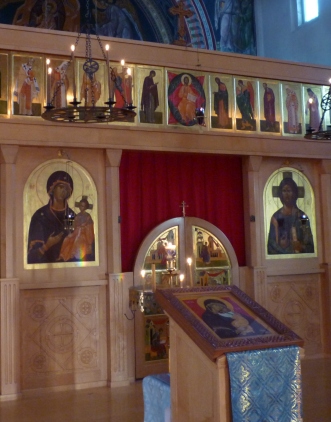
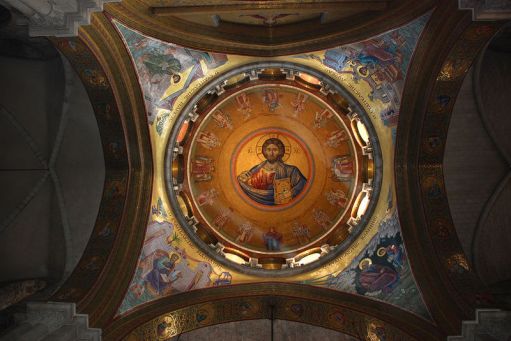
It was the Sunday of the Last Judgment, and in the homily our attention was directed to the icons on either side of the doors to the altar. On one side is the icon of The Incarnation, and on the other, of The Pantocrator, or Judge. Everything in between happens right here, Fr. Stephen said, in the Church, from the altar and in the Holy Mysteries, bringing heaven to earth and joining all who partake or have died in Christ. We had just an hour earlier read on Wikipedia that kairos refers to “a moment of indeterminate time in which everything happens.”
The meaning and reality of Time is a deep well into which I love to dip, with my mind, but it is a heady beverage and makes me dizzy. I didn’t do any further reading this week, as I plodded on through chronos — chronological time — and tried not to get behinder in it and in my housework and tax preparation and garden planning….
I plodded, because after my joyous interlude of a kind of kairos, about which I wrote in my last post, I returned to my house that still seems empty without my husband, to my responsibilities that continue to overwhelm me, to a future whose unknowns appear daunting, now that I have to meet them without my life’s companion. And in less than two weeks we will come to the one-year mark, of his death. Is there another kind of time that reflects what I feel, that it was only last month? Or that it is a perverse, somehow false, fact? I guess that would be called grief.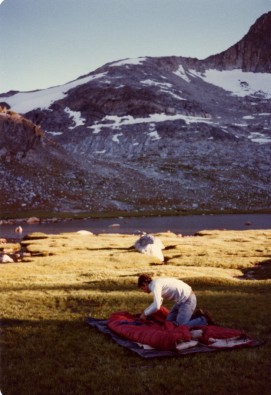
Yesterday I spent most of the day updating my screensaver, which right now is scrolling through a folder of photos named “Mr. Glad.” I had decided it didn’t have enough files in it, so I combed through all the other folders to find more images of him, and I was very nurtured by reviewing his life, and my life with him, in this visual way. We had over the last years scanned hundreds of pre-digital photos into the computer, so there he was as a little boy laughing on his father’s lap, bursting with the energy and zeal of youth at our wedding, cradling our newborn babies or reading to our little children; singing with his strong and beautiful voice in church, backpacking with his kids, giving me a kiss on the cheek while I was standing over the stove.
My housemate Kit had never met my husband, and she was glad to look through many of the pictures with me and hear some stories. It made me happy to collect my pictures, and even happier to have her to share them with. I went contentedly to bed and sleep last night.

I hadn’t planned to attend Liturgy this morning, for the Commemoration of the Holy Monastic Saints. But I woke at 4:30, and after an hour passed and I couldn’t go back to sleep, I turned on the light and got up, and it seemed at the time that God had awakened me so that it would be easy and sensible to go to church. And there is nothing that makes me feel so needy for the Holy Mysteries as missing sleep!
(Which reminds me of how we moderns are so far removed from the sacredness of even chronos that we have to try to control it with our silly clock changes.)
I went back to my rest and dreams after all, not before a good session of musing on how this month is likely to be harder than I expected. I woke at last in time to get to church, where I was surprised that in addition to the Holy Ascetics, we were remembering a beloved priest from San Francisco, who reposed ten years ago this day.
In his homily and other remarks, our rector brought up the reality of kairos, speaking of how in the church, in the Liturgy, we are joined together with everyone who has ever died in Christ. He said, “It is common to hear, ‘I have Christ in my heart,’ but we also can have a little of each other in our hearts, because we are brought into the Kingdom, in that moment of kairos.” It was what I needed to be reminded of this morning: not my loss, but the enduring nearness of my dear husband.
Now I want also to read more about this truth, this kairos that I experience. I imagine that Fr. Alexander Schmemann’s book The Eucharist will speak a good deal to the subject, and just this afternoon I ran across a pertinent article, on The Chalice of Eternity. It will be a good place for me to start. Here is a quote from what appears to be a thorough treatment of time in all its facets and forms:
In Christ, as the Lord of Time, is realized the ingathering of all moments in one moment of what we might call an ‘eternal temporality’ and which Schmemann calls temps immobile, that is, the co-inherence or co-presence of each part of time to each other in the present in Jesus Christ. Christ is Himself the Lord of Chronos or time proper because He is the Kyrios Kairou, Lord of the appointed time of our salvation. In Him, our broken mode of temporality, chronos, is renewed and sanctified, ascending with Him to the Father and becoming a spiritual mode of time through its marriage with creaturely eternity (aeon). But when He returns to us in His Body and Blood in the liturgy, which is both our ascent to God and His descent to us, we see that our new mode of time, eternal temporality, is something radically new to creation, sensible and spiritual at once, as it has partaken of the very mode of God Himself as everlasting Trinity (aidiotes), God before the ages. -Dr. Brandon Gallaher
Tomorrow is the Sunday of Forgiveness, and The Casting out of Adam and Eve from Paradise. And then (for us Orthodox) Lent begins! May the everlasting Trinity use this blessed season to reveal to us Himself and all of His Truth, including the reality and fullness of kairos. Amen.
 Early on in our 21 years of homeschooling I found that my style of learning and teaching was suited to doing unit studies. Someone has explained the concept like this: “Unit studies are collections of learning activities tied to a theme. They are popular with many homeschooling families because they provide a hands-on approach to learning that incorporates subjects such as math, science, language arts, and the social sciences.”
 r, as long as we lived in that house, while we ate our meals we could watch the house finches enjoying theirs at the same time.
 of what there is to study and know. All the rest has no substance.
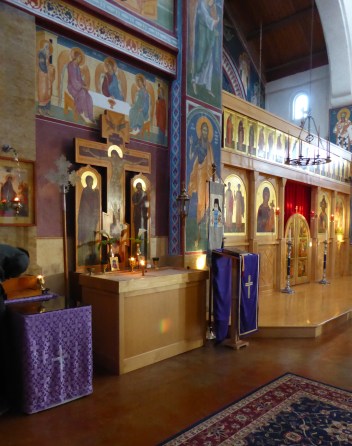 During the Vespers of Forgiveness last Sunday, the vestments were changed to purple. We began this season of the year — approximately a tithe? — that seems to convey the heart of Orthodoxy, because it calls us back to our First Love and to real Real Life. As someone reminded me this week, Normal Life is what Adam and Eve had in Paradise, when they walked and talked with God in the garden. It can take a lot of effort to put aside the usual cares and concerns for a season, and to do whatever is necessary to reach an awareness of our great need for Christ, and to receive His love and forgiveness, which is the healing of our souls.


 Gladsome Lights