Shy little bird in the rib cage.

“Three forces carved the landscape of my life. Two of them crushed half the world. The third was very small and weak and, actually, invisible. It was a shy little bird hidden in my rib cage an inch or two above my stomach. Sometimes in the most unexpected moments the bird would wake up, lift its head, and flutter its wings in rapture. Then I too would lift my head because, for that short moment, I would know for certain that love and hope are infinitely more powerful than hate and fury, and that somewhere beyond the line of my horizon there was life indestructible, always triumphant.

“The first force was Adolf Hitler; the second, Iosif Vissarionovich Stalin. They made my life a microcosm in which the history of a small country in the heart of Europe was condensed. The little bird, the third force, kept me alive to tell the story.”

Those are the first two paragraphs of the book Under a Cruel Star: A Life in Prague 1941-1968 by Heda Margolius Kovály, which I read last year. What a survivor that “little bird” helped the author and heroine to be, again and again; her story is gripping and intriguing in every way, and I highly recommend it. She survived Auschwitz, and near the end of the war managed to escape. She ran to her friends in Prague, but none of them dared take her in. The remainder of her story is very suspenseful, and demonstrates the strength of will and hope that continued to uphold her through the suffering and loss under Communist rule.

An interview with Heda was recorded in 1980 for “Voices from the Holocaust,” which you can listen to here: Heda Kovály. The outline of her life is laid out in a transcript and episode notes. They are a good supplement to her book, but I’m very glad I learned her story first from her earlier, very personal telling of it.

Not long after reading Under a Cruel Star, I came across the poem below, which speaks of a place such as Heda’s little bird occupied — this hidden place from which help comes in the form of a song.

LACK OF FAITH

Yes,
even when I don’t believe—
there is a place in me
inaccessible to unbelief,
a patch of wild grace,
a stubborn preserve,
impenetrable,
pain untouched by the sleeping body,
music that builds its nest in silence.”

― Anna Kamieńska, Astonishments: Selected Poems

The milky way, and church bells.

PRAYER (I)

Prayer the church’s banquet, angel’s age,
God’s breath in man returning to his birth,
The soul in paraphrase, heart in pilgrimage,
The Christian plummet sounding heav’n and earth
Engine against th’ Almighty, sinner’s tow’r,
Reversed thunder, Christ-side-piercing spear,
The six-days world transposing in an hour,
A kind of tune, which all things hear and fear;
Softness, and peace, and joy, and love, and bliss,
Exalted manna, gladness of the best,
Heaven in ordinary, man well drest,
The milky way, the bird of Paradise,
Church-bells beyond the stars heard, the soul’s blood,
The land of spices; something understood.

-George Herbert

The oddest plant in the garden.

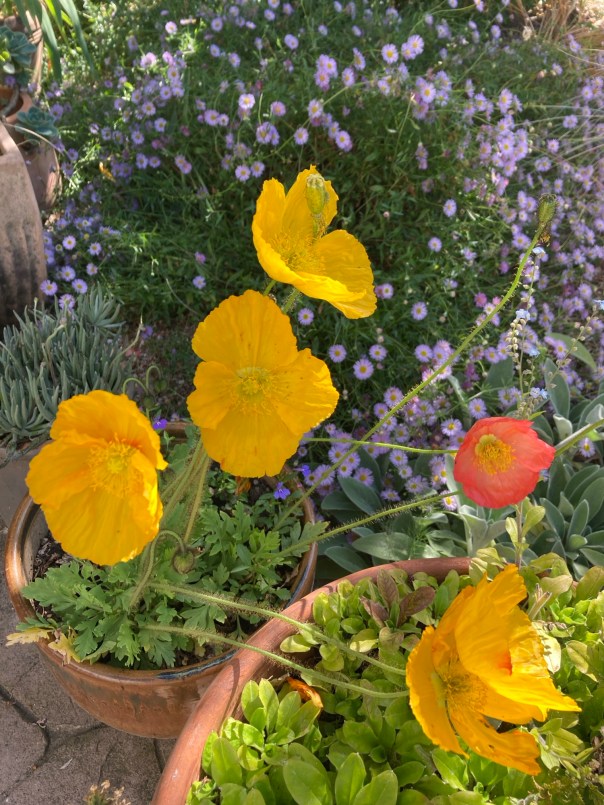
I’m holding myself back with all my might, from sharing a dozen flat images in an effort to convey the magnificence in the garden. The plum trees are adorable, short and squat as I’ve trained them to be, dotted with their pristine white blossoms. The Iceland poppies sway gracefully in the breeze, and the anemones are coming on in red, violet and white.

I ate lunch out there near the pineapple guava one day this week, because it was sunny, and much more pleasant than in the house. As I wandered around I gave thanks for all the hardiness of the plants, their constancy in coming back again and again. Most of them look fairly ordinary in their pictures, at least the way I take them — and I really think no one else could love them the way I do.

But I will share the funny and fantastic Dutchman’s Pipe Vine again (above). It’s in the peak of bloom right now, and the leaves just coming out. Mine is the native Californian species, modest in comparison to some exotic ones (a few far-out examples here), which I planted in hopes of attracting the Pipevine Swallowtail butterfly. So far I haven’t been aware of success in that way, but I enjoy the plant itself very much. This is what the butterfly looks like:

I’ll be sure to tell you if I ever see one in person!

Man recovers his true nature.

“Fasting is the only means by which man recovers his true spiritual nature. It is not a theoretical but truly a practical challenge to the great Liar who managed to convince us that we depend on bread alone and built all human knowledge, science, and existence on that lie. Fasting is a denunciation of that lie and also proof that it is a lie.”
….
“Let us understand …that what the Church wants us to do during Lent is to seek the enrichment of our spiritual and intellectual inner world, to read and to meditate upon those things which are most likely to help us recover that inner world and its joy. Of that joy, of the true vocation of man, the one that is fulfilled inside and not outside, the ‘modern world’ gives us no taste today; yet without it, without the understanding of Lent as a journey into the depth of our humanity, Lent loses its meaning.”

-Father Alexander Schmemann, Great Lent