Oregon – Granite Man, Pennyroyal, and Deer Brush


An hour before the race began

On the first of June Mr. Glad competed with other members of the family in the Granite Man Triathlon in southern Oregon. It was one of several events and meetings that formed the outline of a little trip around our neighboring state.

My husband was doing the swimming leg, as was the other grandpa of our Oregon grandchildren, and the two of them were the team captains. Our son and three grandsons made up the remainder of the teams, with the younger athletes compensating somewhat for the slowness of their elders. We womenfolk and some out-of-town kin were the support crew and also played with the baby (cute boy even if he isn’t one of my grandchildren).

My favorite swimmer left of center with his hands on his hips

Perfect weather, and a lovely setting, with trees leafing out, flowers beginning to bloom. As we stood around on the grassy slope of Applegate Lake waiting for the race to start with the swimmers’ portion, I had my first botanical experience of the trip. It started with a smell that only gradually broke into my consciousness enough to make me look down and search out what source my feet were tramping on.
pennyroyal – or not?

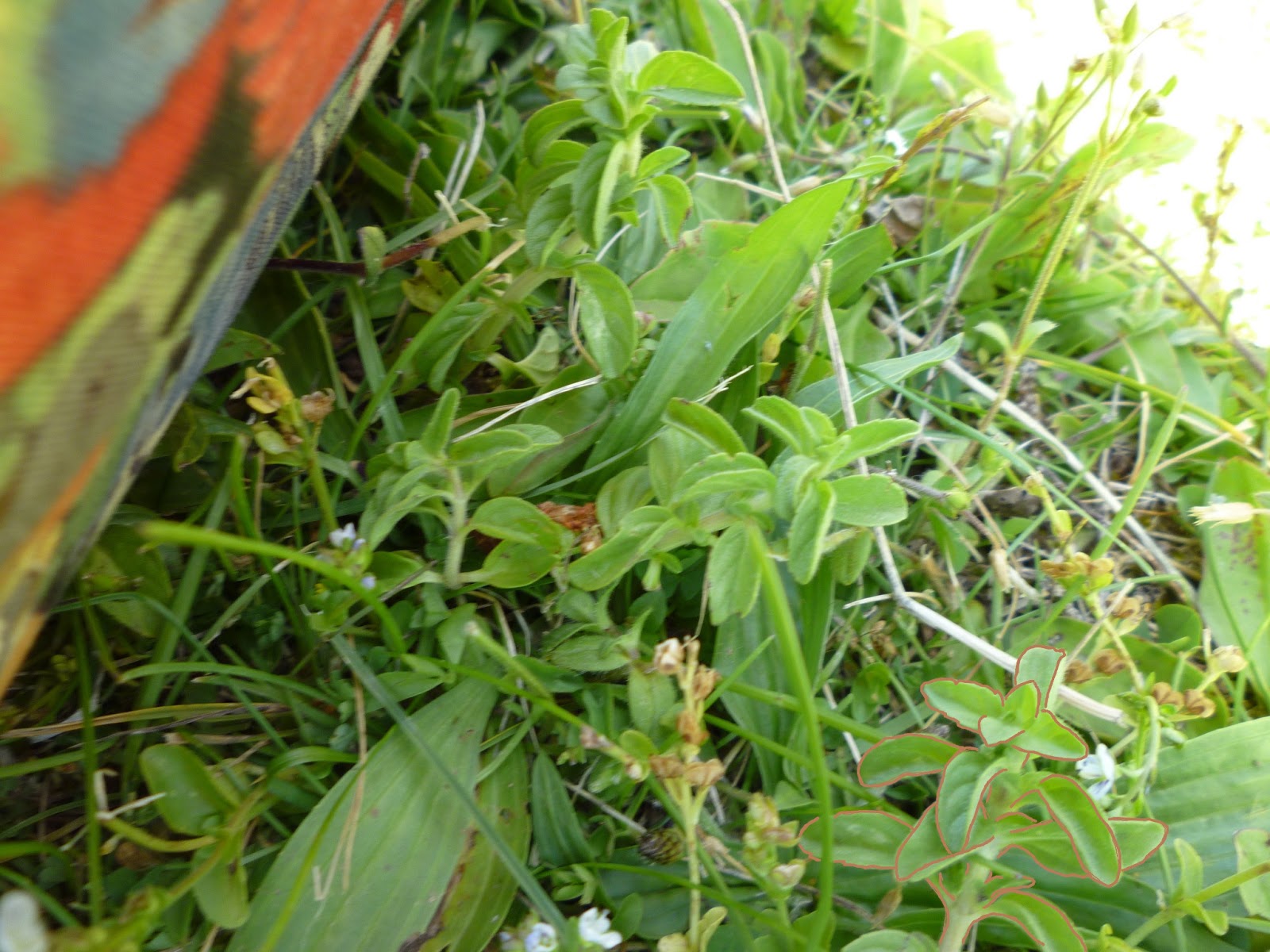
Pennyroyal was my first thought, as I picked off some of what was growing in the wild lawn, and in case you aren’t familiar with it, I outlined one cluster faintly in red, in the photo above, in the lower right corner. Even so, you may have to click on the photo to see it.

But it doesn’t exactly look like pictures of Mentha pulegium, though that pennyroyal is considered mildly invasive in California and Oregon. It doesn’t even look like pictures of the Oregon “field mint” Mentha arvensis, which I looked at in case my sniffer is not able to distinguish between members of the mentha family.

Pennyroyal has what I’d call a sharper aroma than most mints, and this one under my feet had that distinctive smell that I have met many times in my life, often in the mountains. Was I mistaken? Its leaves do look in some ways more like Monardella odoratissima, whose common names include “Mountain Pennyroyal” – but not exactly.

This Applegate Lake variety looks like a cross between it and another mint, as I study it further. And that impression might not be too far from reality, because it turns out that pennyroyal has an ability to hybridize with other mint species, adding to its troublesome weediness. It may crowd out native plants and even threaten Oregon’s commercial peppermint and spearmint crops, as I read in this article.

I learned a new word while reading it: allelopathy: a biological phenomenon by which an organism produces one or more biochemicals that influence the growth, survival, and reproduction of other organisms. I am familiar with this kind of influence from my experiences in gardening, but I didn’t know the name for it. The latest instance is the way nothing much grows under my manzanita bush because of its negative allelopathic qualities. The authors of the article experimented by treating seeds of a rare Oregon plant with a weak extract of pennyroyal root, and found that the germination rate dropped.
Deer Brush near Applegate Lake, Oregon

I didn’t know all of this bad stuff when I was lolling about in such a bucolic place; I was only pleased to have found a plant to check on as soon as I got home.

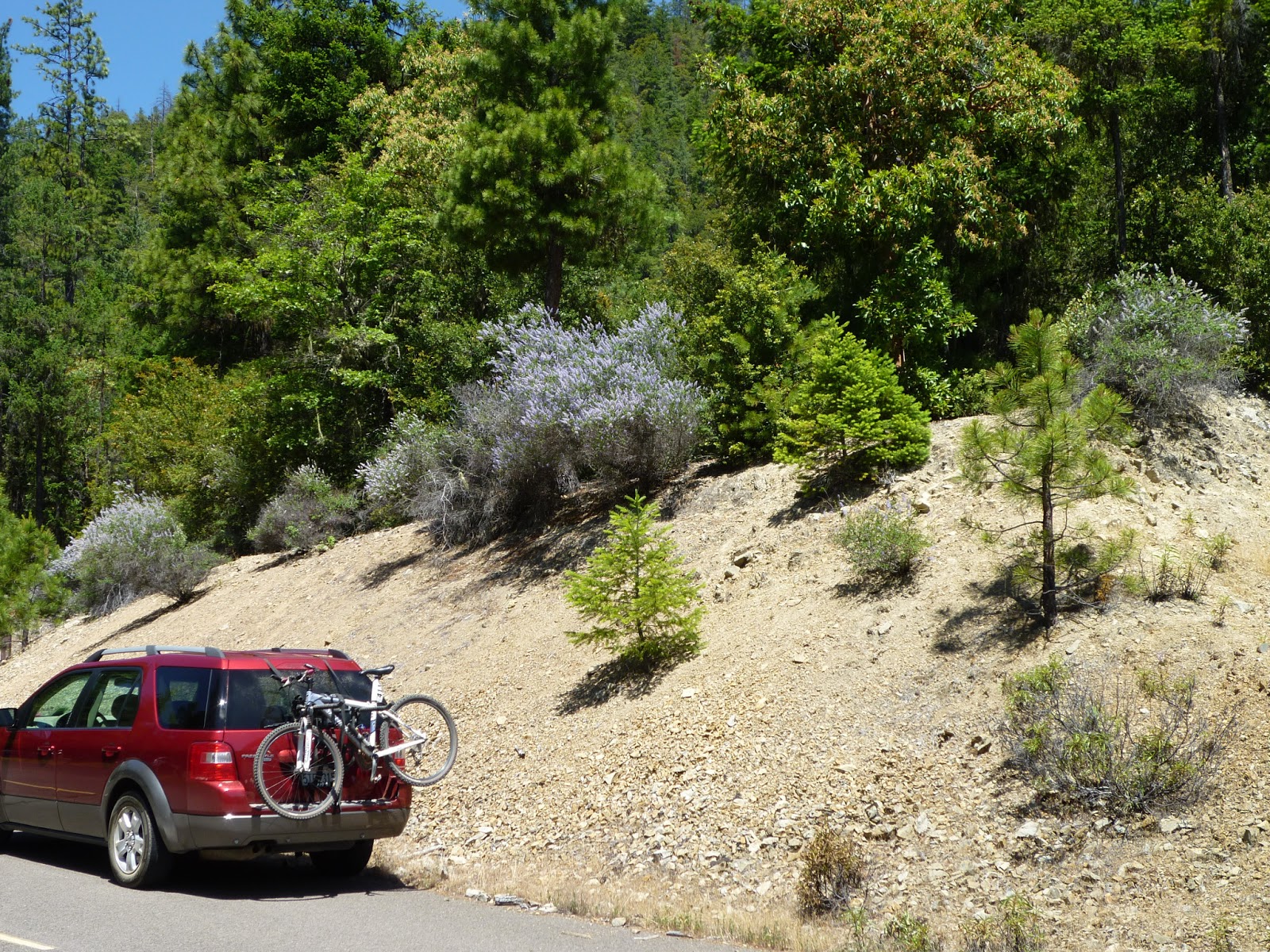
When we went out to the parking lot after all our guys were done (and some were done-in) I found another, a bush covered with honey-scented flowers. I thought it might be a type of Ceanothus, and I was right. But about the common name, I was wrong. I guessed Mountain Lilac, and it is in fact called that by some people, but maybe by mistake…? It’s officially known as Deer Brush.

The flowers come in shades of light blue and white, mostly, and it’s native to the western states. All of its uses are positive: animals eat it, the Indians made baskets from it, and it fixes nitrogen in the soil. Everybody likes this one!
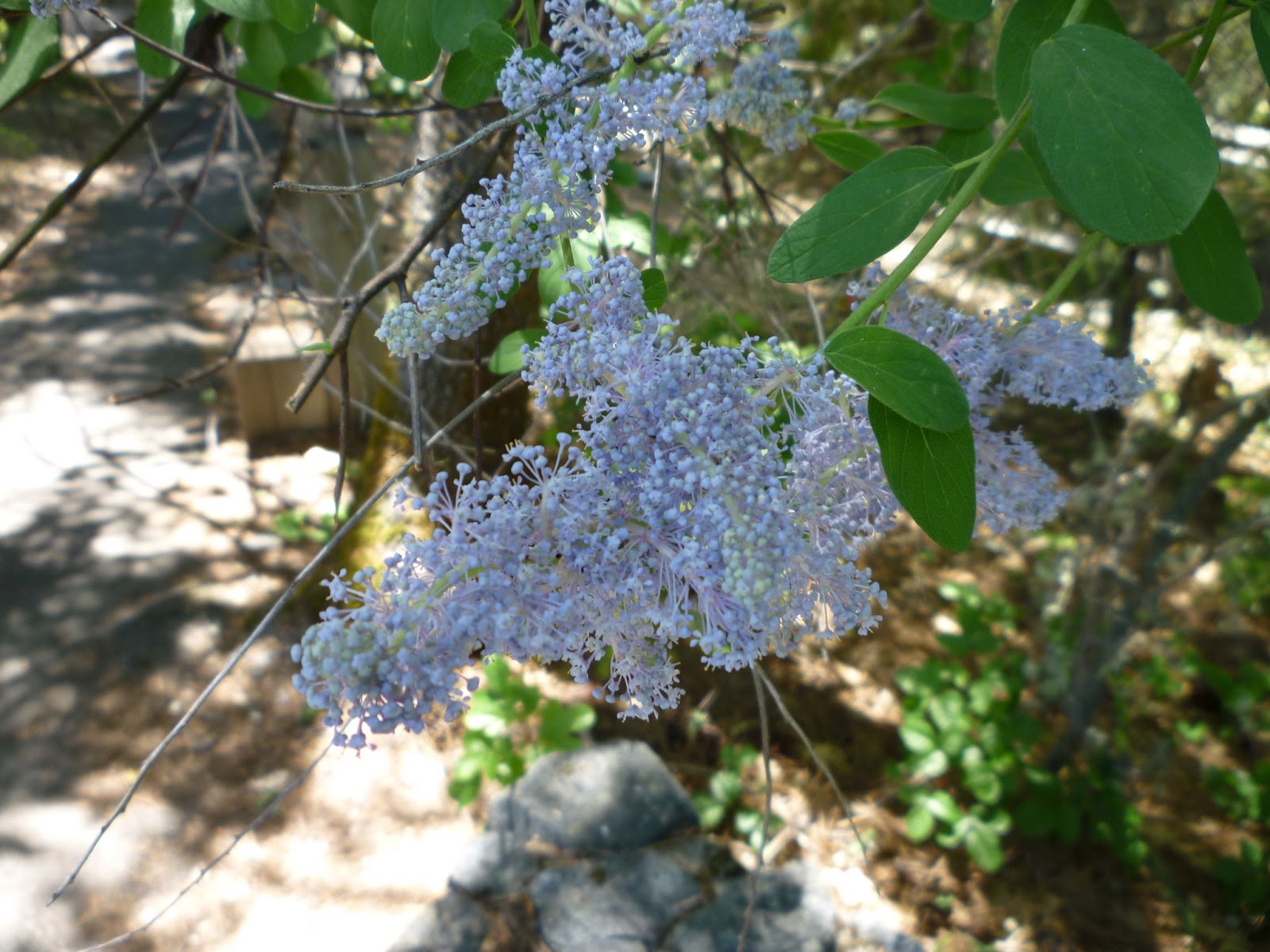
Ceanothus integerrimus

Gardening Notebook

As long as I’ve been trying to grow things I’ve been using pencil and paper in my planning and sometimes to record how long seeds took to sprout, or what date the tomatoes got ripe. I had a box in which I kept articles from Sunset and Organic Gardening, and that box still is overflowing into a closet somewhere, full of ideas I mostly did not use.

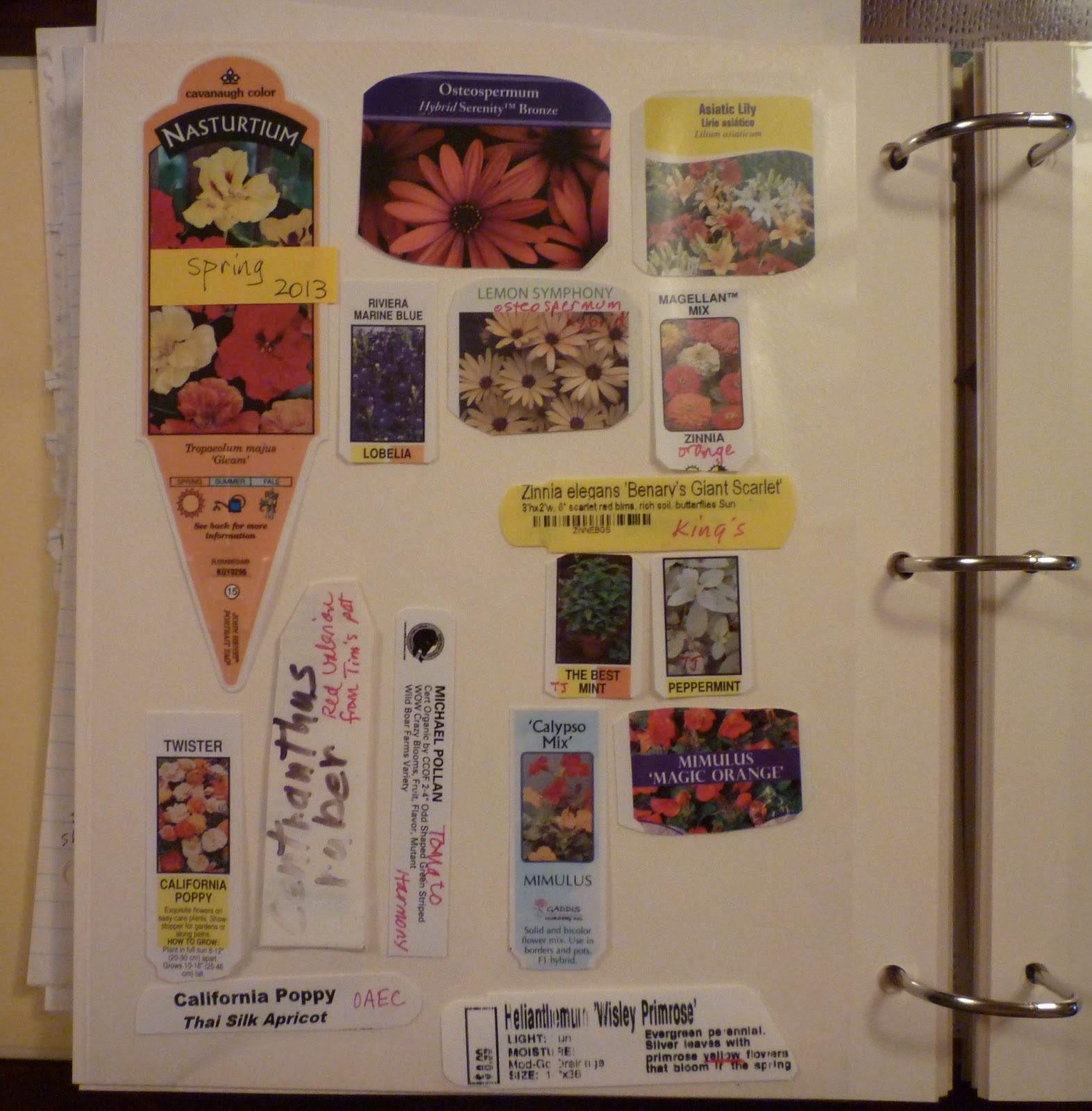
A few years ago for my birthday a friend set us both up with pretty binders and colorful pages to go inside, all ready for garden-type information. At first I used lined pages to write lists of plantings and dates, but lately things have degenerated to the point where I just put my tags and labels under the clear sticky page-covers.

This has turned out to be the most successful way to keep track of what is what in the garden, and how long it’s been growing there.The pockets can hold those articles I’ve clipped, or a few seed packets.

It’s still a bit messy and chaotic, which seems increasingly to be my style. If I try to do things neatly and orderly they never get done. Even the creating of this notebook was a little too much like Kindergarten and I felt rushed and inept while we were putting the pages together, but now that I’ve figured out how to make it mine, it works!

Gardening? I’m on it!

pimiento peppers with nasturtiums

I thought I would skip this week’s discussion of The Hidden Art of Homemaking at Ordo Amoris, because what on earth — or about growing things in the earth — could I possibly say, that I haven’t said in my 115 blog posts that already have the tag “garden”?

But this chapter comes in springtime when it’s hard not to talk about gardening. I’d rather be in the garden doing it, but what do you know, it’s raining as I begin this ramble. And I happened to run across a couple of other blog posts as reminders that I haven’t covered every aspect of the subject.

kale with Mexican bush sage

The spiritual aspects of gardening are well treated by Vigen Guroian whose book is excerpted in  this blog. But I have a hard time making myself read about gardens or gardening, and if I wanted to convince a non-gardener to give it a try, I would just have them work in my garden with me a few times, and hope that they might by osmosis come to see the fun to be had.

If you don’t have a yard, as Edith says you can have a pot of something, and if you don’t want that, you can grow some sprouts on your kitchen counter. There are so many kinds of sprouting seeds available that you can grow a tasty and gorgeous salad in a week or so.

I do love to visit other people’s gardens and even look at pictures of my own yards of yesteryear, so I looked long enough at this Garden Rant post to see that it was about the gardener’s dismay when he realized that he had planted a dreadfully monochromatic and inartistic design.

His problem is the flip side of what I am careful about, the planting of clashing colors. What? you say, echoing my husband, don’t all the colors go together, as in God’s creation? It doesn’t seem to work that way in my gardens. Magenta flowers have caused me problems in the past – they don’t look nice with some of the red flowers nearby.

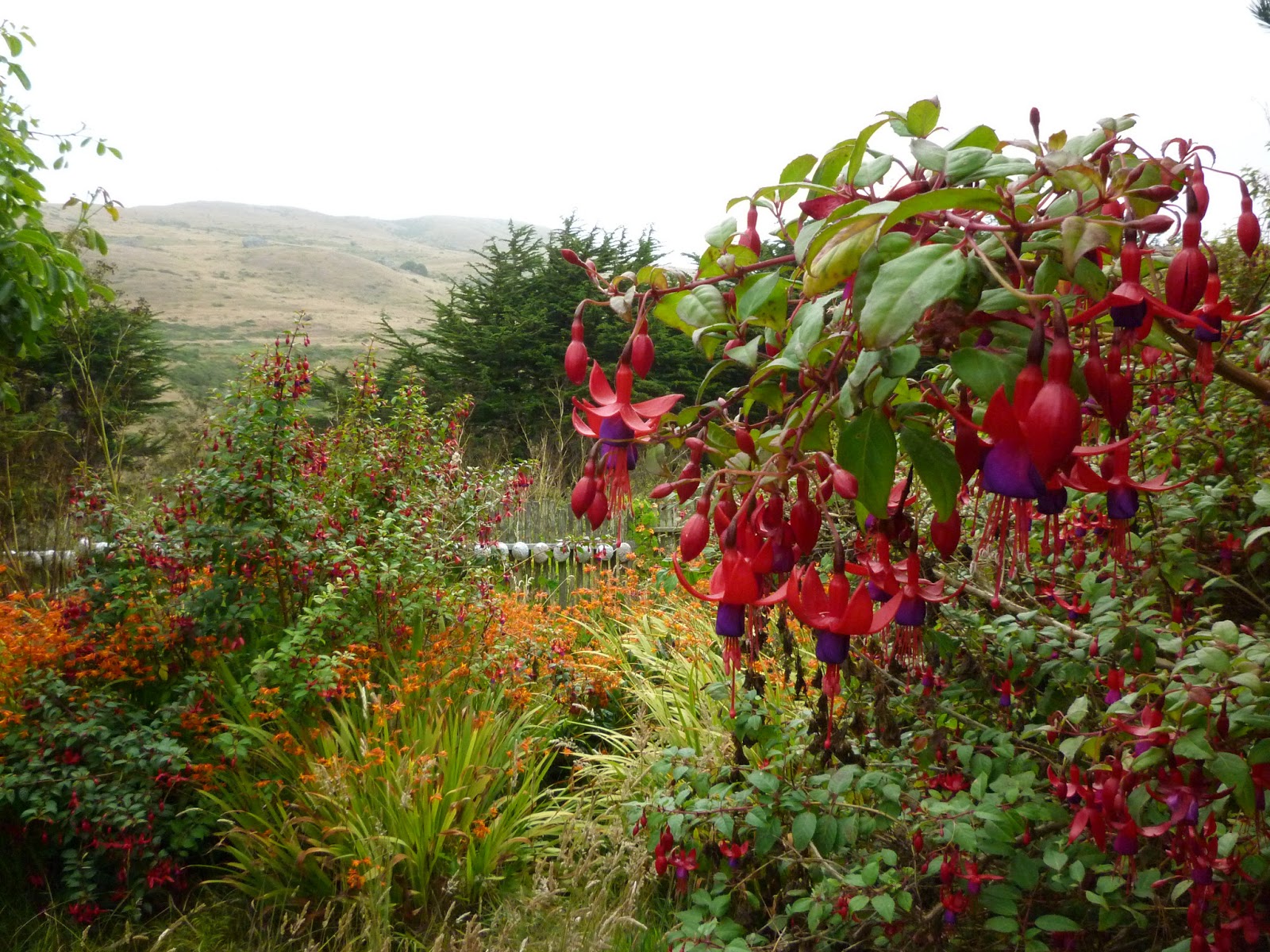
Once a bunch of bright red-orange flowers pretty much spoiled the look of my pale yellow and pale pink roses when they sprouted up in between, while the lavender bush in the same spot blended in nicely. So, I try to avoid mismatches and matchy-matchy. Most of the pictures I’m posting here are of nice contrasts in my own garden, but the one below is from our friends’ neglected beach cottage yard. It’s surprising how glorious these bright and wild colors look together. In foggy coastal areas it seems that whatever flowers you have are a welcome brightness, and they always steal the show by contrast with the white or grey skies.

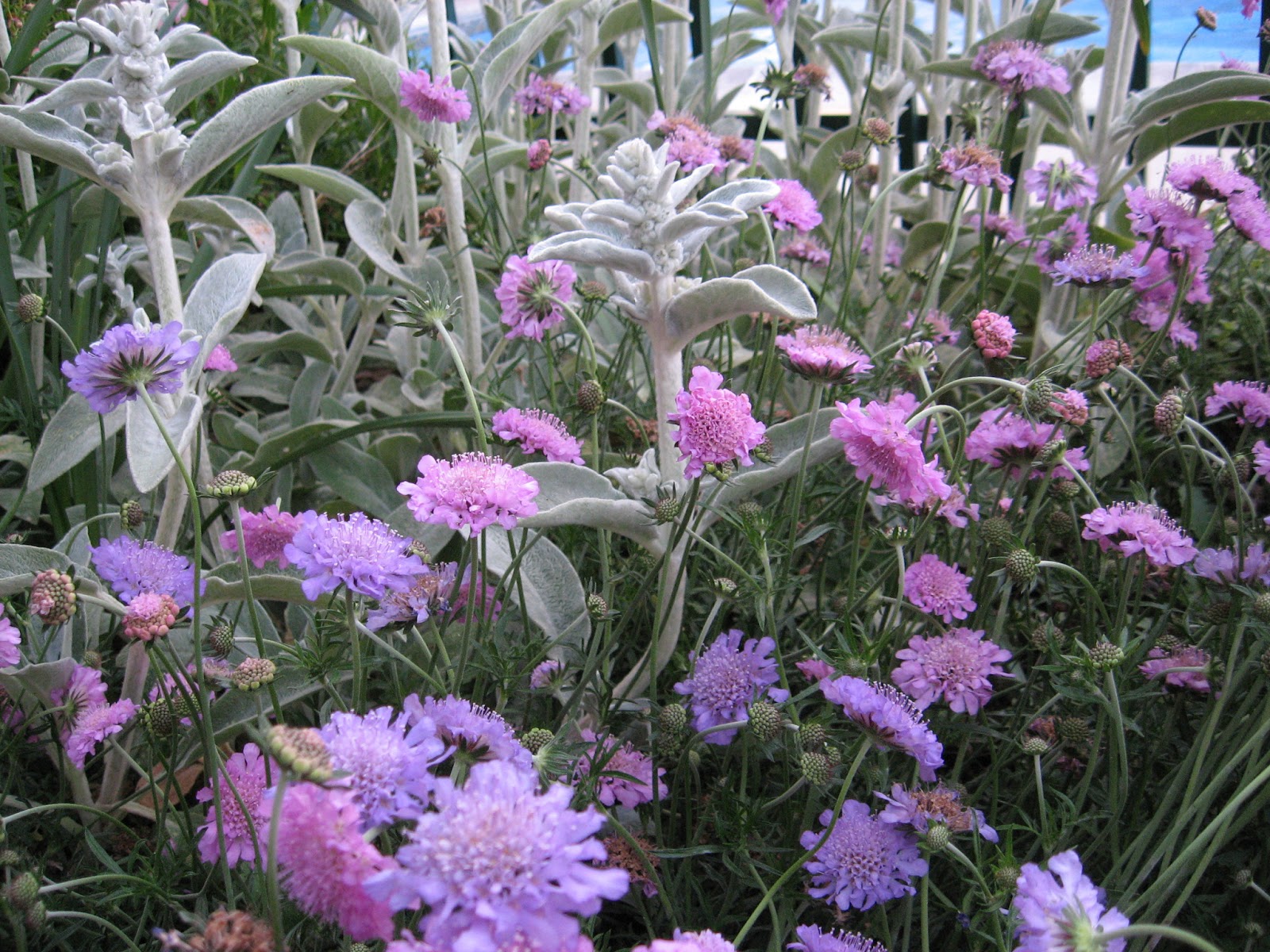
Here’s a much quieter scene: Greyish Lambs Ears make a soft contrast to almost any bright color, as with these pincushion flowers.


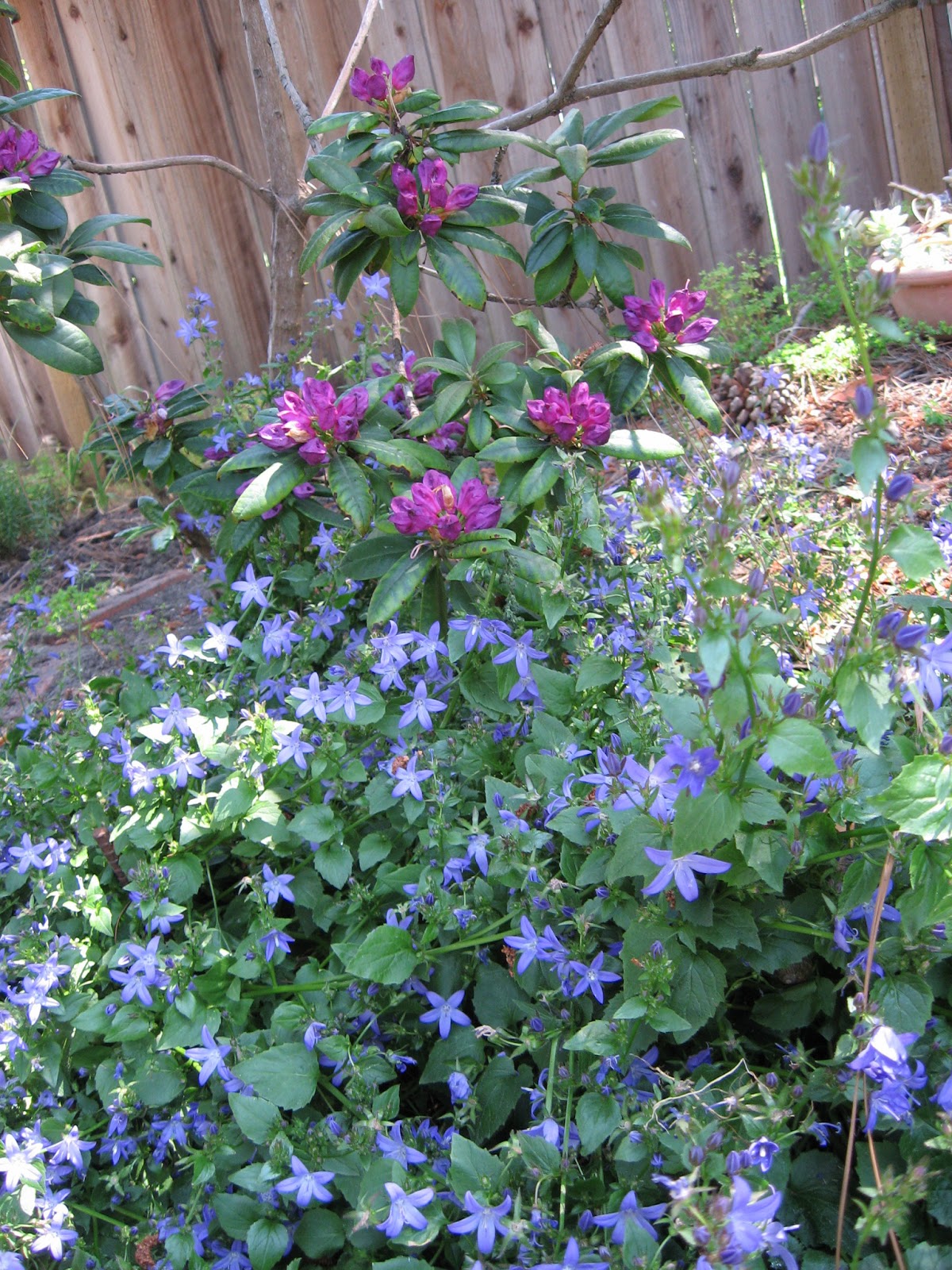
And even the magenta rhododendron is nice with blue campanula. I have learned to think of my garden beds as individual paintings, each with its own color scheme that may change somewhat with the seasons. Some have magenta, while some on the other side of the yard have red.

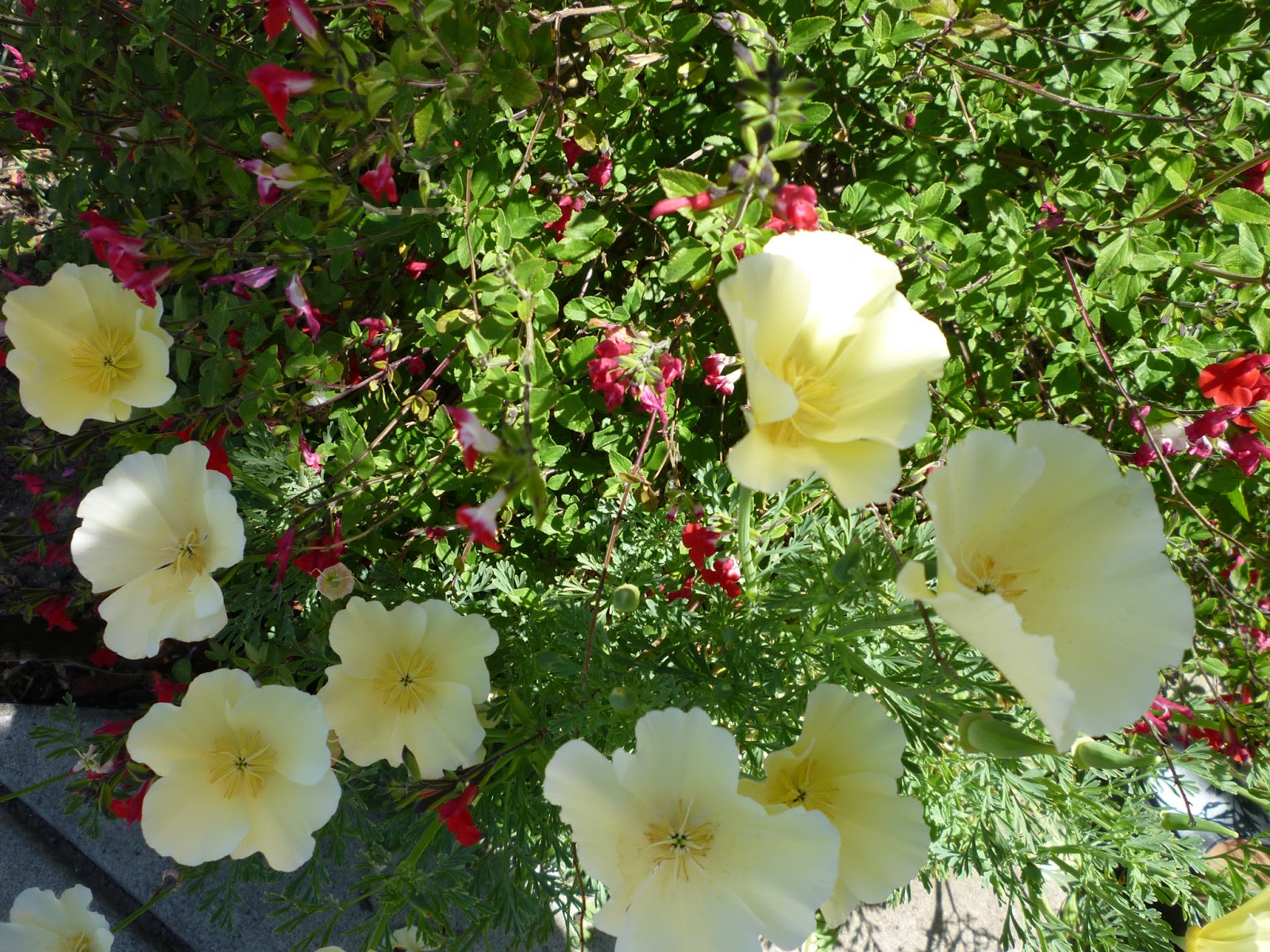
unusual California poppy with Hot Lips salvia

Either color can go with yellow or orange or blue…

It’s fun creating landscapes, if you don’t mind surprises, and  w – a – i – t – i – n – g  for things to grow and bloom, and sometimes having to re-do your design or be happy with a missing part that died. If you take pictures or actually take paints to paper and save an image of the way your plants’ colors and textures have miraculously blended to become Beautiful, you can remember and enjoy your past gardens for years to come.

May the pots never grow cold.

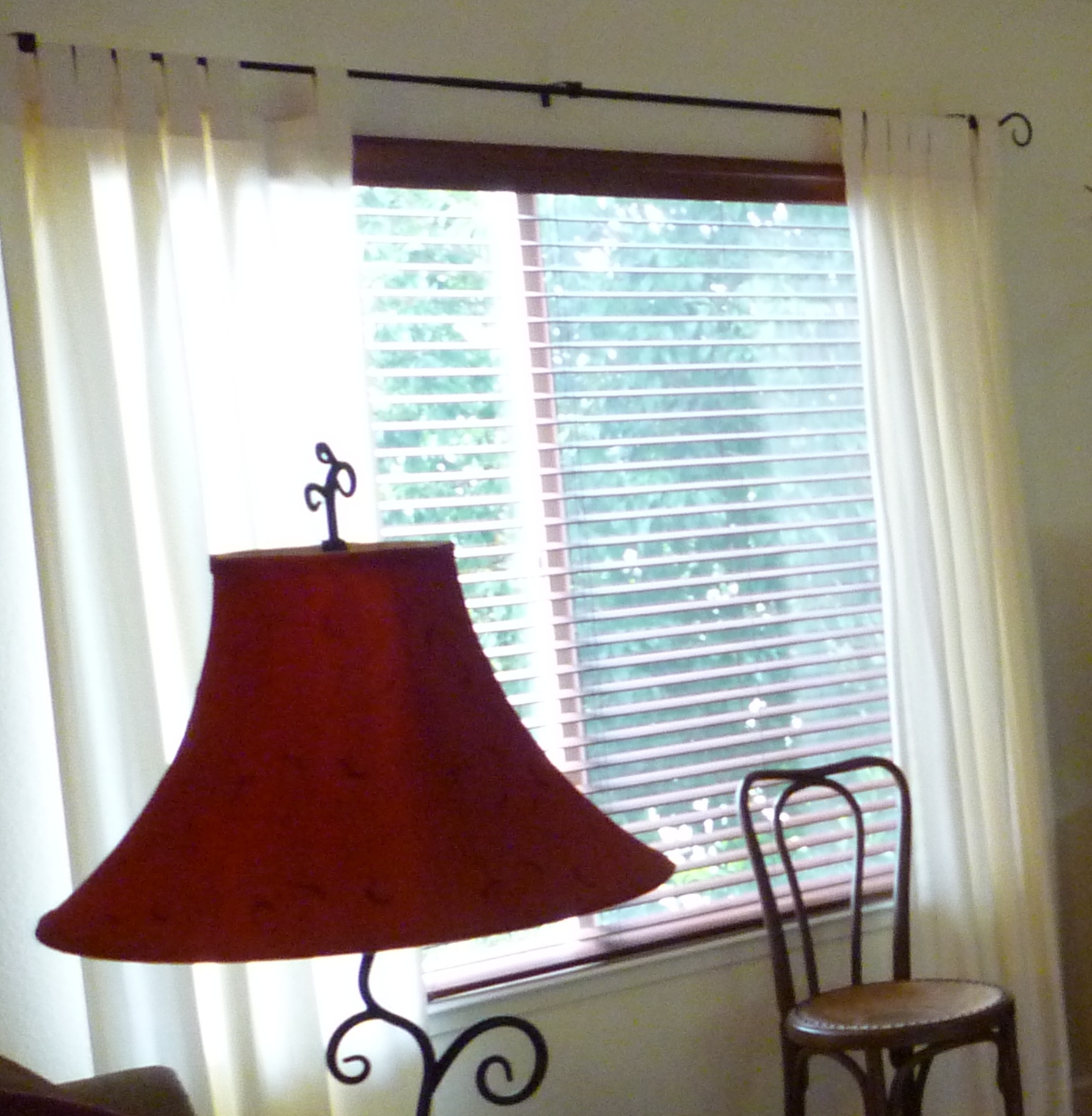
About 30 years ago we owned a modular house whose many large windows were covered by the original fancy draperies, so that when the curtains were closed they covered most of the expanse of three walls with nubby gold curves. The walls were thin particle board painted to look like wood, as you can see in the photo – but I didn’t mind those as much as the drapes. I would have preferred something more rustic and casual and of another color to go with the country setting, but even if we’d had the money we couldn’t have justified spending it to replace Perfectly Good high-quality drapes.

It was a recurring temptation to me, though, to stew over how ugly and Not Me they were. This was tiresome, and eventually my better self convinced my offended self to stop, using this argument:

What is your purpose in life? To love God and be useful to Him.

What is the most important way for you to do that? To love people.

Do you need pretty and tasteful drapes in order to love people? No, I answered. If someone who comes to my house sees my drapes and not me, I can’t help that. If they need my hospitality and friendship they need it from me personally, and God will just have to use me in spite of this ugliness in the room. (Which of course was not a universally recognized ugliness anyway.)

Those of us who have read any of Edith Schaeffer’s other books know that she by her life and words demonstrated the importance of love and hospitality. Her book The Hidden Art of Homemaking, which is the subject of a book club hosted at Ordo Amoris, I do not take as contrary to the rest of her life and work, but complementary to it. Some of you may not have read the other books like What is a Family? Partly from reading it I am pretty sure that if she had to choose, she would herself rather have been a resident or guest in a plain and even ugly house run by a warmhearted woman than in an artistically decorated dwelling with an unkind or angry soul. We’ve all heard of and perhaps had the experience of going into a house where the decor was shabby or messy but you wanted to be there because it felt like home — welcoming and nurturing. Mother Teresa’s saying fits here: “Love begins at home, and it is not how much we do… but how much love we put in that action.”

I think Edith’s own houses were like this, because she was that kind of woman, and likely much more than I myself am. But I have it as a vision to be like that, and am inspired by quotes that speak of a woman being able to make a home wherever she finds herself, of a woman herself being the heart of her home….but I can’t find any of those at the moment. The line that has intrigued me for years now is from the Santana song “You’ve Got to Change Your Evil Ways,” from the perspective of a man who is dismayed by his woman who’s gadding about all the time:

When I come home, Baby,
My house is dark and my pots are cold.

These are just signs to the poet that there is no woman at home to welcome him.  The verse reminds me of advice I read to housewives who haven’t figured out what to make for dinner, but who want to do something to give their husbands a good feeling when they come in the door after work: While you are getting your act together put an onion in the oven to bake so that he will get a hopeful olfactory signal.

A message I get here: A woman conveys her love and hospitality by these simple modifications to the environment: opening the drapes or turning on the lights, cooking something in the kitchen, and in both ways warming up the sensory atmosphere. If she has a kiss and a smile for her family and guests all the better.

The last few years when my husband and I live here alone, I notice that I am the one who thinks about light control. In that photo above you can see all the light that came into the humble house with the gold drapes. It was the best feature of the house, as I was later to discover, when I wanted our new house to have as much light — it was not to be. The photo was likely taken in the winter, when we would open the drapes wide and let in all the warming sun.

In our area we can get along pretty well in summertime without air conditioning, if we manage the windows and window coverings: At night open all the windows to let the cool air in; in the morning close everything up to shut out the sun’s rays, and leave them that way (and the house kind of dark!) until the air inside gets as warm as outdoors — then you may as well get any breeze that might stir, and be ready for the coolness to enter as soon as it arrives.

In Spring or Fall our present house doesn’t get very hot, so in the mornings I like to open the blinds and let the sun in as soon as I come downstairs — but my man never thinks of doing this. For my mind, sunlight is the very loveliest decoration. And at night, I like to close the curtains or blinds so as to feel sheltered against the world. This also seems to be, in my experience, a homemaker’s impulse.

I have learned to do many artful things in my houses over the decades; I have arranged and painted furniture, swept the floor, bought bedspreads and embroidered Bible verses to hang on walls that I painted, but those things aren’t more important than the light-monitoring I do. I also tend the fire in the stove, and light candles, and keep the pots warm.

While you’re working on the outward appearance of your home, attend also to your heart and keep it warm with prayer. If the family members are getting snappy or sulky, take a prayer break together and ask God’s help – then sing something to warm up the atmosphere. I like this quote that Debbie posted, by Laura Ingalls Wilder:

Let’s be cheerful! We have no more right to steal the brightness out of the day for our own family than we have to steal the purse of a stranger. Let us be as careful that our homes are furnished with pleasant & happy thoughts as we are that the rugs are the right color and texture and the furniture comfortable and beautiful.

Thank God for making Edith Schaeffer the kind of woman who could pass on to us a bright homemaking heritage.