How to stencil a wood floor?

What it looks like just before you trip

Since we replaced our vinyl floor with wood last year, we’ve become afraid that one of our guests is going to break an ankle, or worse.

The entry area is raised 6 inches above the rooms on either side, but formerly a metal strip provided a visual cue for most people. Now even friends who have been in our house many times before have missed the step and abruptly stumbled off.

View from the down side

We have wondered why our flooring man didn’t anticipate this problem and use a darker wood for the edge of the entry. Oh, well, he didn’t. And vaguely Mr. Glad and I have said many times, as when a friend actually fell all the way down, “We should paint that edge with a stencil.”
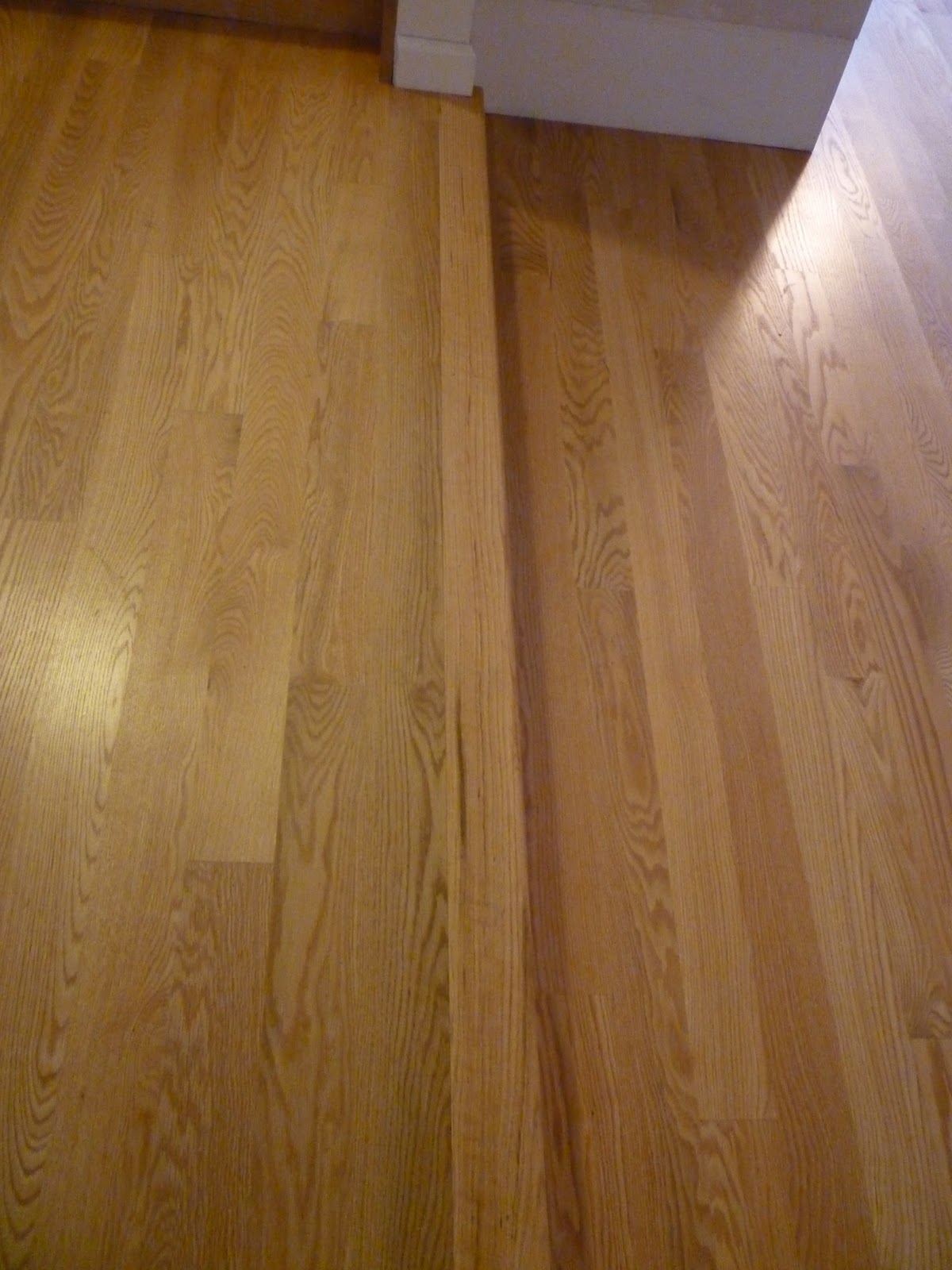
In center: edge that wants marker

But we are not decorators, and have no idea where to start. Wouldn’t stenciling a wood floor require some different techniques or materials than the more typical wall stencils? Not that we know anything about that job or have ever had an iota of interest in it, either! This oak floor has two one coat of oil-based sealer and two coats of water-based sealer on it, if that makes a difference.

I know that most women, and many men, have way more experience than I do with decorating, so here I am blegging for any tips and knowledge that any generous soul would like to send my way. It would be nice to get some kind of “safety strip” on there before our houseful of Christmas guests arrives.

[Update: I never painted anything, but I bought a narrow rug to put on the lower level, and wrote about it: Beauty and Function – Rugs]

Can’t say anything good enough.

Actually it seems to me that one can hardly say anything
either bad enough or good enough about life. 
–C.S. Lewis

The Christian life includes both joy and sorrow, and it seems that the intense experience of either aspect can’t adequately be described. Each of us has our own unique pain or bliss.

What comes to us on the journey is meant to be shared with and offered to our God; He’s the only one who knows our heart, without us saying a word. Christ endured shame, abuse, the Cross, and hell, for the joy that was set before Him. He does know what we are going through, and He went through worse, and the Love in the Holy Trinity is the Sun of which our happiness is only a ray.

Right now I’m walking on the sunny side of life, and I’m glad to say so here, but I won’t try to describe my giddiness. I can’t say anything good enough about Life. He is the Source, He is the Life, I know that, and I am finding His goodness and kindness in so many things: my husband’s love, the warmth of my home, the fatigue from housecleaning, the hope of the tulips I planted blooming in the Spring, the rest at night.

The photo is of a vase that was my grandmother’s, with some snippets from my garden. A bit of this and that, a unique medley that reminds me of my blessed life.

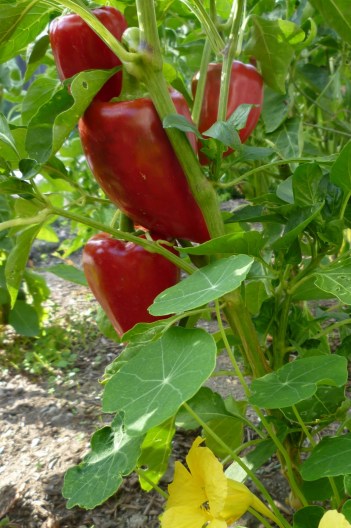
Pimientos from the October garden.

Have you ever seen a fresh pimiento pepper for sale in the grocery store? No? That’s why, if you have a garden, you should consider growing them yourself. The little jars of diced pimientos that are the only experience most people have of them — sorry, but they are not to be compared to the fruits you can expect to harvest from your back yard.


I went around the garden this afternoon snapping pictures of the prettiest things, including the peppers.

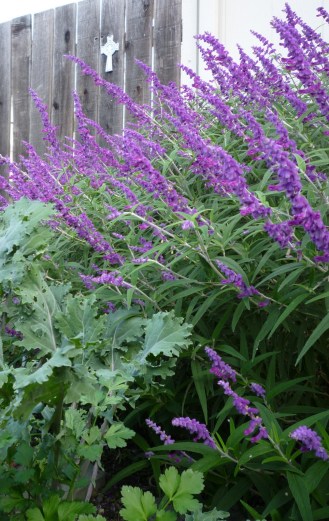
What first caught my eye was the way the color of the Mexican Sage coordinated so nicely with the Red Russian Kale. Some parsley is peeking up at the bottom.

Arugula (with the white flower) is a real self-starter and has come back up through the basil, and the nasturtiums are still going strong.

But about those pimientos: It was about 30 years ago I encountered a fellow gardener’s planting of them, on a sunny hillside growing alongside beans and tomatoes and other more common things. Ellie said, “Pimientos are marvelous; they are good with everything. We just love them!” It was at a time in my life when I was very suggestible regarding any homemaking idea, and the garden was a big part of my homemaking.

Since then, I don’t think a year has gone by that we didn’t grown some pimientos, though one time we ended up with plants that had an odd shape and slightly different flavor. That’s when we learned that there are different varieties called pimiento. But the shape of the fruits in my photos here is what we think of as standard.

Pimientos have a richer taste than the standard sweet red bell pepper that the supermarkets carry, and the wall of the fruit is probably twice as thick. For 20+ years I would mostly serve them sautéed with mushrooms and/or onions and garlic as a vegetable dish. The skins would often slide off before I got the skillet to the table, in which case sometimes I’d sometimes manage to remove some of them. Mostly the skins got eaten.


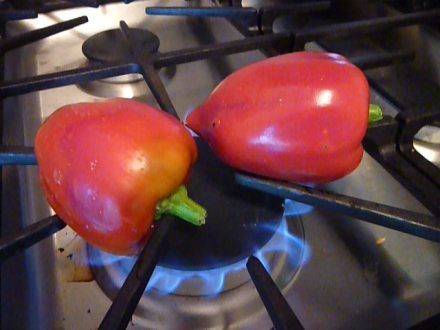
But now that I have a gas range I can easily turn them around on the stove with tongs while they hiss and sputter, and have fire-roasted peppers. (I also did this with poblano peppers this summer.) After they are blackened all over, you stick them in a bowl or something with a lid — I tried a plastic bag but the peppers were so hot they melted holes in the bag — and let them sweat a few minutes until the skins rub off easily under water.

Meanwhile, the house starts to smell like a Mexican restaurant!

Once they are bare and thick slabs of sweet flesh, it is so easy to chop some up into soups or stews or salads. Lay a pepper on top of bread and cheese, or just bread…or feel really indulgent eating one all by itself. I freeze some flattened between waxed paper to use all year long.

Apples I Have Known – in a book

Janet blogged recently about an apple-picking expedition, with photos that reminded me of excursions to the apple orchard that has been our family’s favorite vender for decades. We didn’t make it out there this year — yet.

The number of munching, saucing and pie-baking kids and grandkids that we had around here at times could consume quite a few bags and boxes of fruit during apple season, and our grower friend featured almost 30 varieties of apples, which kept his barn open to customers for a deliciously long time.

My daughter whom I call by the name of a favorite apple gave me a small book that is fun to peruse when the apple farm closes, or when there isn’t enough demand for fresh fruit in the house. It is all about various kinds of apples, with bright watercolors of those featured. Some old varieties, some newer.

Above is the Cortland that Janet is enjoying. If you want to read the text in any photo just click on the picture to enlarge it.

The Arkansas Black is one of that large selection on the local apple farm, and I have cooked with it many times.

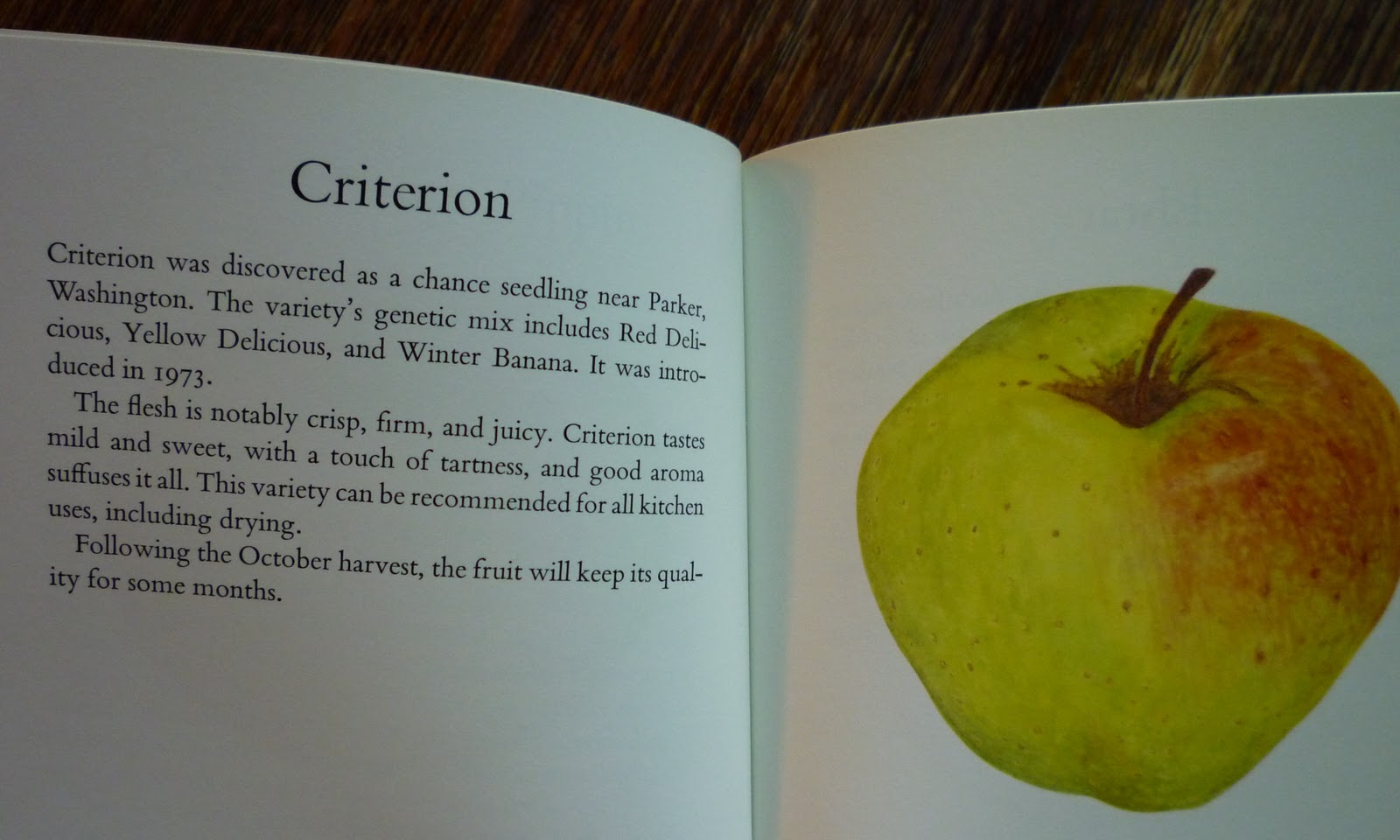
Another friend and neighbor grew an orchard full of Criterions and sold gallons of the fresh juice out of his barn. Our older kids helped on the ranch, thinning the crop and such like, and no doubt these extra sweet and crisp fruits contributed to their good health.

Jonathans were a favorite of my father, as I discovered late in his life when I was given a boxful of runts. Late in the mountain season I sat in his cabin cutting up the fruit for applesauce, and he ate a dozen while youthful memories flooded his head.


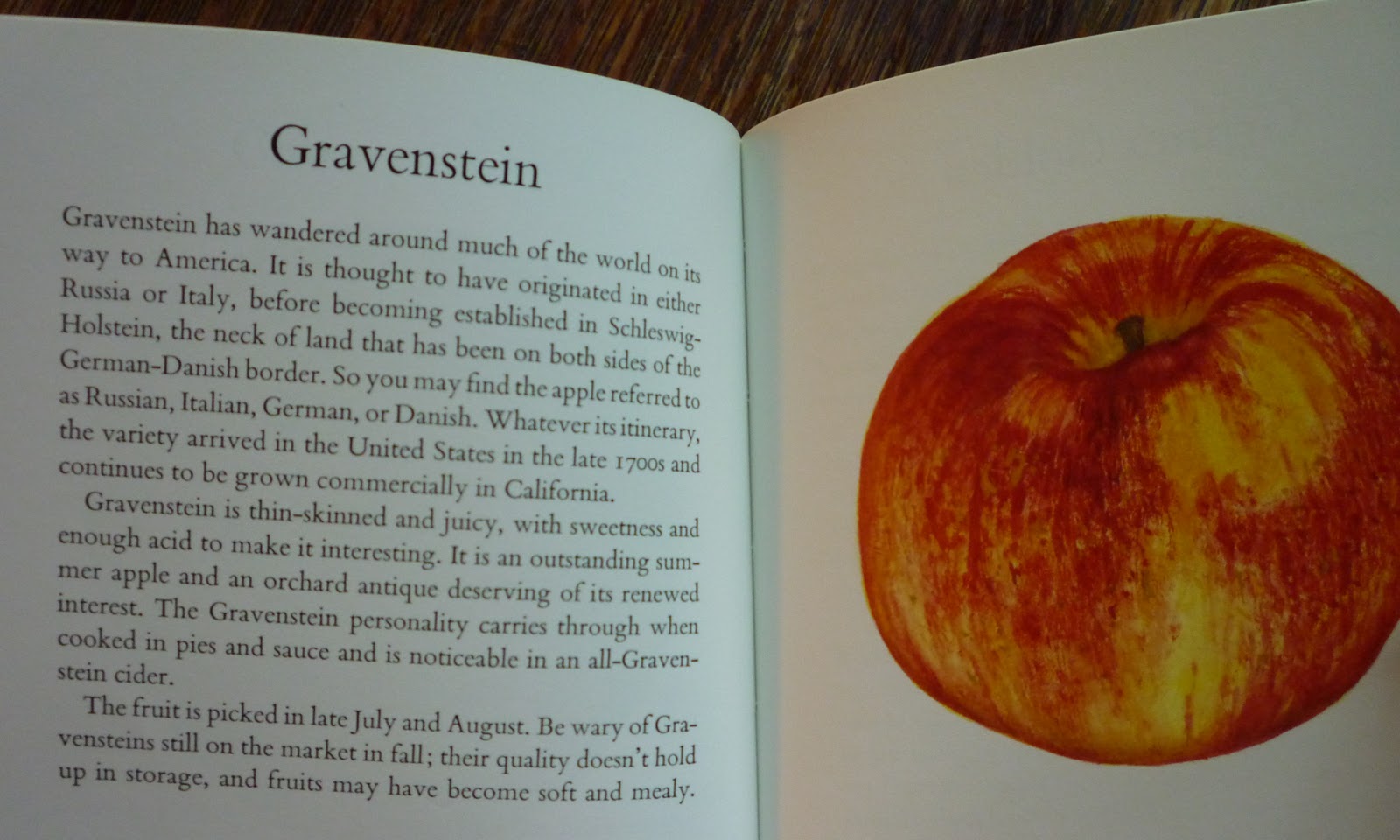
And the Gravenstein — it’s got such a tang that as I write about it I start salivating. Its season is short, but there are plenty of orchards in our part of the country, and it adds the most appley flavor to whatever you cook with it. I have made many a curried apple turkey loaf with Gravenstein sauce.

I like the pictures of all the odd apples that I’ve never encountered, especially the sort of ugly knobby ones, or those with russeting or bumps, or elliptical shapes.

But my favorite apple of all, and naturally the best-for-me entry in this book, is one that was more available in stores when I first learned to bake pies. After using the same apples for many years, I have to admit that only Pippins make a pie that with my whole being I can rejoice in as Apple Pie. To prove my love, I am feeling a need to make a trip to Our Orchard this week and get a boxful.