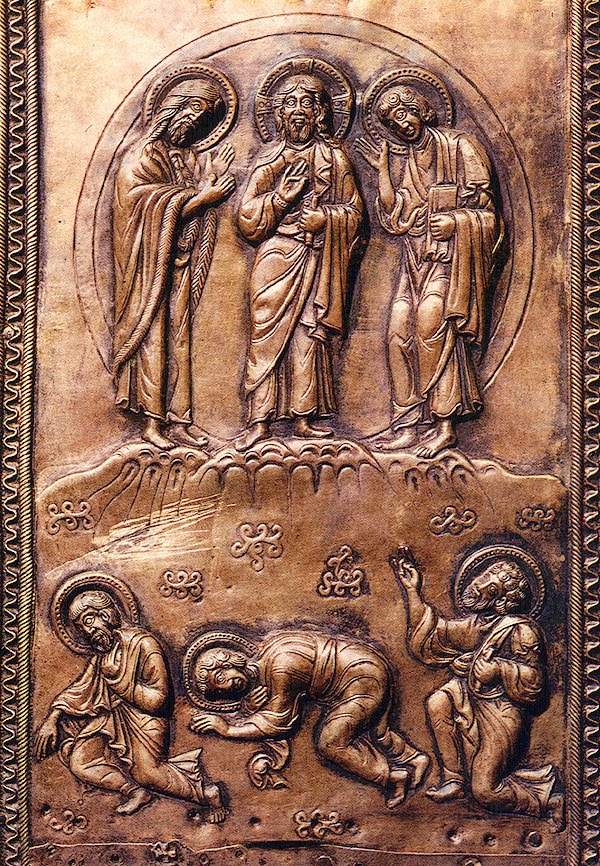
Transfiguration

You were transfigured on the mountain, 
O Christ God,
revealing Your glory to Your disciples 

as far as they could bear it.
Let Your everlasting Light also shine upon us…. 

On this feast day it was good to go back and read my ruminations about Fr Arseny on the date last year. This year, unfortunately, I’m missing the services at church, but I have the troparion (above) playing in my mind.

Also another chorus from long ago, one that I don’t think is popular currently in the Protestant world, that goes like this:

The Lord is my light and my salvation,
Whom then shall I fear? Whom then shall I fear?
The Lord is the strength of my life,
The Lord is the strength of my life.
Of whom then shall I be afraid?

At least, that is how it plays in my memory.

This icon I found on the Orthodox Church in America site, where its source was not given. Does anyone know?


Cherry Tomatoes Then and Now


Today I had a hankering for soup, so it was lucky that I found in the freezer a quart of the Cherry Tomato Soup I concocted last summer, or fall, to be exact. It seemed to want to go with the quart of Ham and Bean Soup that I also found in there, and after that, it was only natural to throw in the leftover green beans that had a smearing of pesto on them. Yum.

Here is what last year’s soup looked like before freezing. When I went back to find the post to link to, I noticed Anita’s tale of how her curried tomato soup happened, and it sounds like something I’d like to try this year, if my eight plants produce. But–I’m afraid they might have blight!

Here’s the biggest picking of tomatoes I’ve made so far. The green one is a Green Grape. It looks more like the Green Cherry I had last year, compared with the red one there, a plain Grape. The dark ones are Black Cherry, and the yellow are Yellow Cherry.

Thank God for cherry tomatoes, which ripen fairly quickly. Even they are three weeks late, and we are still waiting on the big tomatoes.

Bread with Sorghum

I made some more bread this week. The bread pans and dough hook were still in hiding, but I enjoyed the kneading, and the free-form loaves do look more rustic, even if they are a bit problematic for B. when making his lunch in the mornings.

This time I used a lot less oil and sugar, and for flour I added some oat and sorghum to the mix. Sorghum? I picked up a small bag of the stuff somewhere, sometime, toward the goal of always-increasing variety in the diet. I didn’t really know where sorghum comes from, but while the dough was rising I read on the bag that it is a grain. This morning I read more about it online and find that it has been used for a long time by humans, more in other parts of the world than here in the U.S., but is gaining popularity here, too.

When it was time to put the loaves into the oven I quickly tried to think of what styles of decorative cuttings I’d seen on commercial artisan breads, but it was too late to do a good job of being creative in that department. So far, my experiment shows that the simple and traditional architecture is nicer.

I have a dear friend N. who is about my age. Neither of us gets to make bread the way we used to 20 or 30 years ago, when The Tassajara Bread Book was one of our bread bibles. Tonight I talked with her on the phone and told her about making bread twice in one week. She was surprised, and said, “You must be avoiding something you should be doing instead.”

That’s one way of seeing it, and how wonderful to have a friend who understands me! Another aspect of the phenomenon is that breadmaking is a relatively small and particular task that I know how to do. None of the little decisions about how closely to follow the recipe comes with very many options, and if the whole batch is ruined for some reason it wouldn’t have much consequence. Baking a loaf or two of bread takes only a few hours, and makes me feel homey, useful, and accomplished.

The tasks I am “avoiding,” on the other hand, consist of three whole rooms, each of which will require at least a day’s worth of work, consisting of one hard decision after another about whether to keep one item or who among my friends, or among thrift shops, might want  another one. If I keep it, how will I store it so I can find it? Etc. Everyone knows how that works.

Now how did I end up talking about sorting junk when I started with homemade bread? The subject is like the clutter itself, creeping in when you are busy doing doing good work. This next week is my chance to tackle one of those rooms, where I hope to lodge a wedding guest if I can clear off the bed. And this afternoon I found both my dough hook and my loaf pans, so it’s even possible I might be inspired to make bread again, too.
Responding to Unpleasantness

Posted on The Morning Offering, this from St. Symeon the New Theologian:

“Faith in Christ is… a good and patient disposition of the soul in enduring all temptations, whether griefs, sorrows or unpleasant happenings, until God’s favour looks down upon us; thus we would imitate David who says: ‘I waited patiently for the Lord; and He inclined to me and heard my cry’ (Ps. 40:1).”

Unpleasant happenings are my excuse for many kinds of sins, from overeating to speaking quickly and unkindly. If I would, at the first notice of unpleasantness, direct my soul to wait on God, wait to speak, wait to eat, etc., I would be enduring temptation. It appears that not all temptations are of the type from which one can flee, or that can be actively resisted. But in any circumstance we can rest in Christ. I don’t write from much experience.

On the other hand, St. Symeon did. He was abbot of a monastery when the monks attacked and nearly killed him. Don’t be confused by his title; his theology was not new, but he was younger than another man with the same name, hence the clarifier.

The Orthodox Church has given only three saints the title of Theologian. I love that the quote above hearkens back to old theology, that of a man whose tradition was of the school My Soul Follows Hard After Thee.