Tag Archives: C.S. Lewis

How to Get Light instead of Fog.

St. Isaac of Syria

Thanks to Christ is in our Midst for this posting appropriate to the beginning of Lent. To me it is a helpful elaboration on C.S. Lewis’s statement that “Virtue — even attempted virtue — brings light; indulgence brings fog.”

…If you cannot be still within your heart, then at least make still your tongue. If you cannot give right ordering to your thoughts, at least give right ordering to your senses. If you cannot be solitary in your mind, at least be solitary in body. If you cannot labor with your body, at least be afflicted in mind. If you cannot keep your vigil standing, keep vigil sitting on your pallet, or lying down. If you cannot fast for two days at a time, at least fast till evening. And if you cannot fast until evening, then at least keep yourself from satiety.

If you are not holy in your heart, at least be holy in body. If you do not mourn in your heart, at least cover your face with mourning. If you cannot be merciful, at least speak as though you are a sinner. If you are not a peacemaker, at least do not be a troublemaker. If you cannot be assiduous, at least consider yourself lazy. If you are not victorious, do not exalt yourself over the vanquished. If you cannot close the mouth of a man who disparages his companion, at least refrain from joining him in this.

Know that if fire goes forth from you and consumes other men, God will demand from your hands the souls which your fire has burned. And if you yourself do not put forth the fire, but are in agreement with him who does, and are pleased by it, in the judgment you will be reckoned as his accomplice. If you love gentleness, be peaceful, if you are deemed worthy of peace, you will rejoice at all time. Seek understanding, not gold. Clothe yourself with humility, not fine linen. Gain peace, not a kingdom.

~St. Isaac of Syria

Quote of the Week – may be only fidgets


I haven’t kept up with my plan for a weekly quote, but it’s a practice worth reviving, especially for those ever-more-frequent periods when I have nothing to say. Today, from C.S. Lewis:

“Don’t be too easily convinced that God really wants you to do all sorts of work you needn’t do. Each must do his duty ‘in that state of life to which God has called him.’ Remember that a belief in the virtues of doing for doing’s sake is characteristically feminine, characteristically American, and characteristically modern: so that three veils may divide you from the correct view! There can be intemperance in work just as in drink. What feels like zeal may be only fidgets or even the flattering of one’s self-importance. As MacDonald says, ‘In holy things may be unholy greed!’ And by doing what ‘one’s station and its duties’ does not demand, one can make oneself less fit for the duties it does demand and so commit some injustice. Just you give Mary a chance as well as Martha!”

C.S. Lewis, Letters to An American Lady

Essential Aromas


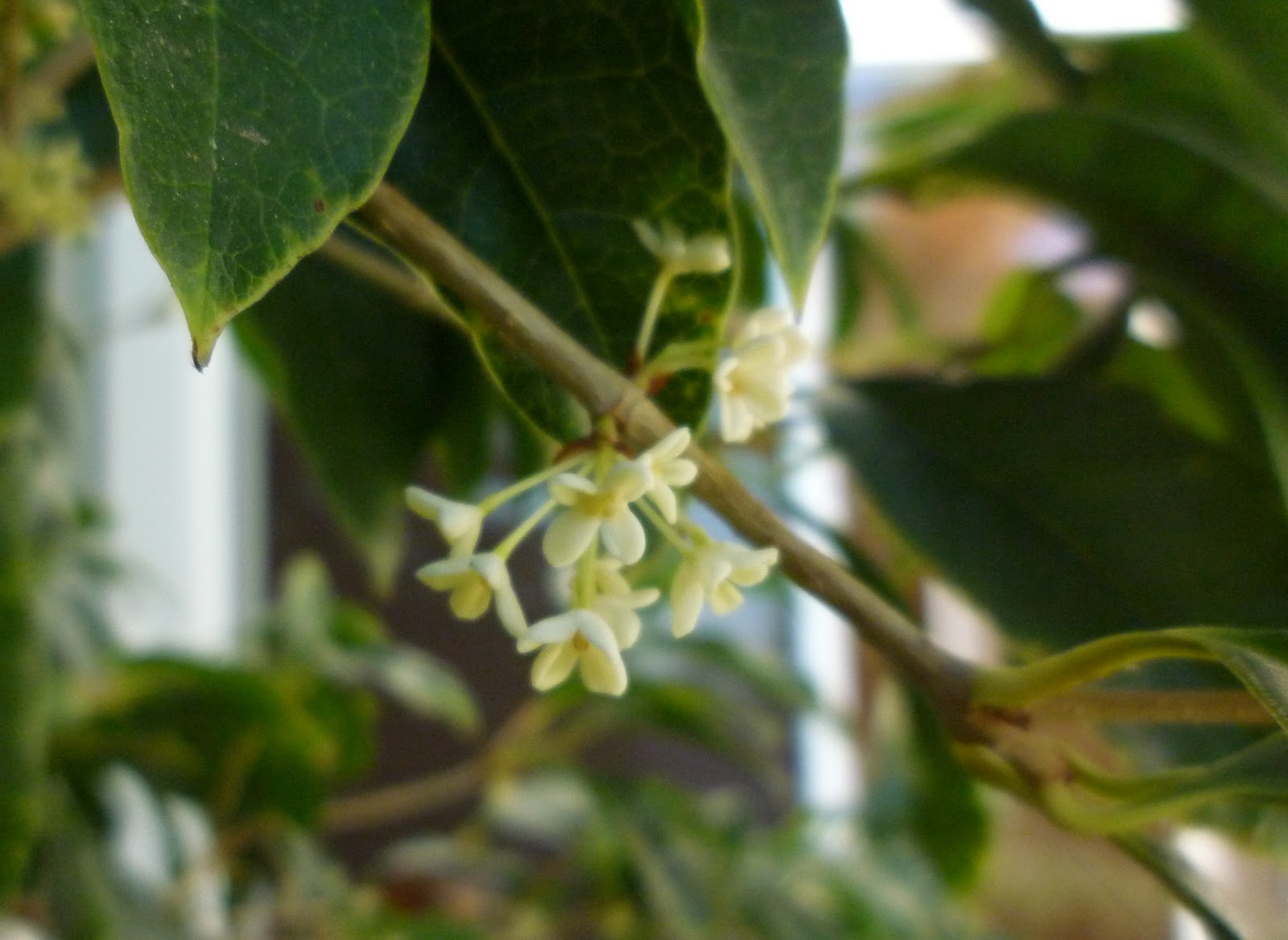
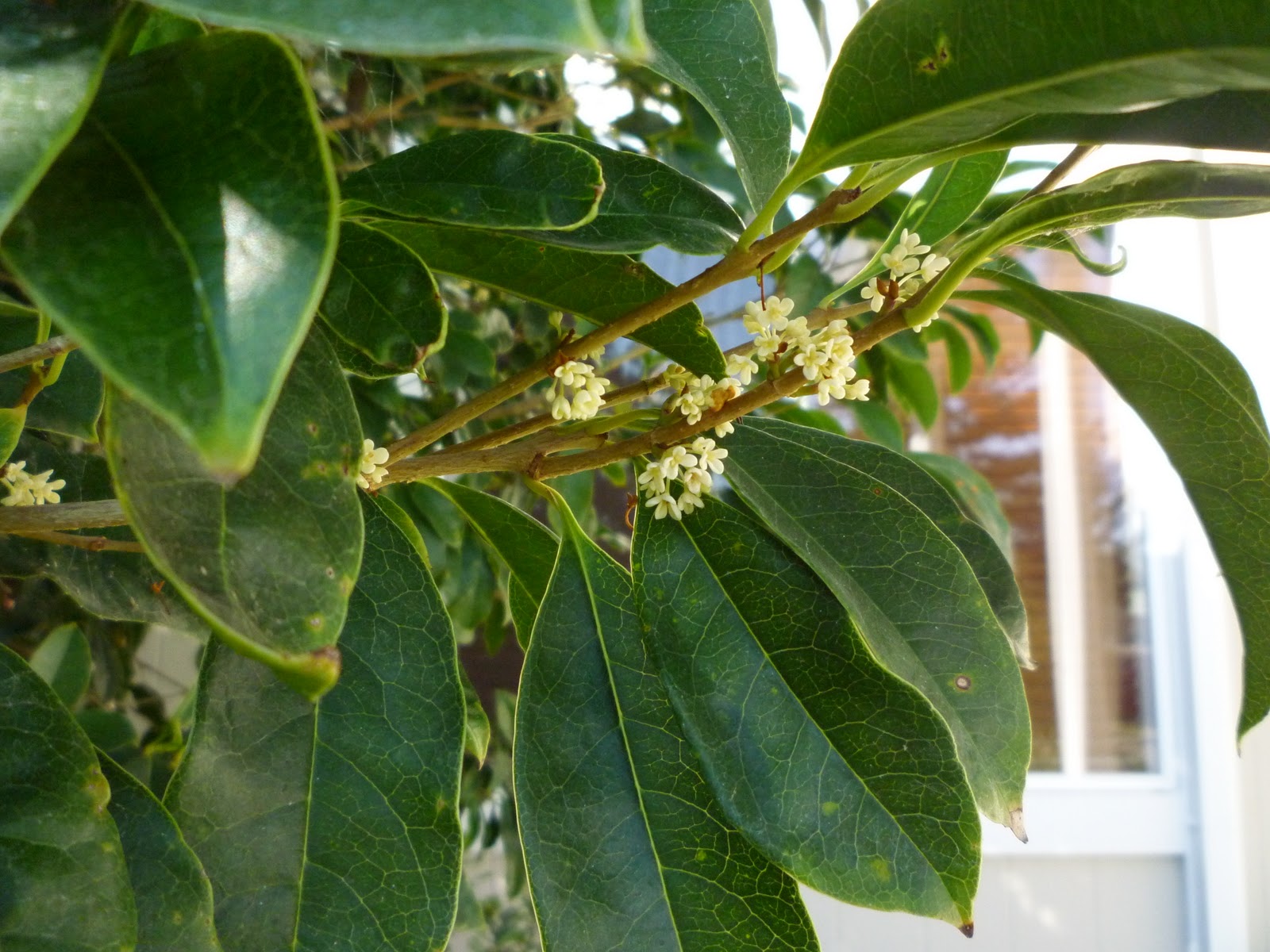
When Debbie at Artful Aspirations posted about her sweet-smelling bush, I suspected a near relation, perhaps even a twin, to my Osmanthus fragrans. She said she bought her plant because of its common name Tea Olive; I had only known mine as Sweet Olive.

Not many days later M.K. at Through a Glass, Darkly, who was not a follower of Debbie’s blog, posted photos of her “holly bush,” with descriptions of its “heady and rich” scent reminiscent of gardenia.

The challenge of describing various scents is always of interest to me. I wonder if an individual flower is easier to pin down than a whole rain forest. We usually have to say that any given smell is something like another. Having grown up in an orange grove, I didn’t confuse osmanthus with orange blossoms, but upon my first encounter I did envision some woman along the route of our neighborhood stroll setting an apricot pie to cool by the window.

Surely osmanthus is its own heady aroma that nothing else is quite like. Last year, at the end of a post about how various other scents link to my grandmother, I tried to describe its effect on me.

One website that sells many essential oils for their aromatherapy benefits describes Osmanthus fragrans as “Friendly, lively, intriguing, what’s new, what’s next, early morning excitement, setting out on a whole new journey.”

Peet’s has blended a black tea with osmanthus blossoms, which might add some extra excitement to those mornings when I choose it over plain black or green.They say “its pleasant aroma could be described as a combination of apricot, chamomile, and orange flower.” They don’t make it all year long; stocking up would be necessary if you want to be assured of having it when you want.

After she heard about osmanthus, M.K. began to wonder if her hollies might actually be Tea Olives. In the meantime I had been reading about fragrant holly bushes and found that there are hundreds of types of holly, and some of them do look a bit like osmanthus. One osmanthus looks so much like holly that its common name is False Holly. Wikipedia mentions that osmanthus flowers can be various colors, even dark orange, and that in China it is traditional to mix some osmanthus jam into millet gruel.

You can see on that page a photo of an orange-flowered osmanthus taken in Japan. All of the photos here on my blog were taken just this week in my yard.  B. and I planted the bush about 20 years ago on the advice of  horticulturist friend. If we had known how big they get, we’d have started it out farther from the house.

Wikimedia also has this whole page of related photos.

Some of my other favorite botanical scents are lemongrass and rose geranium. I have a big bush of the geranium in a pot on the patio, and in my cupboard some essential oil of lemongrass to add by drops to hand soap. So far I’ve only enjoyed my osmanthus when it happens to fill the air with its essence, and that occasion always takes me by surprise and humbles me by the extravagant gift. “The osmanthus is blooming!”  I will announce, if someone is around. This happens at least twice a year; do I really need the oil extraction at other times?

The people on the planet of Perelandra in C.S. Lewis’s novel by that name had an admirable way of making the most of every experience. They considered an actual event in time to be only the smallest part of anything that they did or that happened to them. The anticipation was also to be enjoyed for all it was worth, and the memory of the incident or act would be savored into the future. In this way even the most lovely and desirable events were completely satisfying whether or not they took place more than once in a lifetime.

When one comes upon a strong aroma, say, walking into a house where bread is baking, or walking out one’s front door to the scent of osmanthus, if the stimulus continues for a time the olfactory receptors get desensitized or something; in any case, you stop noticing, until you go out and come back again. So I don’t know, if I had only smelled osmanthus once, if I could have made much of the experience. I’m not too good at paying attention, if that’s what’s necessary.

But I’ve had decades of being enveloped by the sweetness and the love that the Sweet Olive aroma signifies to me. I think I’ll just try to bask in it for a few seconds longer next time I pass by, or sit on the step and drink it in as long as my nose will keep sending the message to my brain. And if we move to a colder climate I’m sure I’ll be busy enough sniffing the air in that place without trying to import gifts that belong to the memorable past.

Silence and Music

My last post remembering Saint Herman prompted Pom Pom to ask me if I had read The Music of Silence, book she had just received in the mail. I haven’t read such a book, so I googled it and immediately have several tangents to run along now. I don’t know if she meant this memoir of Andrea Bocelli, or this one about singing the Hours or services of the church through the day in Gregorian Chant.

One reviewer wrote of the latter book:

“Nothing is as ordinary, or as sacred, as time. Far from being an infinitesimally small unit of measurement or a means of separating one event from another, time provides the means by which the still, small, silent voice of God may be heard.”

Silence….hmmm….I know so little of it.

When I read about music, silence, solitude, it can be an inspiration and a reminder, but my readings and thinkings are typically like so many rabbit trails, to use a term that hints at the fun of scurrying from one author or thought to another. A rabbit is doing what he was made to do, and glorifies God by it. I was made to live by the Holy Spirit in communion with my Creator.

So I need to STOP on the trail and pray–and maybe even get off the trail sometimes! It wasn’t books and ideas that made it possible for Father Herman to sing with the angels. It was prayer. The kind of prayer St Isaac of Syria is talking about when he says:

“The wisdom of the Holy Spirit is much greater than the wisdom of the entire world. Within the wisdom of the Holy Spirit, silence prevails; the wisdom of the world, however, goes astray into idle talk.”

My mind is given to talking idly with itself. So much of my remembering of my Savior is like the awareness I might have of an earthly friend when she is in the room with me, but I am not paying close attention. I might hear her talking without really listening, I might even speak with her–but not make eye contact.

Don’t we all have this weakness in our human condition, worsened by modern life, that we can’t settle our minds down firmly even when in prayer? Abba Dorotheus of Gaza says:

“Just as it is easier to sin in thought than in deed, correspondingly, it is more difficult to struggle with thoughts than with deeds.”

But C.S. Lewis encourages us:

“Virtue–even attempted virtue [I hope this includes attempted prayer]–brings light; indulgence brings fog.”

So I will keep struggling in prayer, to push past the distractions, to listen for the Silence that is God’s music.

It’s not the wonderful blog posts and the writers of them that are my problem. Nor my own writing, because just the discipline of organizing the chaos at least gets me on the road to taking every thought captive to Christ, though my readers might legitimately question how often I get to my destination. With God’s help, I know His presence and see His working in the world by the goings-on of the blogosphere and the piles of books throughout my house. Glory to God for all things! Lord, have mercy!

One more rabbit trail, leading quickly to the spot where all those paths ought eventually to end up, was brought to my attention this month, a poem by George Herbert:

Christmas

The shepherds sing;
and shall I silent be?
My God, no hymn for Thee?
My soul’s a shepherd too;
a flock it feeds
Of thoughts, and words, and deeds.
The pasture is Thy word:
the streams, Thy grace,
Enriching all the place.
Shepherd and flock shall sing,
and all my powers
Outsing the daylight hours.
Then will we chide the sun for letting night
Take up his place and right:
We sing one common Lord;
wherefore he should
Himself the candle hold.

I will go searching, till I find a sun
Shall stay, till we have done;
A willing shiner, that shall shine as gladly,
As frost-nipped suns look sadly.
Then will we sing, and shine all our own day,
And one another pay:
His beams shall cheer my breast, and both so twine,
Till ev’n His beams sing, and my music shine.

-George Herbert