Tag Archives: California

Pacific in Pacific Grove

Seaside paintbrush

Counting my dear sons’ wives, which I very thankfully do, I now have five daughters. It’s sad to think how I spent several years complaining that I didn’t birth more children; during that time I never anticipated the familial wealth that in-laws can bring.

Point Lobos

In an effort to enjoy our family friendships we women spent a few months planning our first mother-daughter holiday. When continents stretch between, the grandchildren have pressing needs, and the young women pressing schedules, so it’s a tribute to our devotion that we even tried. In the end, only half of us, two daughters and I, were able to get together recently, on California’s Central Coast.

Seaside daisy

Pacific Grove was our home base. Every morning I woke with the feel of long-ago visits to my Aunt Margaret, whom I knew mostly in my teens. She lived in Carmel in a cream-colored house with white carpets, under a sky that was often white with fog or overcast, and the mood was so quiet. The sort of quiet that is filled with the sound of surf and the cry of sea gulls.

Our gathering of last week was a quiet group, too, in spite of our much talking, which I imagine was still on the low end of charts that might be made of all-women excursions, as we often stood in silent wonderment over our surroundings.

In our Keen boots — really, no one one had coordinated our foot attire, contrary to all appearances — we walked a lot, up and down the hills of Pacific Grove and Monterey and Carmel-by-the-Sea. And we looked at flowers and trees and birds and tried to identify them all.

Flower is California hedge nettle
ceanothus in Pacific Grove

On Point Lobos especially the sweet smell of ceanothus blooms was filling the air, along with the buzzing of bees who were crazy over it. We liked the challenge of photographing busy bees. They liked how the pollen was offering itself to them on vast fields of stamens.

Carrying great loads of pollen
Protea behind Cannery Row
Lucky for us that Mrs. Bread showed us a Protea in her garden our first afternoon, so that we could guess their identities when we kept seeing them everywhere from then on. The genus includes a huge variety of forms that are really striking. I came home to find that our bottlebrush tree is not a Protea, however. Proteas seem to have come originally from the southern hemisphere, but they definitely like growing on this patch of the globe.

Behind Cannery Row murals have been painted along the bike path, evoking the culture and history that John Steinbeck depicted in his books. I liked browsing this lane better than the touristy shops which carry, as Joy pointed out, all the same stuff from China that touristy shops all over the nation carry.

Oh, except maybe the otter dolls. I was expending so much mental energy drumming up buyer’s resistance that I didn’t even think about how I could have taken a picture of one. There were three stuffed toy versions of the captivating creatures that we watched lolling and playing in Monterey Bay, and I can’t find one online that is as cute, to post here.

fava plant in bloom
While in Monterey it was quite fun to revisit the Cooper-Molera House so soon after our last visit, but long enough that the plants were further along in spring, as this fava bean plant with its black-and-white blossoms. There were even little bean pods forming lower on the plant.
Another Protea
cistus
Pacific Grove is called Butterfly Town, because of the Monarch butterflies that migrate there every year. I’ve long had a vicarious and romantic attachment to the place thanks to the book by Leo Politi, and now it has become a direct relationship with the same feelings.
Updated adobe cottage in Pacific Grove

The weather we experienced was surprisingly mild in spite of frequent short showers of drizzle or light rain — but I might find it difficult to stay long where the sun doesn’t show itself often enough to keep the spirits up.

Flowers seem to glow more vividly under grey skies, though, and that makes up for the drear a little bit. People paint their houses in cheerful colors. And peace and quiet count for a lot.

The Pacific Ocean is not always peaceful, but it was fairly calm this week. The tsunami from Japan didn’t make a big wave here. You can’t see them, but two otters are playing in this picture. And peace and serenity and love were all playing some quiet music in our hearts.

New Friends on the Way

Heteromeles arbutifolia – toyon

On my way to visit Pippin, The Professor, and Scout last week I stopped to see some of my tree friends. The lovely bay tree was blooming, all tangled up with the madrone, whose berries were almost gone.

toyon with manzanita behind

Also in the jumble was the toyon, with slightly fresher berries. I read in Pippin’s tree book that toyon is the only species in its genus, and it grows only in California and Baja California. Though I’d been introduced to Mr. Toyon many times in the last 40 years, I didn’t seem to pay much attention to him. I think we’ll be friends now. On this occasion I had the time and Google to help me focus and learn more, and I also have a blog where I can find him again if my memory fails.

another view of toyon

I did see quite a few of my most beloved manzanitas as well. Manzanita means “little apple.” The botanical name arctostaphylos means “bear berry,” though of course other animals also feed on these fruits. The common name of some varieties is also bearberry.

Right now the bushes are in bloom (so is the one in my yard); I saw pink- and white-flowered variations. There are about 60 species total, and most of those are native to California, so it’s a hard one to pin down as to which species you are seeing.

manzanita

Many of the trees I saw on this outing are growing on the slopes of that volcanic mountain I told about before, Mt. Saint Helena, in Napa County. On the weekend scores of cars were parked at the trailhead for hikes up to the top. The spot is in Robert Louis Stevenson State Park, so named because the author and his wife honeymooned on this mountain in 1880. He went on to use it as the model for Spyglass Peak in Treasure Island. One New Year’s Day a decade ago our whole family made the trek up and got amazing views.

I left the forest and after driving a while longer I caught a glimpse of something off the highway that made me flip a U across three lanes to go back and take a second look. I was lucky there was a turnout right opposite the meadow where 20 elk were grazing!

Later The Professor told me that he had seen this herd of tule elk many times over the years, in this their winter home; it is the largest migratory elk herd in California. Tule elk are a subspecies of elk only half the size of Roosevelt elk, whose habitat is even more narrow than the toyon: they only live in California. I stumbled through the star thistles and got my socks full of prickles, trying to get as close as possible and watch them for a few minutes before they escaped.

On the way home I looked and looked for the spot where I’d pulled over three days before, but I couldn’t even find the turnout across from the meadow, much less see any animals. If I can get a view of the elk another time or two, I might put them in the category of friends, though they didn’t show any signs of wanting to get to know me. So far I’m content to thank God for this happy meeting.

Journal of October Trip South

As we were getting ready to go on a weekend trip, I was more calm than usual, because we’d only be gone one night, then home again. And it appeared to be the last trip I would make for months to come. The occasion was a gathering with my sisters and brother, in a countryside place spread with orange groves. One brother and sister live within a couple of miles of each other, but with mailing addresses in different towns, and neither of them close to even a village. We drove south, instead of my more frequent northward to Pippin’s, but about the same distance, 5+ hours.

Mr. Glad and I stayed overnight with my brother, who lives in the house my dad built over 50 years ago, where I mostly grew up. This morning I got up early and sat in a big stuffed chair in the living room, tucking my feet under me the way I used to as a girl. The house feels so quietly solid. It’s a wood-frame stucco house on a concrete slab, and you never hear any creaks walking around the ranch-style layout. A big picture window looks out on the foothills that are dotted with oaks, and behind them shady layers of taller and taller mountains forming the Sierra Nevada. Curving grids of trees like dark green pom poms hug the lower slopes nearby. The first time I went home after living in Northern California for a while, I was struck with how short all the orange trees were, not even as tall as nut trees or peach trees, but certainly dwarfed by the Coast Redwoods and other tall trees we have up here where the rainfall is doubled.

The net effect is of a lush but flattish scene, house and orchards keeping close to the earth. The sky is bigger therefore. This October we got quite a bit of rain; all the autumn landscapes were more beautiful having been washed by the rains, making every tree and bush stand out brightly against the background of greening fields. I had my usual thrill of watching the cloud performances all the way down and up the center of the state. We saw black cattle grazing in a pasture, and in the middle of the herd, a white egret standing at attention.

Over a big dinner, we siblings talked about our mountain cabin and how to manage things as the new owners since our father passed it to us just over a year ago. We hadn’t all been together for more than a year, and we aren’t big phone or e-mail users, so we had a good time catching up. We always have to hear as well the news of our mutual old school and neighborhood friends, and the goings-on of the farming community there.

Some citrus crops are being picked already, by crews of Mexican farm workers. And olives are at the peak of harvest in the same general area. Cell phones have created changes in the way the picking crews operate. You might say they have created some degree of anarchy, or at least free-lance options that didn’t exist before. My sister Farmer Woman told us about how some growers were having difficulties getting enough pickers for the oranges, because they could make more money in olive-picking, at least until the frost cuts off that opportunity.

Because of the shortage, a crew was enlisted one day to drive down from the county to the north, in several cars. At least one car-full never arrived, because on the way someone got a call on his cell phone with a tip from a friend, that a different grower was paying $1 more per box, so they detoured that way. This sort of thing happens all the time now.

Dinner was over, and we were sitting lazily around a big table when Farmer Woman’s cell phone rang. The screen said it was her nephew, our Soldier, who was calling. As she talked to him it became apparent that he and Joy were in the area, too, having been to a wedding nearby. Neither of us had told the other that we were making a trip down there this weekend, so it was a pleasant surprise for everyone when they were able to join us for breakfast this morning, and a bigger family get-together than they had hoped for.

After that, they took off northwesterly, and we more to the north, but evidently we both wandered around the next city of over 100,000 population for a while, getting fueled up or something, because when we were leaving town, there we were driving alongside one another. Twenty minutes later, merging on to the interstate, we were right behind them. It was the kind of happenstance that would make a child happy, and it did me, too.

On the way home I read the Forward, the Introduction, and the Preface to a book by Leon Kass that I plan to write about at length later on. It’s philosophy, and as I had nothing much else to do, I could put the book down every few minutes and chew on the ideas. I read it two years ago and might need to read the whole thing again before I’ll be able to know and express why I love it so much.

Then I dozed for a while, and when I woke up my husband was playing parts of his iPod collection. I asked again, for the fortieth time, “Who is singing that song?” It was Police. So I worked on a mnemonic that would make me learn this fact for once and forever. They were singing, “There’s a little black spot on the sun today,” so I imagined that the black spot was a black Police car driving around. I watched them in my mind for a few minutes, and then on the iPod they were singing a different song, “Every little thing she does is magic,” very ardently, so I amplified my image so that the Police car driving over the sun’s surface was full of Policemen who were loudly singing these very words about a magical woman. I can’t lose it now.

Getting closer to home, I was more and more excited about the beauty of the world. Rows of eucalyptus trees form windbreaks here and there, and beneath them the colors of a dahlia farm don’t seem to have faded in the rains.  On the slopes in our county it’s the vineyards that catch your eye, and they are starting to turn gold and orange. Flocks of starlings were swooping like fluttered polka dots. I understand that they are eating insects as they do their dances. That reminded me of my book, which is about eating, nature, our souls, the unity of reality. There is a wholeness to life, because God in His Holy Spirit fills all things.

I guess that’s the reason I’m content to write about our trip without trying to find a theme for it. The entire weekend seems of a piece, a large piece of joy.

Oregon – Part 2

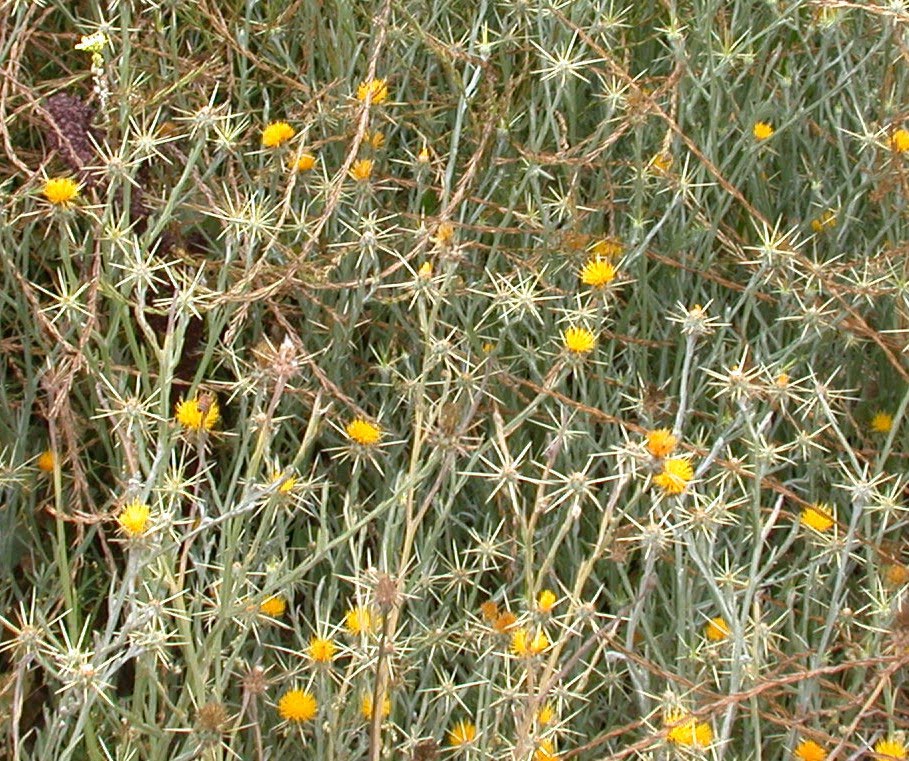
yellow star thistle

Summer isn’t glorious the way spring was, along the track we take driving north. On our way to Oregon the only flower I saw on the first leg of the journey was yellow star thistle, the most unfriendly plant, growing where I’d stopped to take pictures of lupines on my last two journeys. Oh, and buckeye, which I also don’t like. The hills are dry now, and “golden,” or just plain brown.

One plain and pale slope I glanced at reminded me of a drawing I had made in fourth grade, of a dalmatian dog standing in the foreground, with the familiar California foothills baking under blue skies behind him, and no trees to be seen. It got me thinking for quite a while, about how the hills I see more nowadays are peppered with oak trees, and therefore hadn’t connected to that odd crayon drawing that was tacked on a wall somewhere long enough to imprint into my brain.

It was a great relief to get out of those foothills and into the valley where green things are loving the sun and heat as long as they get some of that precious California water to their roots: broad fields of tomatoes, sunflowers and safflowers in long rows, and the plantings of onions still with their flowers waving in the breeze. My heart swells seeing all the lush produce, comforted by the land producing so much food.

And oh! we saw in one huge field an amazing kind of machine, that will save the backs and knees of many a farm laborer. Unfortunately we passed by too quickly to get a good look at it, but it consisted of a couple of tractors, one on each end, slowly pulling a sort of rack, on which several men lay face down, with their hands in the dirt and moving quickly. We think they were setting out small plants.

Oleanders are another kind of flower I enjoyed on the way up Highway 5. When I was a child living in the arid Central Valley, oleanders were pretty boring, but as I don’t see them every day anymore I really appreciate them. There must be many thousands planted along the highways, and they are a delight in all their many reds and pinks and white, looking cheery and hearty in spite of 100° weather.

It was 108°, actually, as we went through the town of Redding, before climbing to slightly higher altitudes. I was grateful for the air conditioning, and thought back to my childhood when we had only a swamp cooler in one corner of the ranch-style house, with the girls’ bedroom at the other corner. When coming indoors after exposure to the wilting termperatures we children liked to wet our faces and stand right in front of it, never understanding why our parents thought this was a bad idea. I first appreciated my grandma’s humor when she wrote me once that she was about to “melt into a puddle of fat” because it was so hot in usually-temperate Berkeley, and when I feel limp in the summer I always smile over this image and her spirit.

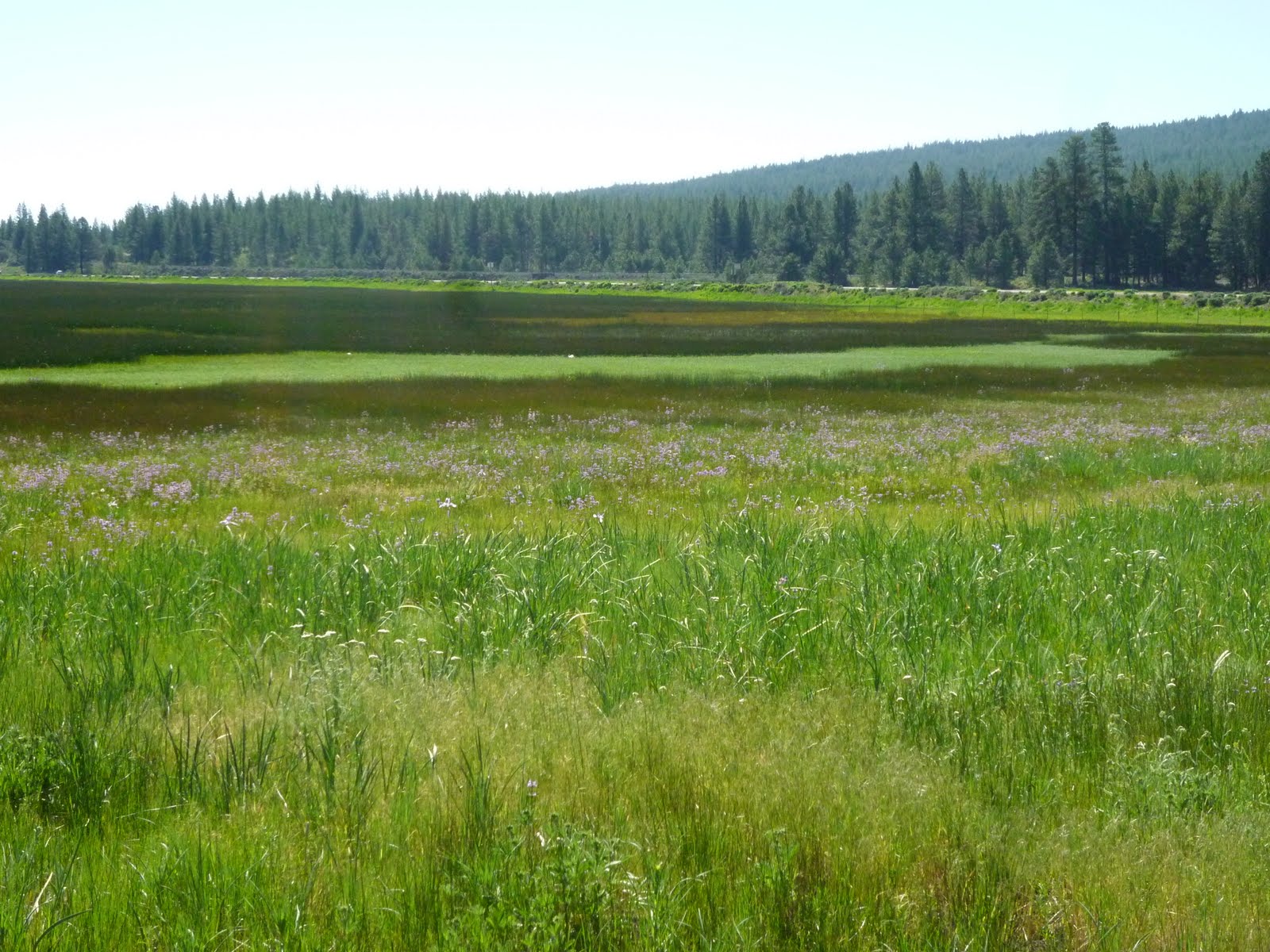
We stopped at Pippin’s house for a night on our way, where the temperature was 20 degrees cooler. The next morning, before crossing the state line, we stopped by Grass Lake, a lush and green place where a hundred gulls were congregating and making a ruckus. In this northeast corner of California you often find landscapes like this with layers of color and texture created from sagebrush, conifers, and wetlands. It all makes an ever-changing feast for the eyes. But in less than an hour we will be in Oregon–finally! More on that soon.