This week the discussion of Hidden Art of Homemaking is on chapter 9 – Writing Prose and Poetry. I haven’t kept up with the conversation at Ordo Amoris for a week or more, and for this chapter I’m just re-posting this from August 2009. Don’t be misled by the now-obsolete references to postage rates!
Old-Fashioned Correspondence
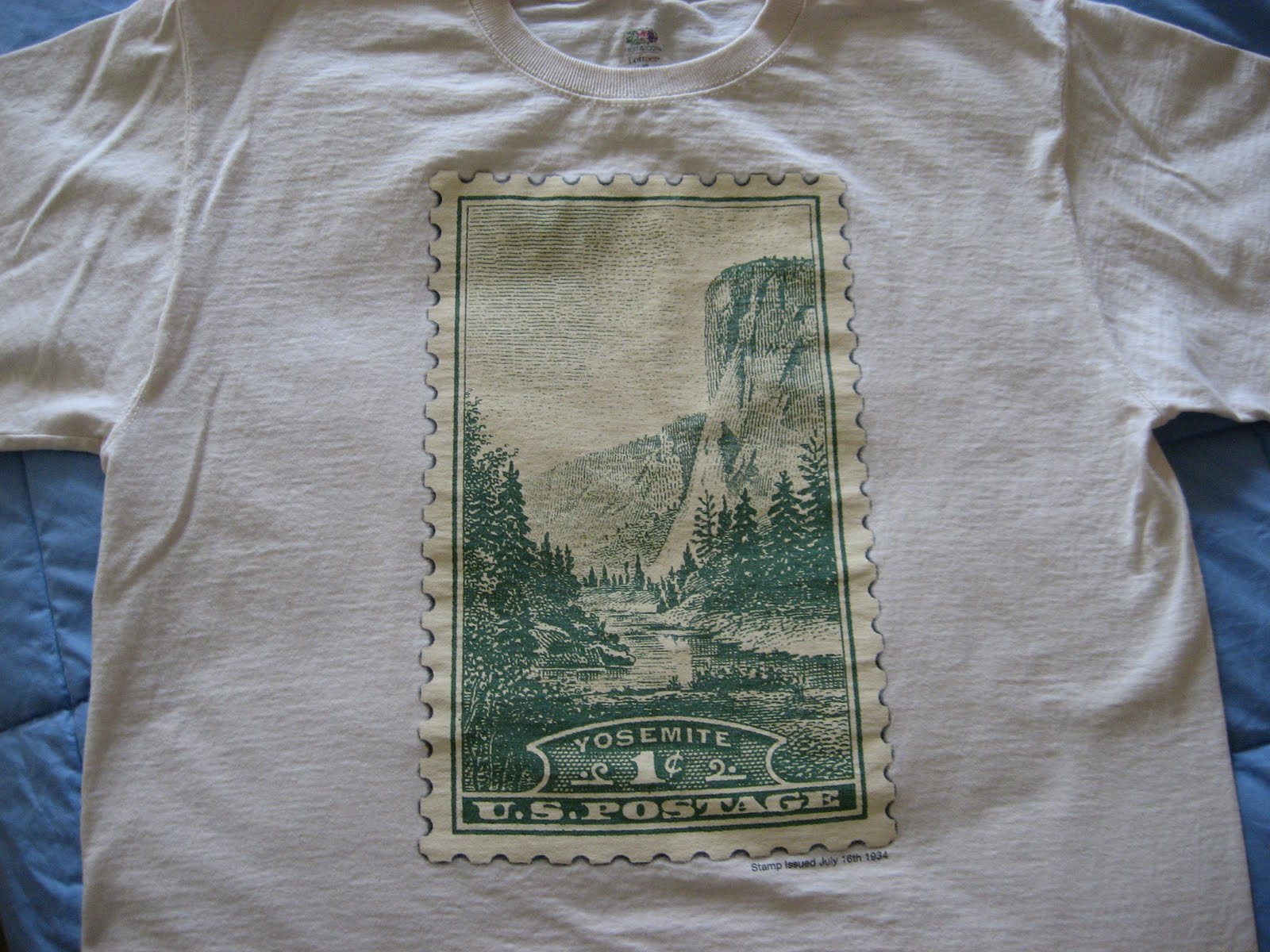
To introduce the postal theme– and for a few moments just forget about the concept of mail that can’t be carried in from the mail box in one’s real hands–I show you this T-shirt we bought in Yosemite last month, at the post office. It was the best clothing deal in the park, and an unusual and historic design: a reproduction of a stamp that was issued in 1936, showing–Yes! my beloved El Capitan! If you have ever beheld that rock I trust you won’t find its frequent appearance here tiresome.
I mostly wanted to tell about postcard-writing, and the shirt isn’t very pertinent to that…though it just occurred to me that one might buy the shirt at the Yosemite post office and then write a postcard sort of message on the fabric before mailing it in its more personalized form. I don’t think I’ll run right back there and pick up a few more, though.

When I was a child, my maternal grandmother would send postcards to me and my siblings from wherever she was traveling. I recall receiving word from Turkey, Norway, Mexico, and Hawaii. She also wrote very entertaining letters from home. As she has been a major role model for me, it’s no wonder that I feel it a natural activity as a human being to share my life in this way with those I love.
It’s easy when on a journey, away from the usual housekeeping duties, to remember friends and family and take the opportunity to let them know I do think of them. A trip just doesn’t satisfy if I haven’t dropped a dozen cards in the letter-box.
This picture was taken at the Grand Canyon. When others in our party were hiking down into the gorge one morning, I walked all over the place looking for a picnic table with a view, from which I might write my cards. That was not to be found, but in a sheltered courtyard I did find a good spot, away from wind and next to a big stone with rain water pooled in a depression on the top. I didn’t notice this rock until I was startled by a raven who swooped down to drink.
Postage “just” went up again. It now costs 28 cents to mail a postcard. On those first envelopes carrying my grandmother’s address in the corner, the stamps on the other corner said “4 cents.” I can’t imagine that a postcard was more than a penny.
One thing I inherited from my father recently was the stamps from his desk drawer. There are some pretty old ones, from when a letter was 25 cents. If they still have stickum on them I use that, and if not, I apply a little Elmer’s glue and save my pennies by using these old stamps.
In California it seems that every town is a tourist town. At least, I find postcards in all the stores. But in some locales, the market has yet to be discovered, and I have to make my own postcards, which I learned to do from Martha Stewart, who gives us this handy template and instructions for using it. I’ve made these one-of-a-kind cards with photos of someone’s backyard, or a lake that is small and unknown, or a town that is seemingly too plain for the professional postcard people.
But why restrict this fun habit to traveling days? I started sending postcards to the grandchildren and friends any old time. A postcard is small enough that I can find time to write a few words while the iron or computer is warming up or perhaps even in the middle of the night when sleep won’t come. I don’t think old-fashioned correspondence of this sort will ever become obsolete or unwelcome.
Not Lazy Summer Days

To be precise, summer only began yesterday, so I shouldn’t be complaining about the lack of hours sitting on a patio with tea, or in the shade reading a book. I will likely yet have time before we get to the fall equinox for solitary early-morning weeding sessions in the garden while towhees splash in the birdbath nearby. But lately I’ve been doing so many fun and good things, I’ve been getting a bit depleted.

A week ago today, I was baking pies. It was a satisfyingly creative job, even if I did have a huge mess afterward.
Initially I wanted to bake an apple pie for the father of my children, for Father’s Day. And at church the ladies were bringing in pies for the agape meal, also in honor of the day. I made three for that contribution, using up some flaked coconut and other goodies in my pantry.
This one above left was named Million Dollar Pie where I found the recipe online, but as I improved it by cutting the sugar in half, I’ll make that Two Million Dollars. It must have tasted like a candy bar, what with the coconut, chocolate chips and walnuts it featured, but none was left over for me to try.
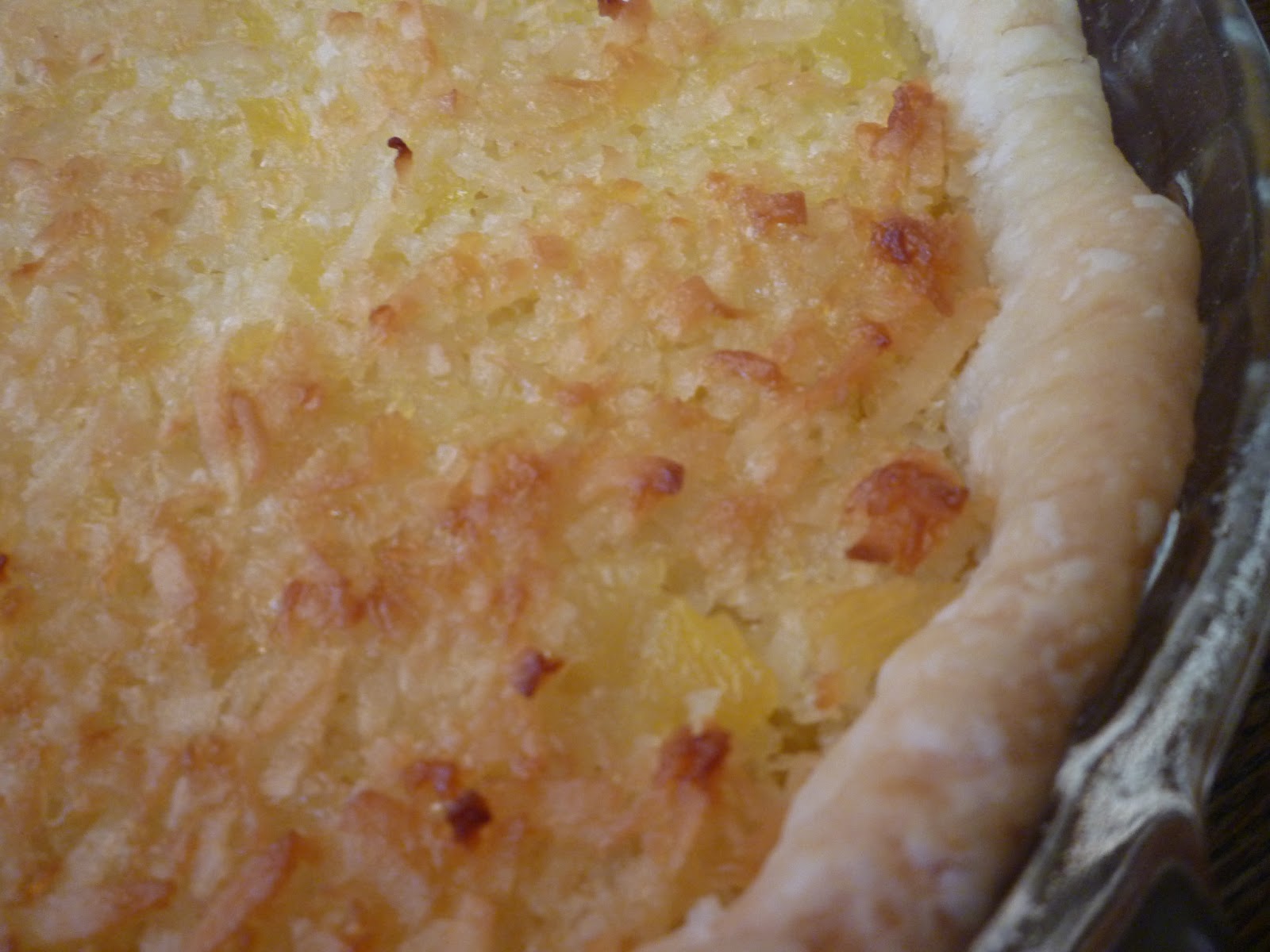 The recipe I found for Coconut Pineapple Pie made two pies from a 14-oz. bag of flaked coconut and a large can of crushed pineapple, with some eggs and butter, etc. in the mix. I did get a taste of that concoction, and I wonder if it might have had more zing if I’d used a name brand of pineapple. Even with its sugar cut in half it was a little too blandly sweet for me, but people liked it.
 My newest favorite kitchen gadget got used that day: silicone pie crust shields. In the past I used aluminum foil to keep my crusts from getting too brown, but foil is not nearly as handy.
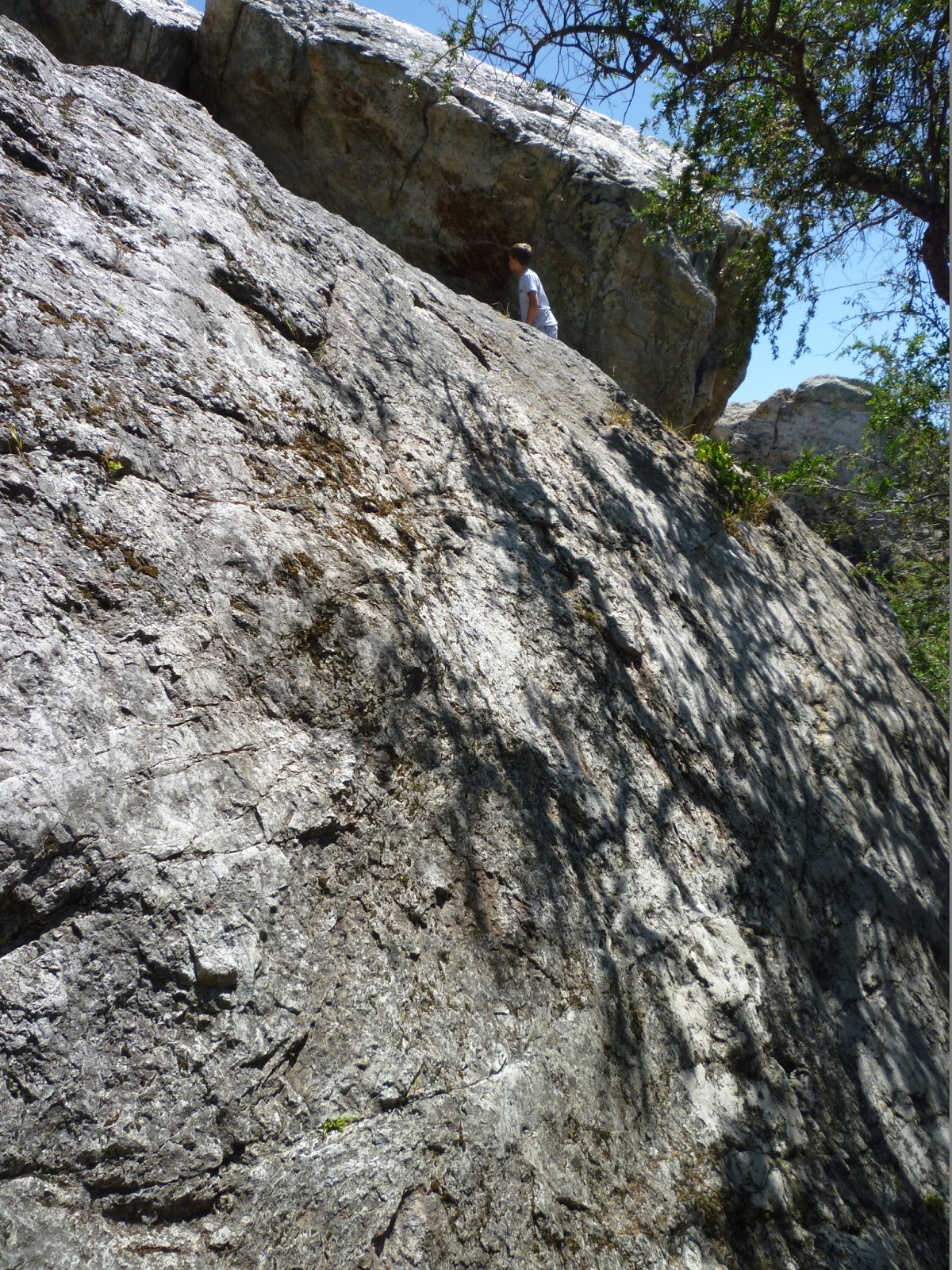
The day after Father’s Day grandson “Pat” flew to California all by his lonesome from D.C.’s Ronald Reagan Airport, mostly to spend a while with Pippin’s family, but we grandparents had the happy task of meeting him at the Oakland airport. Oakland is next door to Berkeley, where year by year I as a child visited my own grandparents, so we stopped in that old neighborhood of Indian Rock and Indian Rock Park in the Berkeley Hills.
 |
| Indian Rock |
My sisters and I used to play here, just down the block from my grandma’s house, and even my father had his picture taken on the Rock when he was a small boy. It’s such a lovely thing that the houses were built all around this cluster of craggy boulders that seem more likely to be found in the Sierra Nevada. Pat climbed “cross country” on them, while we older people used the flights of steps long ago cut in the rock.
 |
| My father in 1927 |
From the top you can see far and wide, both the Bay Bridge and the Golden Gate Bridge, and at the bottom, where the hill slopes into the town of Albany, it’s possible to walk down to Solano Avenue by way of stairs passing between houses. It takes only a few minutes to go this way, descending to shops and in my grandma’s time, her beauty parlor and the ice cream parlor that she let us visit by ourselves. Those were the days when children were safe.

After a couple of days having Pat all to ourselves, I drove him north to have adventures with the Professor and fun little cousins.; we listened to most of The Voyage of the Dawn Treader on the way up, with me interrupting frequently to say, “Would you look at all those sunflowers!” (There were a couple of thousand acres, I think, visible from I-5.) and “Those are tomatoes in that field, and this is alfalfa….” Sadly, we couldn’t get one of those faraway views of Mt. Shasta because of clouds.
 I had a few sweet hours with Scout and Ivy before I wore myself out driving back the very next day. I needed to come home and get ready for multiple house guests, and for events such as the much anticipated Feast of Pentecost.
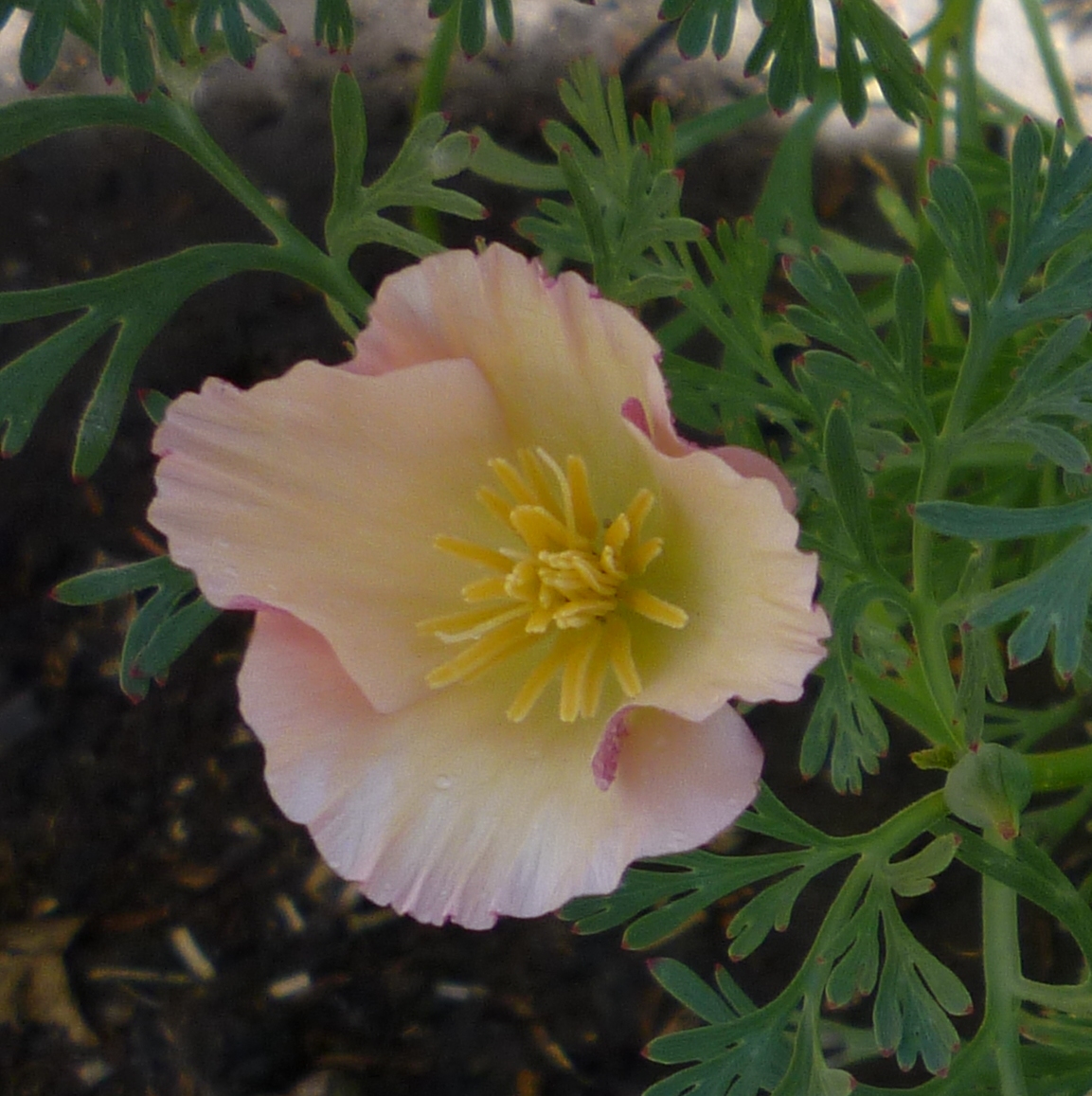
Friday morning when I was back watering the garden I discovered that more of my unusually colored California poppies had bloomed, like this one.
A brief look-around at my flowers didn’t seem to be enough R&R, though, so I asked Mr. Glad to take me to the coast where I could “just sit and stare at the ocean.” He was happy to comply.

The weather wasn’t as summery and calm as the predictors had led us to expect, but the fog hung around only thinly so that we mostly noticed the sunshine. I tied a bandana around my head so that the wind wouldn’t make a total tangle of my hair, and we sat in the lee of a sand dune where I could rake my fingers through the warm sand for an hour.
I don’t know how long I may have to wait to experience even a short string of rejuvenating days, but for now I think my half of a lazy afternoon will do nicely.
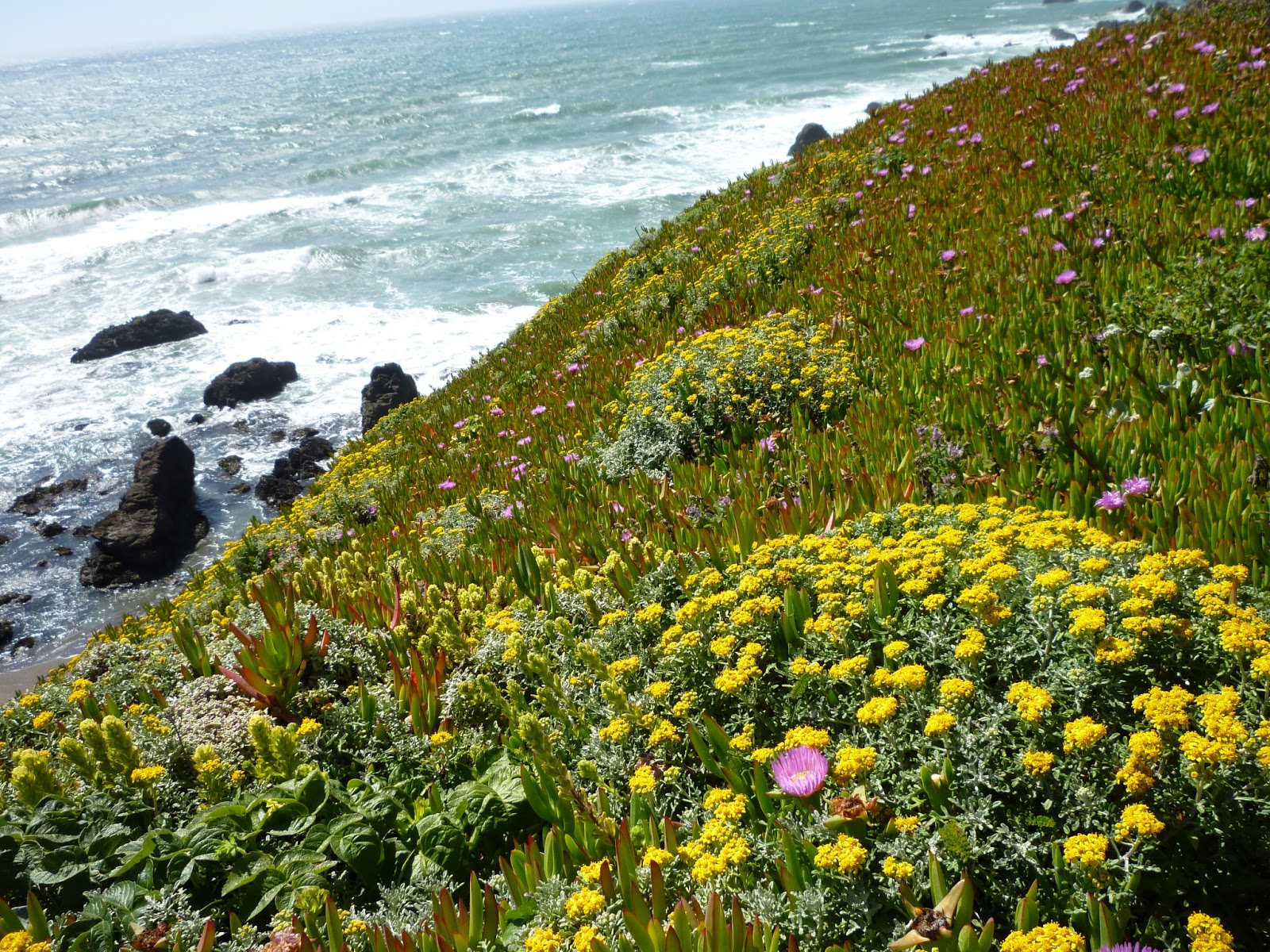
Sweet Dreams and Blue Eyes
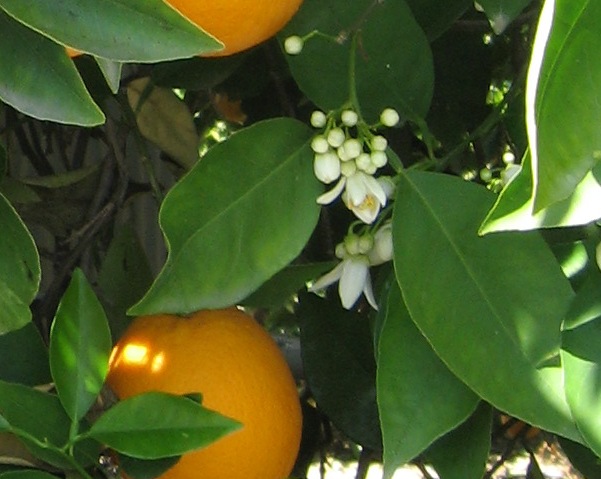 I relived one of the literally sweetest experiences of my childhood yesterday and I didn’t even have to journey the five hours back “home” to the groves my father used to tend so lovingly. We Glad gardeners visited a local nursery just to get one replacement plant for our project of last fall.
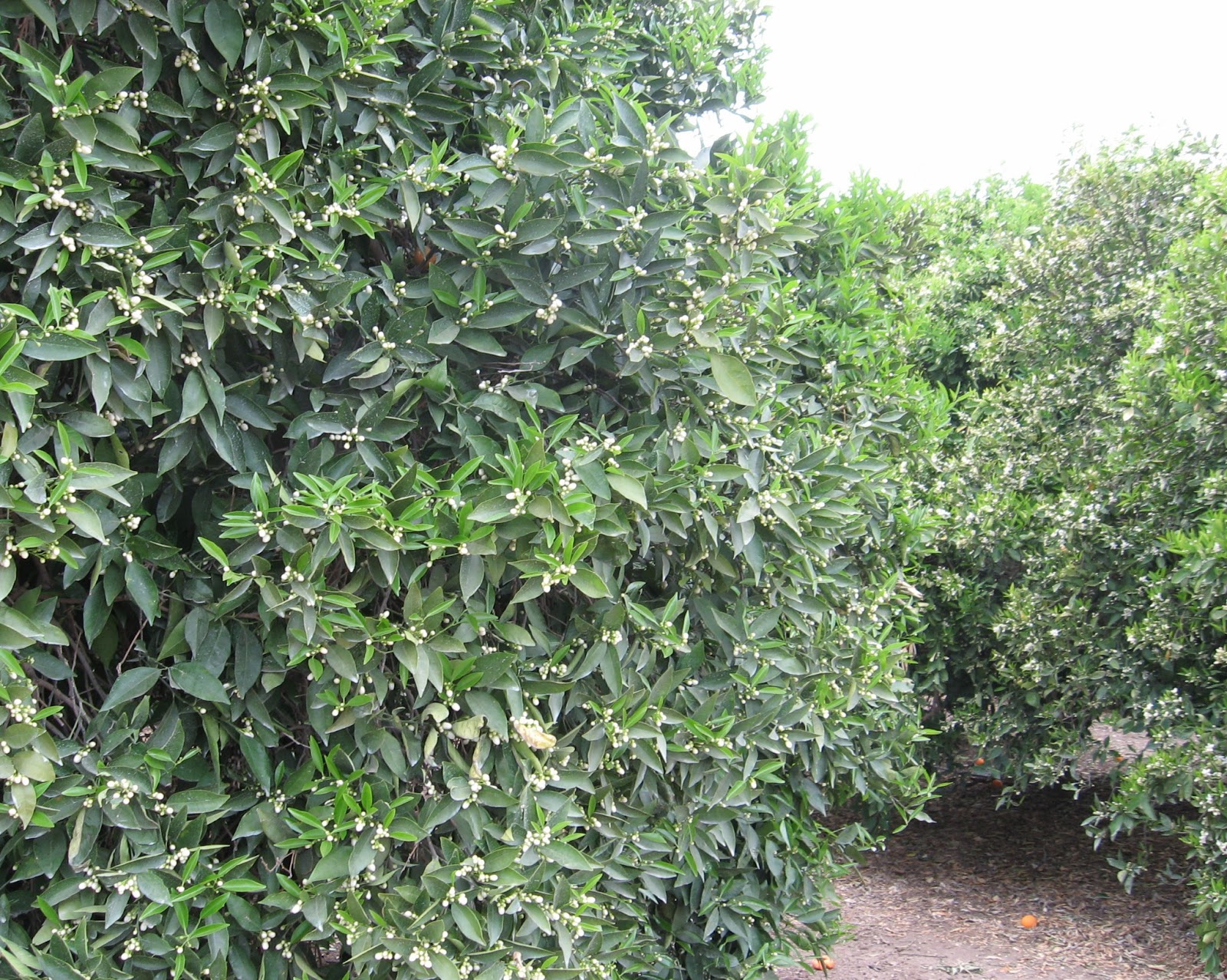 |
| navel oranges in bloom |
We were looking for a helianthemum, and they are in the area in back of the store, so we passed through the breezeway and were suddenly enveloped, not in a breeze but in a stillness heavy with fruit and flowers.
Overlapping rows of pots containing various citrus trees, including many oranges and mandarins, lined the alley and were exhaling their essence into that space. For me it was a whiff of the deep past, springtimes slowed down to a dream — orange trees taking their sweet time and confusing the mind, because isn’t springtime when everything and everyone is waking up and getting busy…?… but this air is like a drug that makes me want to lie on the grass and let my eyelids droop.
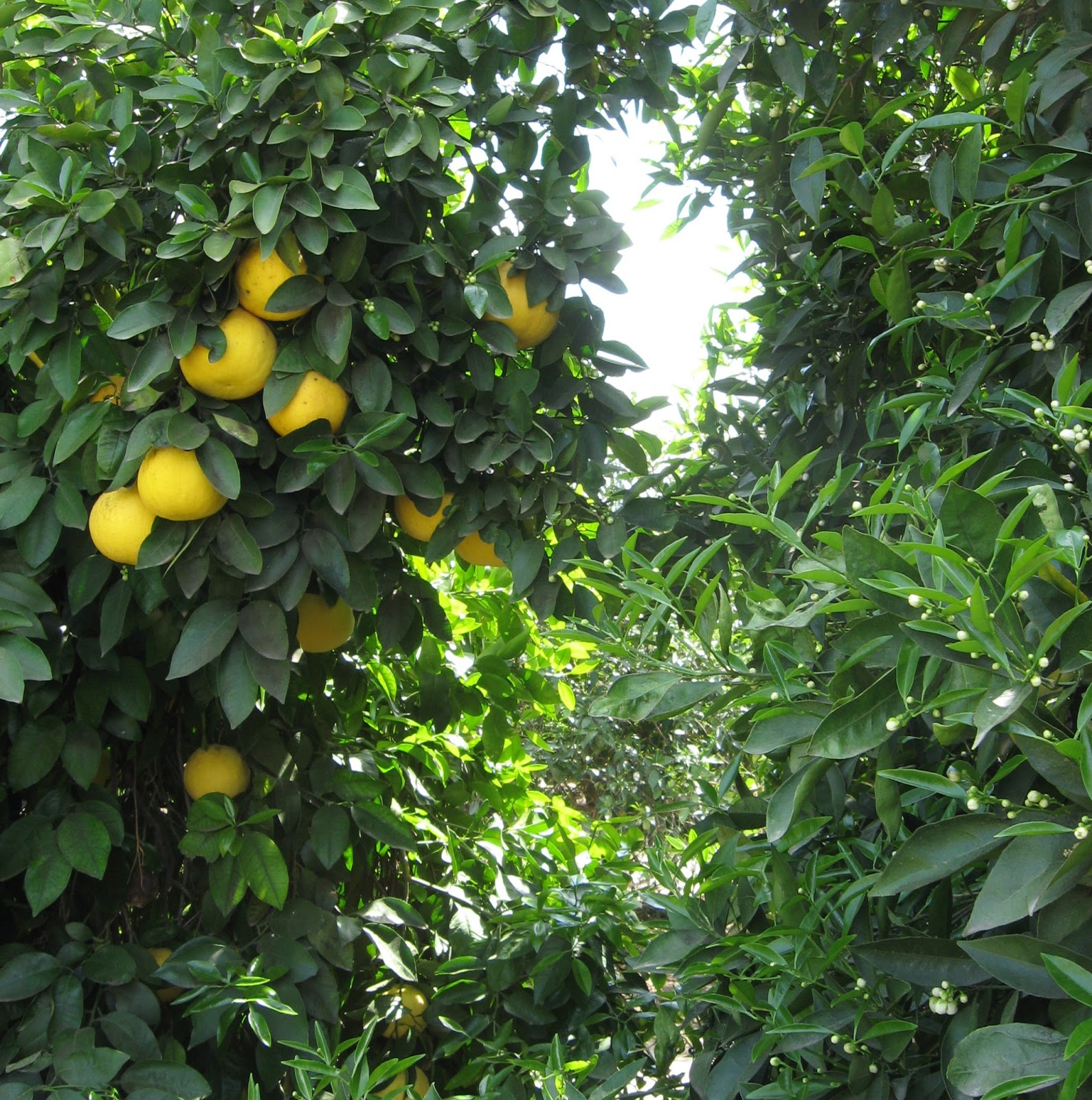 |
| grapefruit and orange trees side-by-side |
Our house was surrounded on all sides by orange trees, so that for many weeks every year we walked around in our own tropical island of scent. Can you imagine living in that house and being allergic to orange blossoms? Two family members were — and I pity them mightily, because orange blossoms are one of the happiest things in the data bank of my senses.
My husband and I had only a few minutes to find our plant, so I couldn’t linger, I quickly pushed on through to the shelves of California native plants and other drought-tolerant species. Our first choice wasn’t there, but we found this:
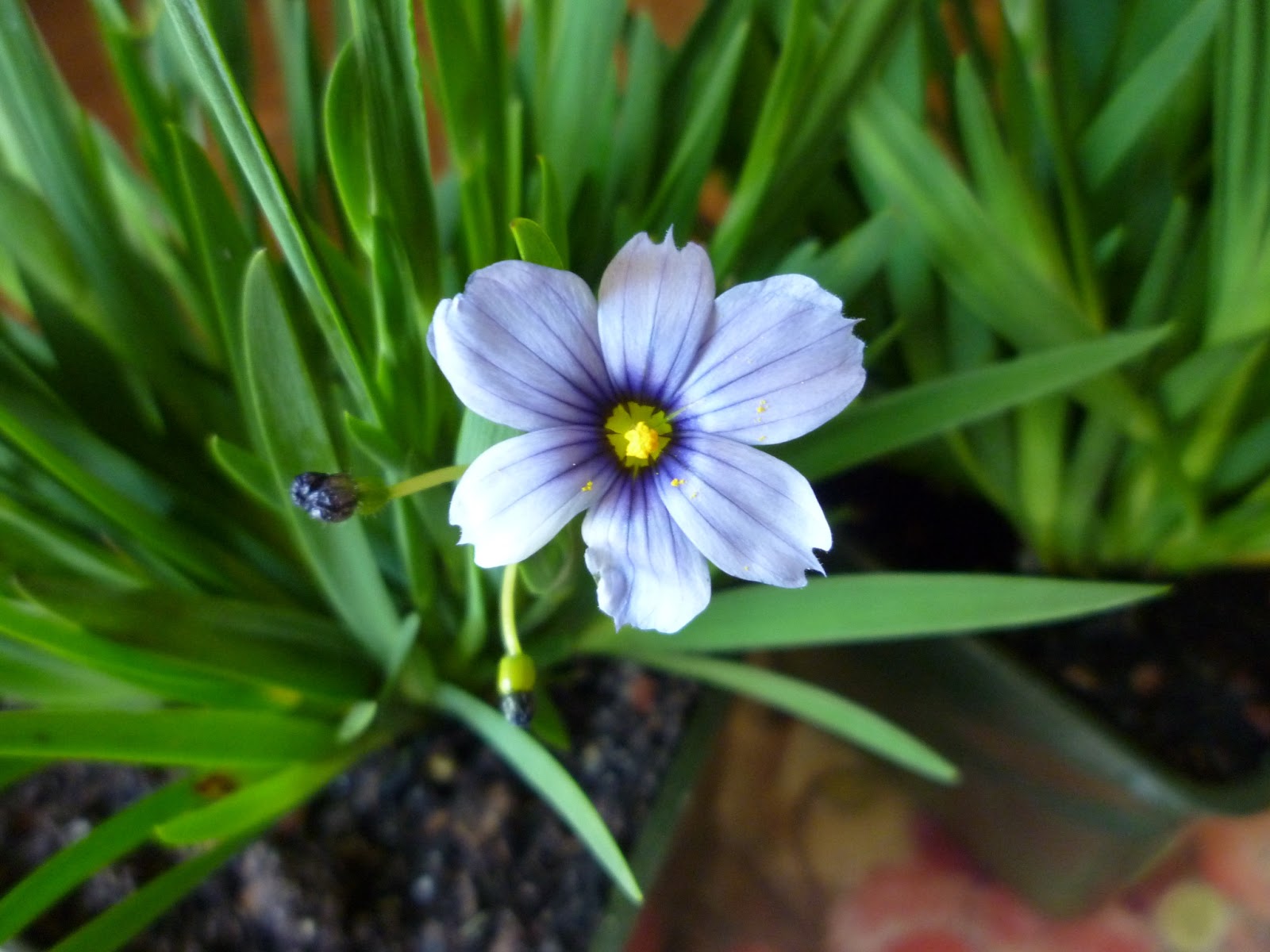
I had luckily forgotten my Western Garden Book in the car so I had to make two more passes through the little paradise to retrieve it. Then we read a bit together about the above plant and some other offerings.
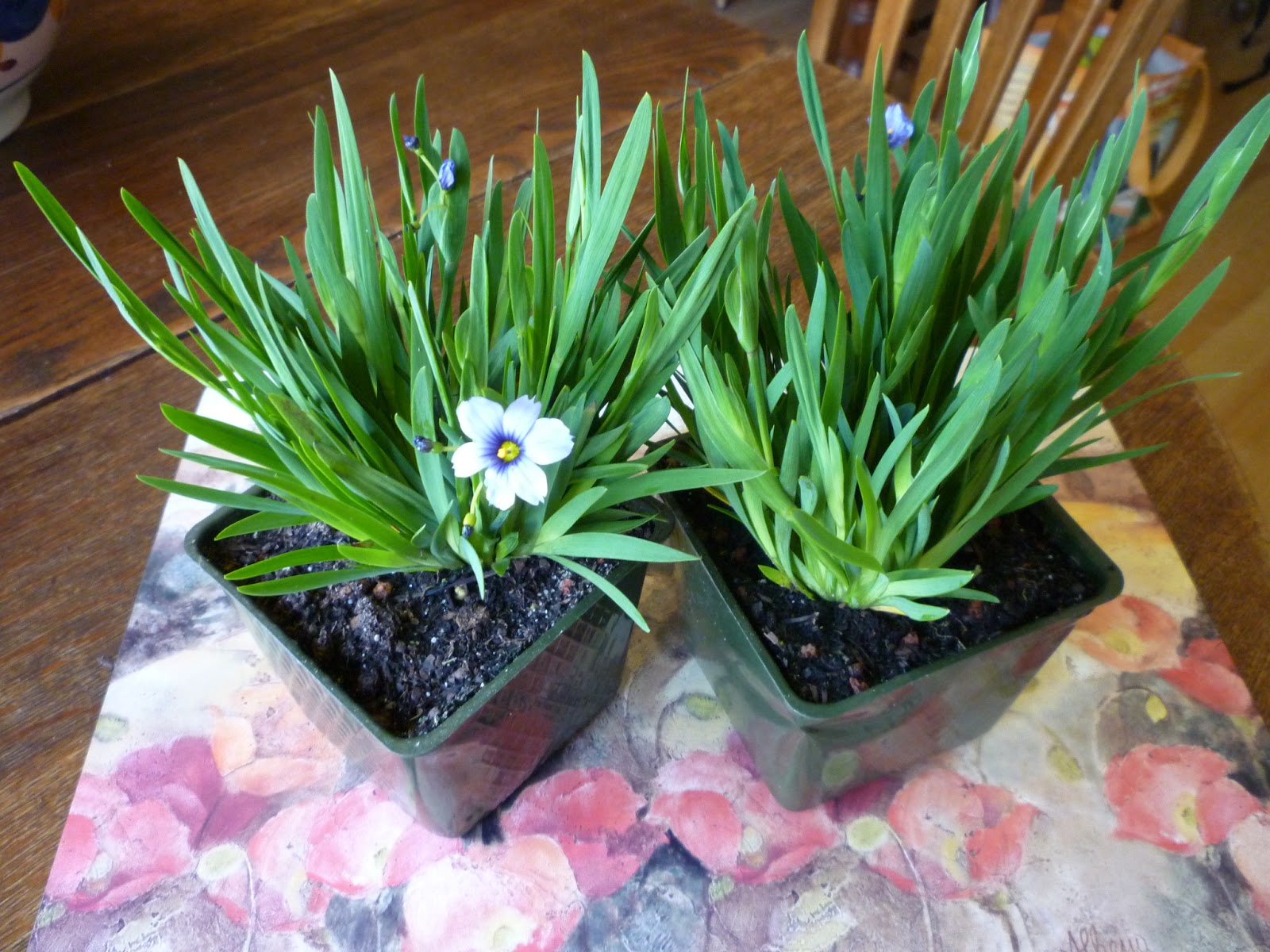
 In the end we did decide on this dear low-growing plant, a newish species of Blue-eyed Grass, developed from a California native, and sufficiently xerophytic for our needs. I remember my friend May showing me one of these wildflowers decades ago as we hiked in the Coast Ranges of our state. They aren’t really grasses but are actually in the Iris family, which seems obvious now that I know it.
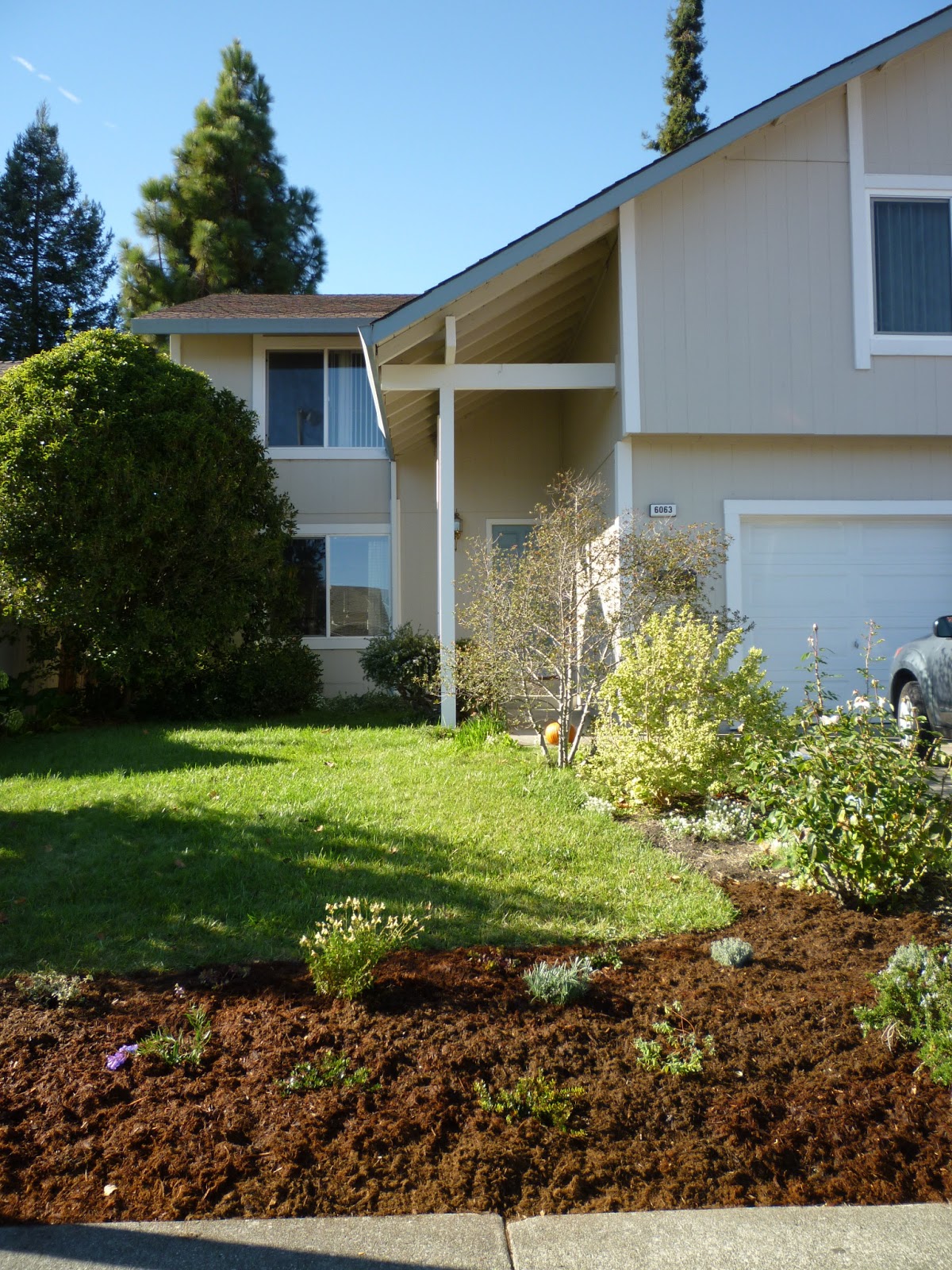 |
| new planting last October |
Except for the one that died, all the plants of our project shown at right are bigger now, but there’s still a lot of space to be filled in.
I can’t settle on which is more fun as a name, Sisyrinchium or Blue-eyed Grass. This is the first we’ve ever had them in our yard, and as you can see, we bought two, because they are small. I planted them tonight, where a blue penstemon, actually two, one after the other, had died last year. I hope to have nice photos of them and the whole bed to show in the future.
And before the citrus bloom is past I will return to that nursery when I have time enough time to wander. I’ll consider the snapdragons in the back, and then the perennials in the front, and I’ll go back and forth through the citrus tree lane at least a few times. I’ll walk slowly each time past the mandarins and Meyer lemons and orange trees and sip my sweet daydream.

Trees live all over the world.
The oaks were of noble bearing: they did not trail their branches on the ground like willows, nor did their leaves have the dishevelled appearance of certain poplars, which can look from close-up as though they have been awoken in the middle of the night and not had time to fix their hair. Instead they gathered their lower branches tightly under themselves while their upper branches grew in small orderly steps, producing a rich green foliage in an almost perfect circle — like an archetypal tree drawn by a child.
It’s surprising how often the subject of trees comes up in Alain de Botton’s The Art of Travel. The description above is from his visit to the Lake District in England, but while he is France he also notices trees with the help of Van Gogh’s paintings. I like the word pictures the artist himself painted when he was working on a series of sketches of cypresses, words that tell us about the trees and about Van Gogh, too:
They are constantly occupying my thoughts….it astonishes me that they have not yet been done as I see them. The cypress is as beautiful of line and proportion as an Egyptian obelisk. And the green has a quality of such distinction. It is a splash of black in a sunny landscape, but it is one of the most interesting black notes, and the most difficult to hit off exactly.
 Van Gogh was with his cypresses for quite a while, getting to know them. I have felt close to some particular trees over the course of my life, starting with a pear tree outside my back door, which for some reason made enough of an impression on my five-year-old mind that it remained the only thing I remember from that house’s yard.
We moved to another place with a significant tree, a huge oak that grew even bigger till it threatened the house in which I spent the remainder of my youth. So I can’t help loving oaks, and I do think trees in general worth a whole post from this book on travel, even if they aren’t that big a part of the book.
But, see here, Van Gogh couldn’t leave out the trees when he wrote about his house:
My house here is painted the yellow colour of fresh butter on the outside with glaringly green shutters, and it stands in the full sunlight in a square which has a green garden with plane trees, oleanders and acacias. And it is completely whitewashed inside, and the floor is made of red bricks. And over it is the intensely blue sky. In this I can live and breathe, meditate and paint.
De Botton notices some trees by a stream on another occasion in the Lake District, while he sits on a bench enjoying a chocolate bar, “a scene so utterly suited to a human sense of beauty and proportion.” But he didn’t pay attention to them for very long, and seemed to forget them entirely when his trip was over. But one day he was in a traffic jam and mentally stressed by the cares of everyday life, and
…the trees came back to me, pushing aside a raft of meetings and unanswered correspondence, and asserting themselves in consciousness. I was carried away from the traffic and the crowds and returned to trees whose names I didn’t know, but which I could see as clearly as if they stood before me. These trees provided a ledge against which I could rest my thoughts, they protected me from the eddies of anxiety and, in a small way that afternoon, contributed a reason to be alive.
I’m sad to realize that in my travels I’ve not spent enough time alone in one place to take proper note of foreign trees, but I do love them. And when we visited the Bristlecone Pines a year ago, I suppose it was the fact that they were the focal point of the place that enabled me to concentrate on them more than is typical for me. But instead of drawing them, I philosophized about them.
John Ruskin tells us, “Your art is to be the praise of something that you love.” Perhaps my first adult drawing effort will be of a tree.
 Gladsome Lights