Tag Archives: figs

From a neglected garden.

In spite of my absence for various reasons, the garden continues to carry on valiantly its business of growing and changing by the hour. I love walking around and picking off a few dead flowers, or noticing seeds forming, even when I can’t give it the more thorough care it needs.

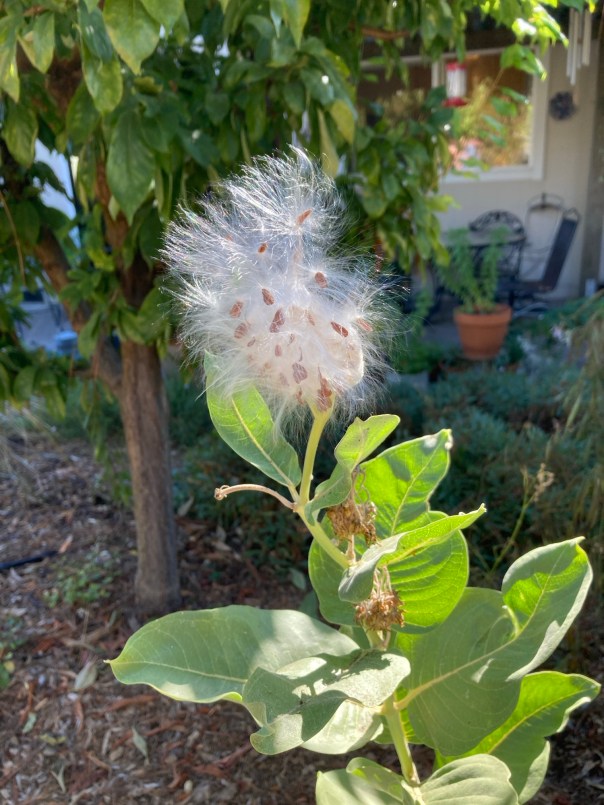
A couple of years ago I managed to transplant one of the vigorous Showy Milkweed plants (above) next to where the Narrow-Leaf Milkweeds grow. You can’t see the latter very well in the background, which is a good thing, because their leaves have mostly had the life sucked out of them by aphids and have turned black. But every spring, they come back stronger than ever.

Tatsoi greens and lobelia

The leafy green Tatsoi really took off in this pot where I stuck it in next to lobelia, and is begging to be thrown into a stir-fry a.s.a.p. Those I set out in the planter boxes are languishing; that soil must need amending.

The dwarf pomegrantes are mostly a fun member of the garden in that for most of the year have flowers, often with hummingbirds drinking from them; or foliage bright and beautiful catching one’s attention in spring and fall; and their darling fruits, that don’t get very large, and in this climate don’t get enough heat for their seeds to develop sweetness. But they are so cute right about now. This one is about an inch and a half in diameter.

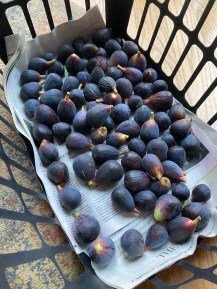
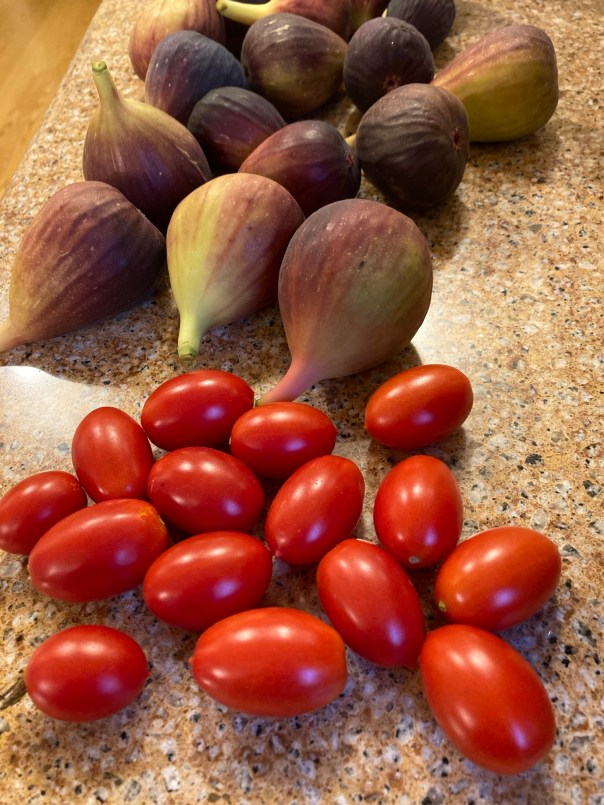
Every day I pick figs; the evening of my return from the mountains I gathered two dozen, and yesterday nineteen. Soon I hope to make that Autumn Fig Cake I told you about one time. And the Juliet grape tomato plant is prolific. I eat the tomatoes in the garden and in the kitchen, and took enough with me to the cabin that I could eat a few every day for ten days, and they were always sweet.
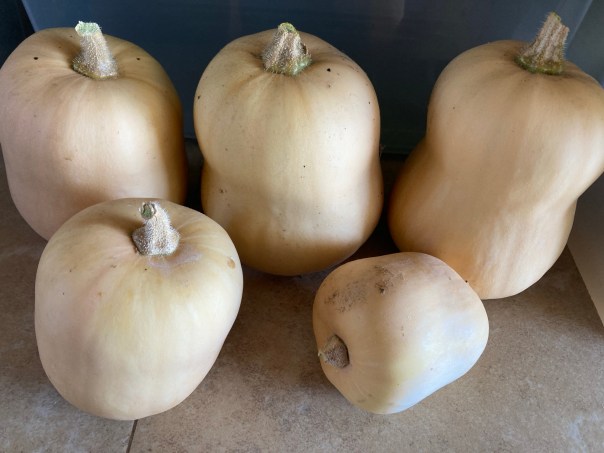
I harvested all but one of the little butternut squashes I grew this year, and planted some Sugar Ann snap peas in their place. Ideally those will start bearing about February, if the winter isn’t too cold and if I can keep the snails from devouring the plants between now and then.

My native sneezeweed is of the less showy sort, but it welcomed me when I returned from my mountain retreat with a particularly lovely array of blooms, not plain at all.

No doubt about it, my garden loves me, and forgives my neglect.
It makes me want to do better in the future.

Popsicle to fig.

I took my root beer popsicle outside — the way we often require children to do — and wandered around the garden. On the earth and becoming part of it I spied three plums that must have fallen sometime since the day I thought I had picked the last of them. That makes — ta da!! — a total of 52 plums this summer, way, way more than ever before. It may have something to do with the copper dormant spray I applied last winter. The foliage has been looking healthy ever since it leafed out.

With a popsicle in hand, I couldn’t very well gather up armfuls of pine needles or do much of anything about the overgrown mess the garden has become, so I sat in a chair facing my little carved stone icon of Mary, and my quite large fig tree. A week ago an afternoon windstorm blew down bushels of crisp, russet brown pine and redwood needles all over the garden, even into the little shelf in front of the Theotokos. The lavender I had put there was long ago dried up.

On this side of the garden the invasion of dead plant matter is from the neighbor’s redwood tree; the twigs get caught on everything on their way down and continue hanging on the guava, the salvia, the fig… Below you can see the swellings of baby pineapple guava fruits:

Drying up jumble that it is, to me it is a lovable mess. In the past I would feel overwhelmed with the task of keeping up with it all, but lately I have accepted the reality that it’s too much for me to manage even well, much less perfectly. And anyway, a garden that always looks perfectly orderly is probably not the best kind of pollinator garden, and here where we get no summer rain many things are going to look a bit dried up at this time of year. But the bees don’t notice; they are still after that African Blue Basil that never stops putting out new flowers. I haven’t used it for cooking, though, because it’s too medicinal tasting.

Bee on lambs’ ears.

I’m focusing less on management and more on friendliness with my plants, and appreciation for their unique cultures and seasonal changes. They keep growing even if I don’t do all the tasks at the right time. Week by week it’s always a little sad to clean up “the mess” — such as the acanthus blooms that have turned from fresh green-and-white to tan, and then brown. Here and there a milkweed stem leans over so far it is lying on the ground, and the tall Indigo spires salvia likewise, but many more of them.

I worked hard in the last few weeks to clean up, though. Three weeks in a row I needed to use space in my neighbors’ bins; two of those weeks I completely filled three 96-gallon yard waste containers and wheeled them to the street. I had removed all the superabundant asparagus and several shrubs, thinned out many patches of lambs’ ears, the fig tree, the juniper…. on and on.

I finished my popsicle and my rest, and as I was headed back to the house, something glowing red in the sunlight caught my eye, among the leaves of the fig tree…. and when I looked in there, surprise ! it was a dead ripe fig (actually black) — I picked it and two more that were hiding in the shade inside. Now begins the bountiful fig season; I knew it would be a good year for them, because of our several heat waves, in contrast to last summer being a cool one and me getting zero figs. I better get my dehydrator ready.

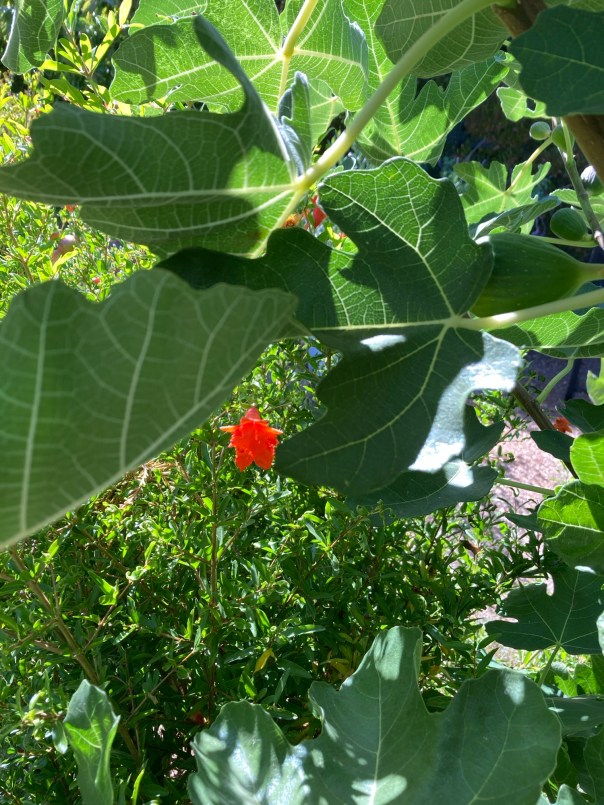
Pomegranate flower seen from inside fig tree.

My favorite kind of autumn day.

I am too busy to write here, but I guess the dishes, the laundry, the sweeping and the paperwork will have to wait a little longer, because I am so in love with this November day, I have to write it down. It would take even more time if I were to write a letter to the grandchildren about it, so they will have to wait, too.
The sky and the clouds! It must be that rain in October and November make for a splendid season, and not just because of the lovely damp-but-mild feeling of the air. As I understand, the rain somehow makes the leaf colors brighter. I drove past a vineyard last week that surprised me so — the colors of the leaves were not just the usual red and yellow and orange, but wide-ranging in deep purples and pinks as well. In my garden the pomegranates have not started turning, and the snowball bush barely.

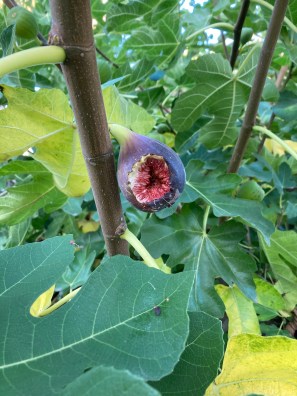
But I have color. My purples are, or should be, my figs. I think this year’s crop is going to be a big loss, because of the relatively cool summer. Yesterday I saw this single fruit ripening. This morning, a meddlesome crow had tasted it and also found it not ready.
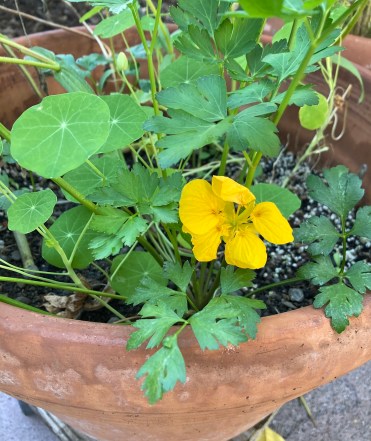
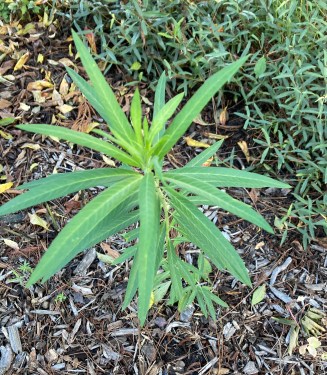
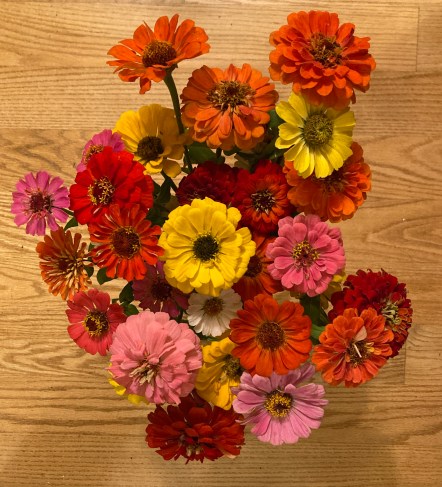
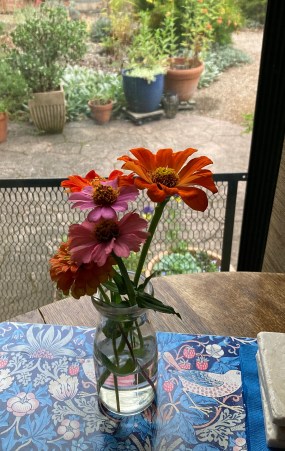
A nasturtium is blooming, and the tithonia still going pretty strong. Yesterday I picked more zinnias, again, to replace those that were turning brown in this vase where I’ve been able to just renew the bouquet in part every few days. But this week may truly be the end, unless the rainy weather keeps the frost off. That would be okay with me.

Yesterday evening was when our neighborhood trash cans are set out at the curb to be emptied the next morning. I wanted to cut enough plant material to fill my yard waste bin, so I worked on cutting the asparagus fronds that are turning gold. I had no sooner begun but gentle raindrops began falling on my head, carrying on another autumn tradition.

The milkweed I cut to the ground last month, as it had been wasted by aphids as is its usual late summer fate, has sent up a new and fresh shoot, green and tender and untouched by any hardship. It won’t last long, but in the meantime it cheers my heart and makes food for next summer’s valiant show.

As long as this mild weather continues, I can put off another task of my housework: carrying wood, building fires and dealing with all the mess around the stove. But as soon as that becomes necessary again, I’ll have one more activity that makes me happy. For today, I am happy with my breadmaking, washing dishes, and wandering around the autumn garden.

More figs and flowers.

It is a joy to have sunny days in which to work in the garden that is heading into its quieter winter months. This is the season for harvesting and cleaning up, often at the same time.

I don’t know if there is any good solution to the overcrowding of the Fig Tree Corner of my garden. There are no plants that I am willing to remove, so I guess I’ll have to just try cutting them back a little harder this winter.

Only the pomegranate bush is a little prickly, when I try to push in next to it to reach a fig. The salvia on the left I just push aside, when I stoop down to enter under the tree’s canopy and then stand up again as straight as I can to reach the fruit up high in the center… or not reach it, which is often the case. The hopbushes (dodonaea) between the tree and the fence don’t actually have a lot of width to trim back. There is the olive in a pot, lavenders, yarrow, and lithodora almost completely hidden under the tree for most of the year.

Birds have been eating many of the figs this summer. They take a big hunk out of one the moment it is beginning to be ripe, and then the wasps come along and gorge on the sweet flesh for a few days, before it is left abandoned in shreds, still hanging.

I was introduced by a mutual friend to a fellow gardener who lives on three acres not too far from me. Rosemary had more figs than she could use this year, so I went to her house and we picked side by side for a half hour; I brought home slightly more fruit than she kept to share with friends that very morning. Her figs were a more standard variety than my dwarf Black Jack type, maybe a Mission or Brown Turkey. They were awfully sweet and tasty, with more concentrated figgyness than mine typically have. I dehydrated most of them.

Yesterday I stood on the edges of my planter boxes to harvest the Painted Lady runner beans and cut down the thick vines that have hardened to sticks. It’s tricky to pull the long stems back over the fence from behind my neighbor’s woodpile, where I know he won’t be making use of the attached bean pods.
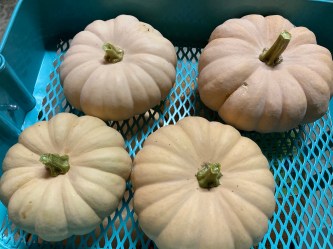
While I was standing up there, I got a fresh view down under the zinnias, and saw that I had three beets ready to pick. I didn’t even remember that any were growing there, next to the eggplant where the pumpkin vine had been encroaching. But when I harvested the  pumpkins, the beets were exposed. Also an eggplant that had been partly eaten… but when I cut off that part, half of it was intact and lovely.

Four little pumpkins got ripe, and there is one more that might possibly. These are the ones I grew from seed collected from a decorative pumpkin last year, because it turned out to be the sweetest of all I  had roasted. I’ll let you know if these prove anything like that tasty.

I’ve been trying to get calendulas to thrive in my garden again, the way they seemed so effortlessly to do in ages past. I think back then they received more water and sunshine; this year they are finally, happily blooming in the planter boxes, after taller (shading) plants have been removed, and I got the watering schedule corrected: those boxes were getting less than half the amount of drip irrigation they needed.

Most of my garden is pretty dry, with minimal irrigation, so anytime I have a plant that needs more than that I put it in the boxes. Right now most of the space is given to zinnias, the last sturdy stars of summer.