Tag Archives: Fr. Stephen Freeman

A few more helpful gleanings.

With my youngest daughter Kate getting married in just a few days, you’d think I’d have precious little time for writing here. And that is so true, which is why I’m mostly passing on some more gleanings from my recent readings. If you ever pray for bloggers you don’t know, add me to the list this week!

1) Leila writes about some of my favorite things in her post Housewifely. I specialize in ironing and wearing an apron, but the other G & S 6-85things are also high on my list. She writes, “When you put on an apron, you do not merely protect the garments. You also announce your commitment to the task at hand, your willingness to suffer the slings and sputterings of the pots and pans, your resolve to see the work out to the end.”

I wish I had written this post. Sometimes I think I could write a whole book about aprons alone, and how practically and symbolically they are so significant to my own homemaking. I don’t only wear a apron in the kitchen, but to clean house and dig in the garden.

Aprons were one love that I shared with my now-departed friend Bird which is why I made her a new apron at a time when she had no obvious need for one. Bird and I knew that she did in reality use one, as a way to keep herself on the continuum of the woman she had always been.

2) Daphne writes common sense and wisdom about dating and marriage.
43 m&l
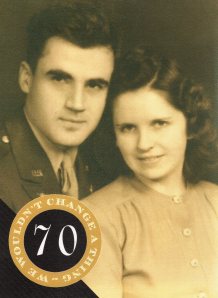
My cousins 70 years ago

“Start dating after you are ready to get married, and date people you can actually see yourself marrying, as doing otherwise is typically a colossal waste of time. ”

“A good marriage is intentional and dating should be too.”

“And none of them live in magical fairy tales; no matter how it’s arranged a relationship always involves confusion, mistakes, and heartache. Crossed wires are built into every human interaction. ”

3) This article on acedia I found to be revealing of all the many ways self-love manifests itself. Fr. Aidan Kimel quotes a 4th-century desert monastic on the eight fundamental passions or thoughts; acedia is central.

“Frustration and aggressiveness combine in a new way and produce this ‘complex’ (that is, interwoven) phenomenon of acedia.”

“’A despondent person hates precisely what is available,’ Evagrius writes, ‘and desires what is not available.'”

4) The last thing I offer you, which was most helpful to me at this time, is Father Stephen writing about Comforting One Another, which is also about comforting ourselves — or rather, not comforting ourselves. You see, we try to comfort ourselves by running away from the heartbreak or pain and suffering, running to pleasures that we think will ease our hurt. They often bring us further pain. We have to make ourselves not run away, but turn to Christ and let Him truly comfort us by His being and presence.

“For it is when our hearts are broken and do not run away or hide that we can call on God to comfort us. And He does….That comfort is the gift of His own life within us, a sharing of His own joy and love.”
Web gleanings for the interested.

Over the last several weeks I’ve collected some good Internet finds into this draft which I haven’t yet managed to finesse into a very cohesive offering. Even so, I think I better post it, before it gets even larger.

What does it take for you women to “feel good about yourself”? This blog post, What’s Your Excuse? spins off a provocative photo and discusses our life’s purpose and calling. It’s true we all make excuses for failings, but maybe some of us are focusing on the wrong goals in the first place.

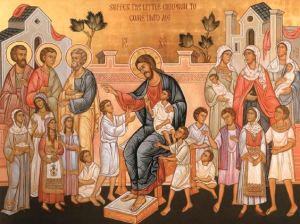
How we live out and demonstrate our priorities has a huge effect on our children. Lisa writes about training our children and about praying for them, in The Prayers of Parents. It reminds icon suffer the little childrenme of a book I read when my own children were small, by Andrew Murray, Raising Your Children for Christ. From the blurb on the paperback cover I expected lots of practical advice such as methods of discipline and teaching, but 90% of the book was a month’s worth of devotionals emphasizing the parents’ faith and prayer. Of course, that is very practical – definitely not theoretical! And so is Lisa’s admonition.

From the cultivation of the spiritual life, I will segue into the cultivation of the earth, and a very surprising thesis of this article on the unsustainability of organic farming. Why would this be? I am only beginning to process the complexities of what the writer is saying. I know that the natural and best ways of doing many things are often not the most “efficient,” and that is one reason I am not a big believer in efficiency. But unsustainable? That’s taking it to a new level of disturbing.

seedbombs-300x225

People trying to promote natural healing of the earth is one aspect of this article on Mossy’s blog  telling about seed bombs. Has any of my readers done this “guerrilla gardening”? Mossy tells you how to make your own at home, but if you search the term you quickly find that you can buy the clay balls ready-made.

I appreciated another blogger‘s treating the subject in more depth and bringing up some issues, such as vendors selling “bombs” that contain seeds of plants that are invasive and undesirable for the part of the country they are marketed to. For example, some people are concerned about sweet alyssum, which I have certainly tulips w alyssumfound to be invasive, but controllable in my own home garden.

I’m happy to tell you that hundreds of hardworking bees are flying around my garden these days. They make me so happy. My husband and I like to sit in the sun in the afternoons watching them buzz all over the lavender nearby. I hope you will go see Kelly’s picture of a honeybee — she caught him in a secret magnolia-blossom cave. I love looking at photos of bees on flowers — they are so hard to get. If any of you have one on your own blog I’d think it the sweetest thing if you sent me the link.

If you haven’t already acquired the habit of reading Fr. Stephen Freeman’s blog, here’s another prod: We Will Not Make the World a Better Place. He discusses “The Modern Project,” modern because, “You will search in vain for the notion of making a better world prior to the 16th century.” Fabian Socialists, the Treaty of Versailles, and the Armenian genocide all figure in his remarks on political theory and history. And a quote: “Stanley Hauerwas has famously noted that whenever Christians agree to take charge of the outcome of history, they have agreed to do violence.”

Last, and important, humor: One of the funniest things I came across this week was on Language Log, a place to read linguists’ comments on many everyday happenings in languages, English and others. From time to time one of their many contributors writes about how Chinese signs get translated inchinese - JustTheQueen1 odd and amusing ways. Some are written to forbid urination in various places and the English versions of the warnings can come out saying, “Urination is inhuman,” or “It is forbidden to urinate here. The penalty is bang.”
My pal Chesterton said that there are no uninteresting subjects, only uninterested people. I hope at least one topic here has been interesting to you!

Mystical Supper

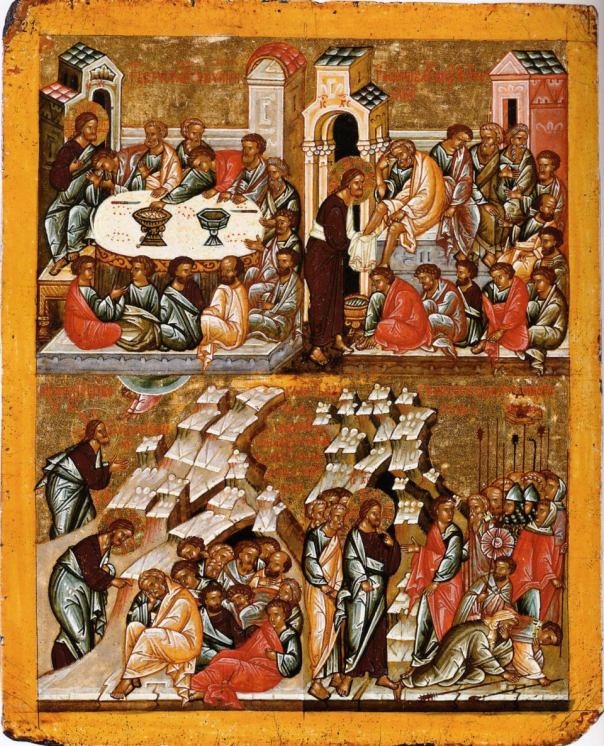
The Orthodox Church remembers so many events on Holy Thursday that it takes five mostly-long passages to comprise the Gospel reading. These events are: the washing of the disciples’ feet, the institution of the Sacrament of the Holy Eucharist at the Last Supper, the agony in the garden of Gethsemane, and the betrayal of Christ by Judas.

Icon Reader shares a 15th-century Russian icon that includes all of these events:

holythursday_15c_rus

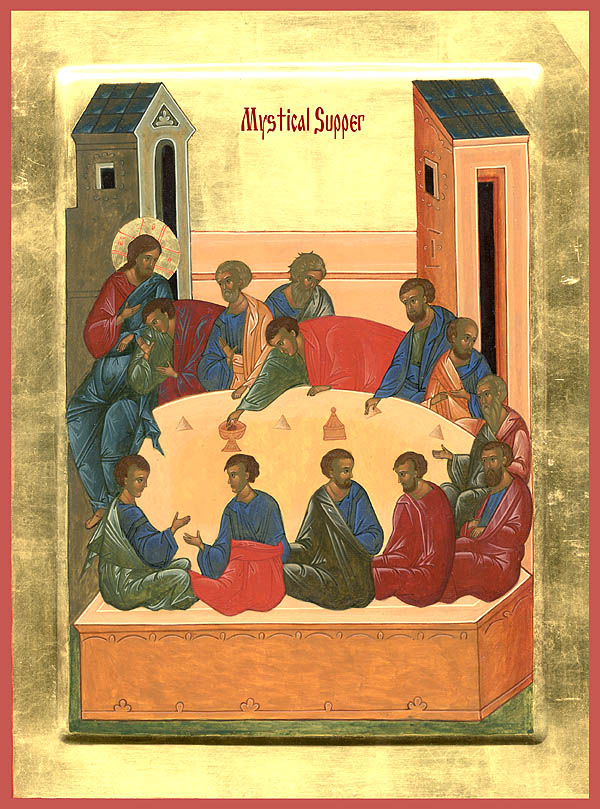
This site explains at length all the commemorations of the day, including the Last Supper, which is our experience also in the Divine Liturgy as the article testifies: “In the Eucharist the Church remembers and enacts sacramentally the redemptive event of the Cross and participates in its saving grace.”

On his blog this week Fr. Stephen explores Judas’s “banal and prosaic” reason for betraying Jesus: the love of money. He writes: “Money is the anti-Eucharist. Like the Eucharist, it is a way of life.”

“Christ gives His disciples the Eucharist on the ‘night in which He was betrayed.’ … Christ loves the Father – and all that the Father has given to Him. The bread that Christ gives is life, and life more abundantly…God give us life!

mysticalsupper

What dust can do.

St. Paul

Father Stephen writes about how we don’t often follow the Apostle Paul’s example of glorying in our weakness. The title of his blog post is “Your Weakness Saves You.” We need to pray out of our weakness and not when we are feeling strong; but Fr. Stephen observes that many of us would prefer to glory in our strength:

At some level, we believe that we are not saved through our weakness, but will be saved through our strength, and that the whole life of grace is God’s effort to make us stronger – never suspecting that God’s grace may actually be purposefully developing our weaknesses.
….
I often tell people who say they are struggling with prayer to quit trying to pray like a Pharisee and learn to pray like a Publican. We often want to pray from strength – to approach God when we at least feel spiritually alive. The Publican refuses to lift his eyes to heaven. The contradiction of his life and the goodness of God are more than he can bear. And yet he prays. And, ironically, it is he who goes down to his house justified rather than the Pharisee.

I find that the Orthodox prayer book cultivates this awareness of my weakness with its many cries of “Lord, have mercy.” Sometimes I am engaged in some activity that doesn’t allow me to give my full attention to prayer, but I am still burdened over a difficult situation or the need of a friend. I can express my helplessness to do anything by human strength, my inability to even think about what a solution might be, by praying “Lord, have mercy,” as many times as necessary to reach a place of quietness of heart.

As Psalm 103 reminds us weekly, “He remembers that we are dust.” When I pray that, I feel the love and tenderness of the Lord. He knows our weakness, and when we know it too, and pray with that understanding, we are near to Him.