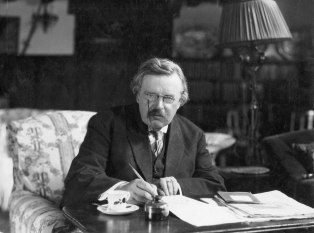
“Americans have a taste for…rocking-chairs. A flippant critic might suggest that they select rocking-chairs so that, even when they are sitting down, they need not be sitting still. Something of this restlessness in the race may really be involved in the matter; but I think the deeper significance of the rocking-chair may still be found in the deeper symbolism of the rocking-horse. I think there is behind all this fresh and facile use of wood a certain spirit that is childish in the good sense of the word; something that is innocent, and easily pleased.”
-G.K. Chesterton in What I Saw in America, 1922

This is the rocking chair I love best, because it is mine, and I have a lot of history with it. Before I was even engaged to be married, I visited the summer cabin of my boyfriend’s family, where this chair sat against one wall of the living room of “La Casita.” Only a big teddy bear sat in it back then, perched on the dome of the cushion whose springs had long ago sprung out of any human’s comfort zone.
And so it remained for decades, until the cabin was sold and we acquired the chair for this house, and had it refurbished. I just ran across a remnant of the upholstery fabric we chose, quite bright compared to the faded seat that still wears it.
 I’ve owned three other rocking chairs over the years, and none was as satisfactory as the current one. The first was a platform rocker that had belonged to another grandma of my husband; the whole chair was too big for me. I nursed all my babies in that chair, and spent quite a lot of time in it over many years, filling in the extra space and propping up my arms with pillows.
Another rocker came from one of the grandmas. It had a nice feel but was unbearably and incurably squeaky. And then there was the one found in the neighborhood with a “FREE” tag on it. How could I not bring it home? But it didn’t fit in with our decor, however you would describe that, and had too big a rocking-footprint for any room in the house. Out it went again.
I’ve realized by this time that on my own I am not much of a rocker, no matter how romantic I feel about the chairs that help one do it. Even though in many pictures of me opening Christmas presents, I am sitting in one.
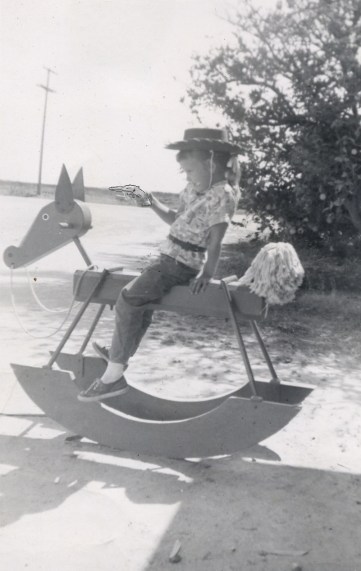
As I recall, some babies like being rocked, and some don’t. I wonder if a liking for rocking as an infant is predictive of certain personality traits later in life? I don’t know if my mother rocked me, but my father built this rocking horse for us, which I have no memory of. Maybe I wasn’t into rocking on it, either! It looks like it might have required some skill to ride and shoot at the same time.
I wonder if people who use rocking chairs when they are restless,
or to rock away their worries,
are doing more rocking these days?




 Gladsome Lights