Tag Archives: lithodora

We survive neglect.

Helianthemum Henfield Brilliant

I use “we” in the title to show solidarity with my beloved garden. Several times a year, a complaint is lodged against Gardener Gretchen for failing to live up to her vision. I guess it’s just the reality of Life Right Now. Tomorrow will be a big gardening day, a day of improvement, but today is when I had a few minutes to stroll about taking stock, taking pictures. All the plants are calling me to come out and admire them, and to notice how they thrive; they don’t want me to feel bad about how much I ignore them.
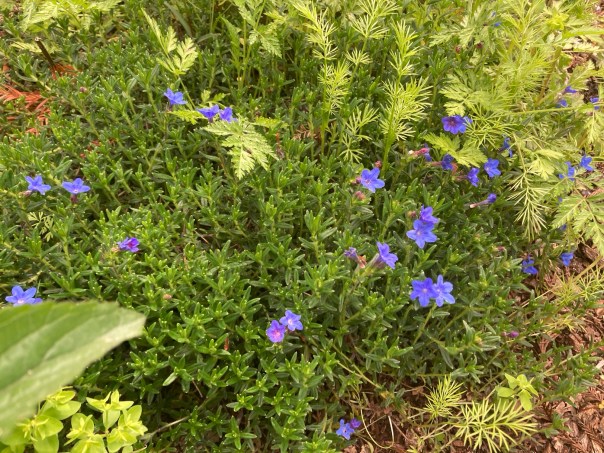
Lithodora with nigella and weeds.

Lithodora is one of my favorites. This week I’m going to pull out all the Love-in-a-Mist sprouts that are growing through and around it and under the fruit trees. In the front I already did as Gardener Dan advised me: I “edited” (thinned) the nigella, which he says will help them produce larger blooms. I think I reduced the number of plants in that bed from roughly 1,000 to 100.

Let me get the rather sad picture below out of the way now, the planter boxes where I typically grow squash and tomatoes. I’m at a loss as to what to do there, as my travels will take me away at just the wrong time for summer vegetables. Maybe the earth will have to lie fallow until August, when I can plant winter greens.

The native Pacific Coast Iris is now blooming in my very own garden (below). I am completely thrilled. This plant is so popular on the West Coast — not just near the ocean but up into the mountains — that it has its own fan club, the Society for Pacific Coast Native Iris.

In native plant nurseries one can find many colors and species of this type, Iris subsect. Californicae, which is in the same family as the Siberian irises. The Flora of North America site says, “Series Californicae presents some of the most complex taxonomic problems in all of our American irises.” In the wild a specimen can be difficult to identify as to which of the three main groups it is in because of “their willingness to cross pollinate whenever their ranges overlap.”
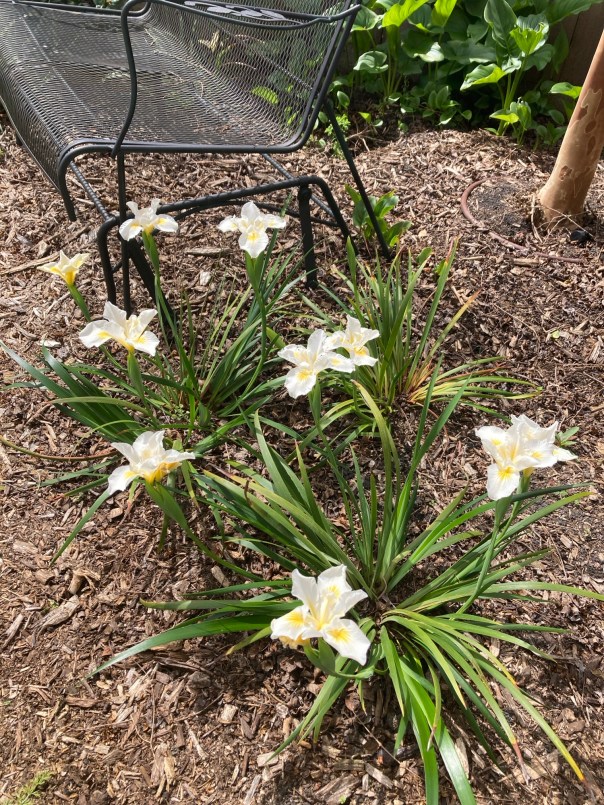
Pacific Coast Iris

When I was offered a choice by Dan, I knew I wanted the white. But maybe I will find a place to plant other colors in the future. One plant site explained, “If the tall bearded iris is the queen of the garden, the natives are the pixies.” My queens are nearby, in the front garden, rising up tall and elegant, with the pale yellow California poppies (and lots of weeds) for contrast.

Back by the lemon tree, I had a sort of iris dumping ground for a few years, where I planted whatever extra corms came my way, usually gifted by iris sellers who threw a few odd ones into the shipment. The colors or the quantities didn’t fit in with the others, so I saved them in that corner, where they never did well. Last fall I put them in a double row behind a plum tree, where they are surprisingly starting to bloom. Yes, I saw that milk thistle — I just need gloves before I will tackle it!

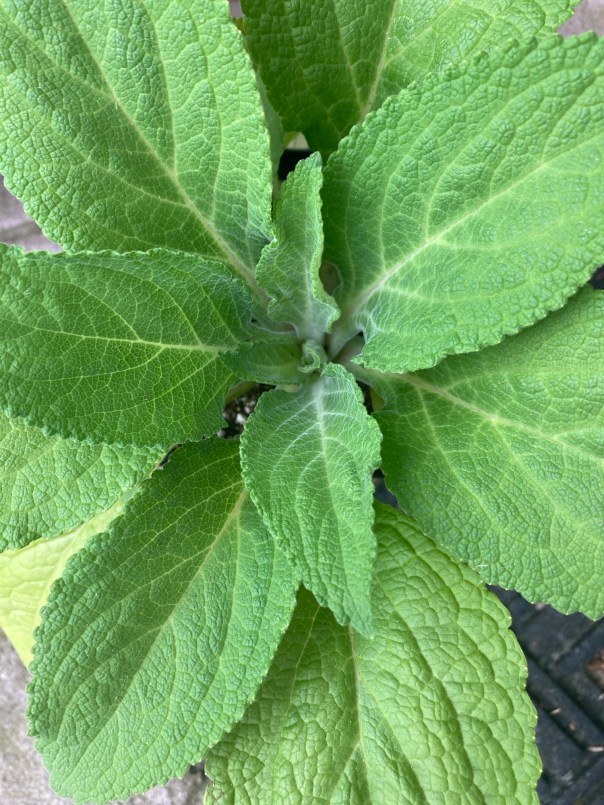
This spring, I bought exactly one plant on my own, without any idea of where I might install it. I will wander tomorrow and find a setting for a foxglove plant.
For a few years, back when my garden was newly landscaped, I had three native currant bushes (ribes) with their showy flowers and intoxicating scented leaves.
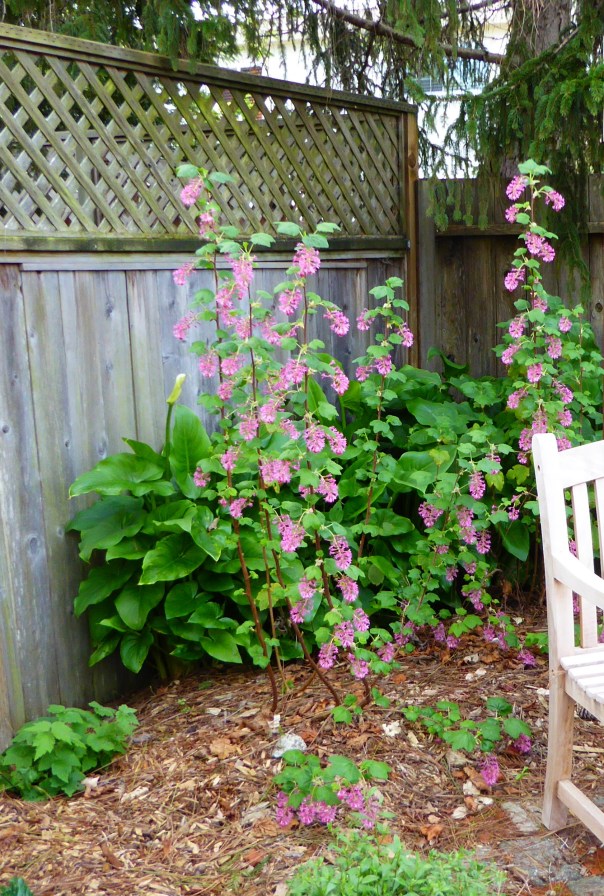
Ribes, March 2017

They grew so large that they engulfed the bench in front of them, making it impossible to sit there:
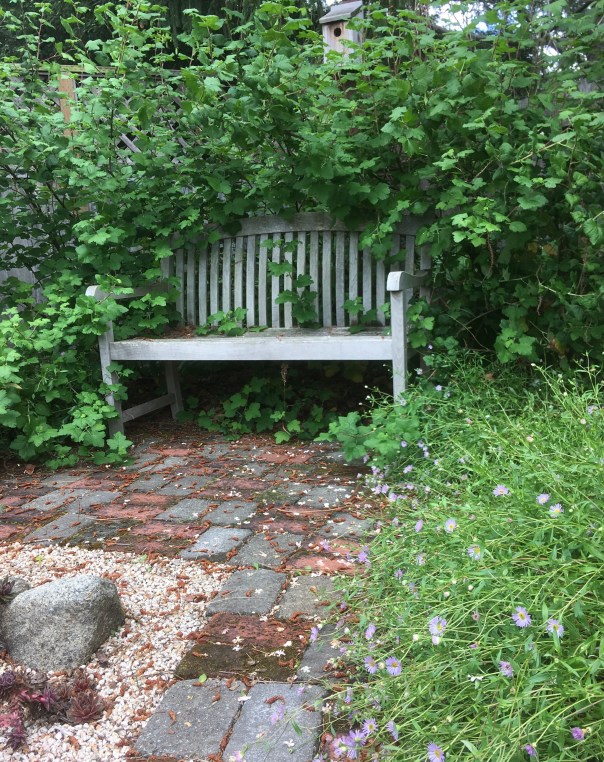
Ribes, May 2019

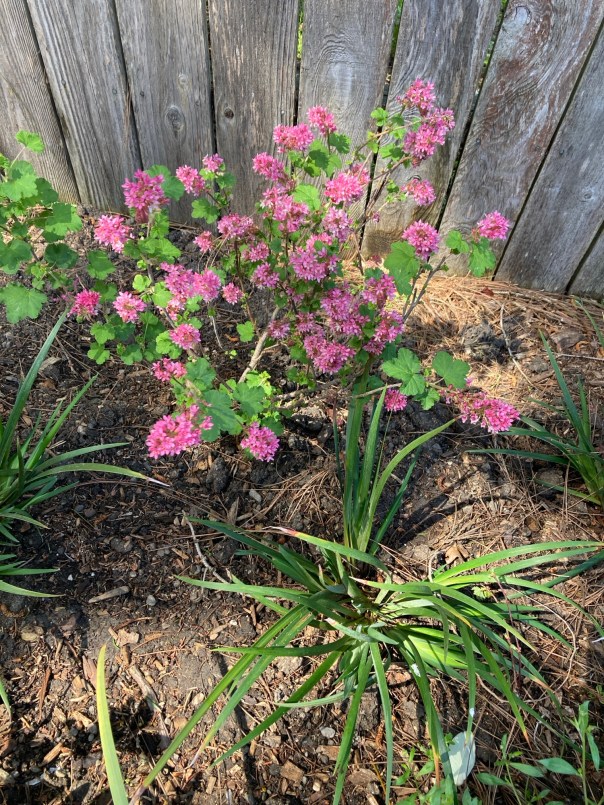
After I pruned them, they bloomed again …. and then one by one they died. No one could figure out why. Now we are trying some new ones, which don’t look like the same plant exactly, but they are blooming very prettily right now:
Last fall I made it to the hardware store after most of the bulbs were already bought up. All they had of muscari were these “special” ones below. I bought a big bag, and then regretted it, thinking they might turn out to be just weird. So instead of planting them near the front door, I put them in various places in the back garden, where they are blooming late… and I do think they are odd.

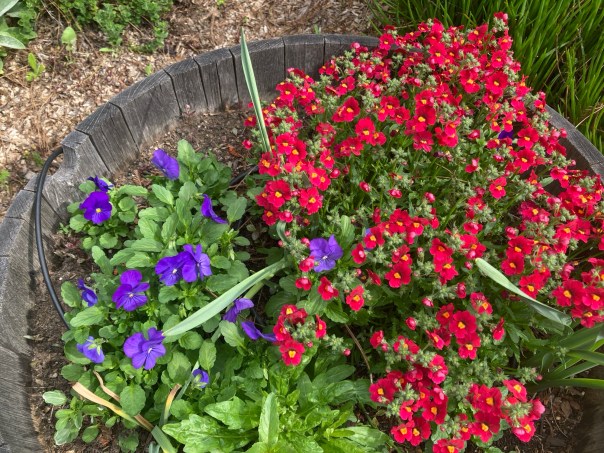
Revived survivors from last year.

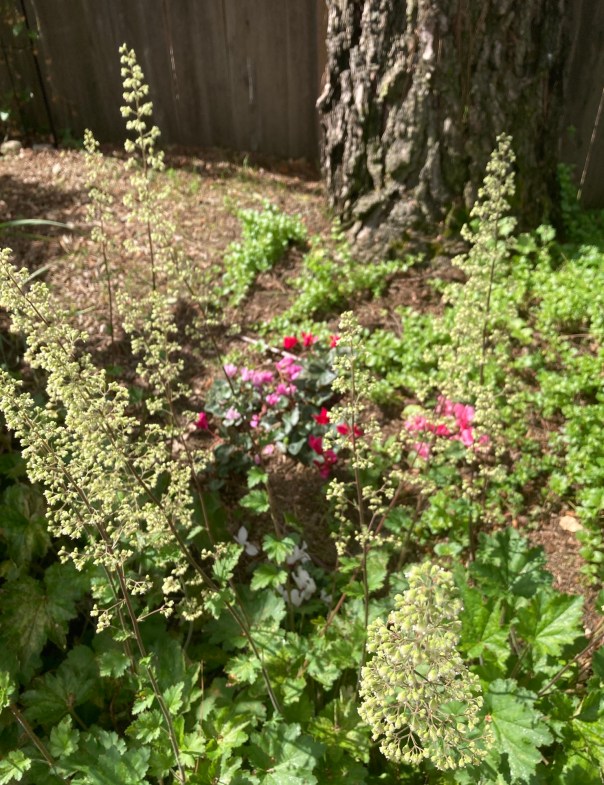
The heuchera are covered with their bells already, and you can see my little cyclamen plantation behind. The soil is very shallow because of tree roots, but they come back year after year; recently I added two more to their family.
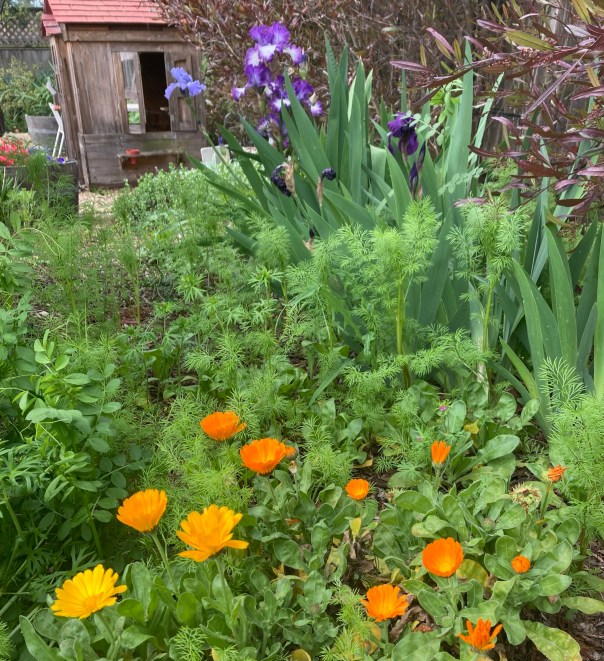
I will close with a cheery calendula group. They are brighter than ever because of all the rain they got, and will never look this good again until next winter or spring, if they get a good winter watering. It’s just too dry in my garden for them to thrive, but they are like many of us that way, right? Rarely are all the conditions optimal for our looking and feeling our best. The calendulas are surrounded by tall, pushy, more drought-tolerant “tares” that don’t seem to bother them at all. I hope to follow their example and cultivate more hardiness, and cheeriness too. Or — merriment.

Because this morning I was reading a Psalm not in my usual translation, and it went like this:

And let the righteous be glad;
Let them greatly rejoice before God;
Let them be glad with merriment.
The fountain is dry, but not I.

This morning the fountain-cleaner Bill did his good work scrubbing and flushing out my fountain, and then left it empty and turned off. I am traveling a lot in the next month and don’t want it to become a swamp while I’m gone.

Out my bedroom window.

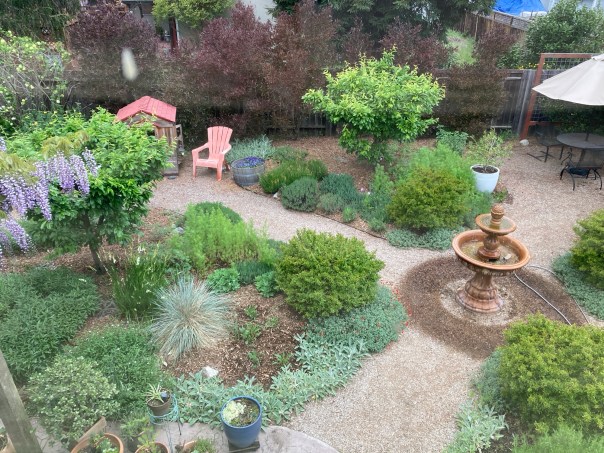
The garden is looking pretty good right now because it’s entering the flowery time of year, and because I’ve had several days to focus on it, to be out there noticing not just little weeds that are easily pulled out of mulch, but this and that glorious scent and sight.

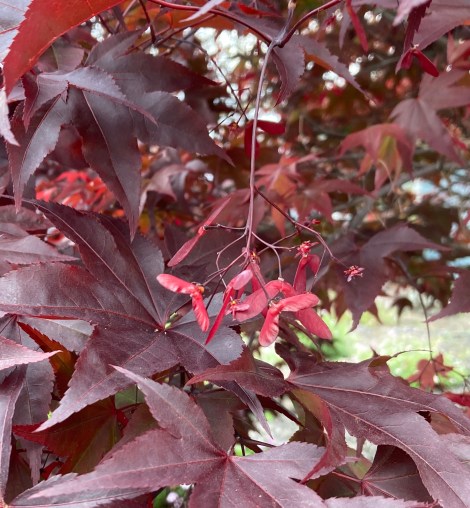
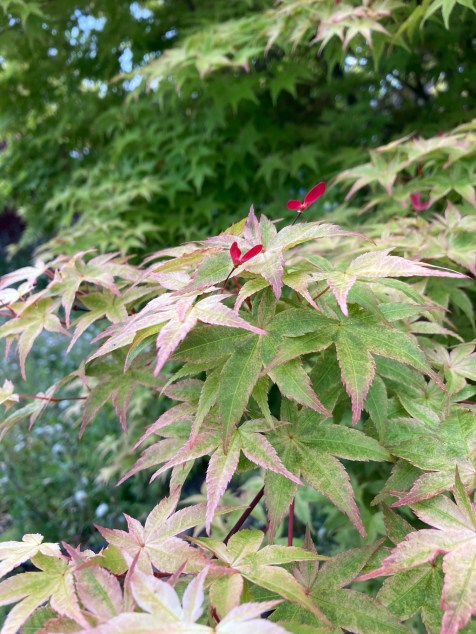
On my neighborhood walks, too, I’m spying perfection of Japanese maples…

…and at church, just look at the wisteria! I could only fit about half of its span in the frame:

Springtime is downright boggling, to the mind and the heart.

During the few days that were cloudy and gloomy, I washed the dirt from my hands and put them into the sourdough. My recent loaf is very tasty, but it would not rise — well, not much. After several hours I gave up and hoped for oven spring, which did not happen. So I got this stunted result, shown after I had sliced it to store in the freezer, so I can take out one slice (2 1/4 inch tall) at a time.

Soon I was back outside again, planting three butternut squash starts and a Juliet tomato plant in the planter boxes. There is no frost in the forecast, and I will soon be gone to Wisconsin for a while, for the first of the grandchild weddings. My original plan was to just wait until mid-May this year to plant summer vegetables, but it seems worth the risk at this point to get them in sooner.

We Orthodox are entering Holy Week on Sunday. I will be away from my parish for most of it, and through Bright Week, and away from my home and garden, so any real-time reports I might have time for will be field reports, or travelogues. For now, I’m soaking up all the familiar and beloved elements of my world to fortify myself against the asphalt and airports that lie between me and daughter Pearl’s garden. Once I arrive there, I will be well nourished by hugs and kisses from a dozen or more family members, and won’t even think of my lemon tree or coral bells back here.

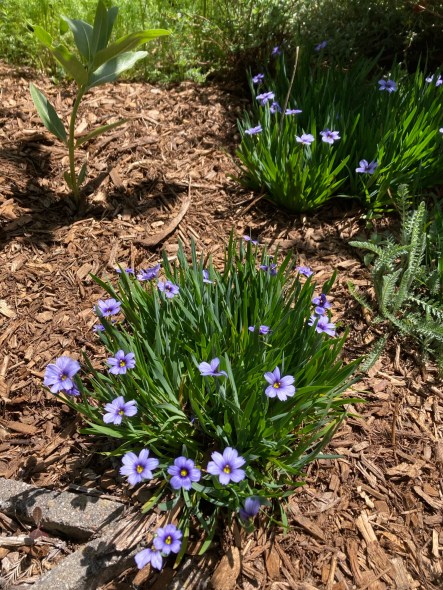
But not quite yet! When I noticed the bee with its head in the lithodora (picture at top), I was mostly looking at the Blue-eyed Grass nearby. It is so sweet it breaks my heart.

Months overthrown by a calendar.

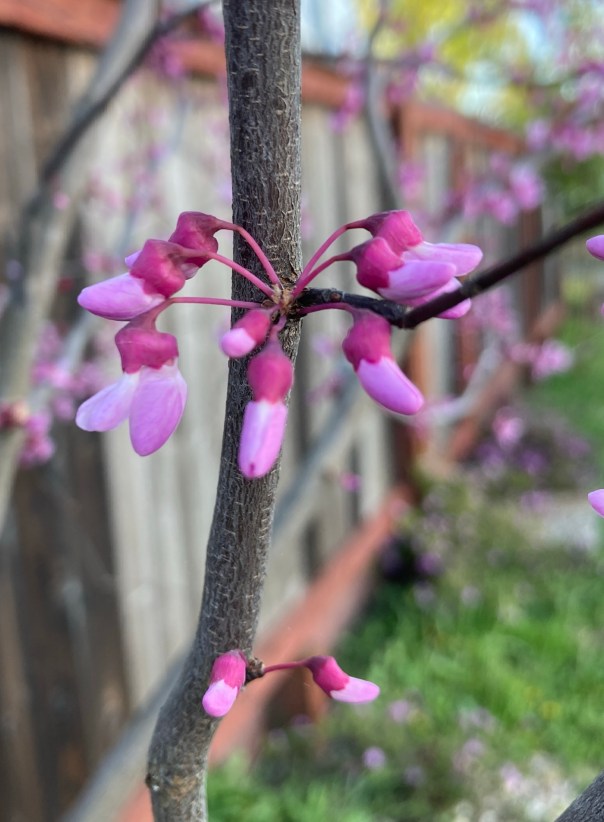
Redbud on my walk.

This is the season when every day’s wandering in the garden reveals sprouts and blossoms that startle me: Can this lithodora already be filled out, and I didn’t notice it happening? When did the coral bells get as high as my nose?

At church the scents of wisteria and other blossoms are heavy in the air, and when I walk to and from my car I have to slow down and focus on breathing as I make my way.

Maybe all of this botanical activity wouldn’t be as surprising if I’d been more attentive to the garden, but I’ve been restraining myself from going to the nursery or planting anything new just yet; the next month or so involves a lot of traveling, when I won’t be able to tend to anything. The reason for travel is, two of my grandsons will marry this spring, and one granddaughter. But in between the May weddings I hope to put a few zucchini seeds in the planter boxes where they will get automatic irrigation.

Wisteria at church.

The plant just above, I can’t remember the name of. [Mrs. Bread already looked in here and reminded me that it is Tasmanian Flax, Dianella tasmanica.] This one is at church, but Mrs. Bread gave me a specimen last year and I’ve planted it here; mine isn’t blooming yet. They eventually have berries that look like elongated dark purple grapes.

I bought one more wall calendar to help me do better at keeping track of where I am in time. I love having calendars and clocks all over the house. It’s from Beauty First Films and claims to promote “the overthrow of months.” I ordered it late, so we are already into Lent, which is revealed by this calendar to transcend the months, and to infuse the everyday chronos of life, emphasizing the gifts of the Church that lead to kairos. This year’s version also features the churches of Serbia:

Lithodora with Salvia behind.
Smallage

Many years ago Mrs. Bread and I split a six-pack of smallage plants. Then I re-landscaped and let mine go. She gave me a sprout from hers a year ago and it is Not Small At All now. I like having smallage around because it’s nice to put in soups, but I don’t really want to give a quarter of the planter box to it. Unfortunately, I think the boxes are the only place it would get the amount of watering it likes.

Swiss chard, on the other hand, I can’t have too much of. I procrastinated picking this crop for a couple of months, during which time a couple of snails fattened themselves on it. There was still plenty left for me, and I finally took off every last beautiful leaf from a dozen plants and cooked it all up. Most of it went into the pot to make my favorite lenten Garlicky Chard with Cannellinis. I’m showing the Italian Silver Rib Swiss Chard, but I actually harvested about twice as much Rhubarb Chard.

April may have rushed in to my life, but now that it’s here I’m pleasantly surprised that we’re only half way through the month. We Orthodox are more than half way to Pascha, which is also surprising. I can tell I was made for kairos, because I never can get used to this chronos life!

Fresh news just before publishing: My dear friend and brother in Christ, “Mr. Greenjeans,” who started me working in the church garden and taught me tons about plant and plant names; who for many years and several times a month made all the huge bowls of dough for our church prosphora bread; who got me literally up to speed chanting the Hours in church; who became an even closer friend since 2020 when he and his wife began hosting small tea-and-talk sessions at their house — That Friend no longer has to struggle in this chronos world, but has fallen asleep in death, has gone to his rest, to await the Resurrection. Memory Eternal!

Louise Bourgeois, Woman and Clock

Getting along in the garden.

The garden always seems to have an intention of its own, apart from what I have planned for it. Last year I planted several new milkweed varieties on the south side, and none of them has emerged as yet. But under the fig tree the hearty Showy Milkweed volunteers have arrived as a whole regiment, even sprouting up through the lithodora.

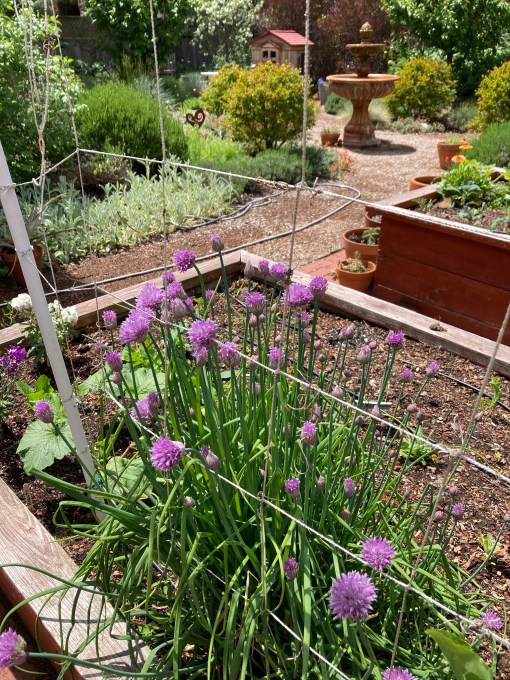
So many of the welcome flowers are of the blue and purple hues, like Blue-eyed Grass and the first salvia bloom. I planted the sweet pea flowers in a row where chives were already growing; the chives are huge now, and I might have to cut them back to clear the way for the sweet peas to see the sun.

A single anonymous sweet pea volunteered in a big pot, back in the fall, and was trailing all over the path, so that I was stepping on it. So I stuck a mobile trellis next to the greenhouse and tied it up there.

This pink jasmine is finally thriving on a trellis against the fence. It looks pretty right now, but soon the salvia will send out its long branches and hide it. The garden is definitely overcrowded in spots….

One of the areas that felt overcrowded was in the front garden where a False Cypress grew. It was getting too big for my taste, and it’s kind of scruffy, so I took it out. Now more sunlight can come into my living room. I will replace it with something smaller and more interesting in the fall.

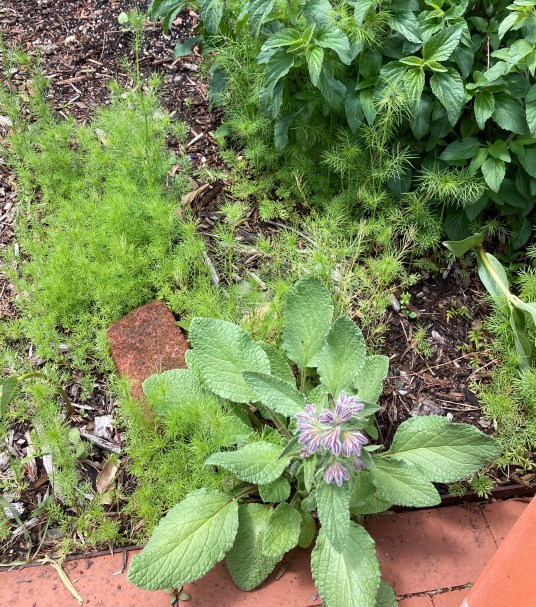
Borage has been surprising me by sprouting here and there, encouraged by all the rain; this is the most vigorous of the plants, and it’s in a place where I might remember to squirt it with the hose occasionally and keep it growing through the summer. (That ferny plant surrounding it is Love-in-a-Mist.) I don’t often use borage for anything, but the bees do! I hope it will grow away from the nearby fig tree, so that in late summer when I’m picking figs, I won’t be encroaching on the bees’ favorite feasting grounds. It will be interesting, day by day, to see how all the plants and insects and birds — and the gardener — coordinate their work for the maximum enjoyment of all.

Bee on milkweed 2019