A wife is not composed of words, so Unlike a novel that takes till dawn To devour she cannot be read through in a night
Repeating the uneasy lines of a poem Over and over, rereading again and again would be different, too (though it probably looks the same)
Yesterday, while driving the car In a break in the din I heard for a moment the beat of a bird’s wings Ah, I thought
That ‘Ah’ was just for one moment, but It would need an eternity to comprehend, never mind My wife, who is before me sleeping or awake
Is it arrogant to even want to read a person? Not her expressions or gestures But to want to read that person, my wife Unable to be satisfied with just living together?
My wife speaking to me from across the table My wife wordlessly tossing and turning in bed The one there that seems like Loyal ladies-in-waiting serving a wife I can’t see
In the breath inscribed in each sentence Punctuated by daily reality Its draft turns the pages of my wife
I wish to grasp not the look but the way of the words In a quiet place far from both my wife and myself And like a twig that smells the approach of snow in the air I want to read my wife
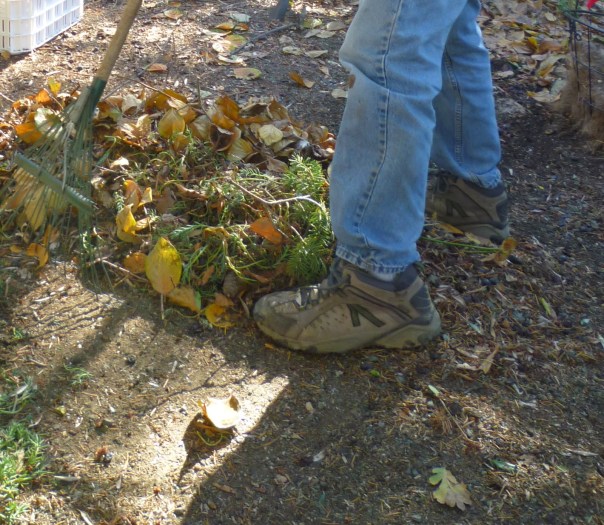
All those times I was bored out of my mind. Holding the log while he sawed it. Holding the string while he measured, boards, distances between things, or pounded stakes into the ground for rows and rows of lettuces and beets, which I then (bored) weeded. Or sat in the back of the car, or sat still in boats, sat, sat, while at the prow, stern, wheel he drove, steered, paddled. It wasn’t even boredom, it was looking, looking hard and up close at the small details. Myopia. The worn gunwales, the intricate twill of the seat cover. The acid crumbs of loam, the granular pink rock, its igneous veins, the sea-fans of dry moss, the blackish and then the graying bristles on the back of his neck. Sometimes he would whistle, sometimes I would. The boring rhythm of doing things over and over, carrying the wood, drying the dishes. Such minutiae. It’s what the animals spend most of their time at, ferrying the sand, grain by grain, from their tunnels, shuffling the leaves in their burrows. He pointed such things out, and I would look at the whorled texture of his square finger, earth under the nail. Why do I remember it as sunnier all the time then, although it more often rained, and more birdsong? I could hardly wait to get the hell out of there to anywhere else. Perhaps though boredom is happier. It is for dogs or groundhogs. Now I wouldn’t be bored. Now I would know too much. Now I would know.
-Margaret Atwood
Here we have a different perspective on boredom from what I posted yesterday… and I love this poem. But I wondered about the line, “Now I would know too much.” Why would the narrator prefer less understanding — which is what I took as the meaning of knowing — ? In what way would it be too much? But then I mused on how well I relate to the feeling of regret, regret that there were any moments or hours in which I was not fully conscious, and thankful for my late husband. That of course would have been the perspective of a saint; if I had the chance to go back, I’m sure I would still not be one of those.
That made me think, maybe the line I didn’t get refers to the fact the narrator has come to realize, that “he” was not going to be around indefinitely, and that the loss of him would be incredibly painful. It’s the sort of intelligence that sinks deep into the soul, where the struggle to comprehend it continues indefinitely. Now, if she could go back, she would not be the same person, and the kind of knowledge she would take back to the past would be truly too much to bear in that “present.” It isn’t given to us humans to skip back and forth through time, which is a good thing, because just reading this poem demands more of my mind than is comfortable. Most of us can barely attend to the present, and excessive theorizing can be a sad waste of our hours.
That I should read the poem during the holiday season, when I’m already prone to missing my husband a LOT… well, it happened, and it’s okay. It prompted me to think of some specific moments and places, my own husband’s hands (easy for me to pay attention to), and habits, and “boring” things he would talk to me about. I even remember a time when I was sitting in a boat, trying really hard not to be bored.
Nowadays, I’m increasingly thankful for all the days that God gave me before, during and after the years I lived with him, though I can’t go back and be this thankful retroactively. And even if I was not always present in the moment, God was always present with me. That is a thought that wakes me up, again and again.
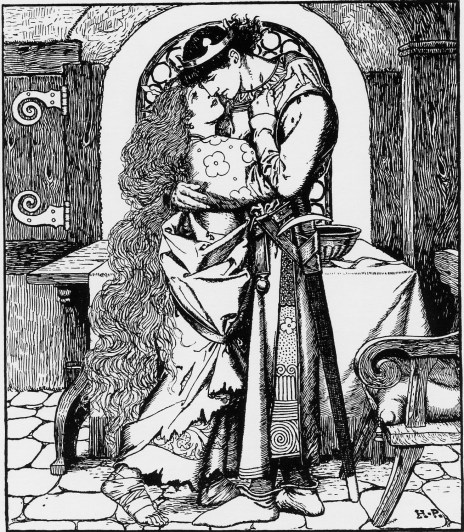
Just now I read a newsletter from a TouchstoneMagazine editor, on the subject of marriage. He included this quite old poem which conveys the feelings that a person might have, after the death of one’s spouse. Having lived that way of existence, the state of being one flesh with one’s spouse, as the Bible describes it, and then losing it… The poet graphically describes, in the most evocative metaphors, what the loss means, from his crown to his feet. He’s lost his grip on his own body.
ELEGY ON MAEL MHEDHA, HIS WIFE
My soul parted from me last night. In the grave, a pure dear body. A kind, refined soul was taken from me, a linen shroud about her….
Mael Mhedha of the dark brows, my cask of mead at my side; my heart, my shadow split from me, flowers’ crown, planted, now bowed down.
My body’s gone from my grip and has fallen to her share, my body’s splintered in two, since she’s gone, soft, fine and fair.
One of my feet she was, one side— like the whitethorn was her face— our goods were never ‘hers’ and ‘mine’— one of my hands, one of my eyes.
Half my body, that young candle— it’s harsh, what I’ve been dealt, Lord. I’m weary speaking of it: she was half my very soul.
My first love, her great soft eye, ivory-white and curved her breast, neither her fair flesh nor her side lay near another man but me.
We were twenty years together. Our speech grew sweeter each year. She bore me eleven children, the tall young long-fingered tree.
Though I am, I do not thrive since my proud hazel-nut fell, Since my great love parted from me, the dark world’s empty and bare.
Dear the soft hand which was here, King of the churches and bells. Och! that hand never swore false oath. Sore, that it’s not under my head.
—Muireadhach Albanach O Dalaigh, c. 1224 Translated from Gaelic in The Triumph Tree
The sun up above does feel like the ball of fire it is, today when the thermometer stands at 100 degrees. Summer caught up with itself and arrived with stored up (solar) energy!
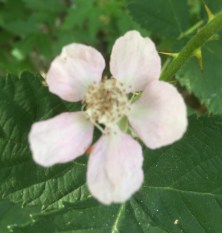
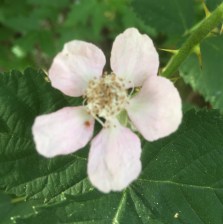
It was too late to take a walk, on a day like this, but I did it. Maybe it was the heat that made the phrase “ball of fire” come to my mind as I watched a spider mite racing around on a blackberry flower, never stopping. What can a mite accomplish if it never pauses? It’s the little smudge appearing in a different spot in each of the shots below.
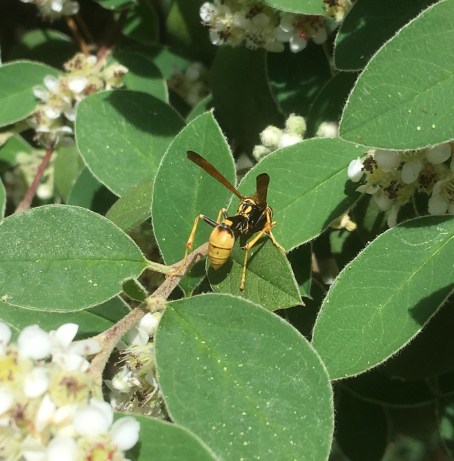
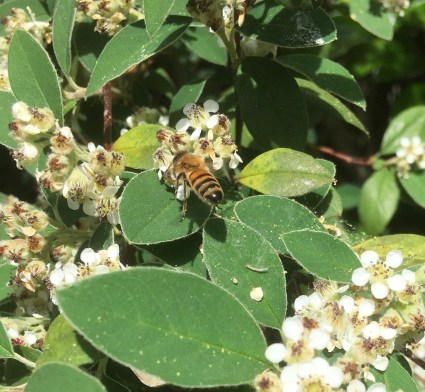
I also looked at the bees and flowers. I saw a syrphid fly and had to learn all over again when I got home that it was not a bee. In the process I learned that in the United States alone there are 4,000 species of bees. Here is another insect I don’t know… Is it a wasp or a fly? At least, I know it’s not a bee. [A year later, my Seek app thinks it’s a Western Paper Wasp.] (below)
I also can’t remember what this shrub is that all three insects are posing on. [So fast! My first commenter reminded me that it is cotoneaster.] Maybe I never have known. But I didn’t really want to spend today doing insect or plant identification. I need to wash the dishes and strip the bathroom floor! So if any of you know about my insect or shrub perhaps you can tell me.
syrphid fly
Most of the salsify have scattered their seeds, but some flowers are still opening.
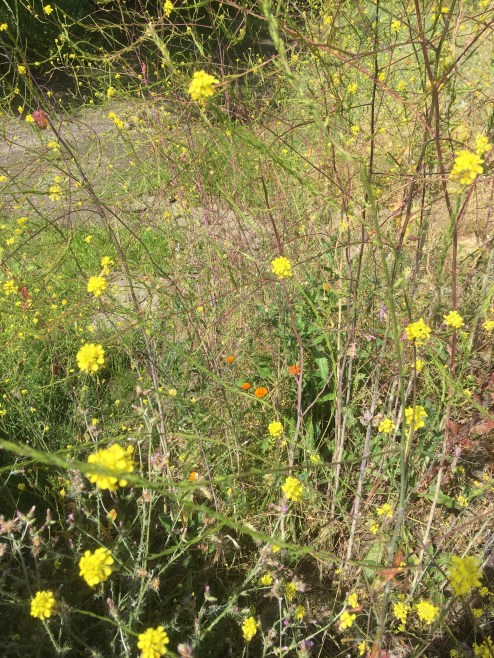
Mustard plants eight feet tall are growing out of the drying-up creek, along with lots of thistles. What is that orange spot that catches the eye…? Not a piece of trash, surprisingly, but California poppies! I’ve never seen them down there before.
All of this life, in many colors, pushing forth. I wondered… if I focus my camera on one small part of the very ugliest thistle, might I see something pretty? I did:
Last night at church we had a thanksgiving service for a couple celebrating their 50th wedding anniversary. When the husband retired from being a professor and a full-time Orthodox priest in Michigan, they moved from Michigan to California to be near their children. The wife said it was as though she had died and gone to heaven. 🙂 Since then they have been part-time participants in three parishes, and from all three of them people came to congratulate and rejoice with them.
I had been to only one other Moleben of Thanksgiving ever before, which was prayed for my husband and me in thanks and praise for God’s faithfulness during our 40 years of marriage. That was already seven years ago! This service was a joy – I was so happy to be part of it and to pray with them.
I had mixed up the time and arrived an hour early, which was kind of nice because I got to chat with the husband and his son a bit. The son was getting the barbecue ready for the party that would happen after the service. We were enjoying the shade of this beautiful catalpa tree whose flowers smelled like the fancy dessert was baking in the oven nearby. But this picture shows what my daughter told me about iPhone cameras, that they distort the sides of the image. Do you see how the buildings on the sides are both leaning in? Okay, now go back and enjoy the tree.
Before I go to my housework, I will have a tall glass of water, and before that, I’ll give you a little lotus weed in warm summery tones. I’ll meet you back here on a slightly cooler day.



 That made me think, maybe the line I didn’t get refers to the fact the narrator has come to realize, that “he” was not going to be around indefinitely, and that the loss of him would be incredibly painful. It’s the sort of intelligence that sinks deep into the soul, where the struggle to comprehend it continues indefinitely. Now, if she could go back, she would not be the same person, and the kind of knowledge she would take back to the past would be truly too much to bear in that “present.” It isn’t given to us humans to skip back and forth through time, which is a good thing, because just reading this poem demands more of my mind than is comfortable. Most of us can barely attend to the present, and excessive theorizing can be a sad waste of our hours.






 Gladsome Lights