Tag Archives: Met. Anthony Bloom

To be without God and to die of it.

I find myself in a phase of grief where from time to time during the day I feel acutely lost without my husband, the absence of him like a soreness in my spirit, an ache in the middle of my chest telling me that something is very wrong with me. Yes, something is wrong!! It’s death that is wrong – it’s wrong for us to be separated, for me to lose the heart of my heart. I have known this truth in my mind and for the world generally – now I understand it in my bones.
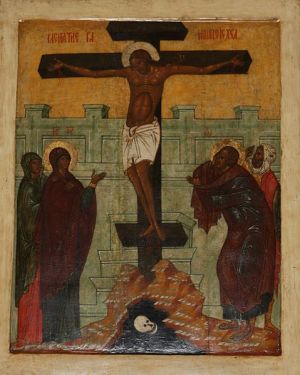
Crucifixion wikimediaBut as I’ve said here more than once already, I have the peaceful assurance that we are not absolutely separated, and a huge thankfulness as well that neither of us has been cut off from the Source of our life and existence. Sometimes we humans use the figure of speech that we will “die of grief,” because it feels that wrenching. But I know even as I am feeling it and railing against it, that I will live through it. This is all because Christ suffered for us, and he overcame death. My pain is like a pinprick compared to what Christ endured on our behalf. As  for my husband, “Blessed are the dead who die in the Lord.”

These words from Metropolitan Anthony Bloom that I first read in God and Man two years ago are even more meaningful to me on this Holy Saturday:

When in the Apostles’ Creed we repeat “And he descended into Hell,” we very often think “That’s one of those expressions,” and we think of Dante and of the place where all those poor people are being tortured with such inventiveness by God.

But the Hell of the Old Testament has nothing to do with the spectacular hell of Christian literature. The Hell of the Old Testament is something infinitely more horrid; it is the place where God is not. It is the place of final dereliction; it’s the place where you continue to exist and there is no life left.

Harrowing-Dionisius

And when we say that he descended into Hell, we mean that having accepted the loss of God, to be one of us in the only major tragedy of that kind, he accepted also the consequences and goes to the place where God is not, to the place of final dereliction; and there, as ancient hymns put it, the Gates of Hell open to receive Him who was unconquered on earth and who now is conquered, a prisoner, and they receive this man who has accepted death in an immortal humanity, and Godlessness without sin, and they are confronted with the divine presence because he is both man and God, and Hell is destroyed — there is no place left where God is not.

The old prophetic song is fulfilled, “Where shall I flee from thy face — in Heaven is thy throne, in Hell (understand in Hebrew — the place where you are not), you are also.” This is the measure of Christ’s solidarity with us, of his readiness to identify himself, not only with our misery but with our godlessness. If you think of that, you will realise that there is not one atheist on earth who has ever plunged into the depths of godlessness that the Son of God, become the Son of Man, has done. He is the only one who knows what it means to be without God and to die of it.

— Metropolitan Anthony Bloom

Christ forsaken.

Holy Friday, and I am sick. I see what a gift it was to be able to participate in last night’s Matins of Holy Friday service, now that I’ve already missed the first two services of the today and am just focusing on being better for the rest of the weekend.

While I am down it seemed a good thing to meditate on some words of Metropolitan Anthony Bloom from God and Man, in a chapter discussing Christ’s incarnation and death on the cross. I will share what seems a terribly truncated passage in the interest of accomplishing it today and in hopes that it will be just long enough to provoke profitable meditation. But I really wish you all could read this book that I first read last year and thought at the time, “That is the best book I have ever read.” Metropolitan Anthony:

One cannot be, as it were, plugged into life eternal and die. St. Maxim the Confessor underlines the fact that at the moment of his conception, at the moment of his birth, in his humanity Christ had no participation in death, because his humanity was pervaded with the eternal life of his divinity. He could not die. It is not an allegory or a metaphor when in the Orthodox Church on Thursday in Holy Week, we sing “O Life Eternal, how can you die; O Light, how can you be quenched?”

He died on the cross, and the operative words are the most tragic words of history: He, who is the Son of God, because he has accepted total, final, unreserved and unlimited solidarity with men in all their conditions, without participation in evil but accepting all its consequences; He, nailed on the cross, cries out the cry of forlorn humanity, “My God, my God, why hast thou forsaken me?”

…When Christ said “My God, my God, why hast thou forsaken me?” he was crying out, shouting out the words of a humanity that had lost God, and he was participating in that very thing which is the only real tragedy of humanity — all the rest is a consequence. The loss of God is death, is forlornness, is hunger, is separation. All the tragedy of man is in one word, “Godlessness.” And he participates in our godlessness, not in the sense in which we reject God or do not know God, but in a more tragic way, in a way in which one can lose what is the dearest, the holiest, the most precious, the very heart of one’s life and soul.

Crucifixion icon Russ

I shall stay where I am.

What is it then to be stable? It seems to me that it may be described in the following terms: You will find stability at the moment when you discover that God is everywhere, that you do not need to seek Him elsewhere, that He is here, and if you do not find Him here it is useless to go and search for Him elsewhere because it is not Him that is absent from us, it is we who are absent from Him..This is important because it is only at the moment that you recognize this that you can truly find the fullness of the Kingdom of God in all its richness within you; that God is present in every situation and every place, that you will be able to say: ‘So then I shall stay where I am.’

                                                              -Metropolitan Anthony Bloom

What the World Needs Now

A recent confluence of thoughts began with hate and destruction, in a blog post from Fr. George:

When we dream about changing the world, we are expressing our own dissatisfaction with it, and thus our rejection and disdain for it. Can you really change something you hate? Not really. What you really want to do is kill it. We want to destroy the world to build one of our own liking.

To love is to accept things as they are, calling the good as good and the bad as bad, and not needing to change them in order to accept them. The truth is you can only change yourself, and even there we have limits because we were all made in certain ways and some things were not made to change.

Fr. George’s exhortation to love and accept “things as they are” brought to mind this poem by Mary Oliver that I have posted in the past:

MESSENGER

My work is loving the world.
Here the sunflowers, there the hummingbird —
equal seekers of sweetness.
Here the quickening yeast; there the blue plums.
Here the clam deep in the speckled sand.

Are my boots old? Is my coat torn?
Am I no longer young, and still not half-perfect? Let me
keep my mind on what matters,
which is my work,

which is mostly standing still and learning to be astonished.
The phoebe, the delphinium.
The sheep in the pasture, and the pasture.
Which is mostly rejoicing, since all ingredients are here,

which is gratitude, to be given a mind and a heart
and these body-clothes,
a mouth with which to give shouts of joy
to the moth and the wren, to the sleepy dug-up clam,
telling them all, over and over, how it is
that we live forever.

When I pay attention, I can hear that a message is always being sent my way, a choice is set before me every day, and on some days it seems to come every few minutes: Will I receive life, and my life, as a gift, or will I fight against what is handed to me, and try to create my own life and self the way I see fit?

I’m familiar with the teaching from wise church fathers that acceptance is a large part of humility. And when I read this passage from Metropolitan Anthony (from “Meditations on a Theme”) it seemed to go right along with these other expressions I’ve gathered here, on what should be my attitude in this life I’ve been made steward over. Met. Anthony credits St. Theophan as the source of his comments about how the earth can teach us:

Just think about what earth is. It lies there in silence, open, defenseless, vulnerable before the face of the sky. From the sky it receives scorching heat, the sun’s rays, rain, and dew. It also receives what we call fertilizer, that is, manure—everything that we throw into it. And what happens? It brings forth fruit. And the more it bears what we emotionally call humiliation and insult, the more fruit it yields.

Thus, humility means opening up to God perfectly, without any defenses against Him, the action of the Holy Spirit, or the positive image of Christ and His teachings. It means being vulnerable to grace, just as in our sinfulness we are sometimes vulnerable to harm from human hands, from a sharp word, a cruel deed, or mockery. It means giving ourselves over, that it be our own desire that God do with us as He wills. It means accepting everything, opening up; and then giving the Holy Spirit room to win us over.

This week I’m getting ready for a trip to the mountains, to My Lake (see posts with the label cabin). I’ll be getting the garden watered, and in the mountains I’ll be seeing lots of earth and its fruiting forests and wildflowers. I will try to take it all as a reminder to open up and give the Holy Spirit room.