 Last night the women’s book group of my parish met at my house to discuss Summer Lightning by Wodehouse, and The Holy Angels by Mother Alexandra. I cooked up two pots of soup, and the other women brought rustic loaves of bread and salad and dessert.
Long ago I had got the idea of Cuban Black Beans from the Laurel’s Kitchen cookbook, and devised a soup with the same name to eat in winter, when the fresh and raw veggies the book’s authors suggested for a topping weren’t available from the garden out back. Now in the era of internet recipes, I discovered several recipes for the soup, and they used a sofrito, added in the last stage of cooking, made up of the peppers, garlic and onion sauteed with olive oil and bacon, topped off with vinegar and spices. This is what my sofrito looked like:

The beans in this case are cooked with ham hocks at the beginning, so it ends up a meaty and flavorful bowl for a winter’s evening. Mine was just the amount of spicy I wanted, but I’m not sure I could replicate that next time, if there is a next time. I had printed out three recipes from online, and concocted a unique stew, using parts of all of them and my old recipe, too. It took two pounds of beans, and I had plenty to send home with a few guests, as well as to put in the freezer. Because we also had Florentine Spinach Soup, which I have posted about before. Overall the women liked the soups very much.
 Thanks to our member who enjoys coming up with appropriately themed foods for our meetings, we ate angel food cake last night as well! I hadn’t read the Jeeves book that was discussed, but I did read The Holy Angels, and I plan to share a bit about that soon. We all thought it was a treasure.
This morning I actually took my walk before breakfast — that mostly because I ate breakfast so late. Now that I’m putting a high priority on walking, I need to keep re-setting it at the top of my mental list, so I don’t forget. One of these days I’m sure I will forget, and then (note to self) I’ll need to take a quick spin around the block in the dark, just before bed. I wonder if this is one of those behaviors that becomes a habit if you do it every day for three weeks?
I worked some more on Psalm 89 as I walked, and the beauty of its poetry did not distract me from the startling sights along the way, whose images I have shared here. One line from the Psalm:
So make Thy right hand known to me,
And to them that in their heart
Are instructed in wisdom.

Amen.
 But what does humility really mean? The derivation of the word “humble” is the Latin “humus,” meaning “soil,” and herein lies a most apt metaphor for understanding what is most basic to humility. The humble feel themselves equal to the soil upon which they walk and from which they are made. They cannot be lowered, for they are already low. But this lowliness in no way means servility; it means purity and godliness. Satan’s great fall came from his inordinate pride, which rendered him impure. For us, each time that we let pride get the better of us; we have similarly soiled ourselves. This is the nature of our lowliness: not servility, but a purity shared with the soil, by which we paradoxically remain unsoiled (by pride).
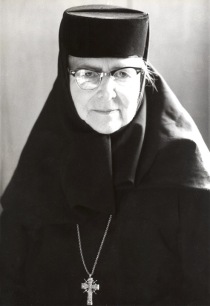
 established hospitals, and wrote books before joining a monastery later in life. A little later still she founded Holy Transfiguration Monastery in Pennsylvania. This year marks 25 years since her repose, and Frederica Mathewes-Green shared this quote from one of Mother Alexandra’s handwritten notebooks:
 Gladsome Lights