It might seem to my friends to make perfect sense, that I would start the new year by reading a book that is about gardening. But I don’t normally enjoy such topics in print, preferring rather to have my own hands in the dirt and my eyes beholding whatever garden the whole of my body is present with. But Inheriting Paradise: Meditations on Gardening by Vigen Guroian drew me in for several reasons:
*It was a Christmas present from Pippin and the Professor, personally chosen for me, and not yet buried in stacks or lost in the large community of other yet-unread books on my shelves.
*Of the books I was gifted with, it is the smallest and shortest, fewer than 100 pages, which makes it easy to read while lying sick in bed (which I have been a little) or anytime before falling asleep in health. This minimalist aspect also leads me to hope that I might be able to stick with the author to the last page. It would be great to restart my Recently Completed list before January is gone.
*I’m familiar with Guroian and have heard him interviewed on the Mars Hill Audio Journal, as he walked around his garden talking about the various plants and about this book.
*I knew that his book was not about gardening as a thing that could be detached from the Giver of Life, but it would also be a book of philosophy and theology, and probably include some good quotes from world literature.

Added to all these is a kind of fellowship with previous owners of this “used” book. On the title page an address label is glued on near the top, showing that Elizabeth A. Weber claimed the book at one time and was willing to leave her mailing address in it. On the next page are both the moving dedication of the author to his wife and a handwritten note from the year of the book’s publication.
Deeper inside were flowers folded in vintage Kleenex. But not too vintage – the book’s copyright is 1999.
I think I will want to share a few quotes from the book with you as I go along. Here is one:
“It is not the gardeners with their planting and watering who count,” writes St. Paul, “but God who makes it grow.” Indeed, we are not only “fellow-workers” in God’s great garden; we ourselves are God’s garden (1 Corinthians 3:7-9, REB). This is the ground of our humility as mere creatures among all other creatures loved by God.
It wasn’t a day to be a fellow-worker in my garden, even to clean up dead flower stalks. I was glad to be indoors, feeling loved by the rain’s healing and blessing. A brief hailstorm added excitement; immediately the nuggets of ice were melting away. I had just come inside from washing off that table when the shower began.

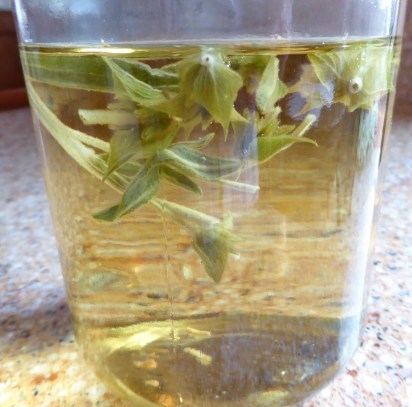
The product of someone else’s gardening or farming efforts came in the form of Macedonian Mountain Tea this afternoon. Mr. and Mrs. Bread tended to me by bringing some to the house to speed my healing. I’m certain this is the same tea I drank cold from a tall glass when I was in Turkey long ago. That was also called mountain tea, or ihlamur.
There seems to be confusion or disagreement in some places (even in my Turkish dictionary) about what constitutes Mountain Tea, but everyone will tell you that it is very healthy. What I am drinking seems to be some kind of Sideritis, if you want to look it up. “Mountain Tea” sounds much more wholesome, though, don’t you think?
To your health!
 Gladsome Lights