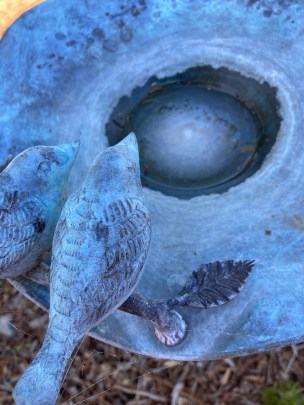
Whatever you do, do it gently and unhurriedly, because virtue is not a pear to be eaten in one bite.
-Saint Seraphim of Sarov
These words from St. Seraphim came into my mind this morning. They comprise one of my favorite quotes of of all time. It’s a strong admonition, but its simplicity and poetry display that gentleness that St. Seraphim was known for. The advice is what I need! I am always hurrying, trying to pack in too many activities, and it is hard to be gentle when one is making multiple messes (visible and invisible) with no time to clean up.
I did a lot of cooking today, and I cleaned up! But before that, I went into the garden to pick a fistful of greens for breakfast. Last night was the coldest yet this winter. But more flowers — and ice crystals — have bloomed since I last looked.
Many of my readers will not see the end of winter for a couple more months,
but I hope you will discover at least a metaphorical flower or two blooming nearby.
This is a post about bees. If you find them icky or boring and don’t care which bee is a robber, I understand! I put a pretty flower at the bottom for you to look at before you leave.
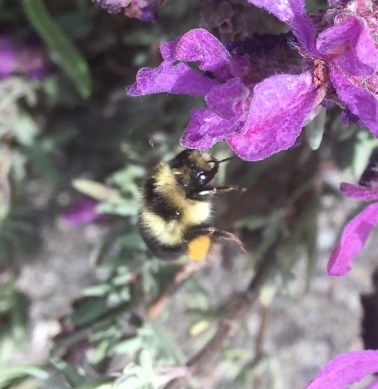
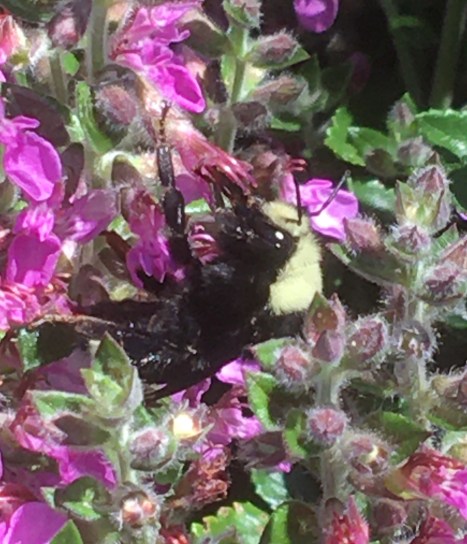
One morning this week I went back and forth along the front walk, for fifteen minutes or so, stooping over the germander hedges to watch a bumblebee. It caught my eye because of its yellow markings that were not what I’m used to seeing, and also because of its nectar-gathering style.
Was it because of its size and weight, that it couldn’t manage the flowers near the tops of the germander stems? It seemed to get lost in the understory of that purple forest, but would eventually resurface, tempting me to try again and again with my camera to fix his image (I can’t help switching male pronouns so I will just give in to my inclinations and be unscientific, because of course I have no idea of “his” sex.) so as to be able to see his markings better.
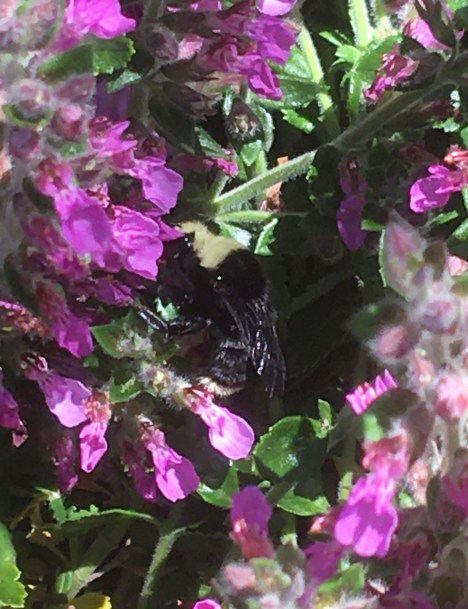
Here are the best pictures I got. Bees are buzzy and usually vibrating!
My Yellow-Faced Bumblebee is funny-looking! In that middle picture sprawled on his back like a suckling child, his yellow face is more like a yellow toupee. Here is a clearer, more classic image of the bee:
It is from the page Bumblebees of California, which is where I realized that what I thought for years was the primary bumblebee enjoying my pollinator garden is not a bumblebee at all.
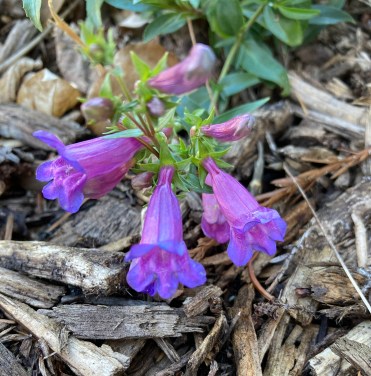
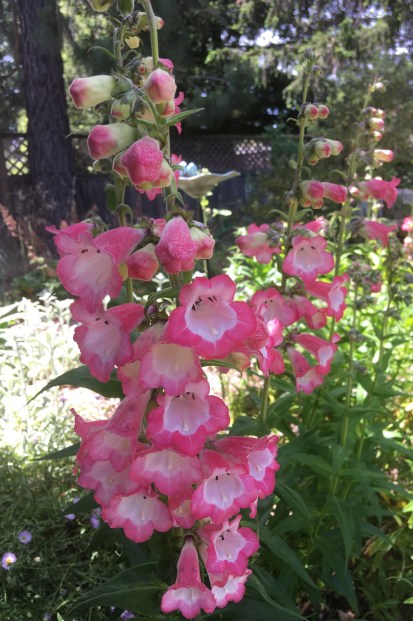
It wasn’t until that same evening that I was set straight. As the sun was about to go down, I was snipping spent penstemon blooms in the back garden when I saw one of these “bumblebees” visiting the non-spent ones. He was not trying to go in at the door, so to speak, but was busy at the top. Did he have a short cut to the nectar? Was he making a short cut?
Back inside, when it began to dawn on me that he was not a bumblebee, I searched for “black bees that look like bumblebees,” and soon realized that he is a carpenter bee. And on the first site I found they described what I had seen a few minutes before: “On flowers such as salvias, penstemons, and other long, tubular flowers the carpenter bee, due to its large size, is unable to enter the flower opening. Instead they become nectar robbers. Using their mouthparts they cut a slit at the base of corolla and steal away with the nectar without having pollinated the flower.”
I learned that there are 500 species of carpenter bees! Most of them are all black and hard to tell one from another. The easiest way to tell them apart from bumblebees is by their abdomens: The bumblebees’ abdomens are covered with dense hair, while the carpenters’ are shiny. This last fact I was well aware of, because it has been the biggest hindrance to me getting a picture of these bees that usually show up as shiny black blobs. But now that I have identified two bees in one day, and have blurry pictures to refer to when I forget, I will relax and move on.
But — early this morning I went out looking for Yellow Face. I didn’t see him, but I did see the carpenter bees, and what were they doing? Stealing nectar from the tubular white salvia flowers!
I wasn’t shocked, but pleased. And I don’t see why this should be called “stealing.” Is there a law of nature that says a bee has a right to nectar only if he pollinates the flower at the same time? Have the tubular flowers filed a complaint about the theft?
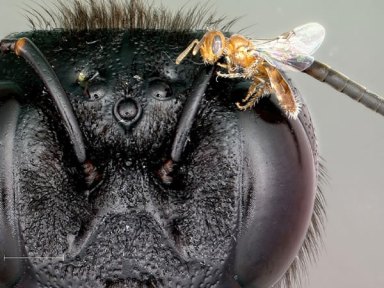
Last year I was trying to identify a strange-looking wasp, and I browsed entomology sites to no avail. Entomologists can’t even keep the thousands of species straight, and we common people who deal with insects our whole lives have strong and conflicting beliefs about their names and identities. I realized back then that wasps were a low priority for me; I’m sorry to say that I even hate some of them. But I feel otherwise about bees. Here is a photo from the U.S. Forest Service showing the smallest bee with the largest bee:
It is the Perdita minima on the head of a female carpenter bee. Wasps and bees, along with ants, are among the members of the Order Hymenoptera, but wasps are not bees any more than ants are bees. The first very readable paragraphs on this site I found helpful in refreshing my own memory on these creatures: Bees, Wasps, and Ants.
The tribe to which the 250 species of bumblebees belong is called Bombini. Isn’t that cute?
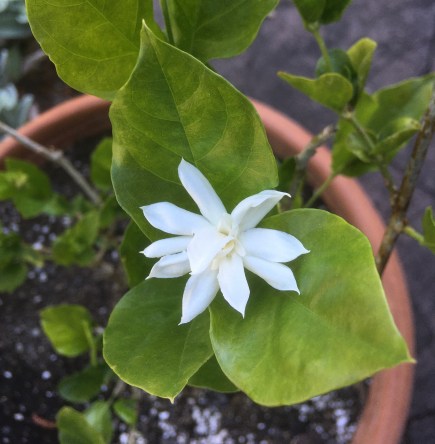
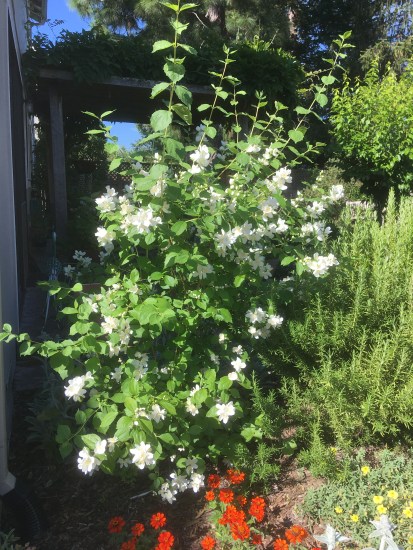
Okay, enough entomology for today. Here is that flower I promised you. It is my Belle of India jasmine that Soldier and Joy gave me for Christmas one year. It’s taken me a while to figure out how to make it happy, but now it is healthy and blooming and so sweet! I wonder if any Bombini will come by for a taste?
I sat in my garden reading Penelope Lively, who when writing about garden fashions that come and go, kept using the word “rill.” I picked up my phone to look up that word and see what the British might mean by it, and quick as a wink a tiny fly, almost too tiny to see without reading glasses, lit on the screen, with its wings open for about one second, a flash of shimmering rainbows.
Then it fell off, on to my book. Was that the fly, merely a black gnat? I got him to crawl on to my finger and back on to the screen, where he was kind enough to display his bright wings again for a moment, and then took flight.
On my walk yesterday I saw just one insect in a sea of catsear blooms. And I worked hard to get a picture of a flower with him on it. Not like most years of my photography, when I tried to avoid bugs on blooms, and would be disappointed if my flower were spoiled by a spider or something I hadn’t noticed when I clicked. But most of those critters had come out blurry anyway. No, getting a sharp image of an insect is not easy with a little phone camera. But I have time, don’t I? And a lot of digital storage, too, in case I don’t get around to deleting all those blurry pictures.
I started looking for flowers with insects, and of course, there were bees! It was so warm by this time, they were flying fast and furious, and couldn’t decide which of many privet or blackberry blooms to drink from, like kids in a candy store. The best shot I got was of one flying away with her loot. And I found a near relation to catsear beetle closer to home, descending a wide staircase of rose petals.
Obviously, I also am a kid in my own candy store, and can’t choose just one or two pieces of ambrosia to gaze upon or aim my camera at or share with you. If the temperature were constantly mild when I sit out in that paradise, I think I would fill to bursting with the joy of the place. But usually I get too hot or too chilly or find a task to do, so I don’t get dangerously stretched.
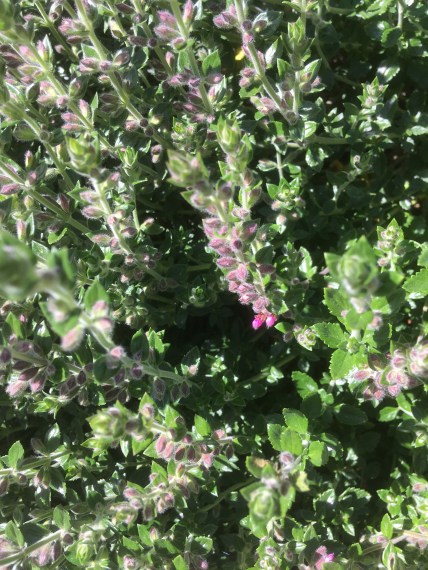
In my front garden many insects are buzzing back and forth and not lighting on any flower. I think they are just hanging around, or more precisely, swooping around — coming back to check every few minutes, so they can be the first to drink at the ocean of teucrium flowers that are going to start opening any minute now. I’m not sure that walkway will be wide enough for human feet to walk without colliding with honeybee wings.
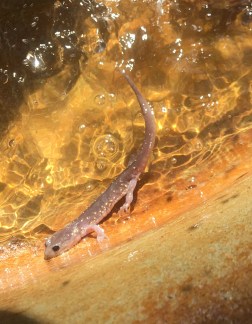
Many of the cistus, Jerusalem sage and helianthemum already need shearing! Alejandro my sometimes gardener was here yesterday and we moved one of the big pots that hold olive trees, and found two salamanders underneath! How they ended up in this droughty place I don’t understand, but I didn’t think about that at the time.
I grabbed the two of them, who looked like Mama and Baby, and put them to swim in the fountain for a minute while I ran into the house for my camera. Then I released them near a faucet with good luck wishes. Maybe I should have carried them to the creek? (Which reminds me, a rill in a British garden is a water feature.)
Back to the insect kingdom and their food… The word nectar carries a heady meaning. Drink of the gods – delicious. But the origin of the word is also pretty tasty if you like words: The first step back is to the Greek nektar (we’re talking about Greek gods, after all), “which is perhaps an ancient Indo-European poetic compound of nek- ‘death’ + -tar ‘overcoming,’ ‘cross over, pass through, overcome.'” No one used this word for the sweet liquid in flowers until about 1600.
Those links to the thought of overcoming of death could lead to an intellectual/writing exercise about how it’s all connected, but I’m not willing for that kind of workout today. I just want to join my fellow creatures in imbibing the sweets.
Last weekend I spent a few days in the High Sierra at my family’s cabin, where the winters bring such deep snow, the village by the lake is only accessible for four months of the year – or if we’re so unlucky as to have a year of little snow, four and a half months.
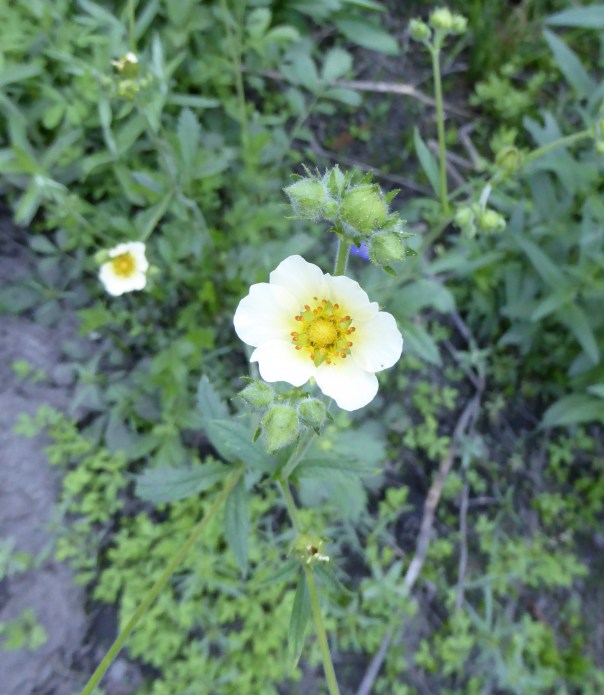
Sticky Cinquefoil – Potentilla glandulosaLarkspur – DelphiniumEnjoying the nectar of Arrow-Leaf Senecio.
Every year there is an annual meeting of the village property owners, and two or three community work days. I have never before participated, because I live far away. In the past I have let my sister and brother take care of these things, and count myself blessed to even get myself to the cabin once or twice a summer. But last week I was able to go up for the group effort, to work and attend the meeting!
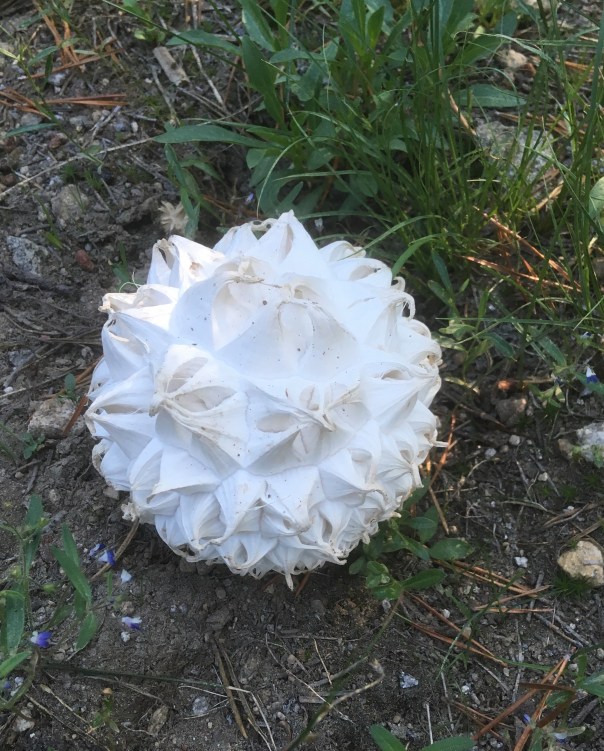
Not a flower, but a puffball fungus, Calvatia Sculpta. It was 5″ in diameter.Leopard Lily- Lilium pardalinum
The most fun for me was seeing the high country in July rather than my usual September, and the many wildflowers. I took hundreds of photos, and have been trying to learn the names of new species.
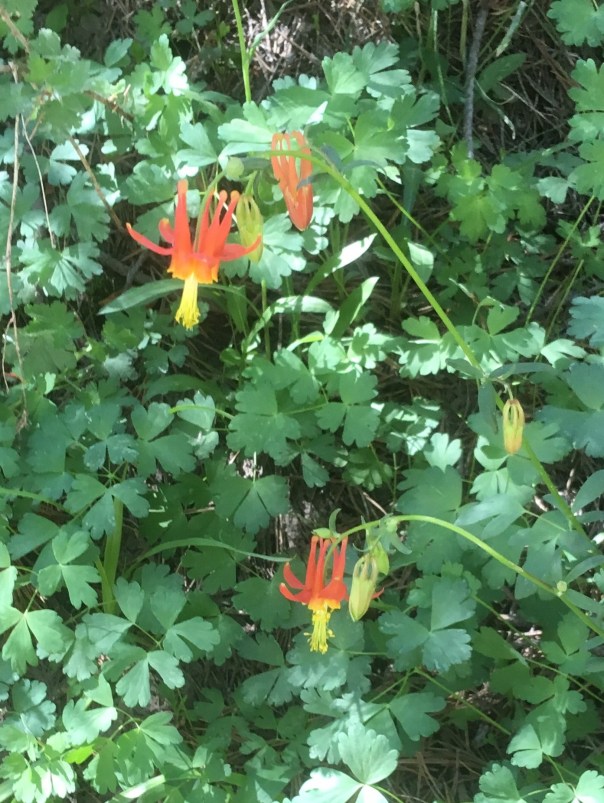
Even when I was cleaning out a culvert as part of the community work, I discovered some columbines and was glad I had my phone in my pocket, even if there was no cell reception.
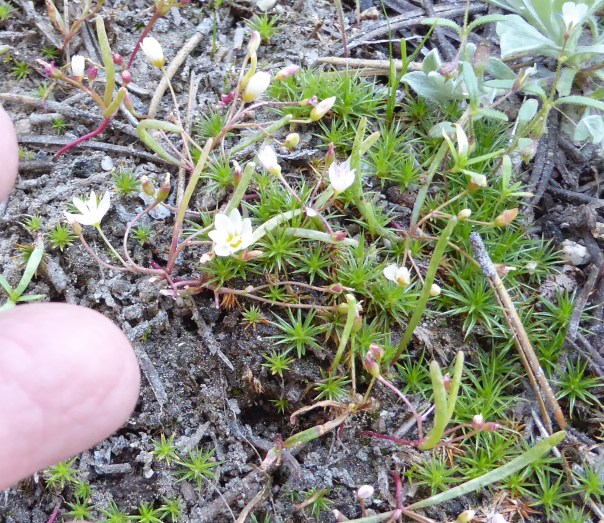
Some flowers are tiny tiny, about a half centimeter in diameter, but even so, scattered like confetti below showier blooms, they make a nice backdrop. Those are my fingertips in the second photo down.
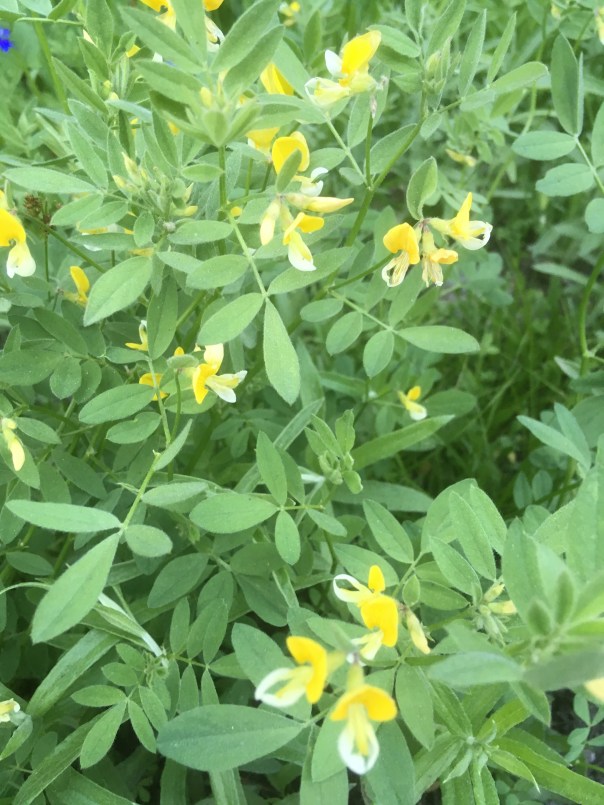
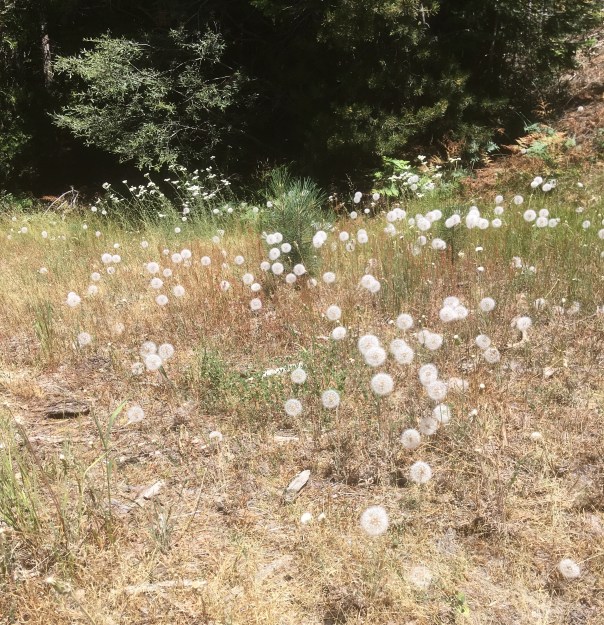
I haven’t figured out very many species, and some will no doubt remain a mystery for the foreseeable future, but Pippin helped me identify some right away via text messages. 🙂 The one below I found at a lower elevation and it is still unnamed. UPDATE: Thanks to Mary’s helpful prodding (see in comments), I have researched what these puffy things might be, and decided that they are probably Grand Mountain Dandelion, Agoseris grandiflora.
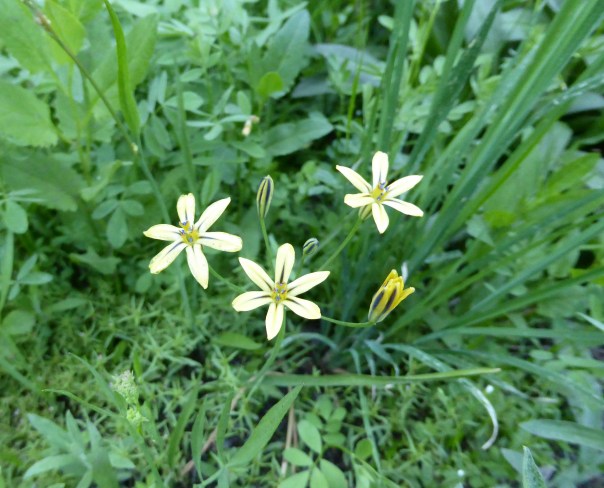
These I am sharing are just a few of the many I saw; there were also lupines, Pearly Everlasting, other penstemons, yarrow…. On a gravelly turnout Pussypaws (Calyptridium umbellatum) had bravely erupted heedless of cars that might soon crush them.
Yellow Monkeyflower – Mimulus, with Shooting Star
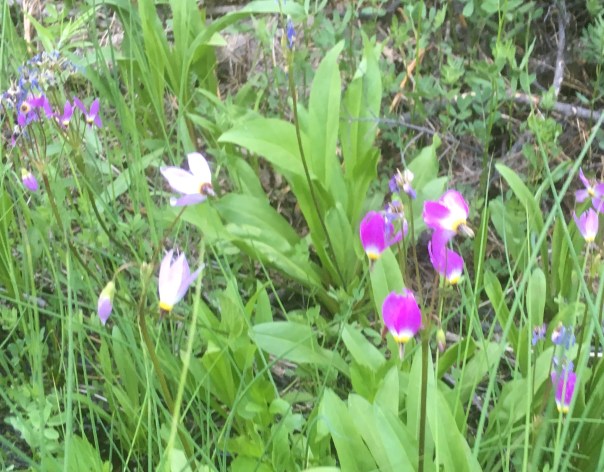
The Shooting Stars (Dodecatheon) were in wet areas. From my perusing of wildflower guides I’m guessing that the bright pink one is Jeffrey’s Shooting Star and the pale pink is Bog Shooting Star.
My plan is to return to the mountains a month from now. It will be interesting to see if I find any new species that bloomed a little later. Or do most of them pop out as soon as the snow has melted? I’m just glad that I arrived in time to meet them!
 Whatever you do,






 ro my sometimes gardener was here yesterday and we moved one of the big pots that hold olive trees, and found two salamanders underneath! How they ended up in this droughty place I don’t understand, but I didn’t think about that at the time.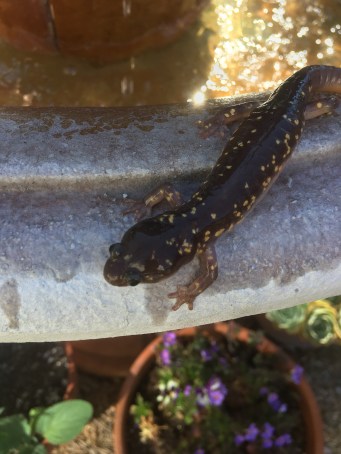









 Gladsome Lights