 Repentance is not self-flagellation;
it is an opening flower.
-Met. Kallistos Ware
In the last weeks I’ve been more aware than ever of the truth that What We Need is Not More Information – all the while collecting more books and reading, reading, reading. When I read Neil Postman in Technopoly say (in 1992) that our society’s glut of the stuff makes information into so much garbage, I was primed so that the word and image brought me great clarity.
“From millions of sources all over the globe, through every possible channel and medium—light waves, airwaves, ticker tapes, computer banks, telephone wires, television cables, satellites, printing presses—information pours in…. The 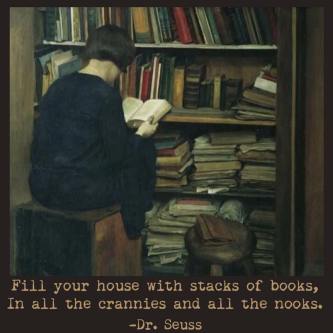 milieu in which Technopoly flourishes is one in which the tie between information and human purpose has been severed, i.e., information appears indiscriminately, directed at no one in particular, in enormous volume and at high speeds, and disconnected from theory, meaning, or purpose.” -Neil Postman in Technopoly
Even more recently Fr. Stephen Freeman re-posted this little meditation on simplicity, When Belief is Complicated, which, though it wasn’t particularly Lenten in focus, brought to mind Metropolitan Kallistos’s quote at top. Now I have two images in my mind, garbage overwhelming and weighing me down, and my soul as a tender flower struggling to open to God’s love and grace, but nearly crushed by the weight of a myriad of non-essentials. And Fr. Stephen introduces another metaphor:
“Kierkegaard wrote that ‘purity of heart is to will one thing.’ But we don’t will one thing. We will everything, regardless of the contradictions.
 “Faith is not a matter of ‘belief,’ an act of intellectual willing. Faith is a perception of things that do not necessarily appear obvious. In the language of Scripture – ‘faith is the evidence of things not seen.’ But the perception of faith is similar to the perception of objects beneath the surface of a lake. If the surface is disturbed, the objects disappear. The objects do not go away – but we can no longer perceive them.
“In a world of manifold complication – the surface of the water is rarely still.
“The journey of faith thus becomes a movement away from complication.”
For those of us who feel that life is too complicated; that we ourselves are difficult to understand; and that trust and faith are impossible, Father Stephen has suggestions. My favorites:
- Quit caring so much. The world does not depend on you getting the right answer to life’s questions. Answers often come when we learn to wait patiently for them.
- Quit thinking so much. If thinking would solve the problem and make things less complicated, you’d be through by now.
- Look for beauty. Beauty doesn’t make us think so much as it makes the heart a better listener.
- Take some time off – from as much as you can.
- Get some sleep.
- Give away money. At least someone will benefit by this discipline.
- Sing (beautiful things). The part of your brain that sings is much more closely wired to your heart than the part that thinks.
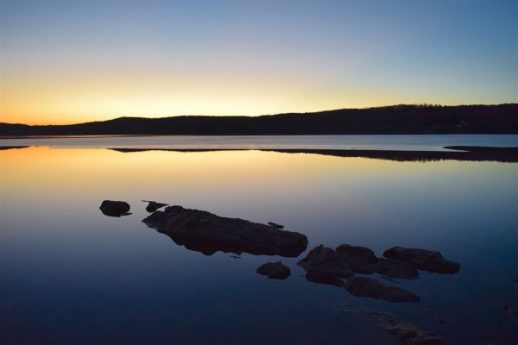
To put my hopes in terms of these evocative images: I am encouraged in the work of throwing off the garbage, opening like a flower, and peering down through the limpid water of a quiet lake, to glimpse the beautiful realities that my heart craves.
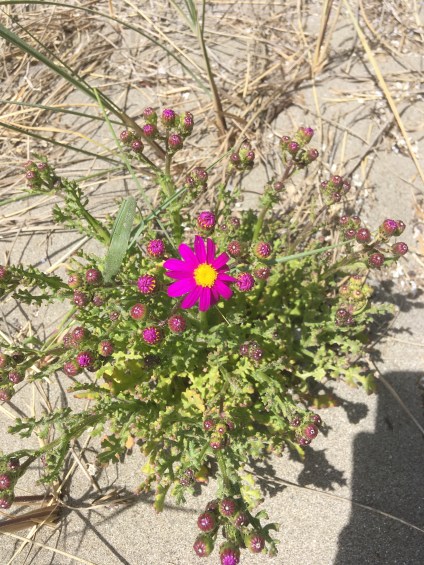
 Today’s beach trip kept getting put off, until by the time I got out to the coast it was already afternoon. These flowers had opened sometime in the last week; I don’t remember ever seeing them on the California coast before. The daisy flower looks like something that might have escaped a back yard, but the plant as a whole definitely does not.


 I saw this new sign, “Sensitive Wildlife Area: Do Not Enter,” one of many posted along the rope that surrounds an area not twice as large as what you can see in this picture. The dunes are of course always in flux from the changing winds. It seems odd to guard a relatively tiny spot, and also not to say what agency is forbidding the children to play there. [See more about this in the comments.]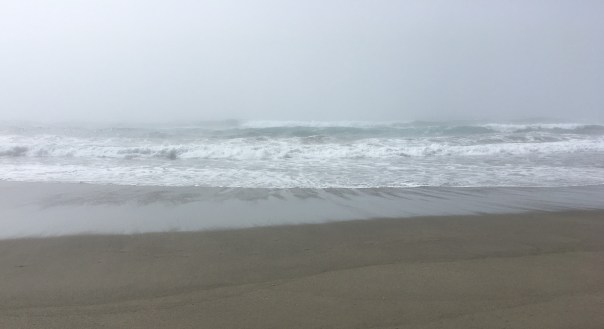
 On his blog
 Gladsome Lights