Tag Archives: re-post

When winter is over.

Last week it seemed that winter had just begun, but this evening a balmy wind blew in from I can’t imagine where, and made me think ahead to when actual winter will be over and gone. I offer this poem that makes reference to that point in the future, metaphorically:

A SHORT TESTAMENT

Whatever harm I may have done
In all my life in all your wide creation
If I cannot repair it
I beg you to repair it,

And then there are all the wounded
The poor the deaf the lonely and the old
Whom I have roughly dismissed
As if I were not one of them.
Where I have wronged them by it
And cannot make amends
I ask you
To comfort them to overflowing,

And where there are lives I may have withered around me,
Or lives of strangers far or near
That I’ve destroyed in blind complicity,
And if I cannot find them
Or have no way to serve them,

Remember them. I beg you to remember them

When winter is over
And all your unimaginable promises
Burst into song on death’s bare branches.

–Anne Porter

So much of any year is flammable.

I hadn’t read this poem carefully since 2011 when I first posted it. Now that I consider it afresh, that last line about Things I Didn’t Do is haunting me again!

BURNING THE OLD YEAR

Letters swallow themselves in seconds.
Notes friends tied to the doorknob,
transparent scarlet paper,
sizzle like moth wings,
marry the air.

So much of any year is flammable,
lists of vegetables, partial poems.
Orange swirling flame of days,
so little is a stone.

Where there was something and suddenly isn’t,
an absence shouts, celebrates, leaves a space.
I begin again with the smallest numbers.

Quick dance, shuffle of losses and leaves,
only the things I didn’t do
crackle after the blazing dies.

~ Naomi Shihab Nye, born 1952, American poet

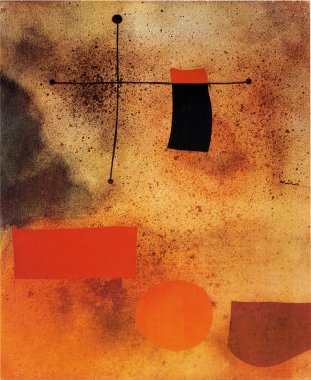
When when Maria Horvath posted this poem on her blog in 2011, she included the painting below, “Abstracto,” 1935 by Joan Miró

A woman without man has begotten man.

I don’t think many of us will be reading blogs on Christmas morning, so I offer this meditation a little early, from a Christmas homily of very long ago:

It was fitting that the Giver of all holiness should enter this world by a pure and holy birth. For He it is that of old formed Adam from the virgin earth, and from Adam without help of woman formed woman. For as without woman Adam produced woman, so did the Virgin without man this day bring forth a man. For it is a man, saith the Lord, and who shall know him [Jer. 17:9]. For since the race of women owed to men a debt, as from Adam without woman woman came, therefore without man the Virgin this day brought forth, and on behalf of Eve repaid the debt to man.Nativity.0

That Adam might not take pride, that he without woman had engendered woman, a Woman without man has begotten man; so that by the similarity of the mystery is proved the similarity in nature. For as before the Almighty took a rib from Adam, and by that Adam was not made less; so in the Virgin He formed a living temple, and the holy virginity remained unchanged. Sound and unharmed Adam remained even after the deprivation of a rib; unstained the Virgin though a Child was born of her.

+ St. John Chrysostom (d. 407), “Homily on Christmas Morning”

Do you wonder where Joseph is? Orthodox icons don’t show him in the typical western setting of the birth of Christ. You can find out about any unfamiliar elements of this picture from Iconreader in his post about the Nativity icon.

He was a divinely good person.

On the Feast of Saint Nicholas, I give you once more the words of Fr. Thomas Hopko from The Winter Pascha:

“The extraordinary thing about the image of St. Nicholas in the Church is that he is not known for anything extraordinary. He was not a theologian and never wrote a word, yet he is famous in the memory of believers as a zealot for orthodoxy, allegedly accosting the heretic Arius at the first ecumenical council in Nicaea for denying the divinity of God’s son. He was not an ascetic and did no outstanding feats of fasting and vigils, yet he is praised for his possession of the “fruit of the Holy Spirit…love, joy, peace, patience, kindness, goodness, faithfulness, gentleness, self-control” (Gal. 5:22-23). He was not a mystic in our present meaning of the term but he lived daily with the Lord and was godly in all his words and deeds. He was not a prophet in the technical sense, yet he proclaimed the Word of God, exposed the sins of the wicked, defended the rights of the oppressed and afflicted, and battled against every form of injustice with supernatural compassion and mercy. In a word, he was a good pastor, father, and bishop to his flock, known especially for his love and care for the poor. Most simply put, he was a divinely good person.”

Happy Saint Nicholas Day!

St. Nicholas Orthodox Church in San Anselmo, California