Tag Archives: reading

Taking the cure with Rumer.

Is it unnecessary and even unprofitable to analyze my reading habits? Why not just read what I like? Because I don’t seem to know what I like, or what I have the strength for. In times of stress, such as in my current bereavement and during my husband’s illness before that, the intellect still jumps at the chance to read books of theology or philosophy, so I have gone on acquiring stacks of them… only to find that my mind will not be engaged enough to get through the first chapter.

Or, I try a “good novel,” hoping to be pulled into the story and have some vicarious excitement. Aha – that is the problem, as I realized yesterday, sick and sitting by the fire with a quiet book. I need rest, not excitement. I need, as I wrote a few years ago about another novel, to embark on a reading journey “as one takes a needed vacation or The Cure at a sanatorium.”

Rumer Godden is a writer whose presence on the pages of her fiction or non-fiction is always strangely comforting and nourishing to me. I suppose my recent acceptance of weakness led me to take her China Court off the shelf, after passing over it for years. Lately it seems that I have almost daily been wandering among the four rooms that house parts of my library, as I look for the Right Book. As I held this one in my lap I mused about why it is that.

When you need to heal and build strength, where do you like to be? Me, I like to be either alone in an orderly and comfortable place, or with kind and gentle, competent people who take care of the place and might even cook for me. If there is a garden attached, and lovers of trees and flowers who might 27a16-p101064228129fruitstandgardenstroll its paths with me, all the better. I could sojourn in this place indefinitely, until I felt in my bones the renewed energy that would prompt me to go home and dig in my own garden or clean house.

Being in Rumer Godden’s books is like that. And China Court is especially so, because it is about a well-appointed house and the generations who have lived and worked and died there, servants making up beds with fresh, age-softened linens and a grandmother who secretly hand-picks little bouquets for her favorite people to find on their nightstands. It has the drama of stories going back a hundred years, if you want that, but it is mostly about being there with real humans, many of them quite sympathetic, and of course none of them requiring anything of me.

I haven’t read too far yet  🙂 but I was charmed by this one scene and wanted to share it:

In the big house in Cornwall the large Quin Family gathers downstairs while breakfast is being cooked in the kitchen nearby. As the father Eustace reads from the Bible and prayer book… victorian-range
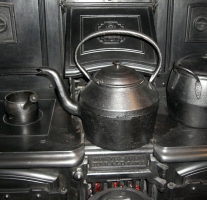
The smell of bacon drifts across the Lord’s Prayer — always for Eliza, the two are mingled, though she does not, at that age, get any of the bacon — and as the smell rises Eustace increases his pace….breakfast is waiting; the children, upstairs, have porridge and milk, white bread and the second best butter; but for Eustace and Adza the morning-room table is laid with porridge in blue and white plates, cream, brown bread, muffins, honey and rolls, while the bacon keeps in a silver dish over a flame, with another dish of kidneys or sausages or sometimes kedgeree.

-from China Court by Rumer Godden

Do you wonder what kedgeree is? I had never heard of it, but when I read on this page Kedgeree and saw the picture, it made me want to try making some myself. Sounds tasty!

Last week I was frying something using bacon fat left over from our Christmas feasting, and the smell of it warming in the pan brought back happy memories of my father and his mountain cabin, my grandma’s kitchen… it was curious how nourished I felt, before I had taken a bite.

I enjoyed reading about this Victorian Era breakfast and the well-supplied kitchen and staff that produced it. I sipped my tea before the fire, glad that I long ago graduated from the Porridge Upstairs stage of life, because I do like a little meat with my breakfast, though I haven’t tried kidneys yet. Winter days are cozy when taken with Rumer Godden, some bacon — and of course, prayer!

A certain reading skill is dwindling.

This year was not a good one for me sticking with books and completing them. I started reading at least three times as many as I finished. The likelihood of my getting to the end of a book in 2017 remains iffy, so to show that I had what it took at least a few times in 2016, I will list here (so you don’t have to click to the Books and Reviews page) my Books Read, most recent at the top. I wrote reviews for two of them — make that three, sort of — and you can use the links to those if you want.

At least I can say that most of these are worth reading again, and they are worthy of better reviews than I accomplished. I’m starting the new year with just one very small book in hopes of getting off to a good start!

Read in 2016

The Fellowship of the Ring by J.R.R. Tolkien
Acquiring the Mind of Christ by Archimandrite Sergius Bowyer
When Breath Becomes Air by Paul Kalanithi
Between You and Me by Mary Norris (audio)
Seventeenth Summer by Maureen Daly
The Year of Living Danishly by Helen Russell
Laurus by Eugene Vodolazkin
All the Light We Cannot See by Anthony Doerr
Babylon’s Ark by Lawrence Anthony (audio)
This House of Sky by Ivan Doig

Happy New Year! And may your own reading nourish your mind and heart!

books-too-many-nyt

Illustration from the NYT supplement “Holiday Books.”
Housemate Kit said it reminded her of me.

Looking at snakes.

Having two boys of my own, and eleven grandsons, I have done my share of reading to them books about snakes, a topic on which I probably would never have read one word if left to myself. I’m so accommodating. Last week I even read many pages of a giant book about dinosaurs.

That book mysteriously appeared in my house a year or more ago and I didn’t pay much attention to it until Scout asked me to read it last week. It may have been the most boring read-aloud I have ever agreed to, and finally I said I’d had enough. After he went to bed I threw it in the trash.

Snakes are more interesting, I admitfree-green-snake-wallpaper-hd-wallpaper, because they live on the earth with us and can be observed as they really are. But still….
I sat with the grandchildren twice last week to read the snake book that is in our home library, and I re-learned several things about the reptiles. Doubtless I will re-forget most of the facts we read, too, as I always have done, even when my brain was younger and more flexible. I have read stuff like this for so many years: “Would you believe that a python can swallow a whole goat?…The snake doesn’t chew or swallow the way we do. It simply moves its body forward with its jaws wide open and ‘walks’ the animal down its throat.”

When I imagine this scene, or look at pictures of it, I think about how the snake itself is consumed by the task of consuming. Even the egg-eater, who takes only 15 minutes to finish the job and spit out the shell, can’t go anywhere or sleep or drink water, for the duration. The beautiful green flying snake can’t sense a hawk threat and take off like a spring to escape.

After Scout had gone home I came across a poem about the way a snake eats, and I started reading it with the idea of someday sharing it with him. But when I got to the last stanzas I realized that it was for me, much more than for a snake-fascinated boy. Through this poem’s impact, what I learned of snakes I won’t be forgetting. It might take a python a few hours to eat a goat. My portion is of a different calibration and I only know that I’ll be at it a while.

SLOWLY

I watched a snake once, swallow a rabbit.
Fourth grade, the reptile zoo
the rabbit stiff, nose in, bits of litter stuck to its fur,

its head clenched in the wide
jaws of the snake, the snake
sucking it down its long throat.

All throat that snake—I couldn’t tell
where the throat ended, the body
began. I remember the glass

case, the way that snake
took its time (all the girls, groaning, shrieking
but weren’t we amazed, fascinated,

saying we couldn’t look, but looking, weren’t we
held there, weren’t we
imagining—what were we imagining?)

Mrs. Peterson urged us to move on girls,
but we couldn’t move. It was like
watching a fern unfurl, a minute

hand move across a clock. I didn’t know why
the snake didn’t choke, the rabbit never
moved, how the jaws kept opening

wider, sucking it down, just so
I am taking this in, slowly,
taking it into my body:

this grief. How slow
the body is to realize.
You are never coming back.

–Donna Masini, from Turning to Fiction


What summer is for.

Do you know how hard it is to pick up just one book at the library? I managed to do it twice this week and I felt my self-control as a great freedom; I didn’t even go into the used bookstore that is off the lobby. But since then everything has changed.d76bf-beefromside

“People can lose their lives in libraries. They ought to be warned.” –Saul Bellow

When I was a child we lived ten miles from the nearest public library, and I never visited it until high school. I had lovely hours in the library in Berkeley when in the summers I visited my grandmother, and she would leave my sisters and me there for a while, and come back later when we had picked out a stack to take home. I remember checking out Anna Pavlova and Little Men when I was ten, and lying outdoors on a cot in the afternoons, in the mountains with Grandma at the Berkeley City Camp. When not at Grandma’s, our summers were too hot to manage much activity, so I sat indoors in an easy chair and read a book every day in those carefree days of youth, supplied by the bookmobile.

I think one of the books I read then was Seventeen by Booth Tarkington. When Bellezza wrote recently about Seventeenth Summer by Maureen Daly, I thought that was it, and I bought a used paperback and have been reading it, but it’s not what I remember. So I hopefully borrowed Booth Tarkington’s Seventeen from the library (closed stacks), and it’s waiting for me now. In no time at all I should be getting to it, because the Daly book is hard to put down. How can that be?

The backdrop of the story is the most luscious and lazy summer imaginable, evoked very effectively by the author’s prose. But when I’m reading it at night I don’t fall asleep, and one morning when I was still in recovery mode (She says, wondering if she will ever again not be in recovery mode…) I picked it up from my nightstand and read for an hour before getting out of bed. It is a book that makes me feel something of the leisure of my youth, when there was no need to hurry. Absolutely no need.14110-beeonflowerfrted

The worst way to read, he said, is with the thought that you do not have enough time. The only way to read is in the knowledge that there is an infinite amount of time stretching ahead, and that if one wishes to taste only a few sentences per day one is free to do so. –Gabriel Josipovici, Moo Pak

Last week on my way home from visiting my children I listened to Mary Norris reading her own Between You and Me, a book that has made me laugh out loud countless times, all by myself in the car. I’m so glad she narrated her own book, and I love her voice and her humor. She reminds me of the women in my father’s family. I could not be content, though, to only listen to it — I must have my own print copy. So I ordered one online. But I could not be content to wait for that to be shipped, and I discovered that the local library had a copy, so that was the first book I picked up.

Two days later Seventeen became available, so I went back for it. Today a dear person sent me a link to a Naomi Shihab Nye poem, “Different Ways to Pray,” and reading it confirmed in me the feeling I’ve had that I need to calm myself and sink into some poetry. I began to read more about Nye and her books. I saw that my local library had a couple of collections by her, and I also ran across this that she said:

There is a Thai saying: ‘Life is so short, we must move very slowly,’ ….Being busy has become our calling card, our sign of success, our obsession—but poetry doesn’t want us to be busy. When you live in a rapidly moving swirl, you can only view your surroundings with a glance. Poetry requires us to slow down, to take time to pause.

So I hurried over to the library and found 4c80e-gjreadhobbitwo27dellcrpthe one children’s book by Nye that I wanted…. and then I found a few more children’s poetry books to take with me; that’s probably the level that I am most likely to access currently.
Then on to the adult non-fiction and another book by Nye… but I could not make myself leave as quickly as I’d come. There I was with shelves of poetry and literature towering on either side of me, and I had to scan some titles, and take a few books down, and notice that a couple of my favorite poets were not even there! The armload I carried to my car included Robert Bly and W.S. Merwin.

Now, will I manage to sink in and let the poetry teach me to move. very. slowly…? I am finding it difficult to quiet down today; it seems that the effort to truly rest is wearing me out. Maybe that’s because I was awake past midnight reading about Angie, whose life before cordless phones and TV served up a flavor of time that we can hardly remember the taste of. Angie speaks of doing “leisurely things like ironing or peeling potatoes for dinner.” (Hinting at an attitude among teens that also may have become extinct soon after this book was written.) If she hadn’t recently fallen in love she’d probably be reading on the porch swing in the warm afternoons, too.

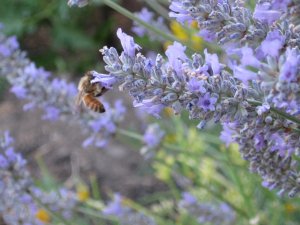
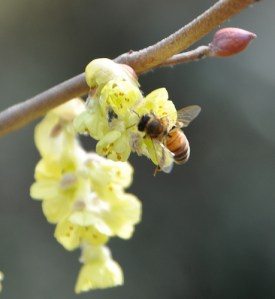
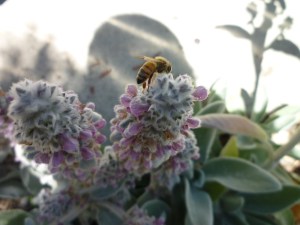
After all this rambling around the subject, I feel I must leave you with at least a little piece of a poem. So here are some lines from Nye’s children’s poetry collection titled Honeybee. They are from the poem “Girls, Girls”:8ec4e-beeinshadowlambsears

When a honeybee is alone–rare, very rare–
It tastes the sweetness
It lives inside all the time.

What pollen are we gathering, anyway?
Bees take naps, too….