Tag Archives: reading

We find old book and doll friends.

P1100825 dolls one box

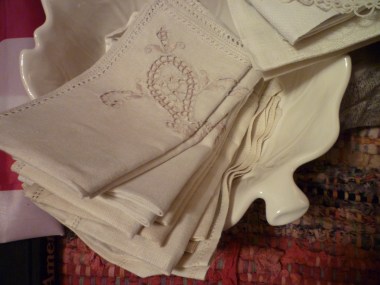
When Kate was here last month she did a lot of plowing through her childhood stuff — Well, to be truthful, that doesn’t really describe what happened. She lovingly looked through boxes of books and toys she’d collected in her first 18 years, and household items like linen napkins and unP1100683used potholders that had been passed down to her from her grandmother. She had in mind the usual sorting categories of Keep, Give, and Toss.

With her wedding fast approaching, it blessed me that she took the time to enjoy the task. She hasn’t lived in our house for many years, but she was remembering what she said was a very rich childhood, surrounded with so many books which she always knew were part of the household because they had some value. This made the finding of a book worth reading much more likely than if she looked in a bookstore or library.
P1100686

P1100685crp


Of course I find my children fascinating, and this peek into Kate’s memories interested me because it revealed that the development of her love for books and reading had an aspect I hadn’t even thought about. I was also pleased because it was a part of a success story. (I’m thankful that my kids don’t tell me about all the failings that I can’t change at this point.)P1100674
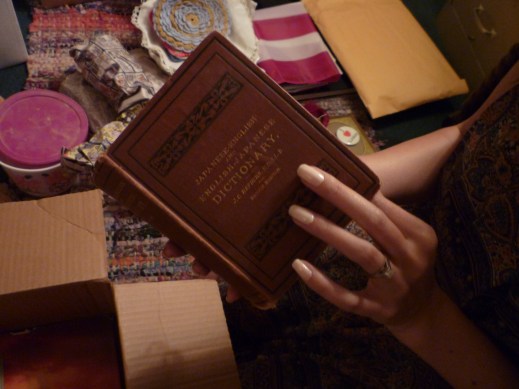
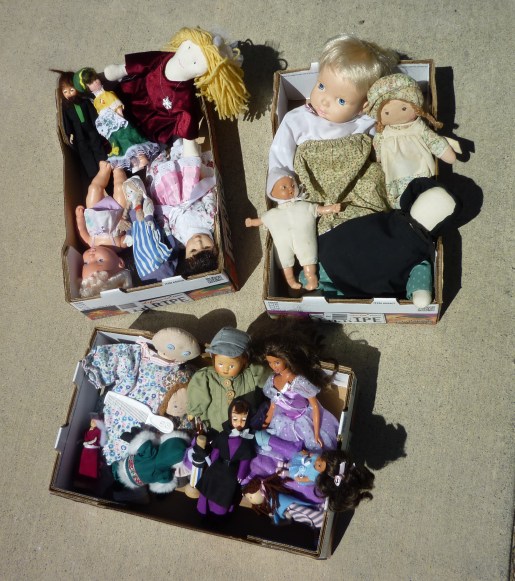
Kate used to collect dual-language dictionaries, even for languages she didn’t plan to study anytime soon, like this Japanese one above. And she had an assortment of dolls, most of which she has now bestowed on me to do with what I like.

I’ve been trying to figure out why grown women often like dolls and play with them, in adultish ways of course. Is it because we miss our children who have grown up? I find it hard to turn down a doll who needs a home, the way some people can’t say no to cats or dogs. I have a drawer full of dolls that I want to make new clothes for or mend in some way, and a suitcase full of really old broken dolls that belonged to our mothers and which I am even now gathering the will power and good sense to get rid of.

But I am quite thrilled to suddenly have so many new doll children who still have a lot of life in them. Before I decide how to distribute them, which ones to let the grandchildren play with, etc., I had to do something about the stink they had acquired by sitting in a plastic container for years.
P1100824

I set them out in the hot sun for a couple of days, and that did the trick. Maybe they didn’t even need the sunshine; perhaps the fresh air would have been enough therapy. But the ones with faces look happy enough to get the full outdoor experience.

P1100826crp

I used to love to read the Raggedy Ann and Andy stories to my children. Probably getting to know the personalities of the storybook dolls and following their secret adventures has contributed to my feelings about dolls generally. I can imagine that Kate’s dolls, over the years that they were ignored in that corner of the house, were sneaking out of their box and into the book boxes nearby to have fun improving their little minds. It sounds like something my children would do.

Books in privacy and retirement.

books one openIt’s now mid-afternoon and I haven’t said a word to anyone today. It’s the largest chunk of solitude to come my way in a long time, and very welcome. In Mansfield Park, which I am still reading, I really identify with Fanny, who, if she is not talking with her one dear friend and cousin Edmund, likes nothing better than to sit in her own room or walk outdoors where she doesn’t have to take part in conversation.
Her personality and character are in stark contrast to her Aunt Norris, who does whatever she can to enjoy “all the comforts of hurry, bustle, and importance.” And to Mary Crawford, who is fatigued by resting and does not take well to “privacy and retirement.”

The meaning of retirement here is not what most of us nowadays think of, but rather a “withdrawal into privacy or seclusion.” For me, today, it helps that the skies are rainy and I’m enjoying a last chance to wear my cozy flannel shirt as I do what many people in this kind of retirement do: read.

While I and people of my sort may be secluded from people here-and-now, we are very engaged with the author and/or the characters in the book. The National Endowment for the Arts research found that those of us who read are more likely to do volunteer work and to be involved generally in our communities. This kind of rest from one kind of “labor” energizes us for other kinds of work and service.

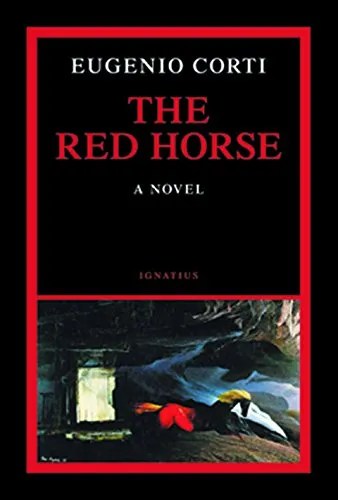
In the interest of reading a greater variety of books than I can heft while lying down in bed, I bought a Kindle. One of the first books I loaded on it is The Red Horse by Eugenio Corti, a giant of a book in every way. At least ten years ago I was deep into it, as one takes a needed vacation or The Cure at a sanatorium, but I had to give it up, mostly because of its size.

If any of my readers have read good books on e-readers, I’m open to suggestions. Many on my To Read list aren’t available on the Kindle, but it seems there are enough to keep me happy for a while. I definitely won’t be giving up altogether on printed books.

Now I must close and get myself another proper retirement accessory: a big mug of tea.

Love and Language

Over my car’s radio yesterday morning I caught the end of an interview with an author talking about her husband’s aphasia and recovery from it. As I drove into the Target parking lot the women were still talking, and I hadn’t heard any names of books or people yet, so I sat in the car a little longer, digging around in my purse to find a tiny black notebook to write in.

Eventually the host mentioned that we were listening to Diane Ackerman talking about her book 100 Names for Love, which tells the story of her husband Paul West’s recovery from a stroke, and the ways in which she was able to help him in the process, though their relationship was challenged and changed. The 100 names were the new pet names he came up with for his wife, when he could not recover the old ones. One of them that she mentioned was My Bucket of Hair. (She has a good head of it.) Many of the nicknames were as unusual and poetic, like My Remains of the Day, and My Residue of the Night.

I have tried reading Ackerman before, and there is too much about her prose and perspective that makes her tedious, but the things she said on the radio about love and care-giving and language recovery made me think I really wanted to read this particular book. I came home and put it on my Amazon list, but then I went on to read about Paul West, and found an excerpt online from the book he himself wrote, The Shadow Factory.

In the interview Ackerman had shared that, when he was depressed about not being able to write — and writing had been his profession — she suggested that he write a book about his experience, and he agreed to dictate to her as he labored to find each word and phrase in the rubble that was his brain. The following day he would rework the text, and the whole project became a huge part of his rehabilitation both emotionally and mentally.

I heard Ackerman describe her husband’s book as a “free associative dream version” of how it felt to have a stroke and to heal from it. Those words gave me the impression of it as the type of writing that I find hard to endure. But now that I’ve read this small part, I’m not sure I agree with her description. Here are a couple of paragraphs from the article I link to:

There was a bewildering assortment of false starts and incomplete sentences for the mind only. I no sooner thought of something to say to myself than I forgot it, and I was lucky to get beyond the second or third imagined word. Of course no one in his right mind overheard any of this, the dumb speaking to the silent in a reverse image, so no one was upset. But if this happens 50 or 60 times, one wants a little revenge of some sort. Of course, one was in all probability speaking no kind of written English, so this meant that whatever you said was relevant and you could not say anything irrelevant.

…

Reading, at which I used to be no slouch, now gave me the most incredible, disheveled experiences of my print-bound life. Now print jigged toward me, then it hung back. The one part of it that was readable swam backward or forward to render the reading experience at best incomplete, or subject to the vilest, maddest vagaries of a proofreader’s nightmare.

So far I am thoroughly enjoying West’s post-stroke prose, and find it much more focused and readable than Ackerman’s, so perhaps I’ll be content with having heard her radio voice, which seems to absorb better, and in my Amazon shopping cart I’ll trade her book for The Shadow Factory.

Grousing About Grammar – Bad Sentence

One thing I didn’t tell you in my recent review of Wordstruck by Robert MacNeil is how he gave an admonition that made me wonder if I am the right kind of influence on people:

“If you love the language, the greatest thing you can do to ensure its survival is not to complain about bad usage but to pass your enthusiasm to a child. Find a child and read to it often the things you admire, not being afraid to read the classics.”

MacNeil quotes a man named Hugh Kenner, who said of some people that they “took note of language only when it annoyed them.” In the days when I frequently read to my children, especially when they were older, I must say in my defense that I do remember stopping at least occasionally to point out particularly well-written sentences. But when the bad sentences force you to stumble or pause or halt completely as you try to figure out what is going on, you can’t help but be annoyed and take note of them, too.

This happened to me just today, and once again I will reveal myself in full nitpickerliness. The sentence that held me up fails in more than one way, so it’s very useful. I’m not going to tell you where it came from, but the author has a (recent) doctoral degree in Intellectual History. I’m not sure why I think that should mean something pertinent to my complaint…but let’s just get on with the beginning of his article:

F.M. [abbreviation mine] lived his life as a poet, a playwright, a novelist, a journalist, and a Roman Catholic. Born in Bordeaux during the year 1885 to a bourgeois family, M.’s mother tenaciously held to her religiosity. His father’s side of the family, on the other hand, sported Voltairean, republican, and anticlerical sentiments.

You can probably guess what happened to me as I was reading briskly along in the first sentence, then cruising through the stop sign period and on to the comma in the second sentence, fulling expecting that M. would be there after the pause — Oh! M’s mother is here, how odd…that must mean the author was talking about the mother’s birth in Bordeaux…strange that he would start out telling us about M., and then in the very next sentence start in on the mother…and there is his father in the following sentence…hmm…I don’t know much about M., but I don’t actually think he is recent enough that his mother could have been born that late…the author must be talking about M.’s birth, then. Too bad, now I have stopped thinking about M. and his mother and am all focused on this writer, poor boy, who spent so much effort in school and can’t get his lovely article off to a decent start.

Before moving on to find out more about M., I had to skip to the end and read the blurb on the author… next I began a rewrite of his problematic beginning in my head — so many times I have done this for myself and five children, trying out different arrangements of words and clauses so that you say what you mean and your reader can read you as effortlessly as possible.

What happened here is called a dangling participle or dangling participial clause. The “Born in Bordeaux” clause actually has no subject (it’s dangling there unattached), but we naturally expect the subject to be close by, so we try to attach the clause to M.’s mother, but it doesn’t really belong to her. The Wikipedia article to which I linked tells it all very clearly, along with other examples that are often funny.

One way that this particular beginning could have been rescued would be to make it slightly longer. Sometimes it just gets awkward, trying to pack too much into a sentence, and the best thing is to make one or two more sentence so you don’t muddle things. To put his birth and his mother’s religious attitude into one sentence seems to be hurrying along too fast, as though the author were just stringing his notes together.

And don’t try to be too clever in switching the order of your clauses and phrases. That’s partly how this writer got into trouble. It’s only the second sentence of your whole article, so certainly you can afford another sentence with the direct and simple subject-verb order.

To say that M. was born “during the year 1885″….It must just be a careless wordiness, because “in 1885” would do nicely, and during gives the impression of an ongoing activity. The time of birth is a date, not a duration.

How about this re-do of the second and third sentences, putting the mother into the father’s sentence, and we don’t even have to add lines. Taking out some commas makes it a  little cleaner, too:

He was born to a bourgeois family in Bordeaux in 1885. M.’s mother tenaciously held to her religiosity, while his father’s side of the family sported Voltairean, republican, and anticlerical sentiments.

Now that I’ve got that settled, I can go to bed. I’ll take the article along and hope I can keep my mind on M. this time.