Tag Archives: redbud

Months overthrown by a calendar.

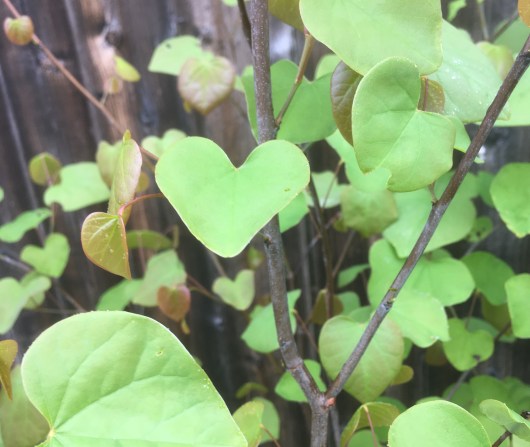
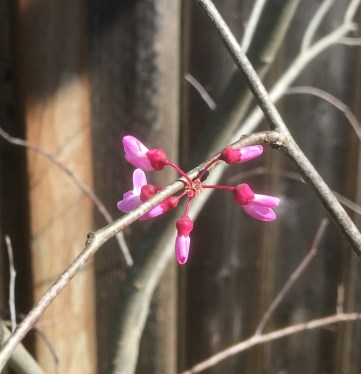
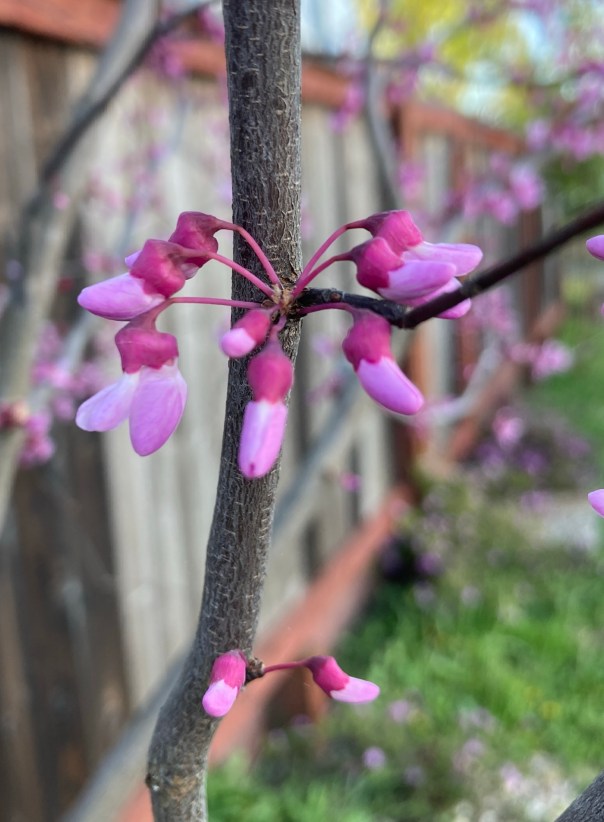
Redbud on my walk.

This is the season when every day’s wandering in the garden reveals sprouts and blossoms that startle me: Can this lithodora already be filled out, and I didn’t notice it happening? When did the coral bells get as high as my nose?

At church the scents of wisteria and other blossoms are heavy in the air, and when I walk to and from my car I have to slow down and focus on breathing as I make my way.

Maybe all of this botanical activity wouldn’t be as surprising if I’d been more attentive to the garden, but I’ve been restraining myself from going to the nursery or planting anything new just yet; the next month or so involves a lot of traveling, when I won’t be able to tend to anything. The reason for travel is, two of my grandsons will marry this spring, and one granddaughter. But in between the May weddings I hope to put a few zucchini seeds in the planter boxes where they will get automatic irrigation.

Wisteria at church.

The plant just above, I can’t remember the name of. [Mrs. Bread already looked in here and reminded me that it is Tasmanian Flax, Dianella tasmanica.] This one is at church, but Mrs. Bread gave me a specimen last year and I’ve planted it here; mine isn’t blooming yet. They eventually have berries that look like elongated dark purple grapes.

I bought one more wall calendar to help me do better at keeping track of where I am in time. I love having calendars and clocks all over the house. It’s from Beauty First Films and claims to promote “the overthrow of months.” I ordered it late, so we are already into Lent, which is revealed by this calendar to transcend the months, and to infuse the everyday chronos of life, emphasizing the gifts of the Church that lead to kairos. This year’s version also features the churches of Serbia:

Lithodora with Salvia behind.
Smallage

Many years ago Mrs. Bread and I split a six-pack of smallage plants. Then I re-landscaped and let mine go. She gave me a sprout from hers a year ago and it is Not Small At All now. I like having smallage around because it’s nice to put in soups, but I don’t really want to give a quarter of the planter box to it. Unfortunately, I think the boxes are the only place it would get the amount of watering it likes.

Swiss chard, on the other hand, I can’t have too much of. I procrastinated picking this crop for a couple of months, during which time a couple of snails fattened themselves on it. There was still plenty left for me, and I finally took off every last beautiful leaf from a dozen plants and cooked it all up. Most of it went into the pot to make my favorite lenten Garlicky Chard with Cannellinis. I’m showing the Italian Silver Rib Swiss Chard, but I actually harvested about twice as much Rhubarb Chard.

April may have rushed in to my life, but now that it’s here I’m pleasantly surprised that we’re only half way through the month. We Orthodox are more than half way to Pascha, which is also surprising. I can tell I was made for kairos, because I never can get used to this chronos life!
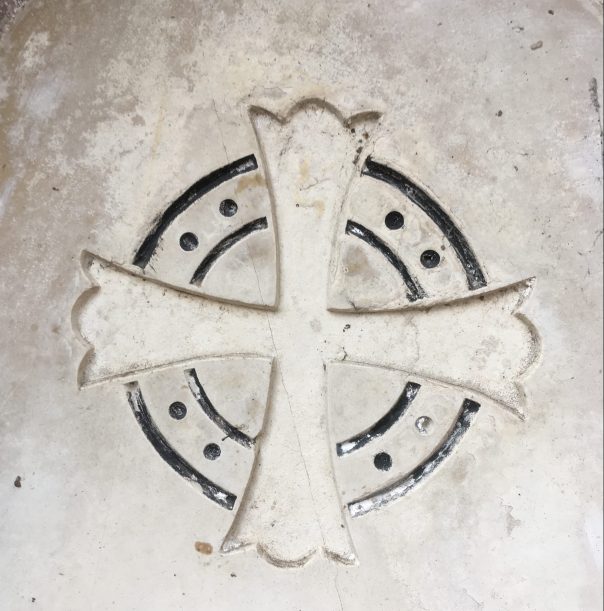
Fresh news just before publishing: My dear friend and brother in Christ, “Mr. Greenjeans,” who started me working in the church garden and taught me tons about plant and plant names; who for many years and several times a month made all the huge bowls of dough for our church prosphora bread; who got me literally up to speed chanting the Hours in church; who became an even closer friend since 2020 when he and his wife began hosting small tea-and-talk sessions at their house — That Friend no longer has to struggle in this chronos world, but has fallen asleep in death, has gone to his rest, to await the Resurrection. Memory Eternal!
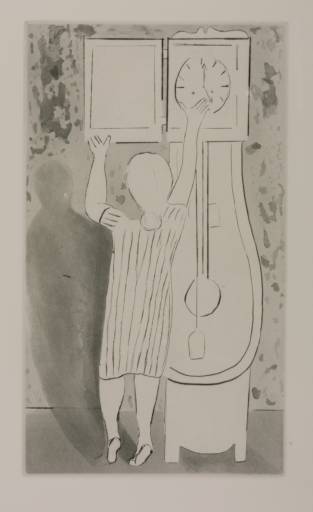
Louise Bourgeois, Woman and Clock

Trees who are themselves.

This morning my walk took me down by the creek, where after the recent rains the leaves on the trees glowed in their contentment at having been washed and well-watered. Lots of light was coming through the gray atmosphere, though the drizzle was thickening. I thought of the Psalm that speaks of us being like trees, “planted by the rivers of water, whose leaf also shall not wither….”

Most of the time I do not feel like a tree! I’m too wispy and bendy, like grass. I won’t say I’m ever a weed, because that concept doesn’t fit with the reality of us being made in God’s image. But the trees are themselves, without fretting over their self-concept, as long as their roots go down where their nourishment lies.

After I came home I made a nice soup breakfast, but before I sat down at the kitchen table facing the garden and the birds — oh! a crow is visiting…. I looked at the books on my mobile bookshelf for something new to read. This was the first page of the one I opened:

“Every creature has in it the instinct to be as true as possible to what God created it to be. Even plants have this directive in them. All nature stretches toward the nurture it requires for its fulfillment — the daily bread, so to speak, that it needs for its survival.

“One spring, we planted a tuberous begonia upside down. When we dug it up in the fall, we saw that it had started growing downward into the earth, but had soon made a U turn and brought itself up into the daylight and blossomed with the other begonias. We have, every one of us, been planted facing the earthly  darkness of sin and death. This business of making our way upward and into the daylight, to blossom forth as the individuals God made us to be — this is the enlightened life to which our inborn instinct calls us.

“As daylight reached through four inches of dark soil to draw the begonia toward it, so the Lord Jesus Christ is always reaching even into the darkest places on earth and inside our souls to draw us into a blessed life. Holy people understand it. They say, He has called you out of darkness into his marvelous light (I Peter 2:9). The Prophet told of it: Upon those who sat in the dark region and shadow of death the light has shined (Matthew 4:16; Isaiah 9:2)”

A few pages further in we read:

“When is a soul mentally fit? When it knows a lot about itself (that is, what God made it to be and how to work with God), say holy counselors. When it readily sees and accepts reality. When it is able to prevail against whatever psychological and spiritual obstacles it may face. When it can protect itself from spiritual harm. When it is using its free will for its own greatest benefit…. The greatest benefit we’re capable of achieving is being in harmony with God’s perfect (all-loving and divinely wise) will for us.”

Dee Pennock, the author of this book, God’s Path to Sanity, calls this health of soul, “sanity.” The idea brings to mind what I’ve read elsewhere, how it is truly irrational to sin against our loving Father, not that we don’t often have perfectly good (irrational) reasons for turning away from His love.

I wanted to drink this book in big gulps, but I restrained myself and will take sips of the tonic. God provided the the fittingly beautiful illustrations before I ever saw the text, and those will, I am sure, be part of my ongoing treatment plan.

Ho, every one that thirsteth,
come ye to the waters,
and he that hath no money;
come ye, buy, and eat;
yea, come, buy wine and milk
without money and without price.

Wherefore do ye spend money
for that which is not bread?
and your labour
for that which satisfieth not?
hearken diligently unto me,
and eat ye that which is good,
and let your soul delight itself
in fatness.

– from Isaiah 55

A Week of Palms and wildflowers.

This is the week in which I finally got out walking. I guess I had before been doing too much of a more sedentary kind of work — God knows in what realm of my being — that made me too weary for walking, other than around the garden. Evidently I’m in a new stage of dealing with the pandemic and its ramifications.

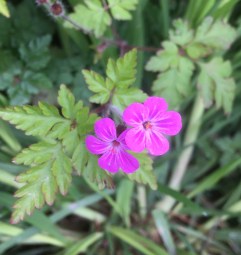
Herb-Robert

For the first walk, I went on the lower unpaved path next to the creek, and didn’t meet anyone. Pretty quickly I remembered the Seek app on my phone and started pointing it at weeds and other plants, many of which I was already pretty sure I knew… just checking. There was lots of Sow Thistle, Bull Thistle, Bristly Oxtongue and Burr Clover. Those are the less pleasing explosions of springtime, which I won’t show you. Tiny white willow puffs drifted down on to my head, and the sun was shining. I discovered a bay tree on the bank above.

For us Orthodox, it is the last week of Lent; Holy Week is not considered part of Lent proper and our Holy Week and Pascha are a week later than Western Easter this year.
So… one period is ending and the intensity of Holy Week hasn’t begun. It reminds me, this year, of the week before finals in college: a week of transition between the end of classes and the beginning of exams. It was called Dead Week. You were supposed to use the time to study hard, but some friends of mine always had a giant jigsaw puzzle going at their apartment, and anyone was welcome to come over and work on it when they needed a break from studying.

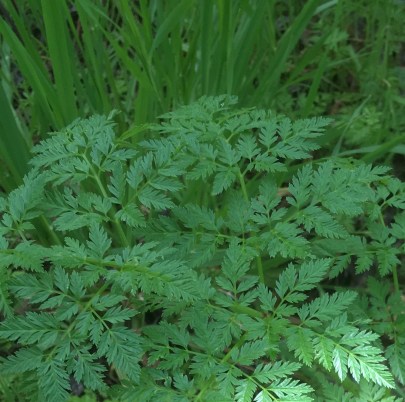
Poison hemlock

It’s not dead by any means in Lent, unless you are talking about Lazarus, who died this week and spent most of it in the tomb. For me, it has been more life-filled than ever. My feeling of renewal began with the Sunday of St. Mary of Egypt, whose story I’ve never paid enough attention to before. Technology failed me, the evening that we were going to have a parish reading of her life on Zoom, so I took an hour to read it aloud to myself (with my brothers and sisters not virtually, but in the Holy Spirit). She helped me to get my bearings.

Now our focus shifts, from our journey of repentance to Christ’s journey, having “set His face like a flint,” to Bethany and on to Golgotha. Soon it will be the resurrectional Lazarus Saturday, and Palm Sunday. This whole week is called the Week of Palms, or Week of Branches. I don’t think I knew that before.

aeonium

This year, because we aren’t able to celebrate Pascha in church, with our glorious middle-of-the night Liturgy and festal hymns and countless shouts of “Christ is risen!” in a dozen languages — it also seems that we are having to set our hearts determinedly to receive what God has given us with thanksgiving. The wife of our priest explains our sadness:

“Sundays, which are a dim picture of how we will spend eternity, are meant for us to be praising and worshiping God together for ages of ages.  Every Sunday is a mini Pascha, and we are being kept from celebrating together in completeness.

“The good news is that these feelings tell us that this isn’t right. This isn’t how things are supposed to be. We shouldn’t be content with just doing our own thing. I literally weep every time I think about missing Holy Week and Pascha with you in our spiritual home. But I cling to the hope of the Resurrection. I look forward to the day when we can come together again in person in the church, to partake of holy communion, and to be refreshed.”

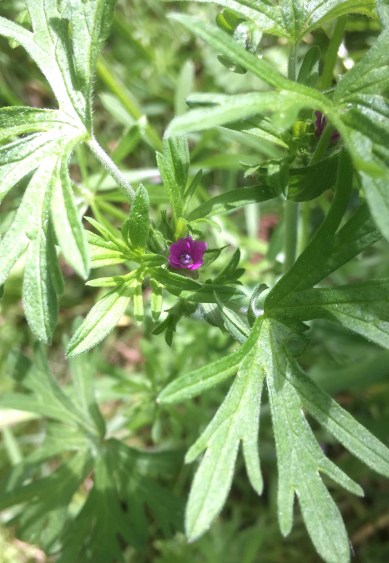
Cut-leaved Crane’s-bill

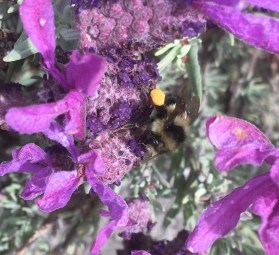
On another level, I especially appreciated the refreshment of some exercise and fresh air yesterday and today. I was happy to see a striped bumblebee in my neighborhood — until this morning I’d only seen black ones around here. My app told me that the buds on this bush below belong to the Eastern Redbud. I thought that strange; why would someone plant an Eastern when we are here in the West? So I looked at pictures of both species in bud, and I can’t see much difference. So I’m just calling this one “redbud.”

redbud

This week was “enlivened” also because Alejandro came to work in the garden, and we had two sunny days and got a lot done. That made it feel more normal.

But as to the abnormal — Father John Parsells, in “The Pascha Nobody Wants,” encourages us that in our present obedience and isolation we have the opportunity to participate in a way that we ourselves would never choose, in the sufferings of Christ.

“His ‘social distancing’ was so complete that He even experienced divine ‘abandonment,’ crying out from the Cross, ‘My God, my God, why has Thou forsaken Me?’ The sinless One became sin on our behalf (2 Corinthians 5:20) and the One who said, ‘I and My Father are One’ (John 10:30) experienced ‘separation’ from His Father.”

“What we go through now can feel very isolating for faithful Christians, yet we are resolutely encouraged, remembering that the Cross of Christ reveals isolation as the door to communion. In obedience even unto death, we find the life that can never be put to death. Amidst our distress and anguish, we find the ‘man of sorrows, acquainted with grief’ (Isaiah 53:3), Christ Himself who says to us what He promised His disciples in their own time of tribulation: ‘I will see you again and your hearts will rejoice, and no one will take away your joy!’ (John 16:22).”