Tag Archives: repentance

You will be their terror.

Met. Anthony Bloom

“Beginning [this week], Orthodox Christians abstain from meat; has it any meaning apart from the ascetic, the disciplinary? Yes, it has, I think. There is a frightening passage in the ninth chapter of Genesis. After the flood, when mankind has become even weaker than before, less rooted in God, more tragically alone, more tragically dependent upon the created because it has lost communion with the uncreated, God says to Noah and his people:

‘From now on all living creatures are delivered unto you as food; they will be your meat, and you will be their terror….’ That is the relationship which human sin, the loss of God in our lives, has established between us and all the created world, but particularly, in a particularly painful, monstrous way with the animal world. And our abstention from meat in the time of Lent is our act of recognition; it is also — oh, to such a small extent! — an act of reparation. We are the terror of the created world, we are those who destroy it, we are those who mar and pollute it, yet we are called originally to be its guide into eternity, into God’s glory, into the perfect beauty which God has intended for it.

Saint Seraphim of Sarov

“We were called to make of this world of ours God’s own world, God’s own Kingdom — in the sense that it is His family, the place where He lives among His creatures, and where the creatures of God can rejoice in Him and in one another. Let us therefore, to the extent to which we are faithful to the call of the Church, remember that apart from being an act by which we try to free ourselves from slavery to the material world, our fasting is an act of recognition of our sin against the world and, however small, a real attempt to make reparation for it, bring a testimony that we understand, that we are heartbroken, and that even if we cannot live otherwise, we live with a pain and a shame, and turn to God and to the world, which we treat so atrociously, with a broken and contrite heart. Amen.”

-Metropolitan Anthony of London, reposed 2003
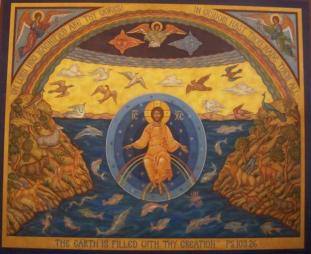
See more of the icon here.
All human conventions are destroyed.

Seeing posts of those who are at the beginning of Lent prompts mixed feelings in me. Orthodox Easter, or Pascha, does not come to us until May 2 this year, and our Great Lent begins March 15th, by which time western Christians will be halfway to their April 4th Easter.
Part of me is envious, and wishes we were already there, in that blessed season of “bright sadness.” But probably the greater part says, “Thank God we have a few more weeks!”

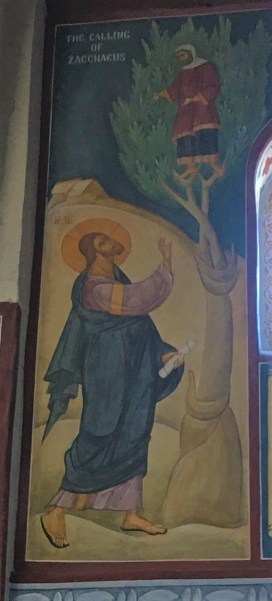
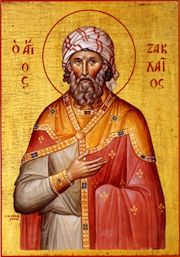
Yes… and I do want to take advantage of that time so that Lent itself won’t fly past without any effect on me. The Orthodox Church gives us five Sundays of preparation, and last Sunday was the first of those, Zacchaeus Sunday. Our rector emphasized to us that Zacchaeus climbed to a good vantage point because he wanted to see who Jesus was.

I appreciated Patriarch Kirill’s homily for the day in which he explained how Zacchaeus “…received his post from the hands of the Romans, the people who captured Israel, who enslaved the Jewish people. In modern terms, Zacchaeus worked in favor of the occupation power. And the freedom-loving Israelites, who painfully experienced everything that had happened to them – the fact that pagans seized power over the chosen people and over the holy places – treated those who voluntarily served the Roman authorities, collecting taxes from their own people, with contempt and indignation. That is why, in the minds of the Israelites of that time, the publicans were equal to the greatest sinners.

“But one of these tax collectors, Zacchaeus, was so eager to see the Savior that, being short, he climbed up a tree to see Him from there. The act itself is out of the ordinary, because Zacchaeus was one of those who had power, and adults who have power usually do not climb trees. If they need to see something, they have the opportunity to come closer: to push through the crowd, to make people part. But Zacchaeus climbed a tree, humiliating himself, only to see the Savior.”

And oh, my, wasn’t he rewarded! He did see Jesus, and apparently not just superficially. His humble act led eventually to true repentance and salvation; can you imagine how the whole town must have been astounded? As another has put it, “He lived in luxury from what he stole in the name of a hated foreign power.” It likely was not an easy process to make restitution to all the people through whom he had made himself rich, and to disentangle himself from the corruption of the political system, but however it happened, he went on to become one of the Seventy Apostles described in Luke Chapter 10.
Patriarch Kirill goes on to say, “Everything in this story is so simple and so unexpected. All human conventions are destroyed by the power of humility.” If we also can act in such a way that we begin to see Jesus more clearly, there is no telling what huge changes might begin in any of us, for the glory of God and our full salvation.

A word on prayer.

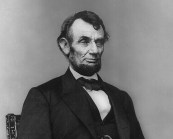
President Abraham Lincoln’s heartfelt message below came to my attention last week, by way of J. Douglas Johnson, an editor of Touchstone Magazine. Here is a piece of history of the best sort, which it comforts and encourages me to read. I’m always thankful for our founding fathers and more recent statesmen who have gone before us and been taken from us, but no matter how wise and good the best of them were, their perspective will no doubt have been adjusted at least somewhat since they have departed.
But if Abraham Lincoln is praying for us today, I suspect that his supplication might include the essence of what he thought important back then. Johnson remarks: “What I find so remarkable about the speech is that Lincoln at no point attempts to persuade the Southern states (or to inspire the Northern ones) about the rightness of the Union cause or the evils of slavery. Instead, he goes right to the core, echoing the words of our Lord spoken through the prophet Hosea:

“‘When I fed them, they were satisfied;
when they were satisfied, they became proud;
then they forgot me. (Hosea 13:6)'”

PROCLAMATION APPOINTING
A NATIONAL DAY OF PRAYER AND FASTING
March 30, 1863

Whereas, the Senate of the United States, devoutly recognizing the supreme authority and just government of the Almighty God in all the affairs of men and of nations has by a resolution requested the president to designate and set apart a day for national prayer and humiliation:

And whereas, it is the duty of nations as well as of men to own their dependence upon the overruling power of God: to confess their sins and transgressions in humble sorrow, yet with assured hope that genuine repentance will lead to mercy and pardon: and to recognize the sublime truth, announced in the Holy Scriptures and proven by all history that those nations only are blessed whose God is the Lord:

And inasmuch as we know that by His divine law nations, like individuals, are subjected to punishments and chastisements in this world, may we not justly fear that the awful calamity of civil war which now desolates the land may be but a punishment inflicted upon us for our presumptuous sins, to the needful end of our national reformation as a whole people? We have been the recipients of the choicest bounties of Heaven. We have been preserved, these many years, in peace and prosperity. We have grown in numbers, wealth, and power as no other nation has ever grown; but we have forgotten God.

We have forgotten the gracious land, which preserved us in peace, and multiplied and enriched and strengthened us; and we have vainly imagined in the deceitfulness of our hearts, that all these blessings were produced by some superior wisdom and virtue of our own. Intoxicated with unbroken success, we have become too self-sufficient to feel the necessity of redeeming and preserving grace, too proud to pray to the God who made us:

It behooves us then, to humble ourselves before the offended Power, to confess our national sins, and to pray for clemency and forgiveness.

All this being done in sincerity and truth, let us then rest humbly in the hope authorized by the divine teachings, that the united cry of the nation will be heard on high, and answered with blessings no less than the pardon of our national sins, and the restoration of our now divided and suffering country to its former happy condition of unity and peace.

—Abraham Lincoln

See how the sower goes on.

“When the times are fulfilled and the end is at hand, when the world’s autumn comes and God sends His angels to reap the harvest — what will they find in the barren fields of our hearts? And yet, the time is nearly accomplished and the end close by for each of us, the time which we shall each face even before the common harvest.

“But let us not be downhearted. See how the sower goes on sowing among the rocks and thorns and by the roadside. This means that he places some hope even in such fields as these.

“And we know from the lives of the saints how often a soul which had seemed irreclaimably stifled by sin, blinded by passion, hardened in evil, became good ground, fertile and productive, purified of poisonous mixtures and alien seeds.”

-Fr. Alexander Elchaninov,  Diary of a Russian Priest