Tag Archives: rocks

wintertime loves

We in the arid parts of the West have been exulting in rain the last week or so. It’s so comforting and even glorious to wake in the night and hear the rain still coming down. Then to wake in the morning and see it is still falling. We had puddles in the back yard! Thank you, Lord!

Mr. Glad and I do live in northern California, but daughter Pippin lives even farther north in the state, and we drove there early this week for a short visit. Often February is a very snowy month at her place, but this year they’ve had more dry weather and rain than snow, and even the rain stopped while we were there, so we could get outdoors easily for work and recreation.
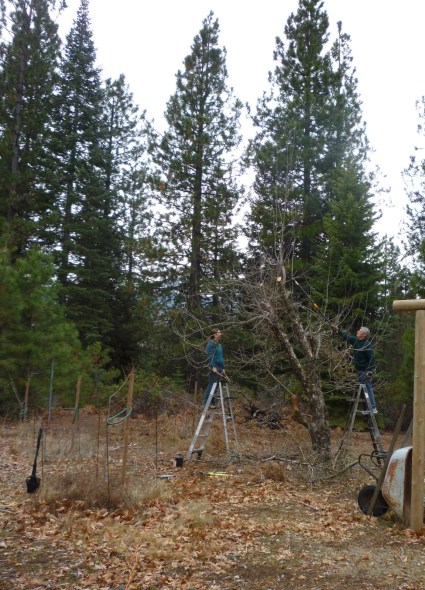
One day we made a family project out of pruning old apple trees that Pippin and The Professor are trying to revive from years of neglect. I floated back and forth between lopping branches and swinging the kids.
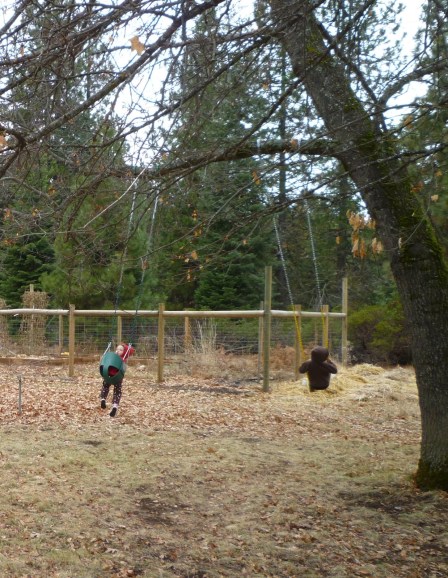
I would get Scout and Ivy going and then run over
to take a picture of the adults on ladders.

Another day we took a short trip to Castle Crags State Park and walked a trail alongside the Sacramento River. Considering the dryness of this year, I was amazed at the thick moss and ferns.
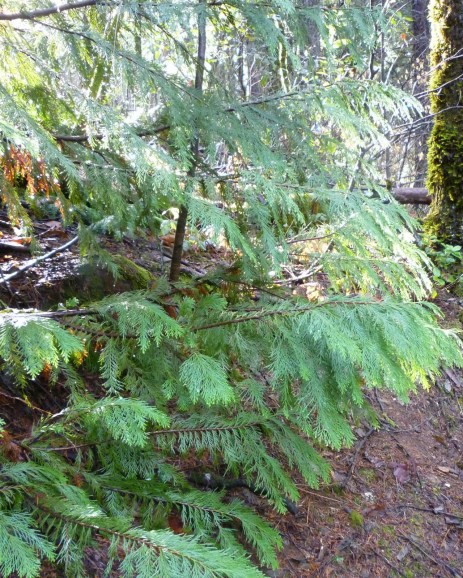
 A pale green, almost white lichen grew on rocks and tree stumps.

yew trees on the riverbank

Everything was wet from the recent rains, and many times our feet slipped on the invisible mosses — or was it algae? — growing on wooden bridges or river rocks.Ivy practiced throwing pebbles into the river, and once she got the hang of it she did not want to do anything else. The supply of rocks was endless.We went to the confluence of Castle Creek (in the foreground below) and the Sacramento River, from which you can get great views of the jagged rocks above, called the Castle Crags. They are high enough that the recent precipitation there was in the form of snow, and some was still unmelted and visible.


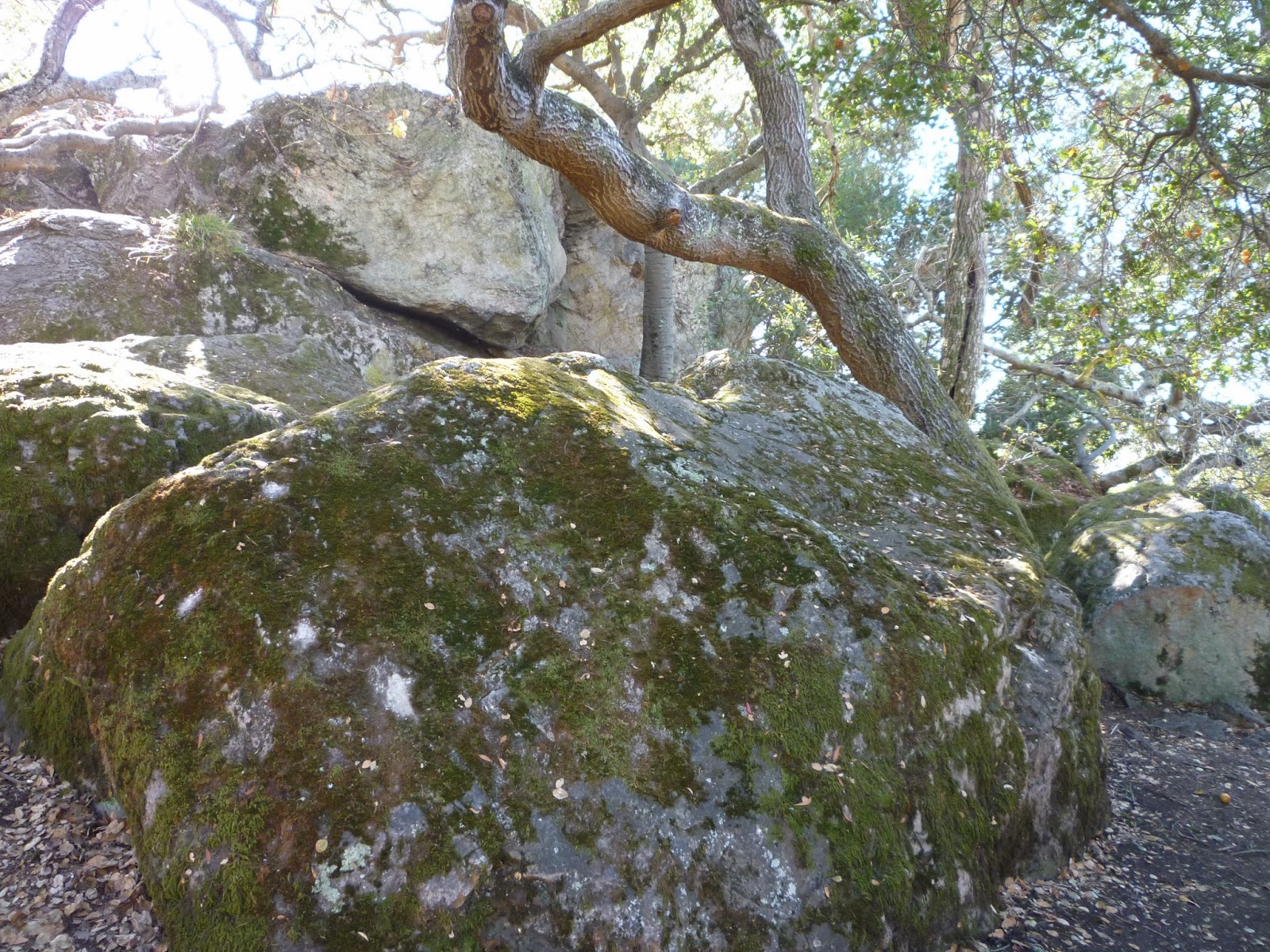
My dear husband showed me this large and artsy rock, which you can also see in the photo at the very top of this post, in its original setting. I wanted to take it home. It was a little too heavy for me to carry, so The Professor hauled it back to the car. It came with us on our journey home and is now living by our house. Mr. Glad classified it as a confluitic rock. 🙂

Winter days are short enough that at the end of our busy days there was plenty of time for cozy gatherings in the kitchen or by the wood stove. I read many books to the children. Scout’s current favorite, which I read about on a blog before Christmas and gave to him, is Bumblebee at Apple Tree Lane, and we read it several times.

Ivy likes The Little Fur Family best right now. We danced to the children’s favorite recordings, and also listened to bird calls on the Stokes Field Guide to Bird Songs CD. After ten minutes of loons and other waterfowl, Ivy must have deduced that those bird songs were some kind of dance music, too, and she started twisting and prancing around.

Hot soup is what you need on a winter’s night, so Pippin and I learned how to make French Onion Soup, using the recipe in The New Best Recipe: All-New Edition by Cook’s Illustrated Magazine. The secret that the Cook’s testers learned is that red onions give the best flavor. Our result was sooo good.

And cookies! Pippin had some dough left in the freezer from her Christmas Peppernuts, the recipe that I concocted a long time ago but haven’t made for years. We like our nuts to be nut-sized, so we always cut the frozen dough into little cubes and bake them long enough that they come out crispy. Next Christmas I’ll give the recipe.But for now, since I do love cookies, they make a good ending to my story of a wintry family visit that was warm and sweet.

peppernuts 13-14

How long will the rocks of Berkeley last?

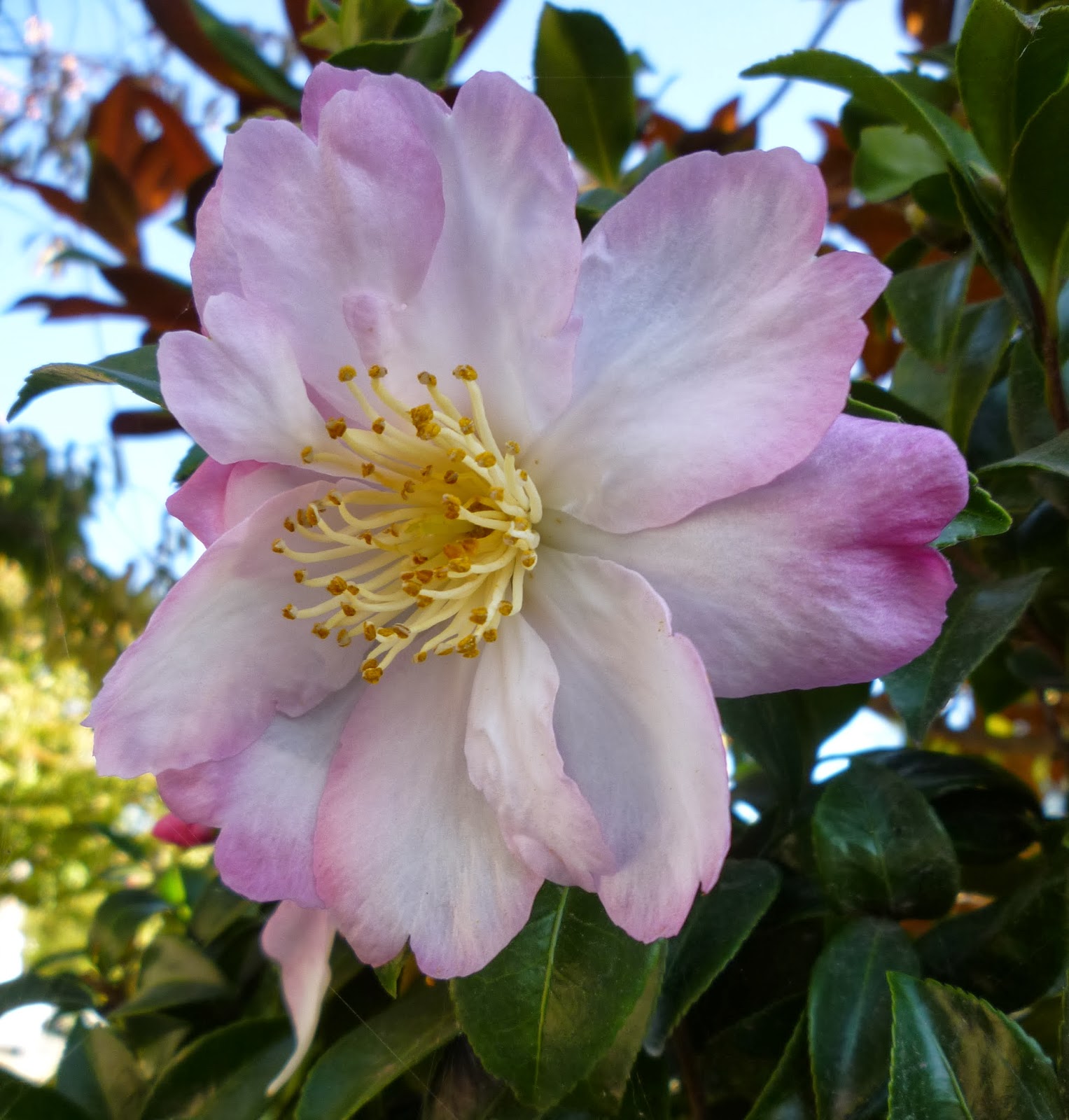
Berkeley Camellia in October

My sisters came to visit, and for the first time in about 50 years we returned together to places in Berkeley where we used to play. None of us has ever lived there, but as children we visited our maternal grandparents every summer.

Both of our parents had grown up in Berkeley, and last week we walked and drove the mostly hilly streets to find several of the houses in which our grandparents and our father and his sisters had lived. Of course we also stopped and stared at our other grandma’s house, savoring the memories that had been born in us there.

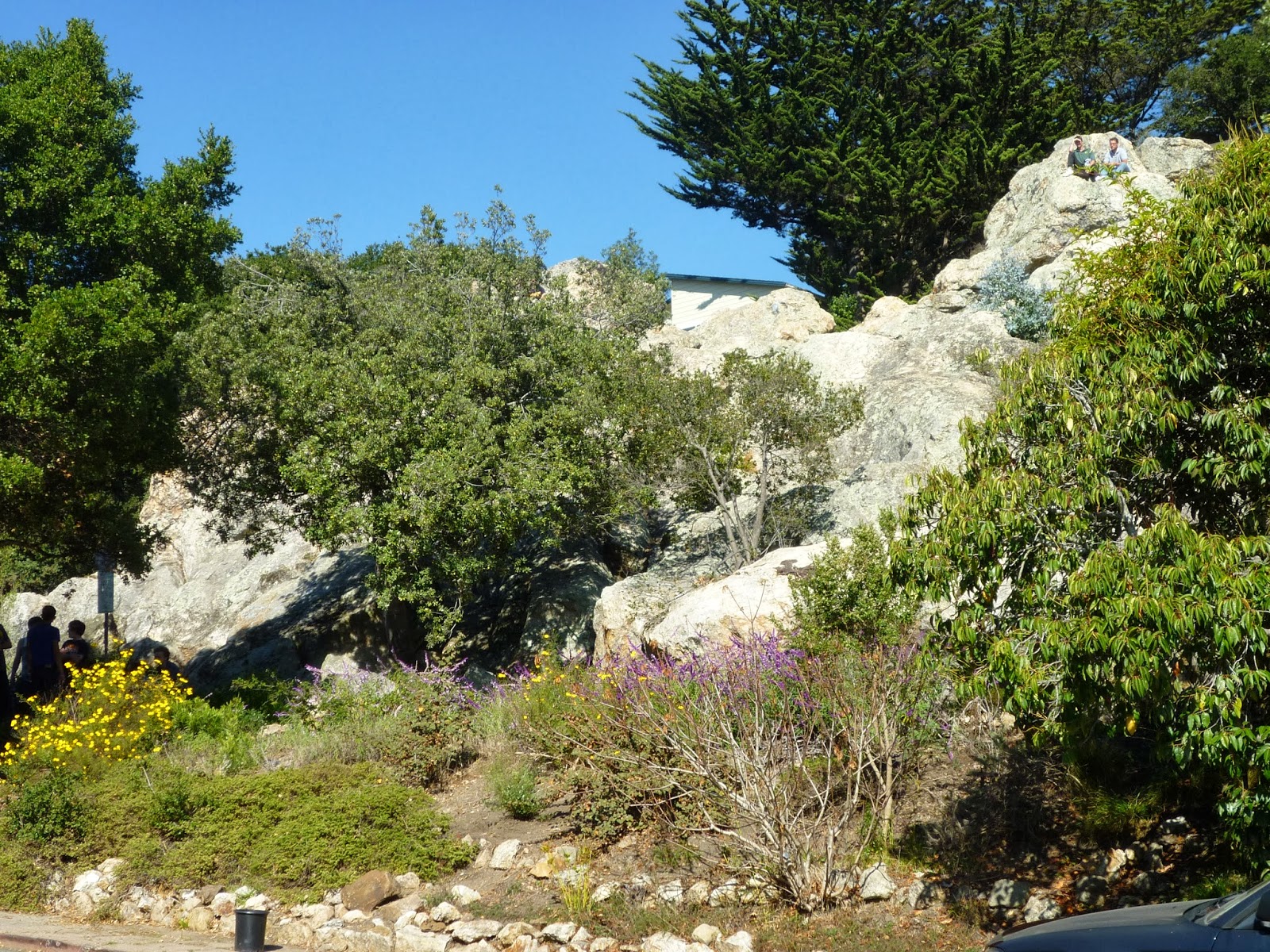
Not far away is Indian Rock Park, of which you can see pictures in my post about the neighborhood where Grandma and Grandpa lived for half a century. Indian Rock is huge — but not as big as we remembered it. And the park includes massive slabs and lava stones directly across the street, which I don’t know if I’ve ever played on. We didn’t go there this time, either, but climbed to the top of Indian Rock itself and sat a while, looking out over the tops of a thousand houses to San Francisco Bay.

Down Indian Rock Path

Not for very long, though, because we wanted to skip on down the steps of Indian Rock Path to Solano Avenue shops. Well, maybe not skip. But skipping is probably what we used to do!

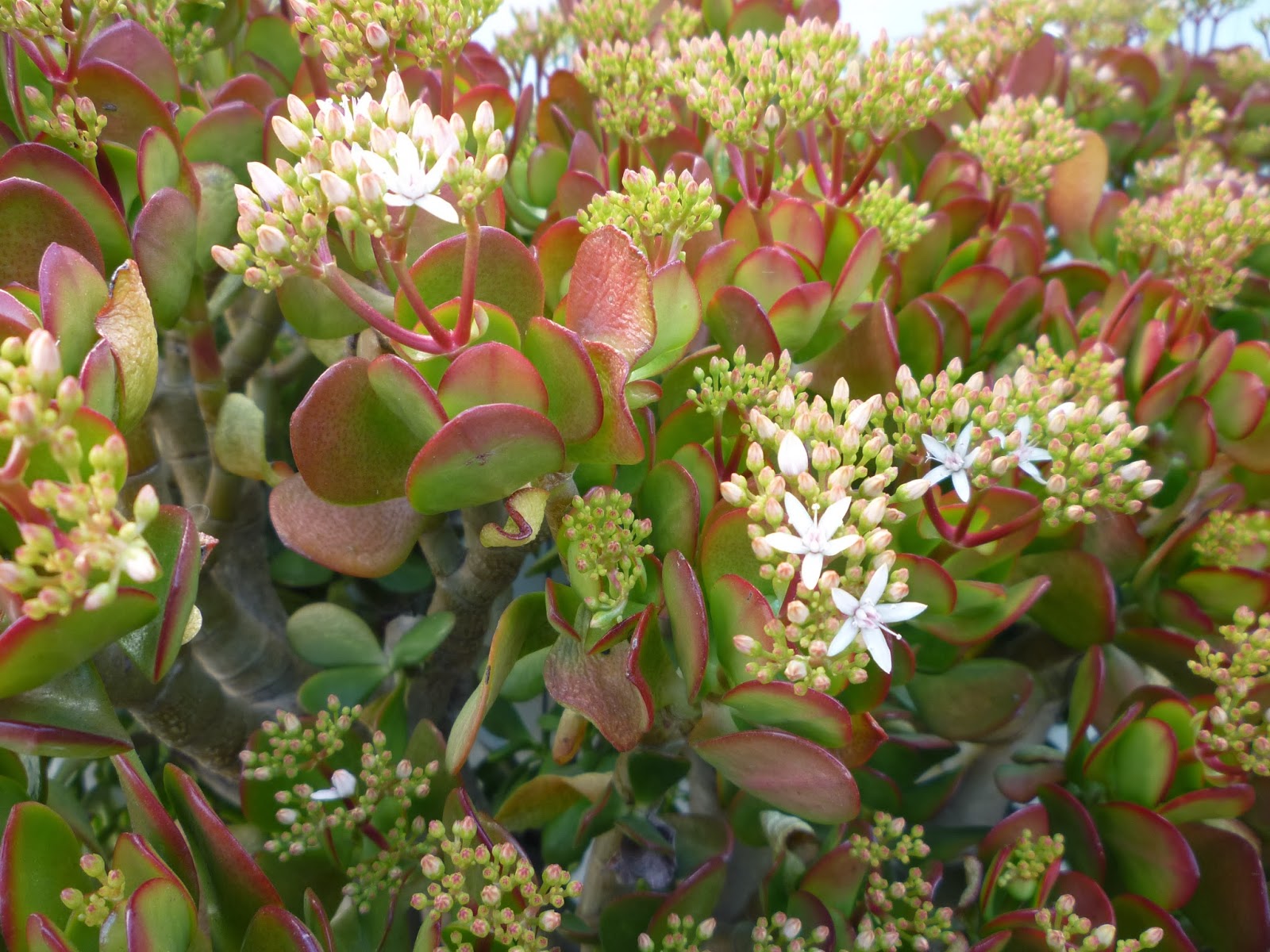
Jade plant in bloom on the path

In our memories the excursion to the ice cream parlor took much longer than what we found this time, even though we have passed the age when one can be unconscious of one’s legs and feet whether walking uphill or down. That shop has a new name, but the wares are similar, and you can look at old scoops while you wait.

After lunch, because we wanted to return to the higher neighborhood, it was necessary to hike up, and this time we took the steep route of Marin Avenue. Again my experience seemed altogether different from that of years ago, when most evenings after dinner Grandma, at an age greater than any of us have reached yet, would lead us on brisk neighborhood walks. It was slower than then. And the crucial person was missing.

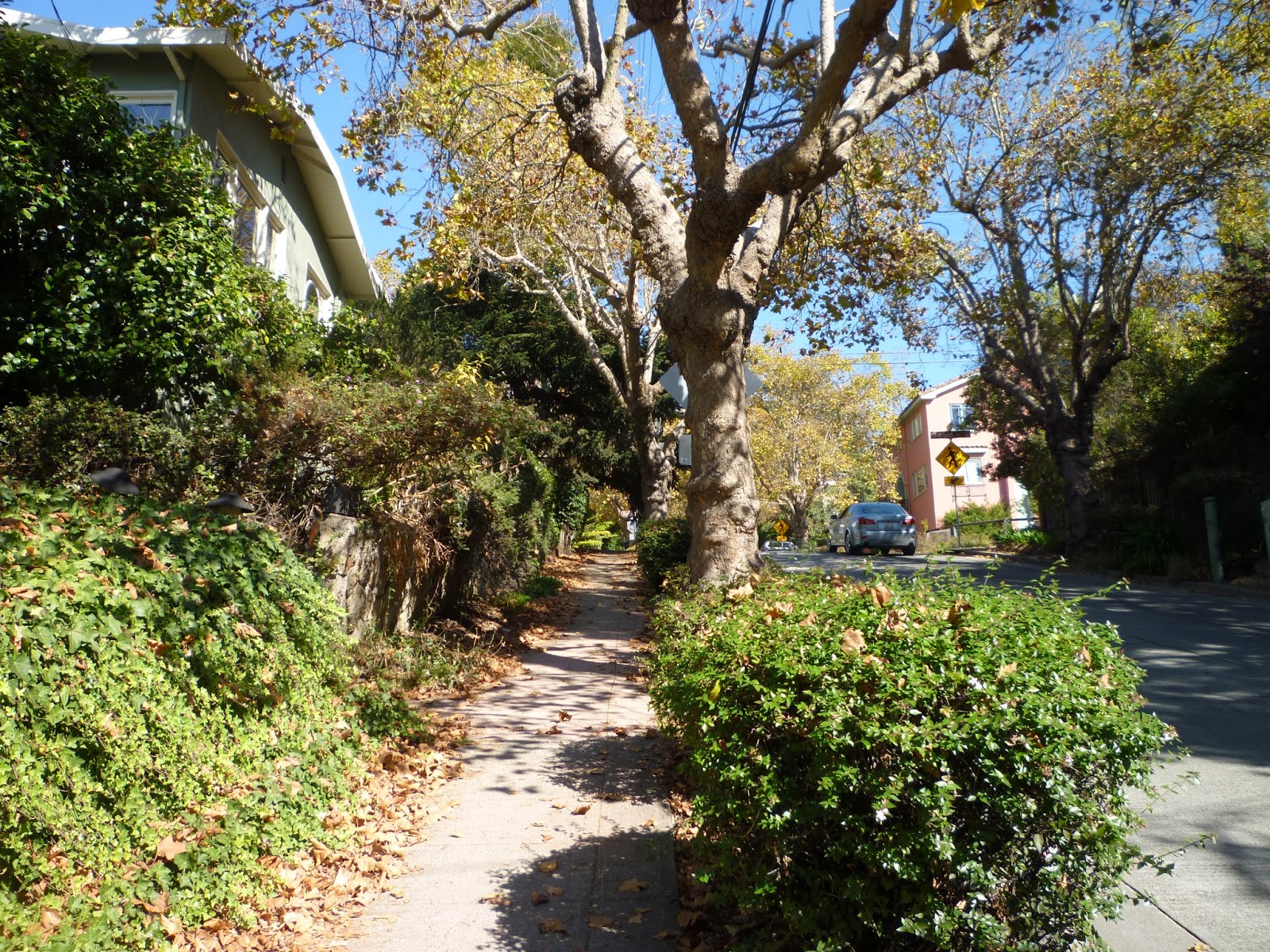
Marin Avenue is a hike.

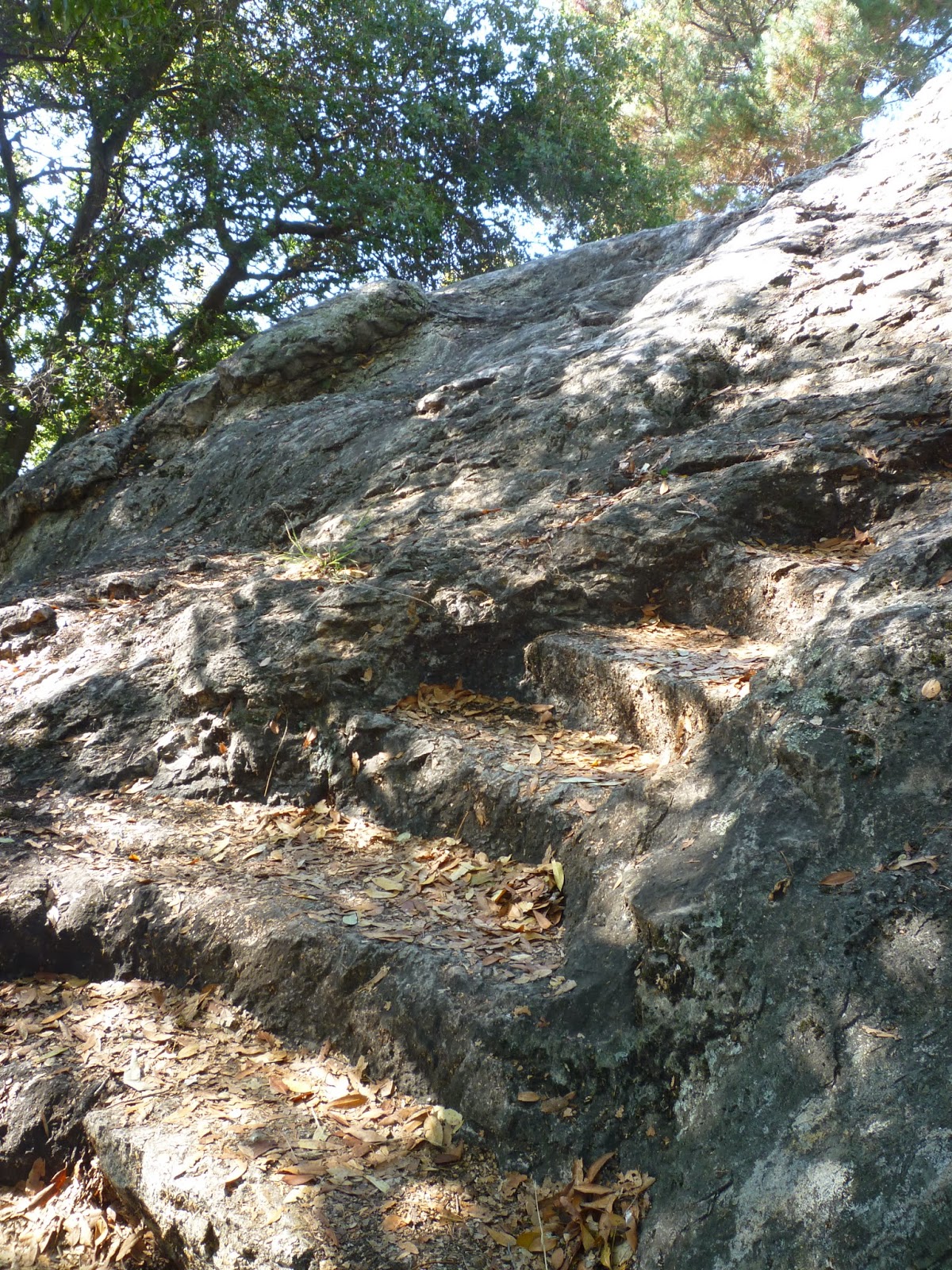
Mortar Rock steps

We circled back to Mortar Rock, just around the corner from Indian Rock, and wandered there longer, just as we used to play there longer in our childhoods. More of those stone surfaces are easily climbable, and Grandma always felt better about us going by ourselves, because we didn’t have to cross a busy street to get there.

The houses next to these parks and paths don’t have much privacy. In this picture you can see how close they are, and how there are not fences blocking them from park goers and their glances.

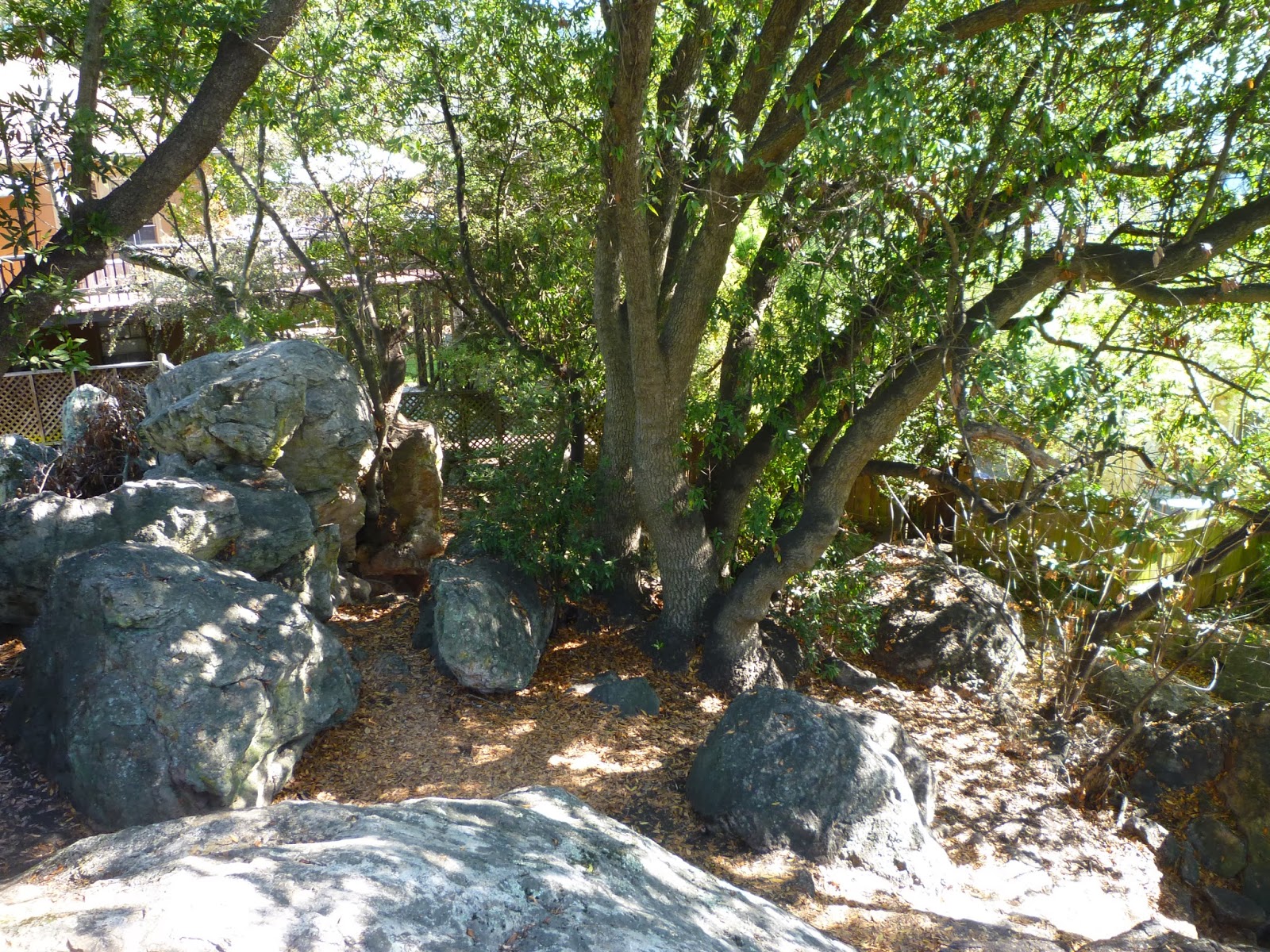
When I first put my feet on the dry paths of Mortar Rock Park, suddenly a familar herby smell registered in my senses, making me look down to see long pointy dead leaves underfoot, just as my mind was linking to “bay tree.” I lifted my head and saw that the dappled shade was cast by at least two tall old California Bay Laurels (along with oaks and buckeye) whose several large trunks were curving high over the rocks.

And yes, there were the grinding mortars in the rock, empty of anything but leaves at this time of year. Do children still pretend to be Indians grinding acorns in them?

One of the houses we were searching for was only a few blocks from here, so we walked up the street, admiring the many flowers still in bloom in this mild climate. Banks of fuchsias always remind us of the long row of them that grew along the brick path in Grandma and Grandpa’s back yard.

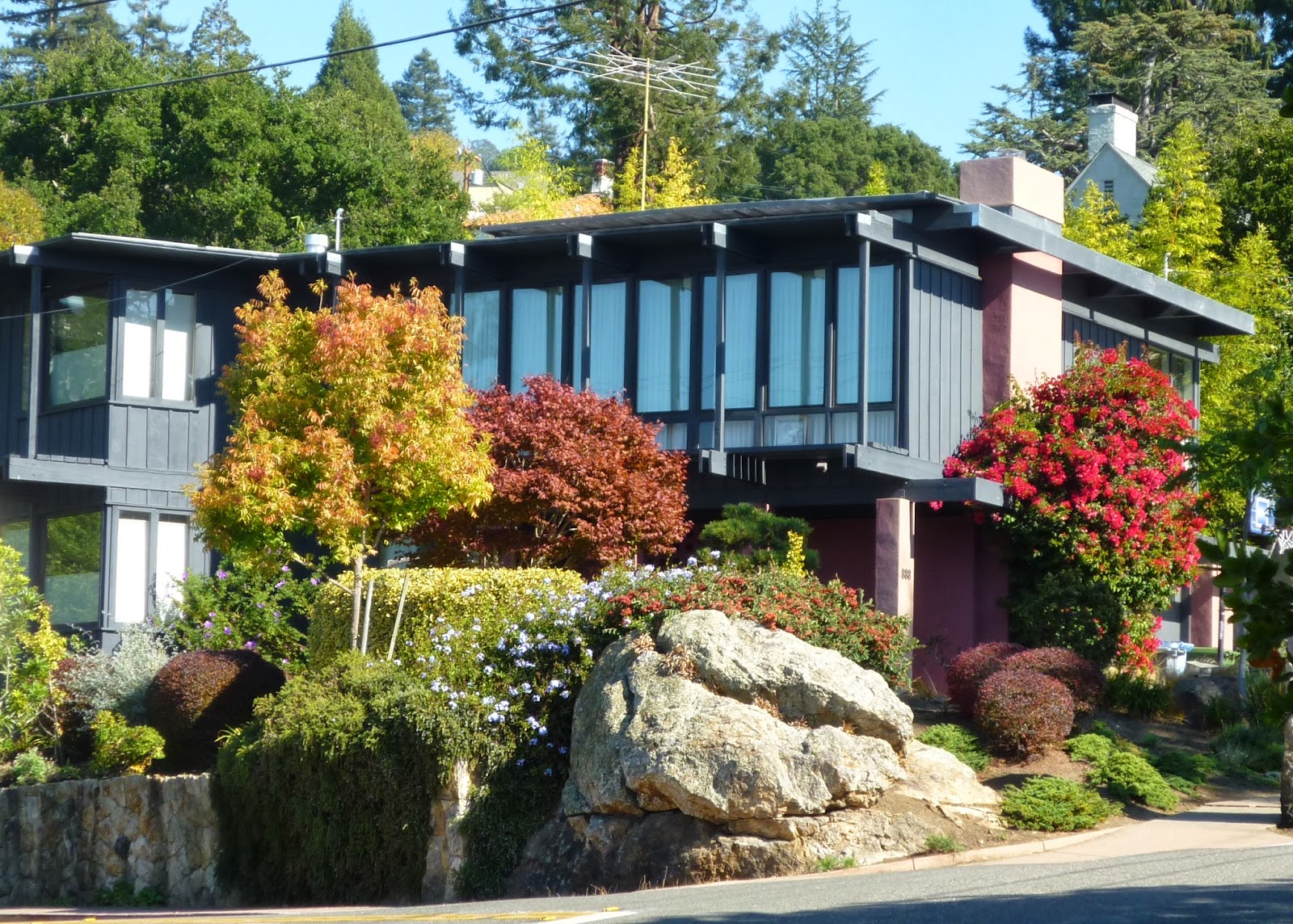
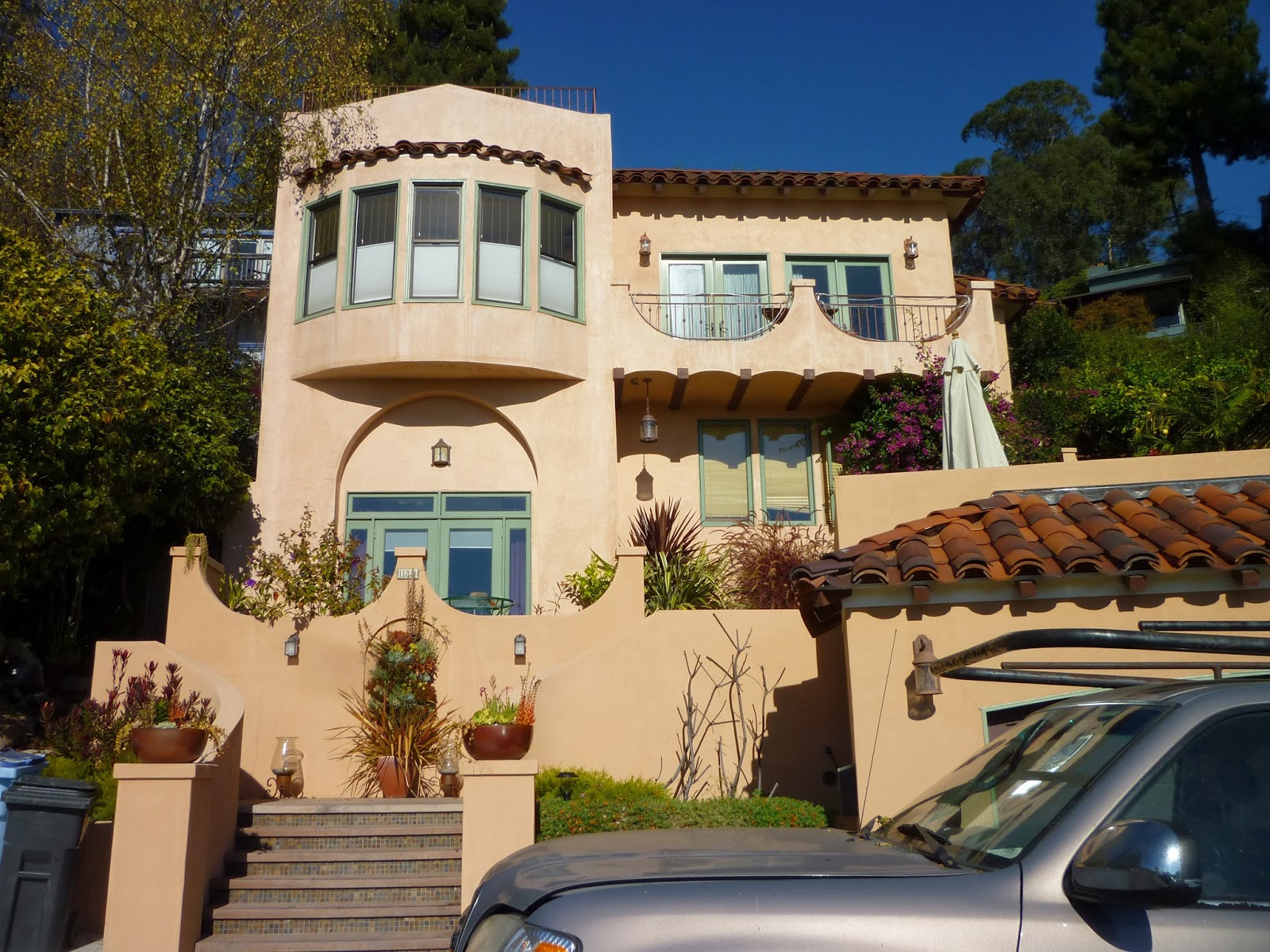
More rocks! This house, though modern in design, has a very traditional and unchanging boulder to distinguish its front yard.


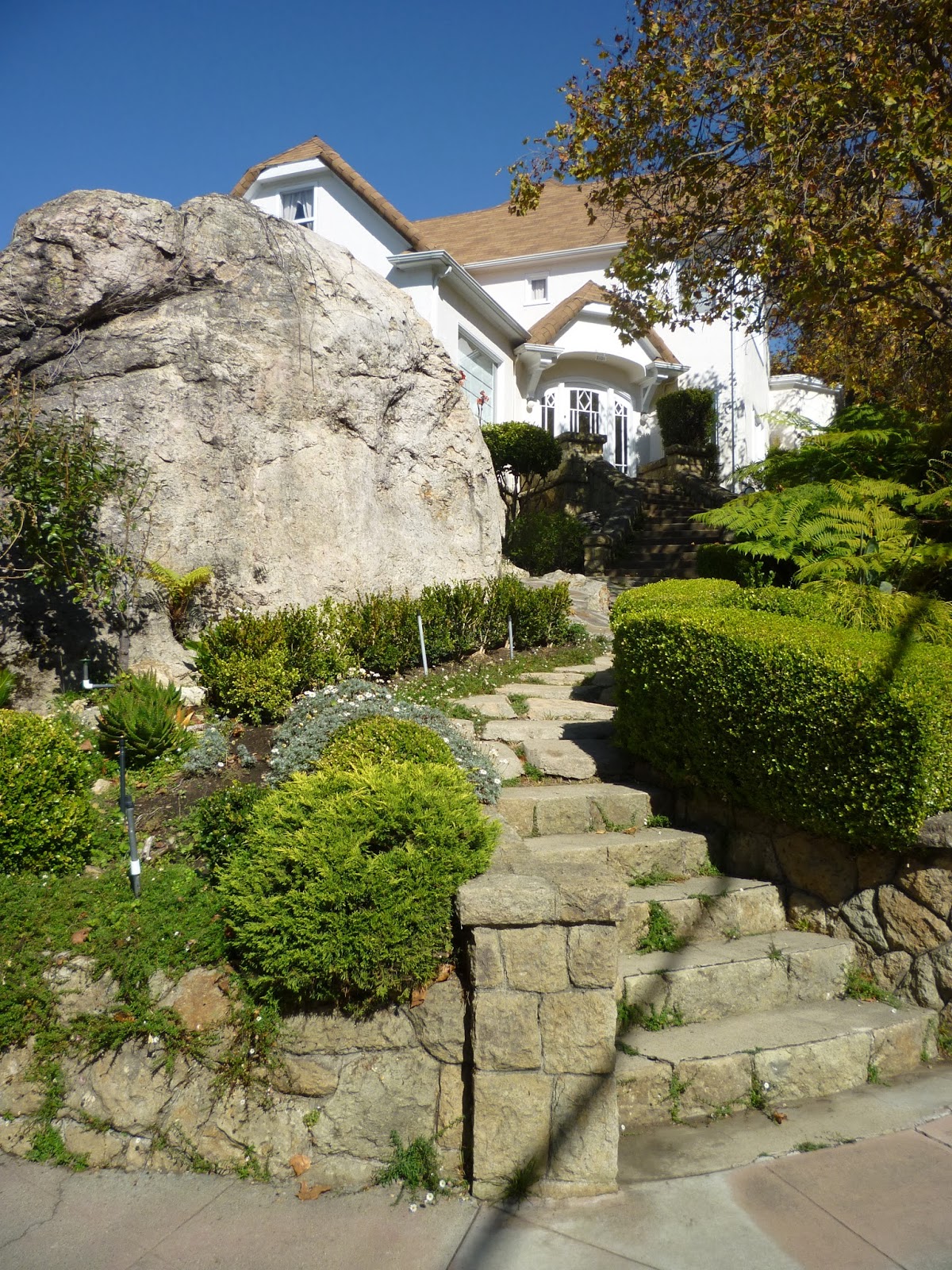
This one’s even more of a monolith. Having such a thing in your front yard would certainly lend drama to the landscaping. I wonder if the owners of the house are helped to keep a humble perspective on their lives, with the antiquity of their mineral friend constantly looming. So solid, and not going anywhere.

Lots of giant volcanic rocks dot the neighborhood. I saw these I didn’t remember on Santa Barbara Avenue, taking up a lot or two.

Rocks on Santa Barbara Ave., Berkeley CA

The weather was summery, and we seemed to walk always up, and up. It felt good to stop frequently to snap pictures of fall color or late summer flowers. Eventually we arrived at the first house of our father’s on our list, on Santa Barbara Avenue.

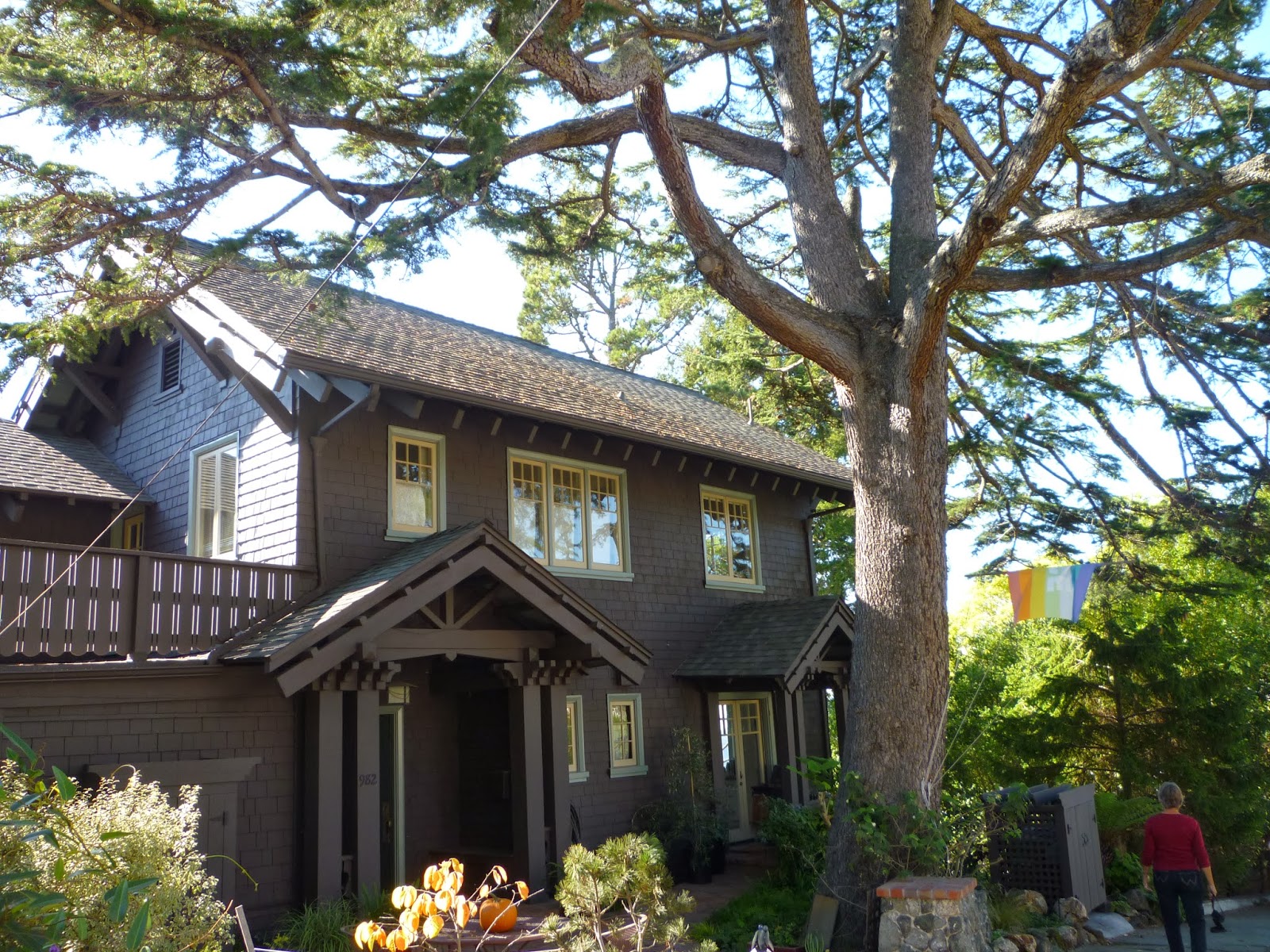
Another childhood home of my father, on Euclid, has had a facelift recently — we compared it with photos from 15 years ago when a patriarchal tree must have blocked the view and the warming sunlight, and the color was white. Paint and trees and even whole houses are easier to change or remove than those giant rocks.

Euclid house

And though it seems ages ago that we walked these streets together, and slept in the Berkeley bedroom wondering at the city lights spread out before us, most of these houses are not more than a hundred years old. Young things, really.

We went back to our car and drove to a few more houses, none so photogenic now. We bought gas at the station where our grandma used to buy hers, and we shopped at the market where she used to shop. We ate dinner at Spenger’s Fish Grotto where we’d eaten many times with our grandparents. And then my dear sisters and I finished our day with shopping at our grandma’s favorite Park & Shop market, now Andronico’s.

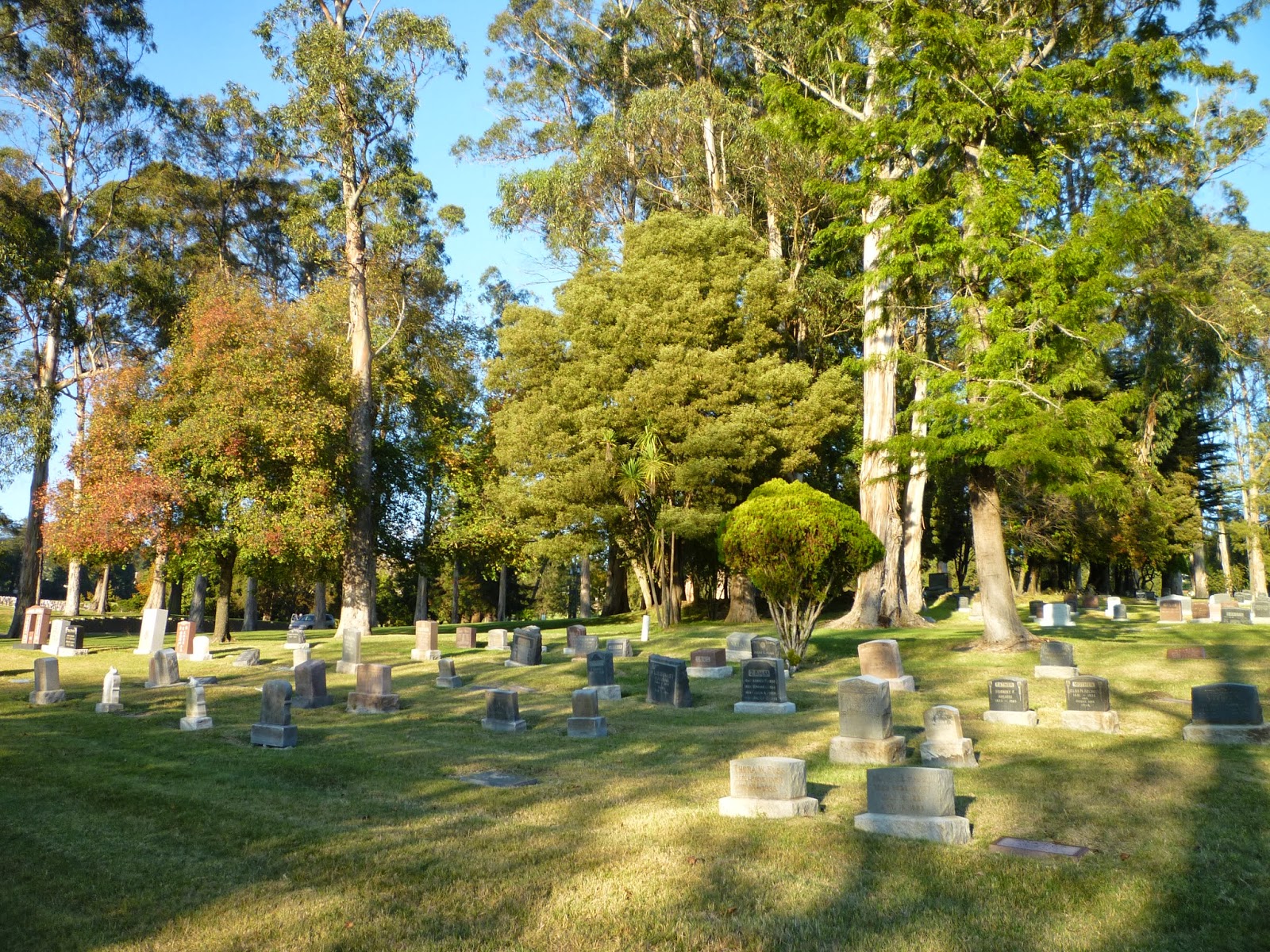
But a little earlier in the evening we’d added to our tour a visit to the cemetery where both Grandma and Grandpa are buried. None of us had visited since the last graveside service almost 20 years ago, and it took some exploring to find the marker. I felt closer to Grandma and Grandpa there at their grave than I had on the street in front of their house.

Cemeteries are where one finds another sort of stone, markers of lives that grew up like grass, and withered and died, most with life spans briefer even than flimsy wooden houses and certainly shorter than those huge stones people built neighborhoods around fairly recently. At the end of time, we read in 2 Peter, “… the day of the Lord will come as a thief in the night; in the which the heavens shall pass away with a great noise, and the elements shall melt with fervent heat, the earth also and the works that are therein shall be burned up.”

Indian Rock and all the granite in the Sierras, though it’s been around longer than we can imagine, will be gone, along with houses and gravestones. Then what is most enduring, the souls into whom God breathed life, will be raised. We are what on this earth is eternal.

Rocks and Stones

If any one rock expresses for me the metaphor the Psalmist uses in words like this (Psalm 18): “The LORD is my rock, and my fortress, and my deliverer; my God, my strength, in whom I will trust; my buckler, and the horn of my salvation, and my high tower,” it is El Capitan in Yosemite National Park. Contemplation of this edifice over time probably contributed to my love for rock and stone. It may seem odd, or lazy, that I’ve never made the effort to study geology or petrology. All I do is stare at the big rocks and collect some pretty little rocks. The latter are good to put on the soil around succulents and keep the roots warm.

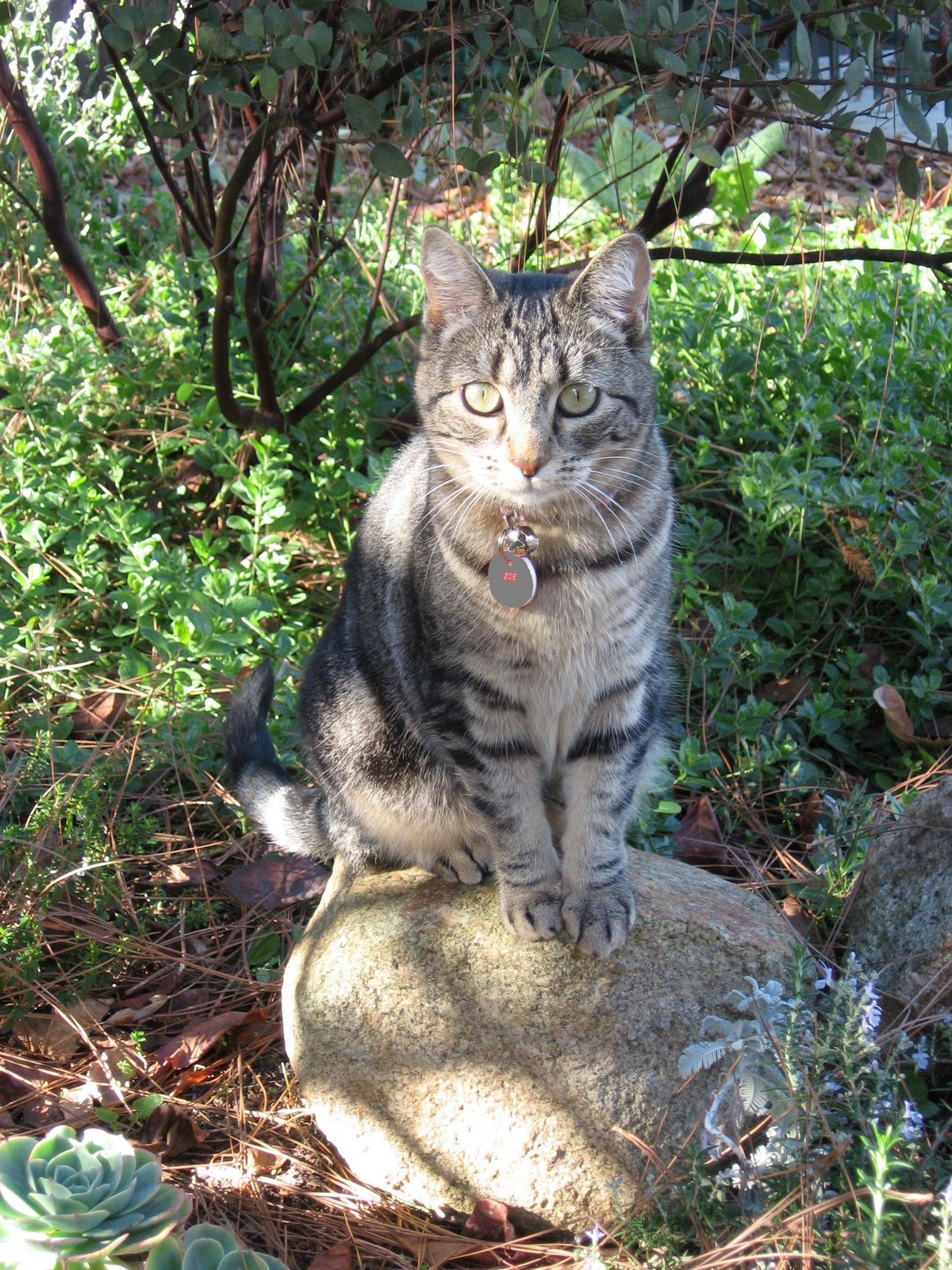
To be truthful, I collect some medium-sized stones as well and haul them down from the mountains on occasion, with the help of stronger and less enthusiastic members of the family. Granite. These are not only reminders of larger hunks of granite, such as El Capitan, but they are very useful in the garden, for beautifying generally, adding another texture and color to contrast with leaves and flowers, or the colors of the cats who sit on them. In some places they also prevent cats from engaging in other less desirable activities.

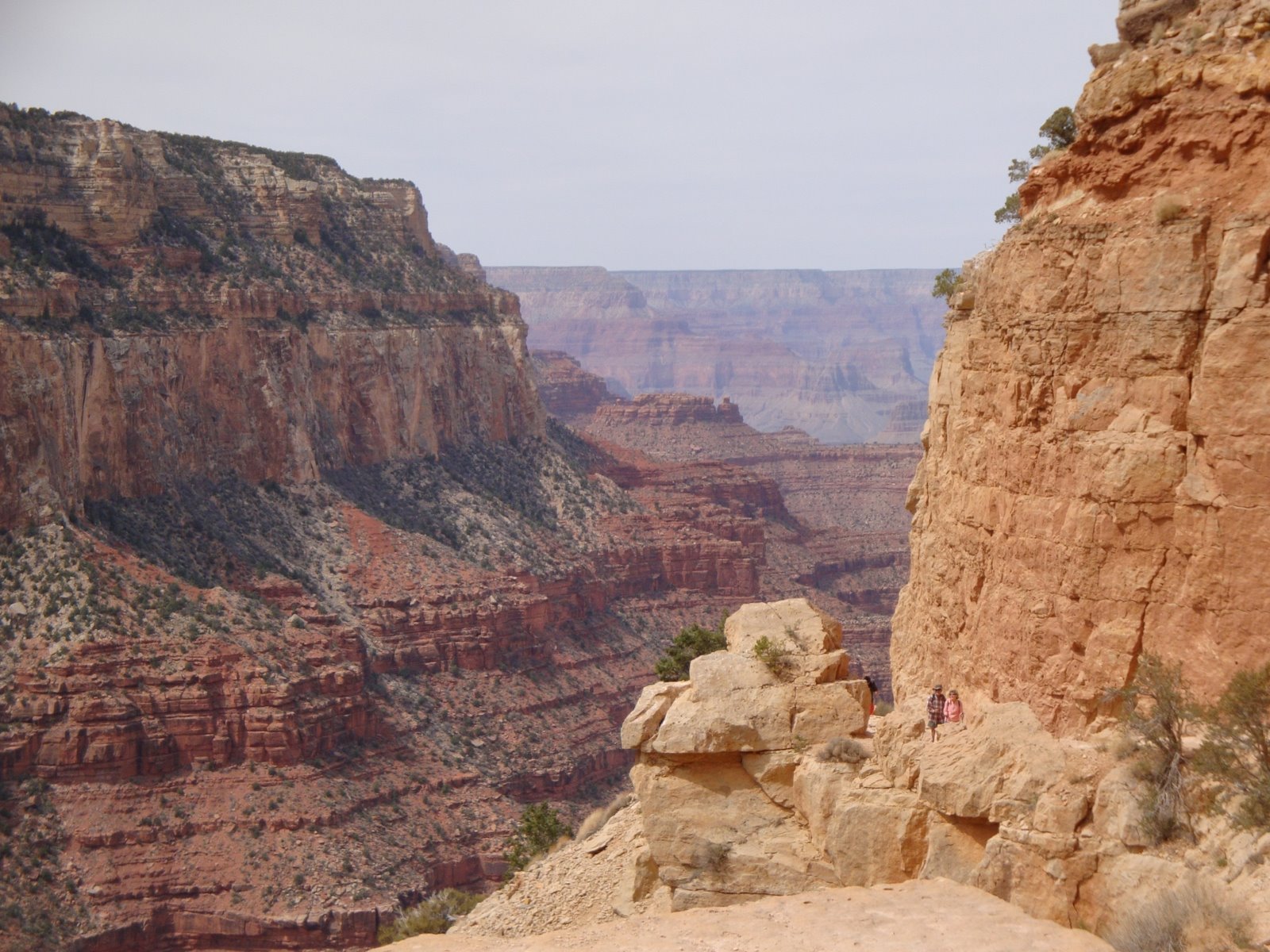
The Southwest, where we have recently traveled, is a delight to rock lovers, even the ignorant type like me. The stone there is typically redder than in Yosemite. Above is a shot from the Grand Canyon.

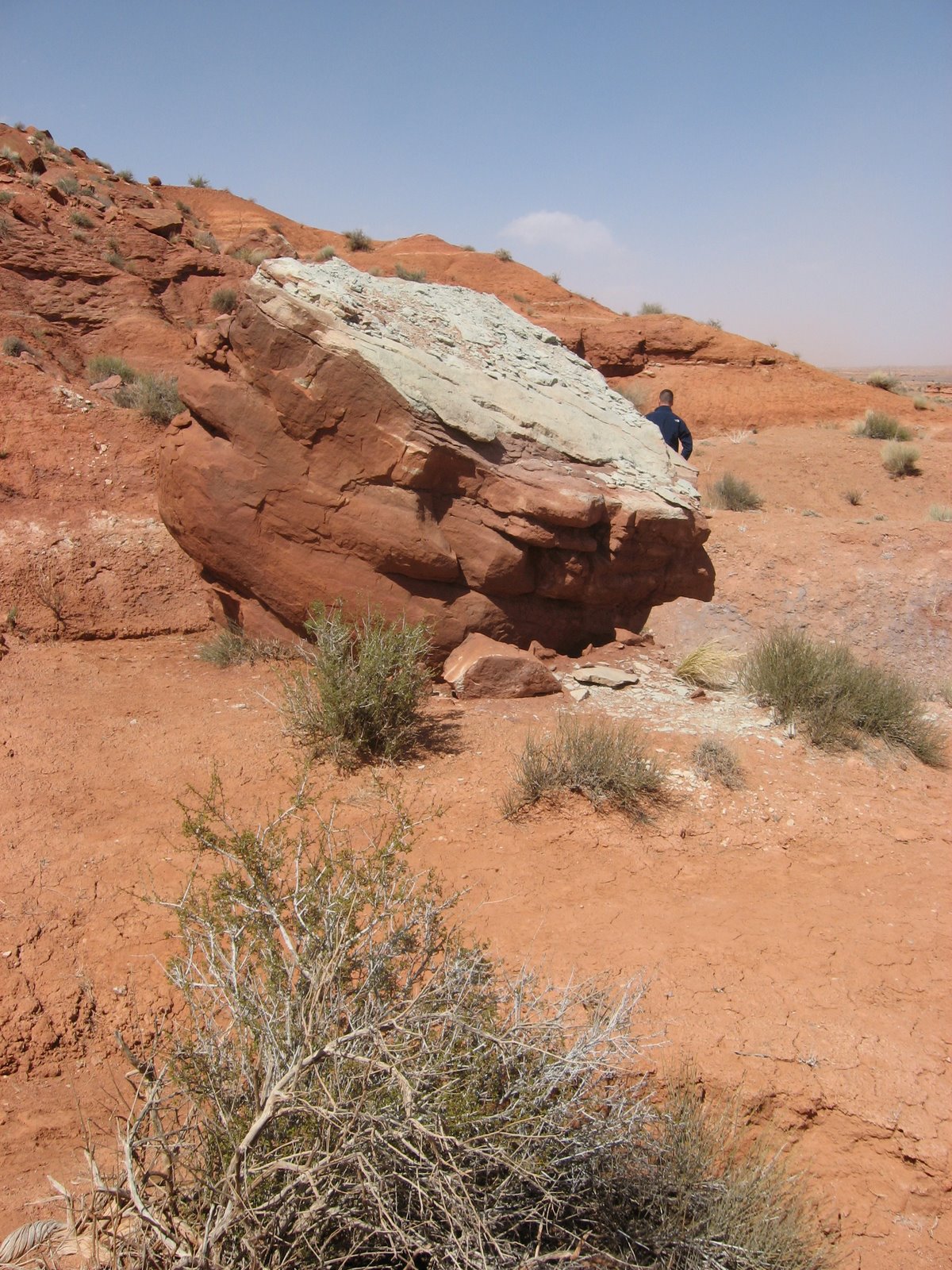
But in Monument Valley I was thrilled at aqua blue rock faces gorgeously setting off the mostly red cliffs. As we climbed out of the car and hiked in among giant boulders and hills of rock, I looked forward to taking their pictures.

Unfortunately, we were in the middle of a sandstorm, which made it unsafe to use one’s camera. My companions said, “What are you talking about? There is no blue rock here!” And when I got close to these piles of brilliant color and picked up some of the chips of sandstone, it wasn’t bright at all, but sort of grayish-white.

This photo I risked (above, with a man behind it) shows the bluest rock I saw–as it looks to normal people. I am still puzzled as to what was going on that day. If the rocks were reflecting the blue sky, why didn’t the others see that? Did I have blue sand in my eyes?

In England and Scotland several years ago I collected small stones that wouldn’t weigh me down too much on the return flight. Here is a photo of the first place where I couldn’t help myself, where the chalk cliffs on the southeast coast of England meet the sea. I am the dark shape bending down to hunt and peck along the shore. >>


 Also while in England, we visited several stone circles. Just being near these stones and thinking about the people who mysteriously erected them makes me praise God for creating humans with a desire to know the Absolute and numinous, people who are not content to live a life that is merely earthly. History is full of evidence of God’s working in men’s hearts, and I am linked with these people because we have all sought God.

The standing stones above are in Swinside. I much preferred just meandering in the historically rich countryside, soaking up….something, to visiting “museums” full of print-heavy posters that were too much like dull textbooks.

 Stone fences and walls abound in Britain, including portions of the famous Hadrian’s Wall and its forts, leftover from the Romans in the 2nd Century A.D. We liked hiking alongside it for a couple of miles (below).

I started out talking about the greatest, and will end this post with photos of the smallest, the collection of specimens I brought back from Britain–one group from Beachy Head in England, and three gatherings from Scotland. The plain white one from Beachy Head is pure chalk. The black cores of the other white rocks are a kind of obsidian. Beyond that I am pretty ignorant. If you click on one of the photos it will enlarge so you can see the stones more closely. I bet you’re not surprised that I could find a stone embedded with a cross.