Tag Archives: salvation

Things above and things below.

In the fifth week of Lent we Orthodox have “Thursday of the Great Canon,” on which day the entire Great Canon of St. Andrew of Crete is sung. This penitential hymn is very long, and in the first week of Lent the singing of it is divided among four services. But today we hear and pray it all at once.

“A basic distinguishing feature of the Great Canon is its extremely broad use of images and subjects taken both from the Old and New Testaments. As the Canon progresses, the congregation encounters many biblical examples of sin and repentance. The Bible (and therefore, the Canon) speaks of some individuals in a positive light, and about others in a negative one—the penitents are expected to emulate the positive examples of sanctity and repentance, and to learn from and avoid the negative examples of sin, fallen nature and pride.” -Orthodox Wiki

Here is a small portion from Canticle Four:

“Thy Body and Thy Blood, O Word, Thou hast offered at Thy Crucifixion for the sake of all: Thy Body to refashion me, Thy Blood to wash me clean; and Thou hast given up Thy spirit, O Christ, to bring me to the Father.

“O Creator, Thou hast worked salvation in the midst of the earth, that we might be saved. Thou wast crucified of Thine own will upon the Tree; and Eden, closed till then, was opened. Things above and things below, the creation and all peoples have been saved and worship Thee.

“May the Blood from Thy side be to me a cleansing fount, and may the water that flows with it be a drink of forgiveness. May I be purified by both, O Word, anointed and refreshed, having as chrism and drink Thy words of life.”

The answer to St. Sophrony’s prayer.

From a church bulletin:

“…in the early twenties—before my departure to Mt. Athos in 1925, I wept and prayed to  God: ‘Find a way to save the world—to save all of us, we are all defiled and cruel.’

I would pray with particular fervor for the ‘little ones,’ the poor and oppressed.
Towards morning, with my strength waning, my prayer would be disturbed by the
thought that if I grieve for mankind with all my heart, how is it that God can look on indifferently at the pain and torment of millions of beings whom He Himself had created? Why does He allow the innumerable instances of brute force in the world?

And I would turn to Him with the insane challenge, ‘Where art Thou?’ And in my heart I heard: ‘Was it you who was crucified for them?’ …The gentle words uttered by the Spirit shook me to the core—He Who was crucified had answered me as God.”

—Saint Sophrony, reposed July 11th, 1993

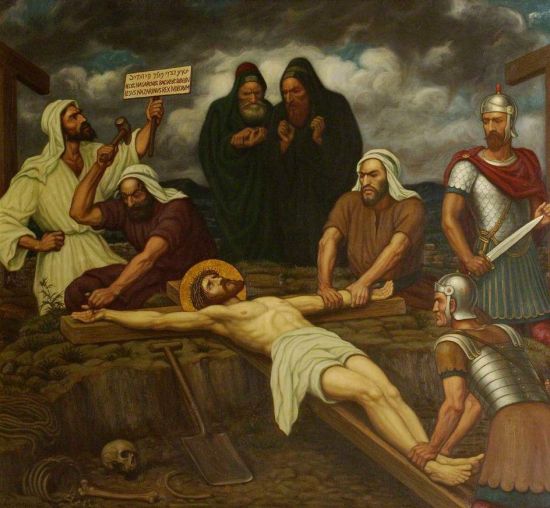
Edward Arthur Fellowes Prynne: Jesus is Nailed to the Cross

A prayer for my friend.

A dear, almost lifelong friend of mine passed from earthly life last night, on the feast of St. Brendan the Navigator. I found comfort in praying for him the Akathist to Jesus Christ for a Loved One Who has Fallen Asleep. Every phrase of the prayer is full of meaning, but something about the following section made me want to share it.

It makes reference to the “soul stripped bare.” This image follows from the fact that the soul and the body are aspects of a whole person, made in God’s image and designed to be a unity; and when you think about how the soul and the body have never had to be fully separated before death, it seems natural that the soul, no matter how pure, should grieve at this loss.

We don’t think of the body as a shell from which our soul ultimately emerges — our bodies are us, and they are temples of God at the same time, in which we worship. If at the end of our lives our Lord takes our spirits from our bodies, it is not because they aren’t precious. They will be resurrected at the end of time.

O Thou Who wast crucified for us and Who for us wast tormented: Stretch forth Thy hand from Thy Cross and with the drops of Thy poured-forth blood wipe away his sins without a trace; and with Thy beautiful nakedness warm his soul, now stripped bare and orphaned:

Jesus, Thou didst know his life from birth and didst love him.
Jesus, Thou didst see him from afar from the height of Thy Cross.
Jesus, suffering painfully on the Cross, Thou didst stretch forth to embrace him as he came from afar.
Jesus, Thou didst cry out for his forgiveness on blood-stained Golgotha.
Jesus, Thou didst in grievous torments meekly die for him.
Jesus, Who didst suffer to be laid in the tomb, sanctify his repose in the grave.
Jesus, Risen, raise up to the Father his soul which was embittered by the world and saved by Thee.
Jesus, All-merciful Judge, vouchsafe Thy servant the sweetness of Paradise.

From The Akathist to Jesus Christ for a Loved One who has Fallen Asleep