Tag Archives: sky

Like bread, or the sea.

After I left my car at the mechanic’s shop for its routine service, I set off walking down the road to the bus stop. After only a few steps I stopped to admire plants along my way; I did that a few times. The California Buckeye startled me as it always does, looking like the dead of winter in early fall. The large conker peeking out redeemed the scene.

It was fun, walking for ten minutes through a sort of industrial park, where all the people arriving for work gave their energy to the atmosphere, and lots of pickup trucks lined the road, bare of sidewalks most of the way. The air was crisp but not harsh.

On a bench at the bus stop, I looked briefly across the frontage road at the seedy mobile home park whose sign was missing some letters and read “Taylo.” A mockingbird’s song came to me from somewhere, surprisingly not drowned out by the heavy traffic noise. And then my gaze rose, hungry, to the sky.
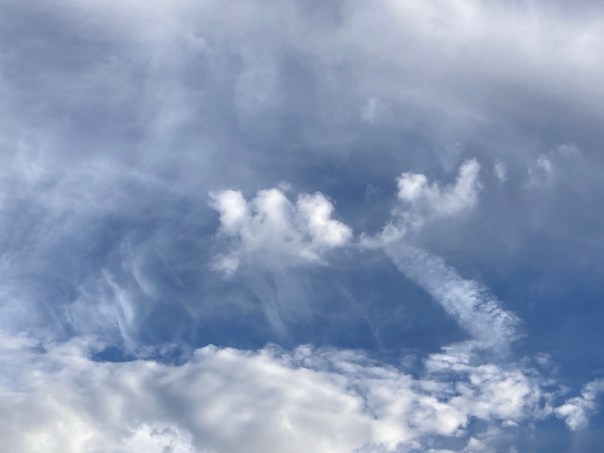
I recognized the remains of a jet stream (or chem trail?) as one element of that picture above, but there was so much else going on up there! I began to think about what Emerson said, that “The sky is the daily bread for the eyes.” I mused on how sometimes we are given all sorts of fancy bread, but at other times the sky is plain blue, or white, or gray….
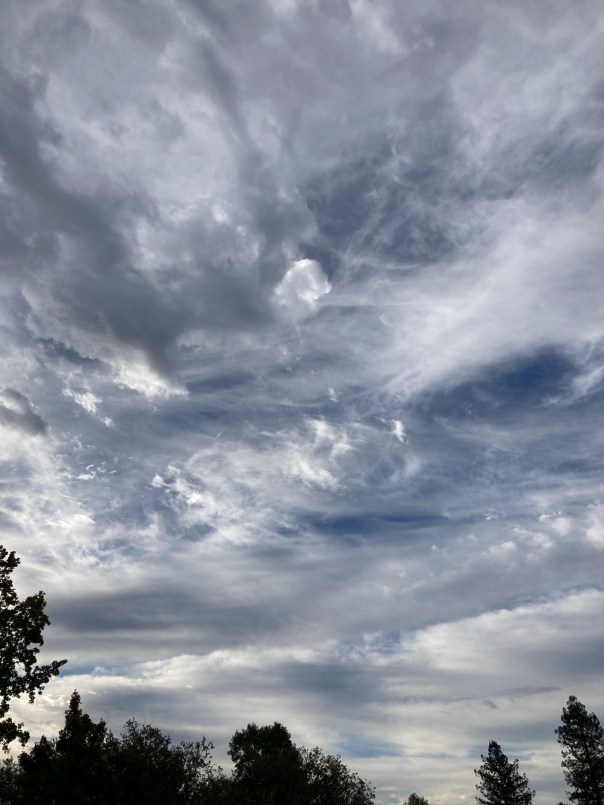
After a short ride on the bus, I got off and started walking the rest of the way home, along a boulevard where I had plenty more of those big spaces to wonder at. I was struck by the realization that I was the only human on earth to whom each particular picture was given, because I was the only one at that GPS location, at that moment in the constantly changing arrangement of images.

If one lives in the big city, with skyscrapers hogging the sky, usually a little bit at least will peek through; I like to get my bearings occasionally by looking at whatever patches are available for viewing. Being in prison, though… now that would be hard. I guess they do often let at least some of the prisoners outside sometimes, but they might not feel safe and relaxed enough to feast on their daily bread in that setting.

Twice now I’ve started reading The Marvelous Clouds, and shared some quotes here. I reread some of Albert’s comments that I included in one post about the book ; he passed on some excerpts from an article about it, which is about media. One thing the author said was that “Clouds illustrate media ontology. [They] exist by disappearing.” 

I gave that book away a while back. It’s very thought-provoking, to be sure, but I think if I had continued reading it I would have just been page by page arguing with the author over various things. I don’t like that he uses clouds for anything. I’d rather receive the gift of clouds as bread for my eyes. This arrangement of clouds below looked like it was pretending to be mountains in the distance:

The author of that book, John Durham Peters, also said that clouds are the original white noise. If you want to follow that thought, read the article linked in that more recent post of mine. But I think it’s more profitable for the soul to go out and look at the sky, whether there are clouds in it or not. When there are no clouds, or they have merged into a less enthralling picture, watching them might be like staring out at the ocean. It’s always moving, but it can be boring at the same time. Sometimes we need that plain bread. Feasting all the time is not good.

While my thoughts were on the clouds, my legs carried me into neighborhoods closer to mine, but I took a less familiar route and saw this beautiful plant that I found out is called a Common Lionspaw. I got distracted from the sky and started thinking about where I could fit one of those in my garden.

My cloud show seemed to go to intermission for a few minutes, with the actors going off stage — but quickly it started up again, as the sun began to break through.
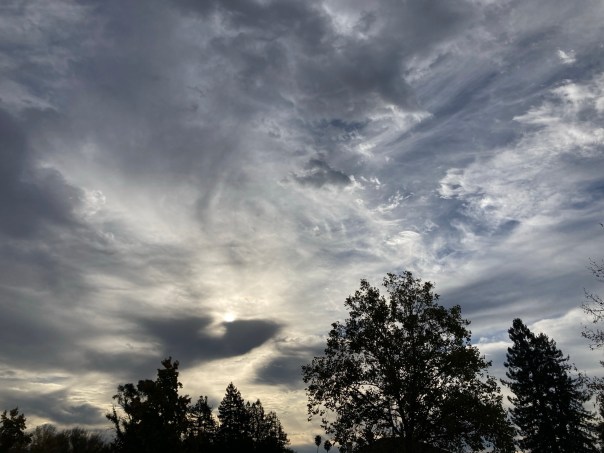
Then, I was home again. It was time to start the rest of my day, and figure out what to eat… but my eyes had already had a big breakfast.

Flying at Night

Back in May, I wrote about how I had been given a nighttime airplane ride with my son-in-law as pilot. I have had the experience on commercial flights, too, and found it enthralling whenever we were flying low enough to see the patterns of lights down below. I wonder if I will have that chance again…

FLYING AT NIGHT

Above us, stars. Beneath us, constellations.
Five billion miles away, a galaxy dies
like a snowflake falling on water. Below us,
some farmer, feeling the chill of that distant death,
snaps on his yard light, drawing his sheds and barn
back into the little system of his care.
All night, the cities, like shimmering novas,
tug with bright streets at lonely lights like his.

-Ted Kooser

View from plane – Wisconsin

Meeting the black night’s face.

This week so far I have seen patches of the starry sky through the window from my bed, and through narrow gaps in the tree canopy as I walked along the gravel road coming back from a campfire.
Those glimpses are lovely, but not as powerful as what I experienced a few years ago when I was alone here in the High Sierra, standing on the deck at night, looking up: I was aware of the stars as somehow sentient beings that were intently and personably crowding and pressing down on me. The poem below expresses the thrill of such a meeting as I had, with added feelings that I didn’t experience.

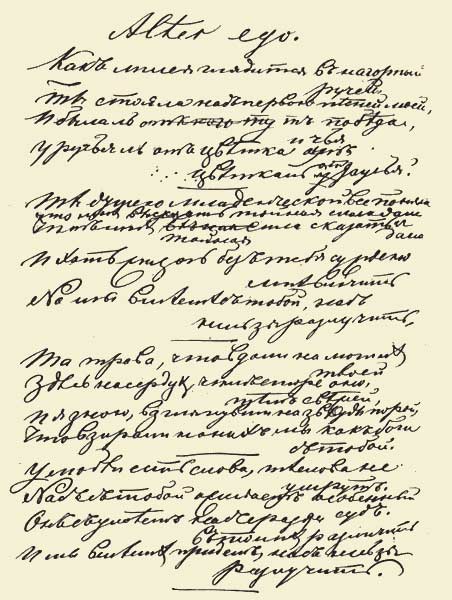
The composer Tchaikovsky, in a letter to the Grand Duke Konstantin Konstantinovich, wrote: “I place some of his poems up there with the very highest that there is in art. In this respect there is one which I am determined to illustrate musically some day.” This is the poem he copied in:

UPON A HAYSTACK ON A SOUTHERN NIGHT

Upon a haystack in lands of South,
I lay, while facing skies of night,
The choir of stars, alive and couth,
Was trembling, spread at every side.

The earth, mute as a dream half-hidden,
Was fast receding into space,
And I, as if the first in Eden,
Alone met the black night’s face.

Did I race to the depth profound,
Or did the stars race straight to me?
In mighty hands, it seemed me how,
I hanged above abysmal sea.

With heart, so sinking and bewildered,
I measured with my look a depth,
Into which, every moment sighted,
I sink, and nobody helps.

-Afanasy Afanasevich Fet, (1820-1892)

One odd thing is, the way Luis Sundkvist translated the letter from Russian, the second line of the poem reads, “I lay with my face towards the ground…”  How this happened I can’t imagine, because of course the poem makes no sense like that.

Golgol and Tolstoy also thought Fet’s poetry was stellar. The writer and publisher Nikolay Nekrasov wrote: “Not a single poet since Pushkin has managed to give such delight to those who understand poetry and readily open their soul to it, as Fet does.” 

The surname of Fet was assigned by authorities to Afanasy because of some question in Russia about the legitimacy of his birth; his parents’ marriage had been registered in Germany. In his later years he wrote to his wife, “You cannot even imagine how I hate the name Fet. I implore you never to mention it… If someone would ask me to give one single name to all the trials and tribulations of my life, I’d say without hesitation, this name is ‘Fet'”. Later still he was able to get back the name of his father, Shenshin, but as his poems were all published under the name Fet, so he is known. Evidently not much of his work has been translated into English, which makes this one even more special.

Another poem by Fet.

We may as well go patiently on.


ON LOOKING UP BY CHANCE AT THE CONSTELLATIONS

You’ll wait a long, long time for anything much
To happen in heaven beyond the floats of cloud
And the Northern Lights that run like tingling nerves.
The sun and moon get crossed, but they never touch,
Nor strike out fire from each other, nor crash out loud.
The planets seem to interfere in their curves,
But nothing ever happens, no harm is done.
We may as well go patiently on with our life,
And look elsewhere than to stars and moon and sun
For the shocks and changes we need to keep us sane.
It is true the longest drouth will end in rain,
The longest peace in China will end in strife.
Still it wouldn’t reward the watcher to stay awake
In hopes of seeing the calm of heaven break
On his particular time and personal sight.
That calm seems certainly safe to last tonight.

Robert Frost, West-Running Brook, 1928

I read Frost’s poem on this blog: First Known When Lost, where it was posted this week along with a couple of others that may be seen as following a theme. Stephen Pentz leads off his article with the reminder that  “… the feeling that the world is going to Hell in a hand-basket is a timeless feature of human nature.”

Then he leads the reader to make a distinction between the world and the World. I have been thinking lately about Mary Oliver’s poem “Messenger,” which is about this, and I’d say “Landscape” as well.

The details of our given “work assignments” are unique to each of us; we need to look to God for light and strength to do the essential spiritual work, which will help us to be ready for any more public tasks that come our way. Pentz’s last line sums it up pretty well:

“Life is ever a matter of attention and gratitude, don’t you think?”