Tag Archives: spring

I float on a sea with bangles.

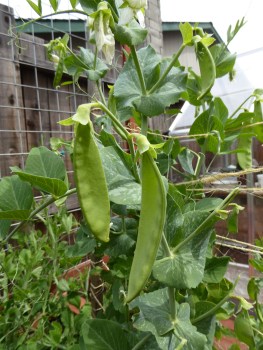
snow peas

Poetry is sane because it floats easily in an infinite sea; reason seeks to cross the infinite sea, and so make it finite. The result is mental exhaustion. To accept everything is an exercise, to understand everything a strain. (This and all quotes in green below are from G.K. Chesterton.)

I had another title for this blog post, something about pollinators, but when I saw the preponderance of green in the images, it made me think of Tuesday’s poem, which could be talking about my own garden that is wild with leaves and flowers popping out at a mad rate. All the glory does make it hard for me to hold a thought, and there are many I should not let go of — starting with all the outdoor tasks that won’t wait: feeding and weeding and trimming and tying….

But going back to the poem, I’ve been thinking about how it describes the way the most common natural occurrences — after all, “the world comes back” in spring year after year — can confuse and even shock us if we really pay attention. In my yard it seems that between the time I walk from the front garden to the back and return again, a new weed has sprouted or an iris has emerged.

Why have I arrived on the path by the salvia? I don’t even take time to ponder, but I immediately start pulling weeds. Then I return to the fountain and see a honeybee on a flower, and must go into the house for my camera and “waste” a few minutes attempting to record one of the thousands of thrilling things happening here, right outside my door.

There is a road from the eye to heart that does not go through the intellect.

This road leads to the heart from other sensory “gates” as well. My garden seems primarily visual, but also the rich scents of osmanthus and daphne and lavender have their own direct routes to my heart, as do the bird songs. I don’t have to think about them or know their meaning. In the poem about the “Deciduous Spring,” sounds of words are used to mimic the visual symphony or cacophony that all this burgeoning creates.

The poet only asks to get his head into the heavens.
It is the logician who seeks to get the heavens into his head. And it is his head that splits.

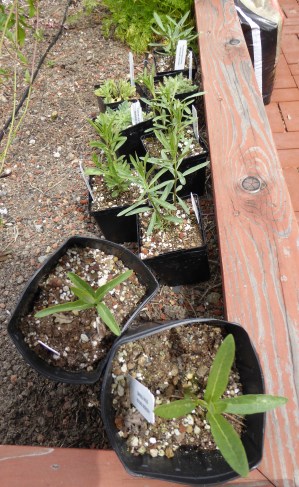
This week I will be adding more plants to the mix, and several of them will be of the sort that the hummingbirds and bees and other insects like. Last fall I planted five types of seeds that did not sprout: poppies, milkweed, prairie echinacea… So — I found a native plant nursery where I was able to buy two species of milkweed plants, orange Moroccan poppies, and penstemon. Visions of Monarch butterflies fill my head.

In the picture below of the waiting plants, the milkweed is mostly in the foreground, two types that are native to the western U.S.: Asclepias fascicularis and Asclepias speciosa
The perplexity of life arises from there being too many interesting things in it
for us to be interested properly in any of them.
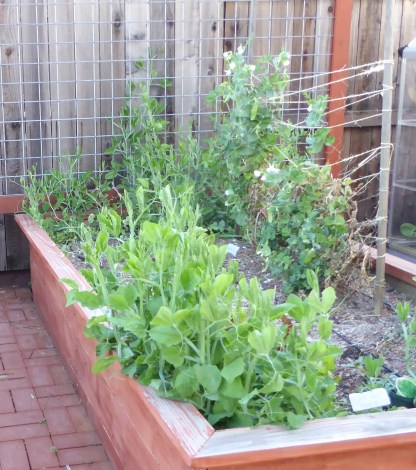
Three varieties of peas, mostly flowers soon to bloom.

To mention a pair of not-green things: The orioles are back! Not in the group that I am trying to attract with certain flowering plants, their preference is sugar water.
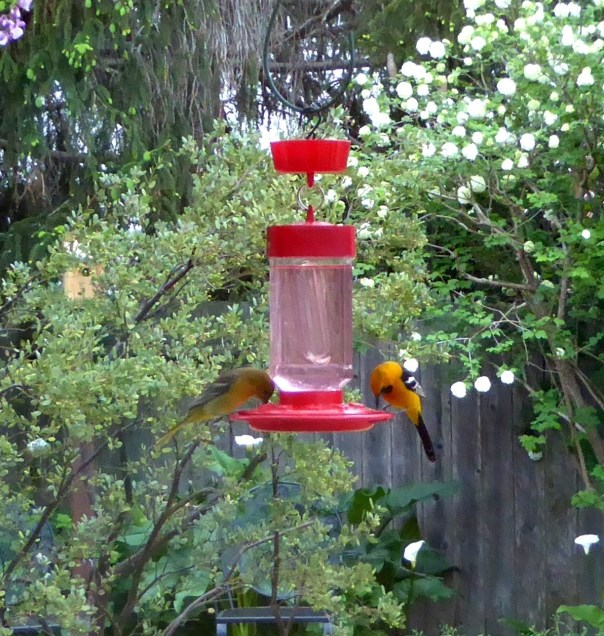
They are very shy, so I’m not going to try to take new pictures of them. This one is from my great photographic effort last spring.
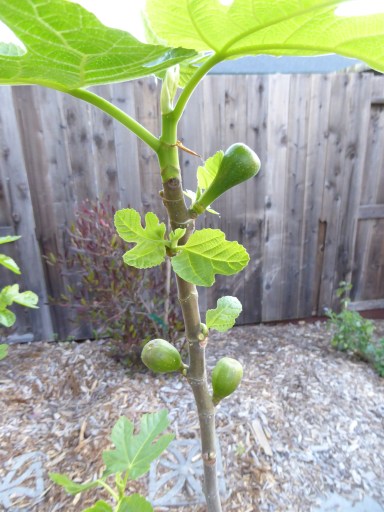
The snowballs on the viburnum are little green things so far. Green fruits are on the fig tree. I ran into a Painted Lady butterfly over there, and bumblebees, but their interest was the lithodora blossoms.
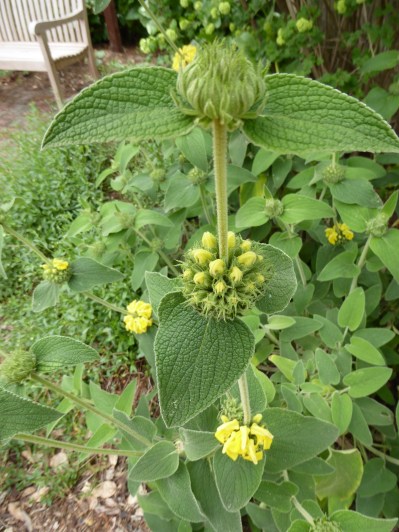
Jerusalem sage

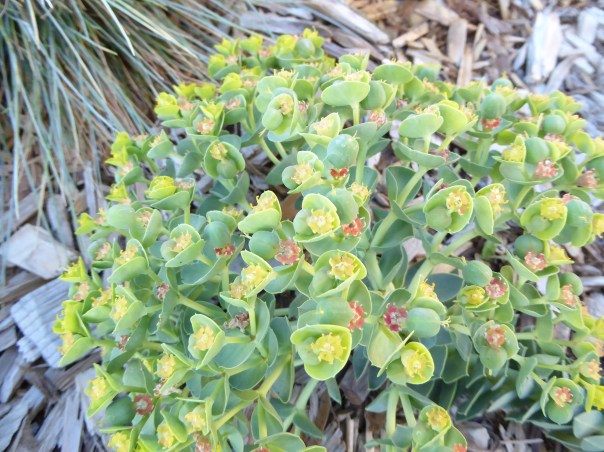
Even the tiny flowers of the Euphorbia myrsinites are swallowed up in their green leaves.
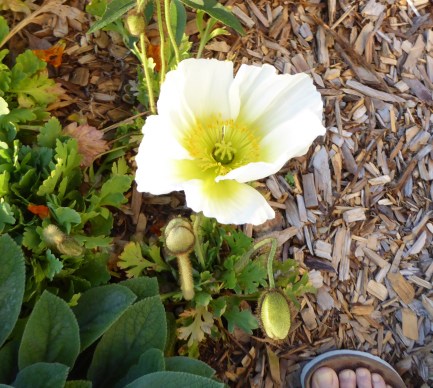
Nearly every day I fall in love again and try to capture another poppy with my camera.
This time my toes got in the picture. At least they are not green.

The whole order of things is as outrageous as any miracle
which could presume to violate it.

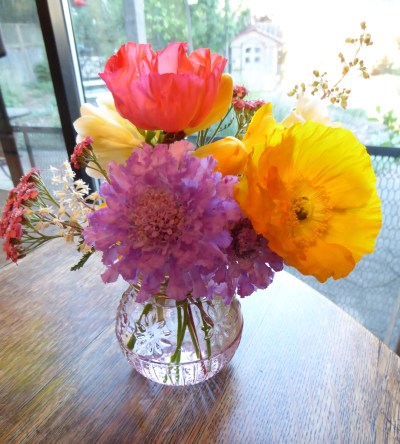
And below, I used a clever jar-vase that Mrs. Bread gave me for my birthday, and made a colorful bouquet that will give your eyes respite from green. It is like a little canning jar with a ring that screws on the top, but into the ring is set a florist’s frog, making it perfect for arranging odd little blooms with their often short stems that one finds in a garden like mine.
That’s my show-and-tell for today! How does your garden grow?
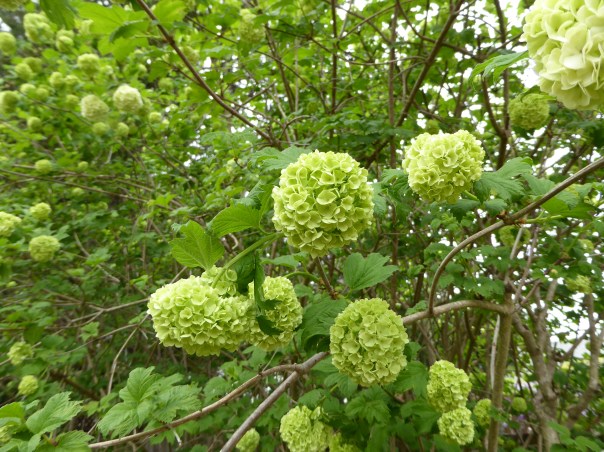
snowball bush


Green mirrors go wild.

It’s National Poetry Month again. Here is a gabbling, spangling and whirling poem I’ve been saving to share at just such a time as this. You really should read it aloud, if only to yourself.

DECIDUOUS SPRING

Now, now the world
All gabbles joy like geese, for
An idiot glory the sky
bangs. Look!
All leaves are new, are
Now, are
Bangles dangling and
Spangling, in sudden air
Wangling, then
Hanging quiet, bright.

The world comes back, and again
Is gabbling, and yes,
Remarkably worse, for
The world is a whirl of
Green mirrors gone wild with
Deceit, and the world
Whirls green on a string, then
The leaves go quiet, wink
From their own shade, secretly.

Keep still, just a moment, leaves.

There is something I am trying to remember.

~ Robert Penn Warren (1905-1989), American poet and writer

Lovely new things…

So many newly sprung buds and flowers to be seen around here — also some not so lovely, even ugly things in my garden. One of the most pure and fresh is the bloom on the plum trees:gl-p1060882

I spent hours in the garden over the last few days; one task was to provide some more strings for the snow pea plants that keep growing up and up and have even formed two infant pods so far. Why do they keep on – how do they do it, on the stems that seem rotted and dried near the ground?

gl-p1060892

I wouldn’t be surprised if I go out one morning and find that they have keeled over, but strangely, life flows through those brown and emaciated tubes. The sugar snap peas did not survive long enough to get flowers, and I removed them yesterday as well.

gl-p1060888

Evidently being beaten down by rain and then frozen every night is not their idea of seasonable weather. Truly, October is the month we are supposed to plant peas in our area, but this hasn’t been a typical year weather-wise….

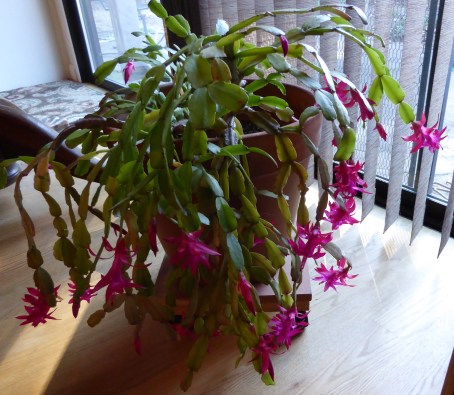
For a week we’ve been having more frosts, so I brought the Christmas Cactus indoors by my computer table and it is giving us Christmas in March.

gl-p1060879

gl-p1060895


The arugula and pak choi have gone to flowering, so I pulled them out and planted some parsley and new pak choi, purple this time. From the flowers you can guess that it is in the Brassica family.

This first week of Lent we have so many wonderful services, I’ve been at church a lot, and am glad to have my phone with me so I can save images like this. Somehow the camellia escaped getting brown spots from being constantly wet. It is giving us a picture of the purity and beauty that is God’s will for our souls.

gl-camellia-at-church-2-28-17

Lenten love and lettuces.

For the letter “L”, Lent is a natural choice of subject, considering the season we Orthodox are in. This year Pascha or “Greek Easter” is five weeks after Western Easter, so we are still in preparation. Everything that we experience or do is placed in the context of our efforts to draw close to Christ and to be ready for the glorious celebration of His Resurrection. If I don’t see that connection on my own, someone around me is sure to say, upon hearing that I’m sick, or my car broke down, or about any number of news items, failings or challenges, “Ah, well, it’s Lent!”P1030845(2)

Sloughing off the unnecessary, becoming more like Mary than Martha, letting go, focusing on the eternal things and soaking up the encouragement of our mother the Church through the heart-sustaining services of this period of the calendar — these are some of the things we try to work on.

When on April Fool’s Day my computer’s hard drive failed, I lost several months’ worth of data and many hours of work that I have to do over, including hundreds of photos and I don’t know what else, because somehow my backup program had also failed since December. My Computer Guy was more distressed than I was; I realized deep down that this loss was of nothing essential to my life. I said something like that to him, mentioning Lent, and he remarked lightly that my attitude inspired him to consider what sort of sacrifices he himself ought to be making. “Oh, no,” I wanted to say, “It’s not about making sacrifices!” But exactly what it is about, I wasn’t prepared to expound. I do know that I did not choose to give up a big chunk of visual and literary records.Christ washing feet of disciples

What Lent is about can be summed up in this prayer that we pray hundreds of times throughout the weeks and the services. It doesn’t say anything about sacrifice or even about food.

The Lenten Prayer of St. Ephraim the Syrian

 O Lord and Master of my life!
Take from me the spirit of sloth, faint-heartedness,
lust of power, and idle talk.
But give rather the spirit of chastity, humility,
patience, and love to Thy servant.
Yea, O Lord and King!
Grant me to see my own errors
and not to judge my brother;

for blessed art Thou unto ages of ages. Amen.

And though to be truthful, there is mention of sacrifice when we come together, it’s in the moving hymn we sing on our knees at one of the Lenten services:

Let my prayer arise in Thy sight as incense,
And the lifting up of my hands

As an evening sacrifice.

I happen to be reading a book that seems very Lenten in its mood and themes. This novel by Eugene Vodolazkin, Laurus, is filling my mind so much the last few weeks, I originally planned to dedicate the whole of “L” to it, even though I’m still in the middle of the book. It’s about the Middle Ages, a holy fool, and kairos. The main character demonstrates the kind of self-emptying that results in making space for God.Image result for laurus

His motivation for asceticism is love for someone for whom he wants to pray, and he does not want to be distracted by being too comfortable. Eventually he comes to feel out of touch with his body, almost insensible to its condition, and free. You might think that such a person would also be oblivious to the natural world around him, but Arseny seems to be more intimate with the creation and appreciative of its beauty than the average person. Perhaps the Holy Spirit allows him to see and interact with things more directly and clearly than we who only have our natural senses.gl lettuce IMG_2014

Speaking of Nature, I am trying to cooperate with her and grow some vegetables. On Friday I set out some little lettuces and also some kale and leeks. The lettuce is of two varieties of Romaine: Forellenschluss (which I probably bought for its name that is so fun to say) is the speckled kind on the left in the photo; it’s an heirloom variety from Austria. The plain green is a heat-resistant lettuce from Israel and is named Jericho.

That Lenten prayer is useful all through the day, and everywhere we go. I feel the spirit of love in regard to my garden, but I need the spirit of patience. I pray the Lord takes from me the lust of power, but I don’t expect it will happen as quickly as I lost all those digital photos.

Did you know that “the English word Lent is a shortened form of the Old English word len(c)ten, meaning ‘spring season'”? Whatever hemisphere we live in, we can with God’s help tend our hearts, and make this season the springtime of our soul.