Tag Archives: St. Nikolai Velimirovich

The Lord in the guise of a woman.

THE TEN DRACHMAS:
The Lord in the Guise of a Woman
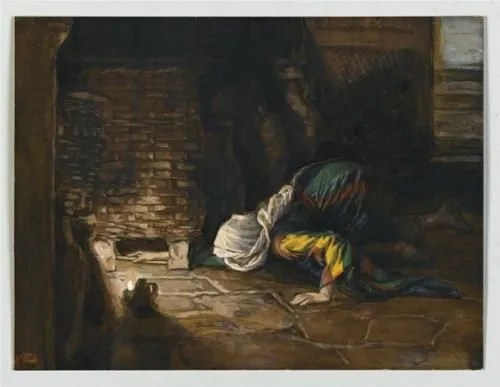

“Can you believe that Christ the Saviour portrayed Himself in the guise of a woman in two of His parables? One is that of the woman who took three measures of flour and made dough. But first let us speak of the other one where the Lord tells us about the woman who had ten drachmas and lost one. These are the most mysterious of all the Saviour’s parables. As the parable of the lost drachma is short, we quote it in full.”

“Or what woman, having ten drachmas, if she lose one, does not light a candle and sweep the house and look diligently till she finds it? And after she has found it, she calls in her friends and neighbors and says, Rejoice with me, for I have found the drachma that I lost (Luke 15:8-9).”

“At first glance this parable seems so simple, or even naive, that it does not impress the reader of the Gospel. In fact, however, the mystery of the universe is revealed in this simple parable.”
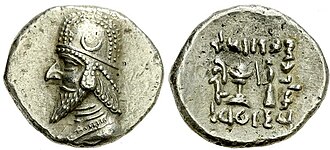
Drachma of Darius King of Persia, 1st century.

The paragraphs above are the first part of an article by St. Nikolai Velimirovich, which I’m happy to bring to your attention. From his statement about the mystery of the universe, the author goes on to point out the puzzling elements in this very short story, and to explain two interpretations, both of which he says are correct. I will let you read the whole exposition at your leisure: “The Ten Drachmas” (in which he also treats the second story, the “Three Measures of Flour,” in detail). But I want to share one more excerpt, which returns to the question of why the protagonist in “The Ten Drachmas” must be a woman:

“Our Lord described Himself as a woman because women are more careful than men in looking after property, in keeping the house in order and in receiving guests. If this short parable, which consists of only two sentences, is explained in this way, whose heart will not tremble? for it contains the whole tragedy of the world, visible and invisible. It explains why the Son of God came to earth. It sheds a bright ray of light on the history of mankind and the tragedy of each individual’s existence.

“It confronts us with an urgent decision, because our life is swiftly passing — a decision as to whether we want to be the lost drachma found by Christ or not. Christ is looking for us. Are we going to hide from him, or let ourselves be found by Him before death hides us from Him, from the world and from life?”

-St. Nikolai Velimirovich
“The Ten Drachmas”

Armies cried out as an echo.

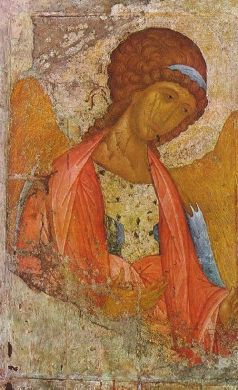
When the Holy Trinity said, “Let there be heaven and earth,” Thou, O Christ, didst serve as a Thought and a Tongue of the divine Trinity. Choirs of angels formed themselves on Thy voice, receiving their form from the multi-colored light; thereupon many armies, as multi-colored clouds, cried out as an echo of the divine glory and divine blessedness, and stood in ranks around Thee, their Leader, singing the triumphal hymn: Alleluia.

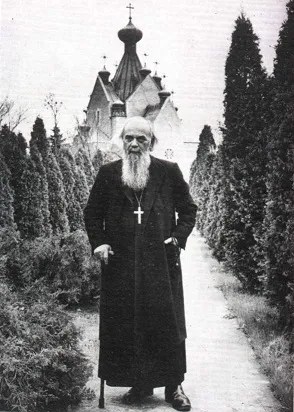
The long poem, Akathist to Jesus Conqueror of Death, by St. Nikolai Velimirovich, contains songs of the nine ranks of angels, of which that above is titled, “The Choir of Angels.” Today in the Orthodox Church we commemorate the Archangel Michael and All Angels, so I will share the second of those songs as well, “The Choir of Archangels”:

Thou hast made us Thy vessels and filled us completely with Thy might and Thy wisdom; of ourselves we are nothing, but in Thy mercy Thou hast made us Thy friends. Lucifer fell from our archangelic rank and dragged all mankind into perdition, but Thou, so as to remove that disgrace from our countenance, hast allowed us to share in Thy victory, the victory over Lucifer, by sending the Archangel Gabriel as herald of Thy descent into battle and Thy victory; thus in gratitude we praise and glorify Thee, singing: Alleluia.

Last year at this time I was trying to learn a prayer song to the Archangel Michael, to teach the little children at church. I had forgotten about the most traditional and easy one that they might already have been introduced to in the past, and spent a long time in finding a hymn (text below) that was really a bit much for the class. But it is my own favorite so far, and I think this is where I learned it:

Father Stephen has written about the legitimacy of praying to angels. About the scripture that says, “There is only one mediator between God and man, the Man Christ Jesus,” he explains:

“…that sense of mediation is a meaning of the word that Christ alone could perform. No angel, no other creature can unite me to God. Only God become man is able to unite man to God.

“But we’re talking about prayer, not union, per se. Can someone else pray for me? I hope so …. Can angels pray for me? (yes they can and they do). Is it wrong to ask them to do so or thank them for it (certainly not)….

“God is the ‘Lord of Hosts.’ He is always surrounded by such a cloud of Angels, saints, etc. He cannot be approached ‘alone.’ This great company of witnesses, as the book of Hebrews calls them, bears witness to my prayers before God, and hopefully improves greatly upon them. They see so much more clearly than what I see. I see and know so little. Thank God someone is praying who knows. God knows, but it is His delight, in the utter humility of His nature, to share that knowledge and to invite us to pray.”

St. Michael the Archangel,
Defend us in battle.
Be our protection against the wickedness
and snares of the devil.
May God rebuke him we humbly pray;
and do thou, O Prince of the heavenly host,
by the power of God,
cast into hell Satan and all the evil spirits
who roam throughout the world,
seeking the ruin of souls.

St. Michael bust relief by Jonathan Pageau

Theology is all or nothing.

“Theology means the word about God. Theology is therefore ALL or nothing. The whole of nature and the super-nature and the subternature IS ALL theology; all man and every part of him is theology; every meadow and every flower is theology; Sirius and the Milky Way, nebulae and meteors are theology; the history of the planet and the history of the people, the history of radioactivity and the history of every butterfly, and of every grain of sand, and of every drop of water, and of every ray of light are theology.

“If the whole of nature is not theology, then theology is nothing or nature is nothing. If the whole of nature does not speak about God, who will believe Isaiah or Paul? If the whole of the world around is a wilderness, what can the voice of one prophet crying about God in that wilderness accomplish? If the whole universe does not speak of God, who can without contempt hear the words of one man?”

-St. Nicholai Velimirovich

I am surrounded by Your heralds.

“Your birds awaken me in the morning, and the murmur of the lake lulls me to sleep in the evening. But it is not the birds that awaken me, nor the lake that lulls me to sleep, but You, O Lord, Master of the voice.

“You lend Your voice to the birds and the midnight murmur to the lake. You have lent a voice to every throat, and have put a story into every creature. I am surrounded by Your heralds, as a student by many teachers, and I listen to them tirelessly from dawn to dusk.

“O Lord, Master of the voice, speak more clearly through your heralds!

“The sun speaks to me about the radiance of Your countenance, and the stars about the harmony of Your being. The sun speaks in one language, and the stars speak in a different language, but all the languages flow out of the same vocal cords. The vocal cords belong to You, and You uttered the first sound that began to tremble in the deafness and formlessness of nothingness, and it broke into countless sounds and heralds, as a thundercloud breaks into rain drops….”

-St. Nikolai Velimirovich, from XXVII, Prayers by the Lake

I am pondering St. Nikolai’s plea, that the Lord speak more clearly… If we can’t understand, isn’t the problem that we are hard of hearing? But maybe it is his way of saying, “I am straining the ears of my heart, Lord, to know You better.”

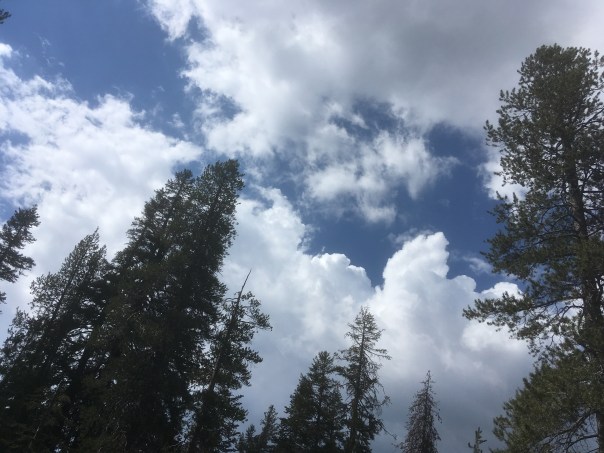
When I found this particular prayer yesterday, it resonated with my own experience here in the mountains, where so much of my attention is focused on the birds, the clouds, and yes, the stars. After a thunderstorm one evening, I went out and found the sky full of them, declaring the glory of God, in their voices that are deep silence.

One afternoon when I sat on the deck reading, the silence caught my attention. At home in the suburbs, I have learned not to pay attention to all the neighborhood noises, and the freeway sounds that come on the wind from a mile away. Some hours are quieter than others, but if I listen closely, there is always the ticking of a clock, or the cars in the street. When I noticed that forest silence that my ears are not used to, I concentrated hard, to discover what might be in it. And all that I could take in was the pine boughs moving in the breeze.

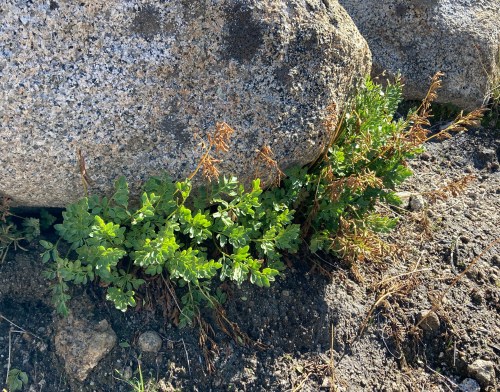
This poem from St. Nikolai’s collection is not really about the voice of God in silence. He goes on past what I quoted to talk about words and stories. It has truly been lovely for me to be slowed down by having fewer matters to attend to; to tune in to the “stories,” as it were, in the activities of the animals here, and to study a few plants. I saw another new-to-me plant not far from lakeside, called an American Parsley Fern:

I could watch the animals all day, I think, from my first-rate viewing perch. Chickadees are plentiful, and a junco made an appearance. I’m thankful that my sister suggested that I bring up some food that the chipmunks would like. This morning two chipmunks came to the slider and ran up and down, peering in with their paws against the glass. Do they know that the seeds come from the other side?

What I have been putting out for them is a mix of seeds and peanuts, and now a gang of Steller’s Jays have come for a share. As many as four at a time were interested.

They are truly handsome birds, with their shiny royal blue feathers. Of course they are greedy, and don’t have pretty voices, but they belong to this place, as it belongs to them. I’m happy that our stories overlapped for a short time, and wouldn’t mind if they did wake me in the mornings — but when I wake everything is still very quiet, and the sky that’s visible between the trees outside my window is turning from gray to pale blue.