Tag Archives: The Cross

The Cross in the heart.

We are celebrating the Feast of the Elevation (or Exaltation) of the Holy Cross. This is a commemoration of historic events in the Orthodox Church, and an opportunity to ask ourselves what these outward expressions of faith have to do with our lives in the current age. The original events are more than a thousand years distant from us, but the human condition is unchanged.

“The Exaltation of the Lord’s Cross has arrived. Then, the Cross was erected on a high place, so that the people could see it and render honor to it. Now, the cross is raised in the churches and monasteries. But this is all external. There is a spiritual exaltation of the cross in the heart. It happens when one firmly resolves to crucify himself, or to mortify his passions—something so essential in Christians that, according to the Apostle, they only are Christ’s who have crucified their flesh with its passions and lusts (cf. Gal. 5:24). Having raised this cross in themselves, Christians hold it exalted all their lives. Let every Christian soul ask himself if this is how it is, and let him hearken to the answer that his conscience gives him in his heart.” 

-St. Theophan the Recluse, Letters on the Spiritual Life
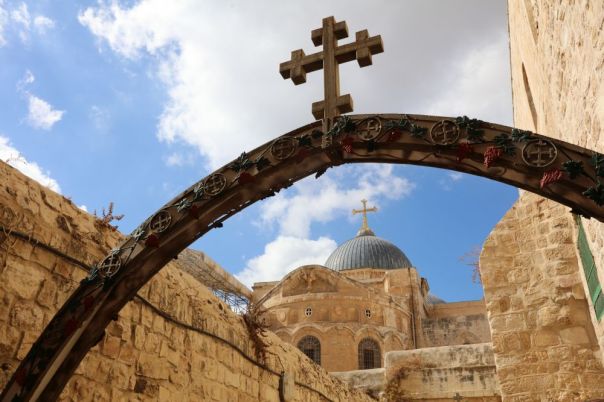
Church of the Holy Sepulcher, Jerusalem

Moses of old prefigured it.

Thy precious Cross, O Christ God,
which Moses of old prefigured in his own person
when he overthrew Amalek and put him to flight;
which David commanded to be worshipped,
calling it Thy footstool:
this same Cross we sinners worship today with unworthy lips.
We praise Thee Who wast pleased to be nailed upon it,
and we cry to Thee:

“With the thief, make us worthy of Thy Kingdom, O Lord!”

Thy Cross, O Lord,
is life and resurrection for Thy people.
And we who put our trust in it
praise Thee, our God crucified in the flesh.
Have mercy on us!

Here is a good article by Patrick Henry Reardon about the Biblical passage referred to above, in which Moses interceded for the army of Israel as it did battle with the Amalekites: “The Best Intercessor in the Bible.”

“Moses conquered the Devil, wrote Gregory the Theologian,
‘by stretching out his hands upon the hill,
in order that the Cross, thus symbolized and prefigured,
might prevail.'”

Illarion Mikhailovich Pryanishnikov, Cross Procession

To make broken things beautiful.

From Mother Melania:

Japanese kintsugi mending tools“Have you ever heard of kintsugi? Literally ‘golden joinery,’ kintsugi is ‘the Japanese art of repairing broken pottery by mending the areas of breakage with urushi lacquer dusted or mixed with powdered gold, silver, or platinum … As a philosophy, it treats breakage and repair as part of the history of an object, rather than something to disguise’ (Thanks, Wikipedia!). I won’t presume to discuss the Japanese philosophies related to this art. But there are certainly deeply Christian parallels to be drawn. Three come immediately to mind.

“First are those who valiantly and humbly endure life’s inequities or unjust persecution, such as Job, Patriarch Joseph, Jeremiah, and the beggar Lazarus. Crushed in various ways through no fault of their own, these saints became beautiful not despite the cracks, but because of how they dealt with them. Without such trials, these saints would never have become as great as they are.

“Second are those who sinned greatly but repented deeply, such as King David, Peter, and Paul. Their great sins are there for all to see and the sins remain sinful. Yet, Christ healed their fractured souls with the gold of their repentance and faithfulness.

“Then there is Christ Himself. He didn’t just valiantly and humbly endure unjust persecution: He came to earth for that very purpose – for OUR sake. So, His wounded side and hands remain in eternity as visible signs of the beauty of His victorious self-sacrificial love.

“So, let’s take heart. Are we innocently enduring persecution? Christ can make us beautiful through our trials. Have we fallen into serious sin? We can repent and still become great saints. We can even go past these things to suffer freely for love of Christ and His people. Thus, we shall most deeply resemble Him Whose greatest glory is that He was freely broken for our sake.”

—Abbess Melania, Holy Assumption Monastery

A voluntary act of foolishness.

“We want to be safe. When we see that another person is sorry for what they have done to us, we begin to think that they will now become safe. We fear forgiving those who show no sorrow or who have not clearly repented of their actions towards us. And we do well to fear it. That is a completely rational, even “hard-wired,” instinctive response. But that tells us what forgiveness actually entails and what it is that Christ asks of us.”

The Orthodox Church starts Lent off with the Vespers of Forgiveness, which all are strongly encouraged to attend, and to participate in, by asking forgiveness of everyone else in the church, one by one.

Not everyone does this, and those who do likely go on struggling to forgive again and again as Lent continues*, and as we pray our daily Lenten prayer of St. Ephraim, in which one thing we ask God to give us is the spirit of “humility, patience, and love for mankind.”  So I am posting a link to this short meditation from Fr. Stephen on why it is so hard to forgive: “The Danger and Shame of Forgiveness.”

More from the article:

“Forgiveness in the Christian sense is properly an act of self-emptying. It is a voluntary act of foolishness in which we act in a manner contrary to the shame that has been cast upon us. Understood in this manner, forgiveness is of a piece with bearing the Cross itself. It is of paramount importance that the one act of general forgiveness offered by Christ is found in words spoken from the Cross. They could have been spoken from nowhere else.”

You can read the whole essay: here.

*(This year Easter in the Eastern Orthodox Church is May 5th,
so we are still in the middle of our Great Fast.)

Downingia