Tag Archives: The Incarnation

Let us eat of it and live forever.

Many, if not most, Orthodox Christians in the world will celebrate our Lord’s Nativity on January 7, as was the custom for all Orthodox until less than a century ago. Under various pressures to westernize, some began to use the “secular” calendar as had been requested of them since the 16th century. I happen to have been baptized into a “new calendar” diocese, so here I am! When I announce a feast day or a calendar date of a commemoration, saying “We –,” I don’t disregard the vast numbers of my beloved brothers and sisters who are waiting thirteen more days for their holy day. But here I go again:

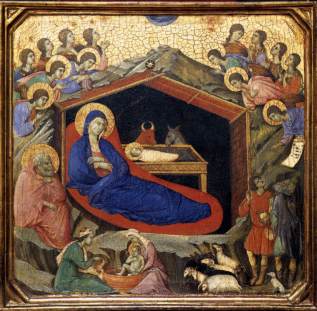
We have entered the Forefeast of the Nativity of our Lord:

Prepare, O Bethlehem, for Eden has been opened to all!
Adorn yourself, O Ephratha,
for the tree of life blossoms forth from the Virgin in the cave!

Her womb is a spiritual paradise planted with the Divine Fruit:
If we eat of it, we shall live forever and not die like Adam.
Christ comes to restore the image which He made in the beginning!

A Rose dispels the darkness.

I didn’t encounter this Christmas carol,  “Lo, How a Rose E’er Blooming,” until long past my childhood. For various reasons it is one of my favorites now. Here it is sung in Ely Cathedral:

Lo, how a Rose e’er blooming
From tender stem hath sprung!
Of Jesse’s lineage coming,
As men of old have sung.
It came, a flow’ret bright,
Amid the cold of winter,
When half spent was the night.

Isaiah ’twas foretold it,
The Rose I have in mind;
With Mary we behold it,
The virgin mother kind.
To show God’s love aright,
She bore to men a Savior,
When half spent was the night.

This Flow’r, whose fragrance tender
With sweetness fills the air,
Dispels with glorious splendor
The darkness everywhere.
True man, yet very God,
From sin and death He saves us,
And lightens every load.

By the time our family brought this carol into our repertoire, several of us would enjoy singing the carol in its original language when we gathered at Christmastime, at least a few times. Even before their father ceased to be one of the singers, the details of our festivities had begun to change. It’s been a while since we have been able to sing as many carols as we would like, usually because of the needs of small children.

This year I will sing it by myself. It will be a good chance to try the German version again and work on memorizing it. The tone and the message are certainly sweet like the loveliest rose. I appreciate the reminder of how Christ ultimately defeated death by his death. God is with us! That’s why every Christmas can be a merry one, and why I’m eagerly looking forward to this feast.

Everything depends upon that moment.

Today is the beginning of our salvation;
the revelation of the eternal Mystery!
The Son of God becomes the Son of the Virgin
as Gabriel announces the coming of Grace.
Together with him let us cry to the Theotokos:
“Rejoice, O Full of Grace, the Lord is with you!”

I had wanted to continue my ruminations on The Lily of the Field and the Bird of the Air by further considering The Moment that Søren Kierkegaard refers to when, after waiting in silence, “…the silent lily understands that now is the moment, and makes use of it.”

I don’t know what that moment consists of for you, for me, for us as a world community, or in our cities or church communities or families. No doubt there are overlapping times and seasons containing infinite instants, and only by quiet listening can we make any sense of them. But this passage in particular I wanted to pass on, in which the writer discusses what is missed when we fail to make the proper, standing-before-God kind of preparation:

“Even though it is pregnant with rich significance, the moment does not send forth any herald in advance to announce its arrival; it comes too swiftly for that; indeed, there is not a moment’s time beforehand…. But of course everything depends upon ‘the moment.’ And this is surely the misfortune in the lives of many, of far the greater part of humanity: that they never perceived ‘the moment,’ that in their lives the eternal and the temporal were exclusively separated.”

So many thoughts swirl in my own noisy mind and heart that I could not imagine how I might find a way to share even these few gleanings with you. Then, in God’s providence and the church calendar, appeared someone who is the supreme example for us of being ready for the moment, that time in history and that time in her life, in a particular moment of a day, when the Angel Gabriel appeared to her. Today we remember that event, when Mary listened, and responded, “Behold, I am the handmaid of the Lord; let it be to me according to your word.”

The Word became flesh and came to live with us, taking on all our human experience, its weakness and suffering and  death. He defeated death, and opened the gates of Paradise. The Incarnation, the beginning of our salvation, is The Moment of history; our own “Yes” to God, echoing Mary’s willingness, can be the essence of our every prayer as well, as we wait on Him.

Kierkegaard exhorts us, in words that seem especially fitting for this time of uncertainty and change: “Would that in the silence you might forget yourself, forget what you yourself are called, your own name, the famous name, the lowly name, the insignificant name, in order in silence to pray to God, ‘Hallowed be your name!’ Would that in silence you might forget yourself, your plans, the great, all-encompassing plans, or the limited plans concerning your life and its future, in order in silence to pray to God, ‘Your kingdom come!’ Would that you might in silence forget your will, your willfulness, in order in silence to pray to God, ‘Your will be done.'”

We know that God’s will for us is good, now as ever. Our inability to see or understand that is due to our weakness or sin, or His hiding of His works. May He give us grace to wait and to pray, and eventually we will see the full salvation of the LORD.

Oh, the depth of the riches and wisdom and knowledge of God!
How unsearchable are his judgments and how inscrutable his ways!
For who has known the mind of the Lord,
or who has been his counselor?
Or who has given a gift to him that he might be repaid?
For from him and through him and to him are all things.
To him be glory forever. Amen.

Romans 11

The opposite of not getting in trouble.

My Christmas tree is still standing in my entryway, at the bottom of the stairwell. It’s handy to have an artificial tree so that it never starts looking worn out and dried up. I didn’t get it out of its box and trimmed until very late, and then all the days this month that I was mostly in bed because of my viruses, I couldn’t even see it much. I missed many services of Nativity and Theophany in which I might have been reminded by poetry and theology of the significance of “Immanuel: God with us.”

So bear with me if I continue on the theme of the Incarnation. After all it is, as was pointed out to me not long ago, the second most important point of Christian doctrine, after the Holy Trinity. If we truly live, we live it every day. And it’s worth giving extra attention to at least once a year. 🙂

One of the days I was in bed I started listening to The Fountain Overflows by Rebecca West. I would love to hear if any of  my readers has read this book or others in the Aubrey Trilogy of which it is first. This makes the third time I will have read this novel in the last ten years, and I could count on one hand the novels I’ve read three times in my whole life. I read the other two in the series as well, This Real Night and Cousin Rosamund, and a totally different novel of hers, The Birds Fall Down.

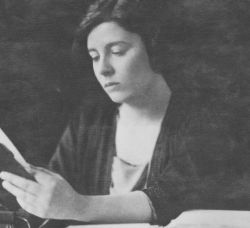
They have all made me ask what sort of woman could create these fascinating characters and dramas, portrayed by means of the most revealing dialogue and natural prose. After I started sitting up in the recliner I began to read The Extraordinary Life of Rebecca West by Lorna Gibb. It appears that there is a lot of autobiographical material in The Fountain Overflows, set in England in the Edwardian period. I don’t know if I will ever be able to write a good review of this book or any of West’s; they seem too vast and rich — and mysterious — for me to grasp, and that makes me wonder, Why am I so taken with her as a writer? and How does she accomplish this enchantment? I have some ideas — maybe they will lead to something!

The only reason I have for saying anything just now is, I ran across this passage about a Christmas Day the Aubrey Family celebrated. It contains one of the thought-provoking pearls of wisdom and understanding that are found liberally scattered throughout, not ever as little sermons, but as insights that come to the narrator Rose, or a phrase spoken by the mother as she’s trying to answer one of her children’s questions.

The father of the family wastes and loses money in various ways, so that they are always on the brink of disaster. In the passage below, the young Rose calls him “unlucky,” but the reader knows that it’s a case of children wanting to think the best of their father. His indiscretions or outright shameful behavior are the reason he and his family are always needing rescuing.

On Christmas Day the mother stays home with the maid to prepare Christmas dinner, and the father walks to church with the four children. The girls, having been musically trained to listen carefully and critically to every piece of music they hear, are often unable to enjoy anything slightly imperfect. The italics are mine:

“In church we were so contented that we did not think of the choir as music and did not approve or disapprove, but gratefully took it that it was giving tongue to what was in our hearts. ‘How bright,’ Mary whispered in my ear, ‘the silver dishes on the altar are.’ We liked the holly round the pulpit, the white chrysanthemums on the altar. Of late Mary and I had doubts about religion, we wished God had worked miracles that would have enabled Mamma to keep Aunt Clara’s furniture and saved Papa from his disappointment over the deal in Manchester, but now faith was restored to us. We saw that it was good of God to send His Son to earth because man had sinned, it was the opposite of keeping out of trouble, which was mean, it was the opposite of what Papa’s relatives were doing in not wanting to see him just because he had been unlucky. We liked the way Richard Quinn stood on the seat of the pew and, though he had been told he must be good and sit as still as a mouse in this holy place, nuzzled against Papa’s shoulder and sometimes put up his face for a kiss, certain that showing love for Papa must be part of being good.”

The picture of the family in church is sweet, but it’s the way the love of God and His willingness to come to our aid are put in a child’s very personal terms that strikes me. They paraphrase a word I really appreciate in regard to His taking on human flesh and frailty, human sin and soul-sickness and chains of death: solidarity. Glory to God in the highest!