Tag Archives: The Resurrection

In this case, He truly wasn’t there.

The second Sunday after Pascha we remember the myrrhbearers, the women who came early in the morning to Christ’s tomb to anoint his body. This article from our parish bulletin gave me great joy, as did the excursion I made with some others from church to several cemeteries this week, where we proclaimed Christ’s Resurrection to those in the graves. Our rector told us that we were also myrrhbearers that day, and he reminded us, “This is not a place of rotting and decomposed bodies, but a place of awaiting the Resurrection; what could be more joyful than that?”

IMG_2185

…The women came to anoint a body, a body that had ALREADY been anointed. What a strange thing to do. After all, as virtually every American mother assures her child the first time that he or she attends a funeral, the loved one isn’t THERE! Only his body! If the seven myrrh-bearing women were to have heard our 21st century dismissal of the human body, they would have been astonished. Perhaps they would have assumed that we are pagans, like the philosophers who declared soma sema — “the body is a tomb” — and who cremated their dead to allow the soul to escape that prison. But this was not the philosophy of our beloved myrrh-bearers. Mary Magdalene, when she saw the empty tomb, declared in grief, “They have taken away the LORD” and then asked, “Where have they taken him?” She didn’t ask, “Where have they taken his body?” In her mind, and to the mind of the Jewish faithful (except for the confused Sadducees!), a person was embodied: they looked for not mere spiritual continuation after death, but for the reunion of soul with body, a resurrection! And so do we as Christians! “I look for the resurrection of the dead.” Physical things matter to God….

IMG_2178

Anointing his body, then, was not such a bizarre thing to do. For this holy Tabernacle of God, this Prophet of prophets, this High Priest forever, this King of Kings, is worthy of every anointing honor that we can give him—though He has no NEED of our praise! In fact, it is He who anoints us with the Holy Spirit. But there is something for which He is looking—our faith. This ending of Mark summarizes for us many of the stories that are told in more detail in the other gospels. Briefly we hear about the women’s astonishment, and the  refusal of the apostles to believe, the surprise on the road to Emmaus, the disbelief in the upper room, and how Jesus “upbraided them” because of their disbelief. The One who struggled in the Garden with his chosen path knows what it is to be weak—though He himself was never faithless. And so, He calls to us, as he did to the early disciples, telling us not to be faithless but believing.
IMG_2170
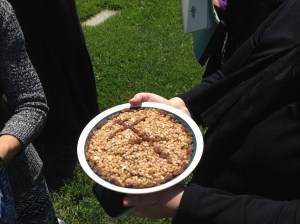
simple barley koliva

The evidences of what He has done and is doing are everywhere around us and among us. Like the early disciples, we have confirmed before our very eyes the truth of His word. Anointed by the Spirit on Pentecost, they went out with the message, and braved many dangers, even death! As the last verse of Mark tells us, “…they went forth and preached everywhere, while the Lord worked with them and confirmed the message by the signs that attended it.” (Mark 16:20)

We too, God’s little anointed ones, are led by the Spirit, as St. Paul puts it; that leading may take us places we would rather not go. “For all who are led by the Spirit of God are sons of God. For you did not receive the spirit of slavery to fall back into fear, but you have received the Spirit of sonship. When we cry, ‘Abba! Father!’ it is the Spirit himself bearing witness with our spirit that we are children of God, and if children, then heirs, heirs of God and fellow heirs with Christ, provided we suffer with him in order that we may also be glorified with him. I consider that the sufferings of this present time are not worth comparing with the glory that is to be revealed in us.” (Romans 8:14-18)

–Excerpt from article by Edith M. Humphrey, Professor of New Testament at Pittsburgh Theological Seminary
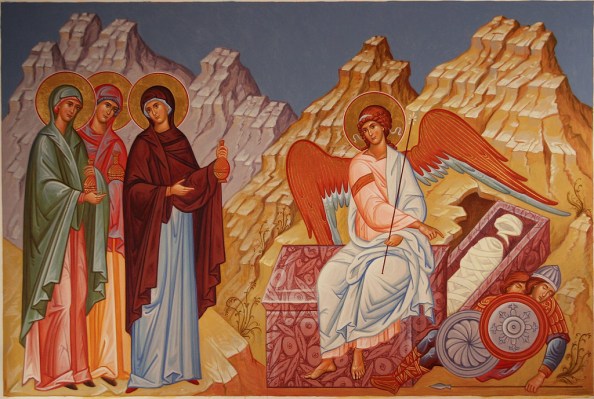
Myrrhbearing women at the tomb

We thirst for time’s transformation.

I continue my alphabetical posts, from which I took a Holy Week hiatus after “S for squash.” That brings me to “T” for — what else? — time.

In my recent musings on the meaning of kairos vs. chronos, I found this passage from Fr. Alexander Schmemann’s journals:

This morning during Matins I had a jolt of happiness, of fullness of life, and at the same time the thought: I will have to die! But in such a fleeting breath of happiness, time usually schmemann close 16‘gathers itself.’ In an instant, not only are all such breaths of happiness remembered but they are present and alive — that Holy Saturday in Paris when I was a young man — and many such ‘breaks.’ It seems to me that eternity might not be the stopping of time, but precisely its resurrection and gathering. The fragmentation of time, its division, is the fall of eternity. Maybe the words of Christ are about time when He said, ‘…not to destroy anything but I will raise it all on the last day.’ The thirst for solitude, thirst for the transformation of time into what it should be — the receptacle, the chalice of eternity.

Death was strangled…

…and other images of atonement are the subject of Fr. Stephen Freeman’s post Knocking Down the Gates of Hell, in which he shares the findings of a research paper he once wrote on Martin Luther’s hymns. Luther’s own atonement theology highly favored the imagery that also dominates that of the early church fathers, in which Christ smashes the gates of Hell and frees all those in chains.

Fr. Stephen shares several verses from various exuberant Orthodox Paschal hymns we are singing this month, such as these I excerpted from his post:

Hell, who had filled all men with fear,
Trembled at the sight of Thee,
And in haste he yielded up his prisoners,
O Immortal Sun of Glory.

Thou hast destroyed the palaces of hell by Thy Burial, O Christ.
Thou hast trampled death down by Thy death, O Lord,
And redeemed earth’s children from corruption.

Though Thou art buried in a grave, O Christ,
Though Thou goest down to hell, O Savior,
Thou hast stripped hell naked, emptying its graves.

Death seized Thee, O Jesus,
And was strangled in Thy trap.
Hell’s gates were smashed, the fallen were set free,
And carried from beneath the earth on high.

Thou didst will, O Savior,
To go beneath the earth.
Thou didst free death’s fallen captives from their chains,
Leading them from earth to heaven.

In the earth’s dark bosom
The Grain of Wheat is laid.
By its death, it shall bring forth abundant fruit:
Adam’s sons, freed from the chains of death.

Wishing to save Adam,
Thou didst come down to earth.
Not finding him on earth, O Master,
Thou didst descend to Hades seeking him.

The Paschal icon shows the resurrected Christ pulling Adam and others out of Hades.

db271-resurrectionstvladorthchurch

It’s Bright Monday as I write. This morning’s Divine Liturgy was splendid and full of love and light. We are all giddy with joy and fatigue, and can’t stop greeting one another with kisses and proclamations of “Christ is risen!” In the Paschal Canon where we sing, “Let us embrace each other joyously!” I always hope I will be standing next to someone I can hug at that moment. Today two women I didn’t know were the closest, and I made so bold as to hug them both at once, which they didn’t seem to mind. gl - EB

I realized just in time for the midnight service of Pascha Saturday/Sunday, something I have had to call to mind again and again over the last months, that wherever my late husband is, he lives in the present. The part of me that grieves for his presence the way it used to be, as my earthly lover and companion, can never be satisfied; it is a longing for the past, and God is giving me instead Himself and all His gifts in this present moment. My dear Mr. Glad does not live “back there” in the past, either!

It’s because the various parts of me are not all united that my heart’s faith and love must keep instructing my mind — and other tangled and erratic parts? — that to be here right now with God is the way to stay close to my husband. In the reality of the Resurrection and our Blessed Hope, in the gathering of time and times that is kairos, he and I are more together than we have ever been, and in Love.

gl rose pascha 16


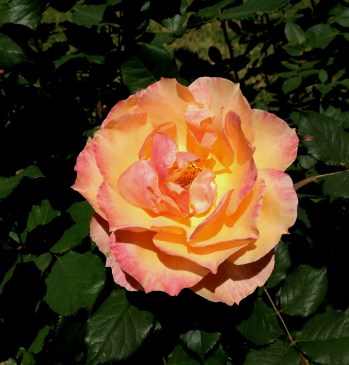
One sweet thing about Pascha coming so late this year is that roses are blooming all over. We have dozens of rosebushes at church that are loaded with flowers (not to mention the white roses that filled bouquets decorating inside the church.) This morning I took a picture of one favorite, to decorate this blog post. Happy Spring! Christ is risen! If you have read this far, I send you my Easter love!


Death and Life in Springtime

purple dicks-type 3-29-15
Dichelostemma capitatum (Blue Dicks)

Death is working in all of us. Last week death, by means of cancer, parted me from my husband, and I am now a widow. But the separation is not absolute, because Mr. Glad may be more alive than ever, to which truth the scriptures testify by the words of Christ Himself, “He is not the God of the dead, but of the living.” Nor will he and I be separated for long; we will meet in the Resurrection:

P1120755 buttercups
buttercups


For the Lord Himself will descend from heaven with a shout, with the voice of the archangel and with the trumpet of God, and the dead in Christ will rise first. Then we who are alive and remain will be caught up together with them in the clouds to meet the Lord in the air, and so we shall always be with the Lord. Therefore comfort one another with these words. (I Thessalonians)

blue-eyed grass crane ck 3-29-15
blue-eyed grass

I do comfort and console myself with these realities, while feeling the equally real tearing apart of me and my “other half,” our souls and bodies having been intertwined like a ball of string that is really two cords so closely tangled you can’t identify which strand you are seeing in any part of the thing. If one string is pulled out of the ball, just how misshapen and odd will it be? That’s what I don’t know, and what scares me.

yellow&white flwr crane ck 3-29-15
Common Meadowfoam

As for man, his days are as grass: as a flower of the field, so he flourisheth. For the wind passeth over it, and it is gone; and the place thereof shall know it no more. But the mercy of the LORD is from everlasting to everlasting upon them that fear him, and his righteousness unto children’s children…

Every member of our family has received huge amounts of grace and joy during the last weeks, and especially in the days leading up to the funeral, which was last Saturday. One friend remarked how sweet it is to die in springtime, the season of new beginnings.crane creek poppies 3-29-15

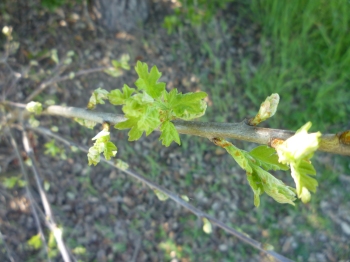
On Sunday afternoon two daughters took me up into the hills for a walk among the oaks with their tiny new leaves, and to see the first wildflowers coming out. It was a stroll, not a hike, because all of us were quite spent from all the emotion and the activity. And one of us, daughter Pippin, was 9+ months pregnant, so we weren’t attempting a fitness walk.

P1120752 oak leaves
oak leaves

I took a lot of pictures, falling easily back into my old self’s delight in seeing the glories of Creation and making memories of them to prolong the experience. We saw at least two flowers that even Pippin didn’t know the names of; I will try to come back later and tell you, if I find out what they are.

Upon our return to the house the dear baby, whether on his own or by the promptings of his heavenly Father I don’t know, decided the time was right to make his arrival. Someone noted that he is an obedient child from the start, waiting until his parents had laid his grandfather to rest before taking center stage himself. That evening we welcomed a new man-child into the family, whom I will call Jamie.G w J blog

Jamie also showed love to his grandmother by being born in this county instead of waiting one more day until he would have been back in his home town. Not only I, but his two aunties were able to be present when he came swiftly into the light and into our arms. Among other good names, he was given that of his grandfather whom he had just missed in passing.

It’s all too wonderful and mysterious and splendid, don’t you think? It’s Springtime.