Saint Demetrios entered the story of my trip to Greece almost at the beginning, and before I end my telling I want to bring him back into it more fully. As I write, I’m still in Greece, but in Athens and on my way home.
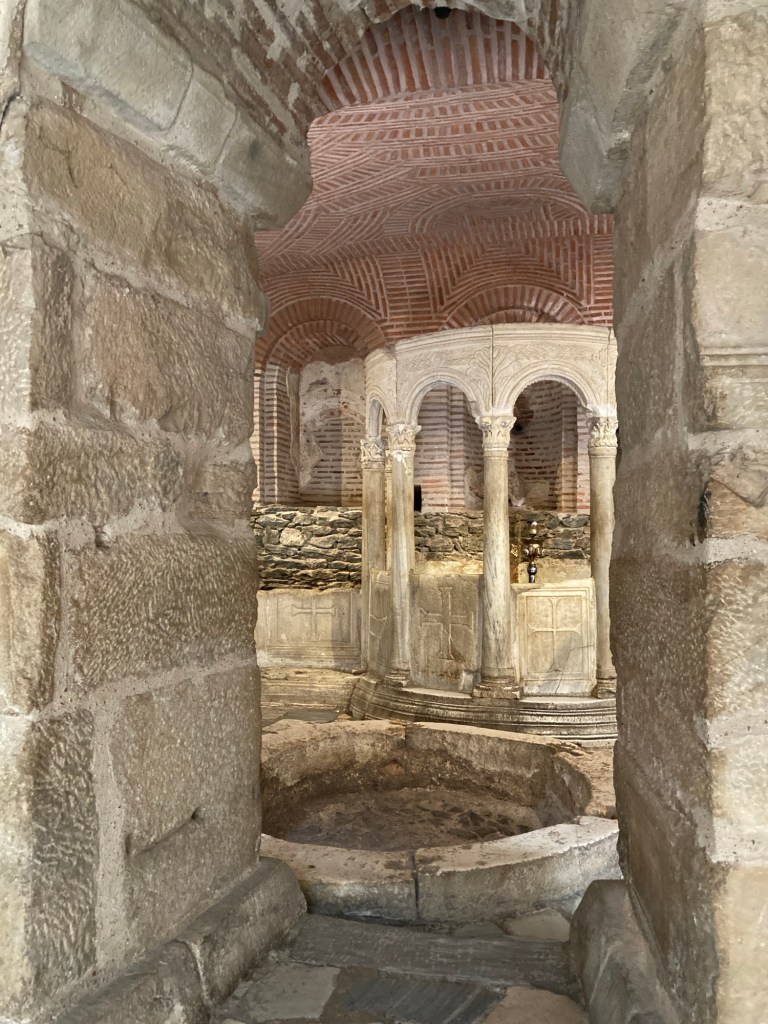
The Church that houses the saint’s relics was built on the site of a Roman bath house, believed to have been the place of his imprisonment and death. Emperor Maximian Galerius — yes, the same one who built the Arch and the Rotonda — had appointed young Demetrios proconsul of Thessalonica district, not knowing that he was a Christian.
One of his duties was to put to death Christians, but instead he preached the faith, and was said by some to be a “second Apostle Paul,” for Thessalonica.
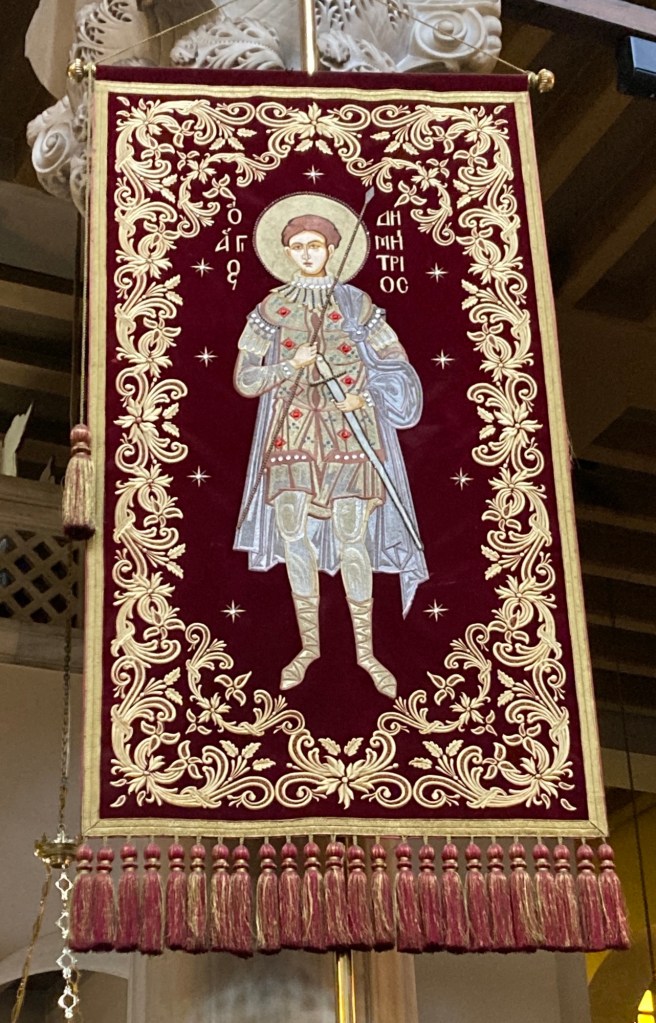
When Galerius found out, he ordered his imprisonment, and eventually his death, on October 26, 306. This article tells the story of his life in detail, including subplots concerning his friend Nestor’s martyrdom at the same time, how Demetrios became so beloved of the Slavs, and how he never would allow his relics to be moved to Constantinople.
St. Demetrios mosaic Kiev, 12th century
During the reign of St. Constantine the first church was built on the site, and in later centuries the Christians began using the old bath house structures.
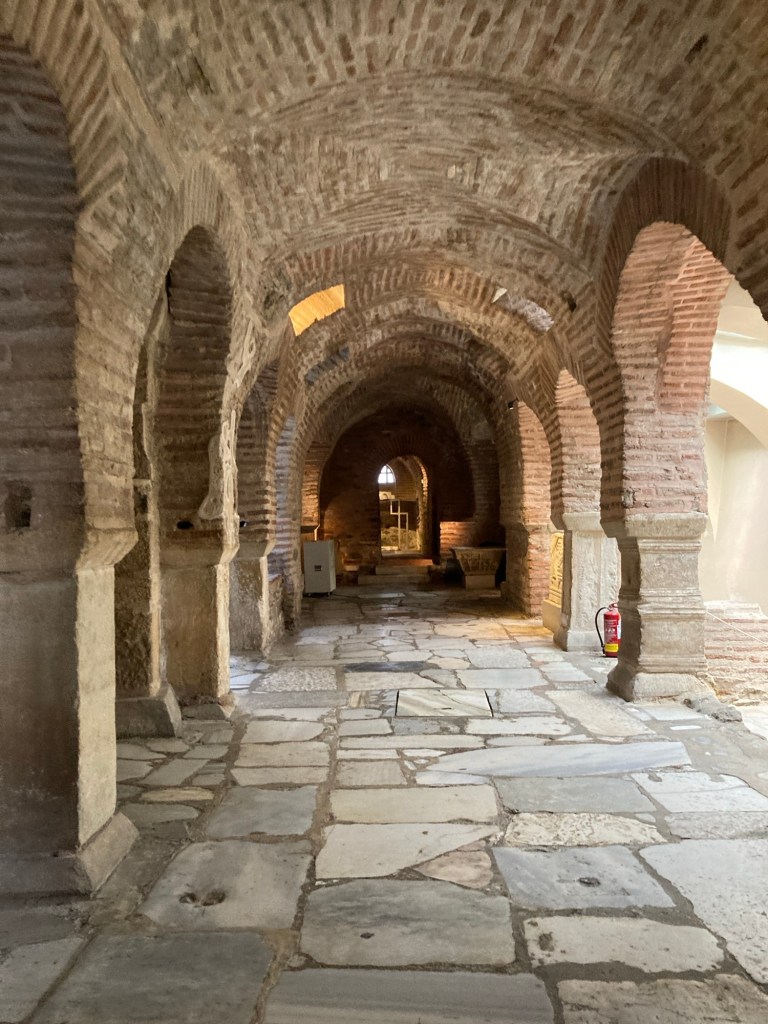
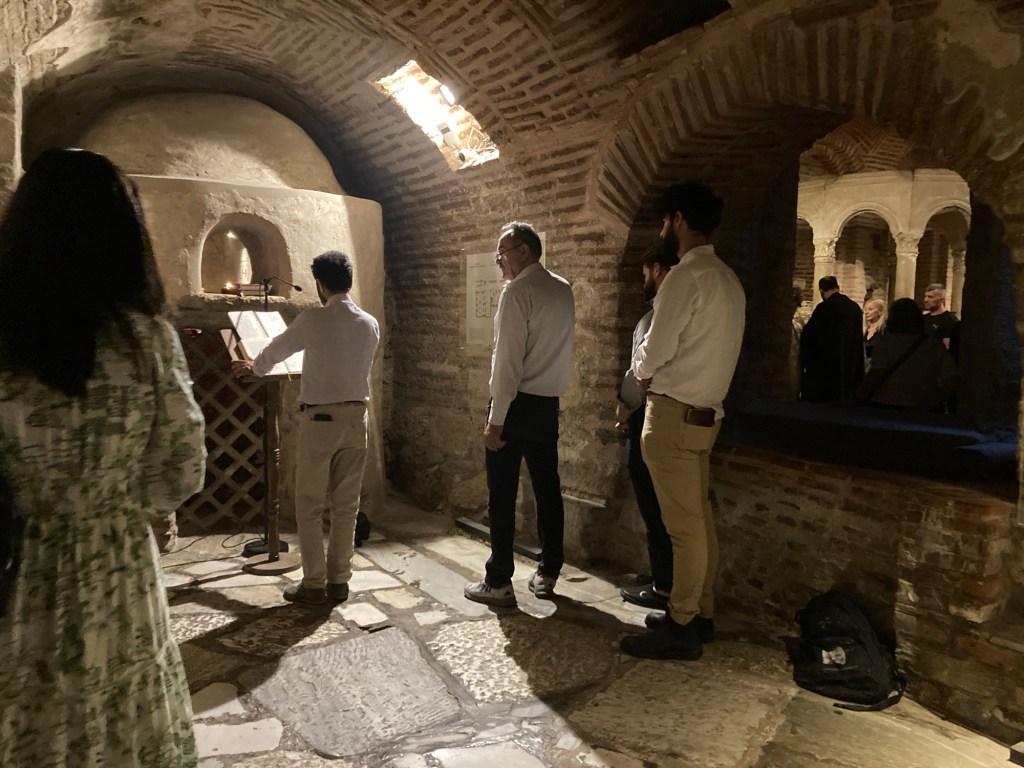
It was during the Ottoman rule when it was a mosque that the underground part became cryptic or “secret,” because whether by their intent or neglect, it was filled with earth and forgotten, until the fire of 1917 that destroyed much of the city; during restoration work on the church the crypt was revealed.
In recent years Orthodox services are often held in the space. I walked up to the church last Friday for Divine Liturgy that was served down there, where so much history is embedded in the stonework and the venerable marble floors.
The day before, the priest at the Church of the Panagia Acheiropoietos had reminded me, over coffee in his office, that there is nowhere on earth that God’s blessing is not present. You might think that He is here in Greece in a way that He is not to be found at the North Pole, for example, but it’s not true.
I have been thinking about that a lot. We Orthodox pray daily to the God Who “is everywhere present, and fills all things.” Also, we experience the eschaton at every Divine Liturgy, when Christ descends to commune with us.
The presence of God has been my experience in Greece, and He will be as immanent as ever back home when I return to the “same old” everlasting mercies of God new every morning. As I embark on my long, long day of travel, I hope I can keep in mind this constancy of grace.
Given the dailiness of our earthly pilgrimage, I can’t be too sad to leave Greece, and at the same time I’m extremely thankful for the short and rich time I’ve had here. Glory to God for all things.
I’ve written already about how my daughters convinced me to make the trip to Greece with them. They had to limit their travel time to about ten days, but I couldn’t face the thought of returning my poor body to the U.S. after such a short period, while it would still be confused from crossing ten time zones. Besides, being shuffled between multiple airports and airplanes, and spending hours in what are at best unnatural and uncomfortable environments — I wasn’t eager to impose that affliction on myself again so soon. So, my primary motivation to extend my visit was negative.
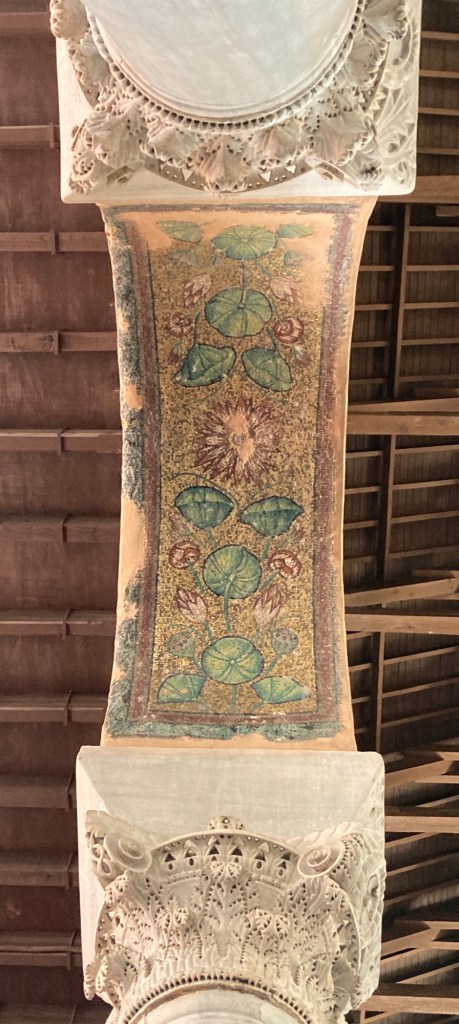
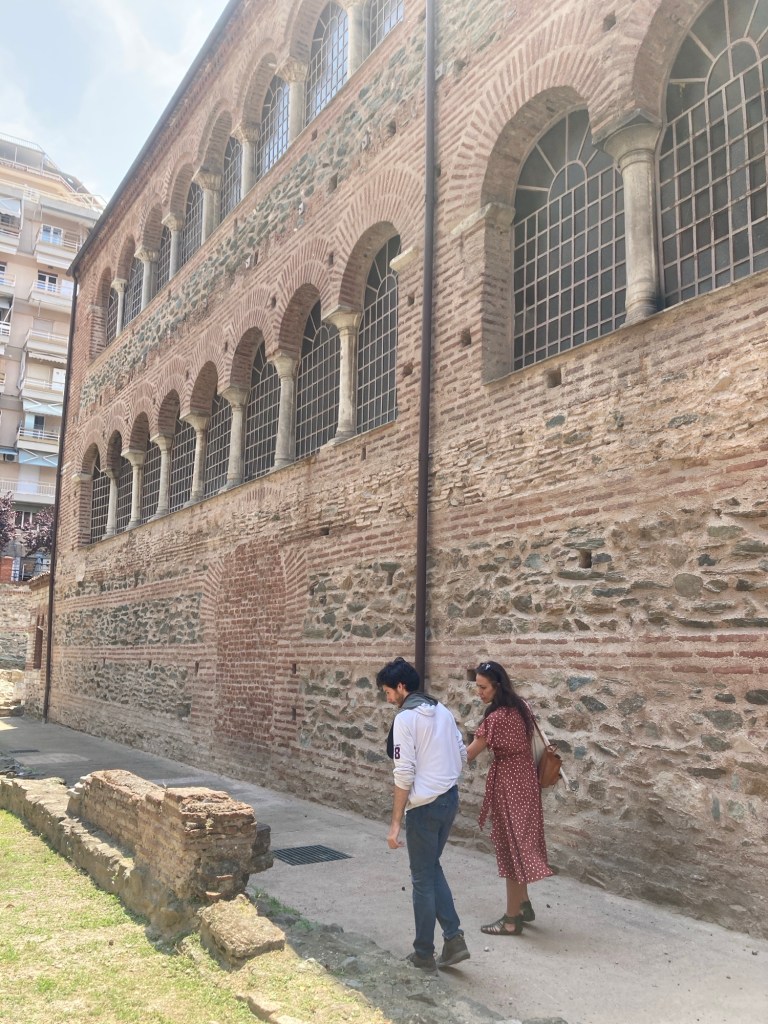
Acheiropoietos Church, underside of arch
But as soon as I began to consider the possibilities this would open up, the idea became exciting in a positive way, and also a little scary. I hadn’t traveled alone in a foreign country since I was much younger, and even then my youthful advantages didn’t prevent me getting into several problematic situations.
St. David the Tree Dweller, Monastery of St. Theodora
I knew I wouldn’t want to join a group tour, but if I could be in contact with even one helpful person in whatever strange place, that would make the adventure seem more doable.
Thessaloniki was the Greek place name that I had heard the most in the last many years. Orthodox Christians know it as a center of culture and scholarship, and a place of pilgrimage very near to that more famous destination for pilgrims, Mount Athos.
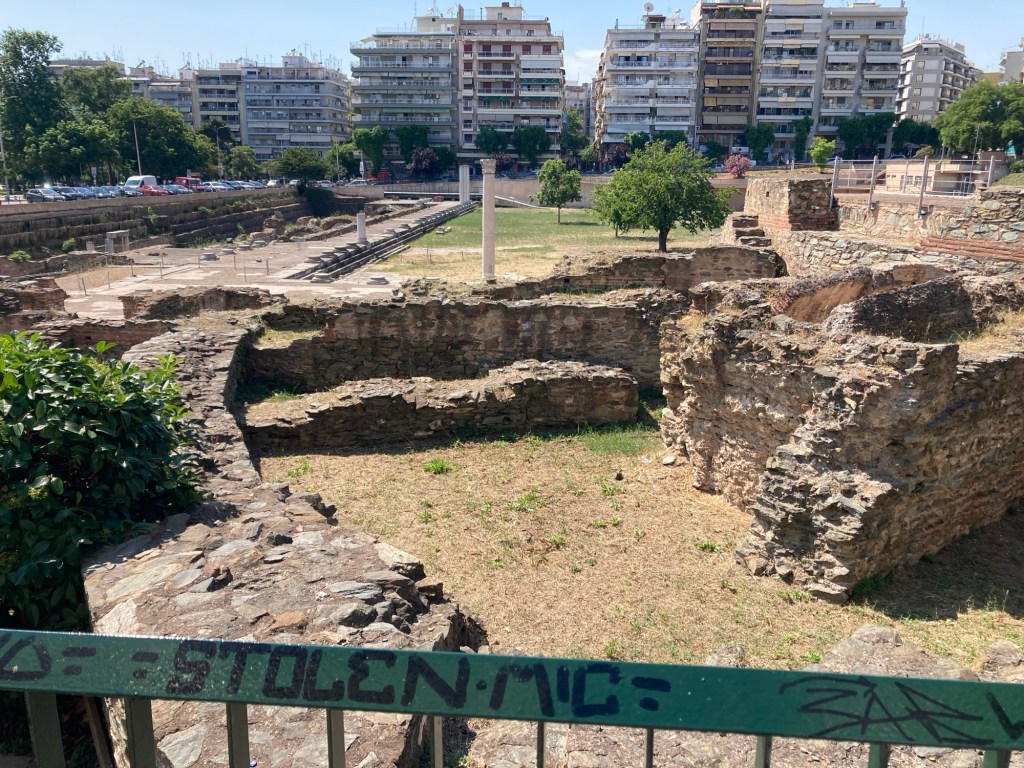
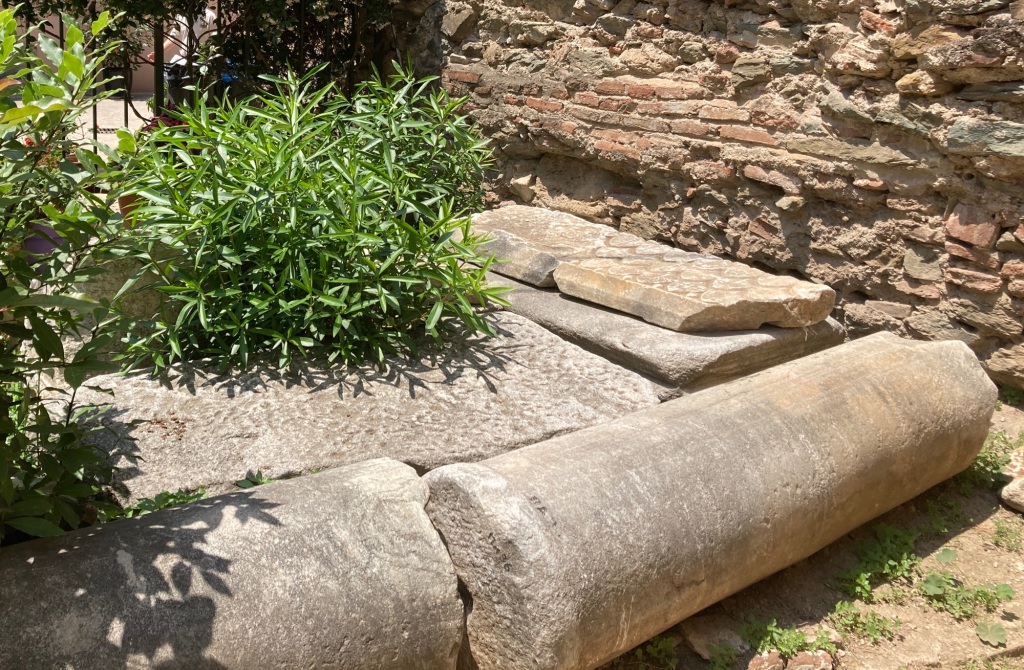
Rubble at Acheiropoietos Church
Travelers to Athos typically pass through Thessaloniki, and if a mixed group of men and women are traveling together in Greece, the women might spend time in the many women’s monasteries near Thessaloniki while the men visit the Holy Mountain, where women are not allowed.
And I had known of several people at my home parish who had visited this city for long periods or studied at Aristotle University, or for other reasons lived in the city, past or present. So, very quickly, my choice of Thessaloniki solidified.
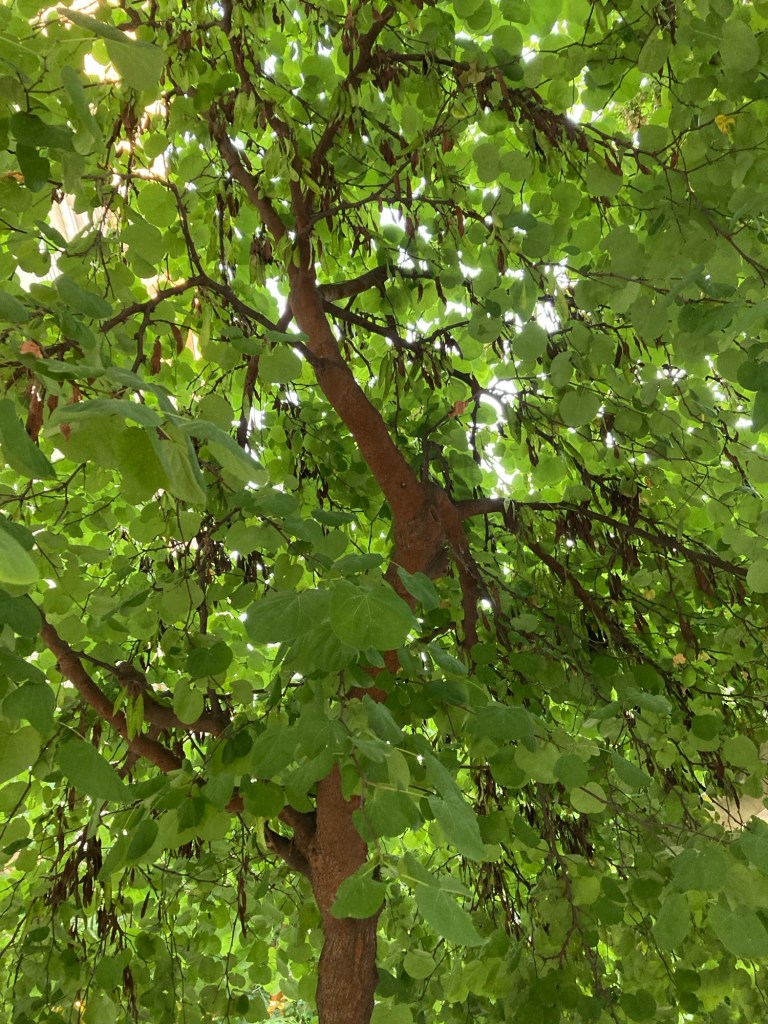
Judas Tree
One friend had encouraged me to include at least two Sundays in the span of my visit, so that I could attend Sunday Divine Liturgy in two different churches. That helped me set the parameters of length of stay.
I really knew very little about the place. The first thing I learned was that St. Demetrios is the patron saint of Thessaloniki, and his relics are here, and I began to ask the saint’s prayers for a successful trip that would bring me to his city and church.
Church of St. Demetrios
It turned out to be easier than I expected to make not just connections but new friends, and to become closer to people I hadn’t known well before. They not only answered my questions beforehand and after I arrived, but they provided hours of good conversation and explanations of Greek history and culture.
You have learned from my recent posts how much more I’ve discovered and experienced here – and I still have more to tell ❤️
You can’t walk very far in Thessaloniki without encountering antiquity as more than an idea; the present city layout incorporates reminders of previous communities and cultures, the oldest of which had been buried for thousands of years.
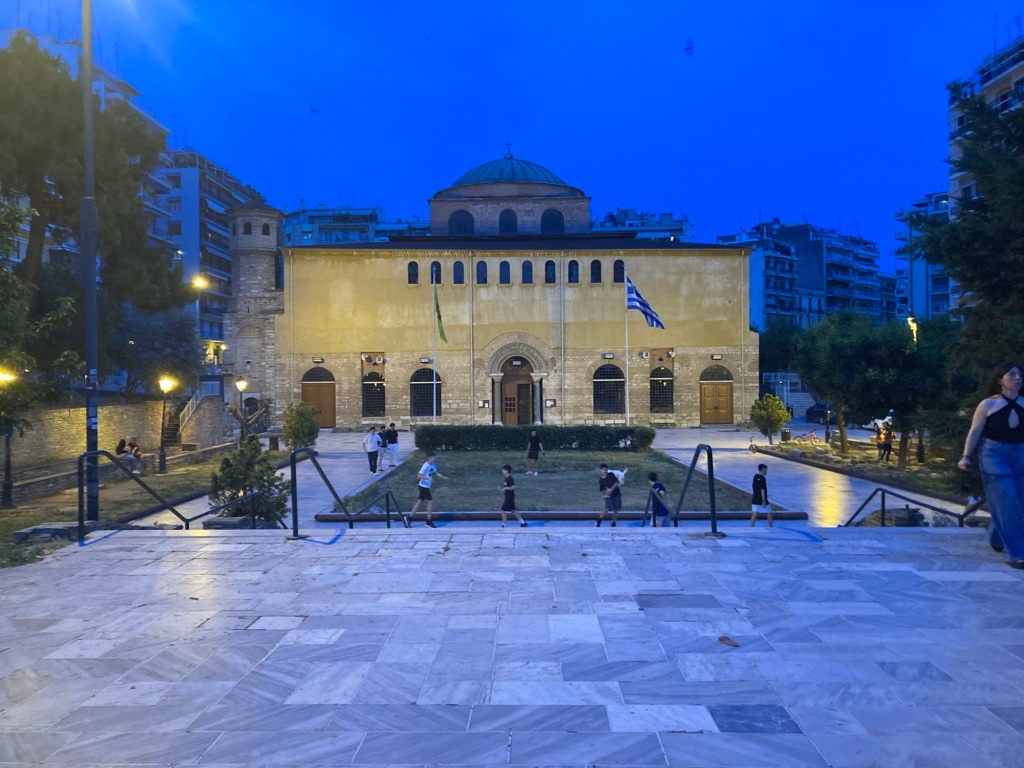
The Church of Panagia Archeiropoietos prompted me to think about this when I visited over the last week.
One has to descend a flight of steps in order to travel back in time to when Byzantine Christians first worshiped here.
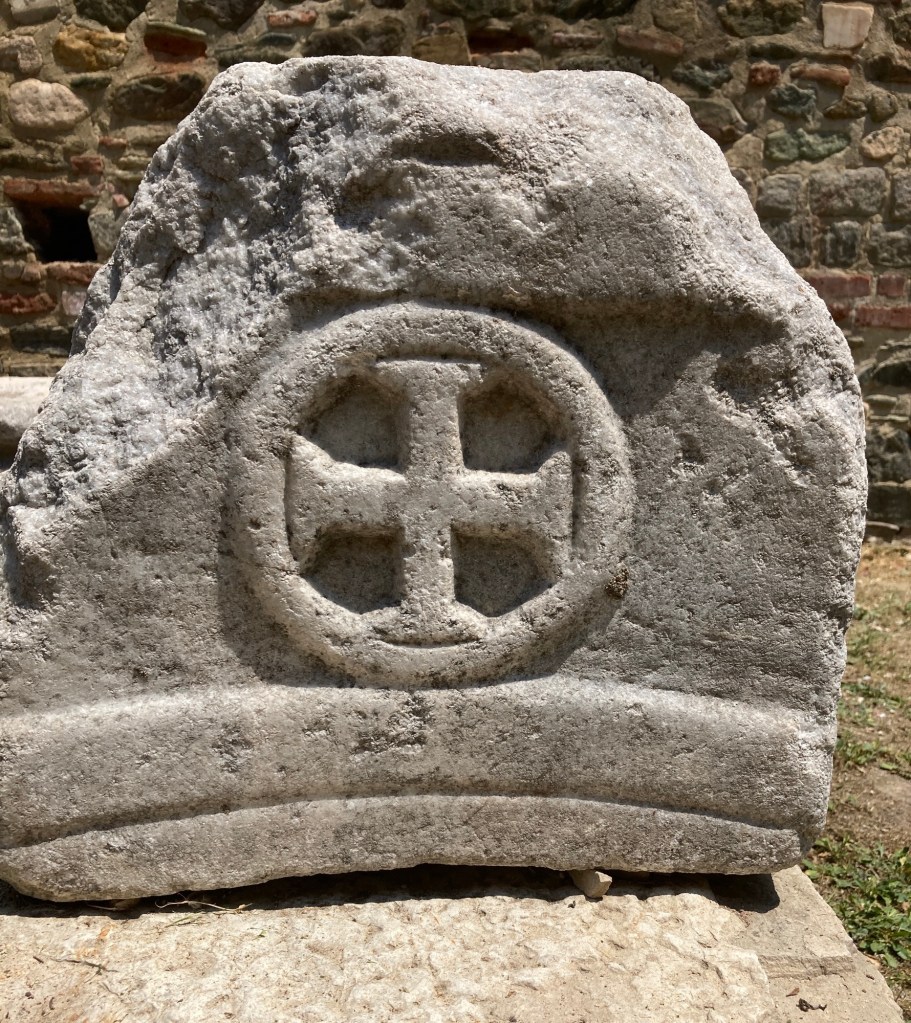
One afternoon my guide Maria and I found a university student at work behind the church, in a gated area where she had never been. The priest had given him two tasks: gardening, and also sorting and organizing stone and marble chunks of the church that had broken during earthquakes. He couldn’t have been more pleased.
“Would you like a piece of antiquity?” he asked me. “We have buckets of it!” And he handed me a few small souvenirs of my favorite type.
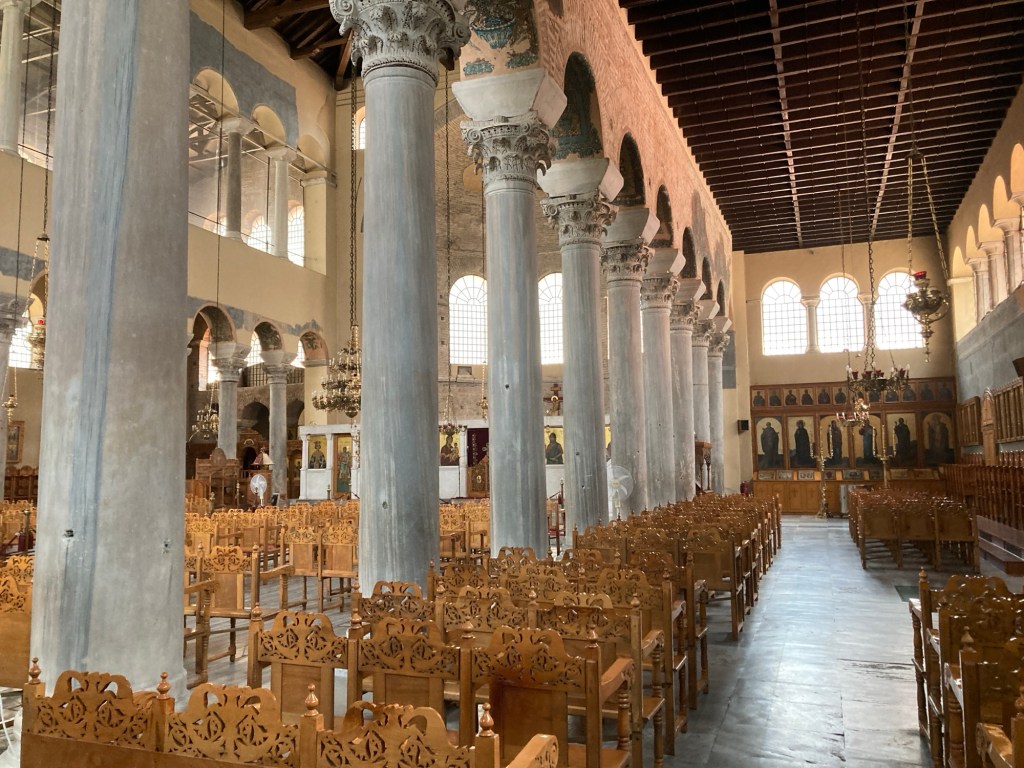
Inside the church, Maria pointed out to me distinctive features of this basilica style temple built in the 5th century.
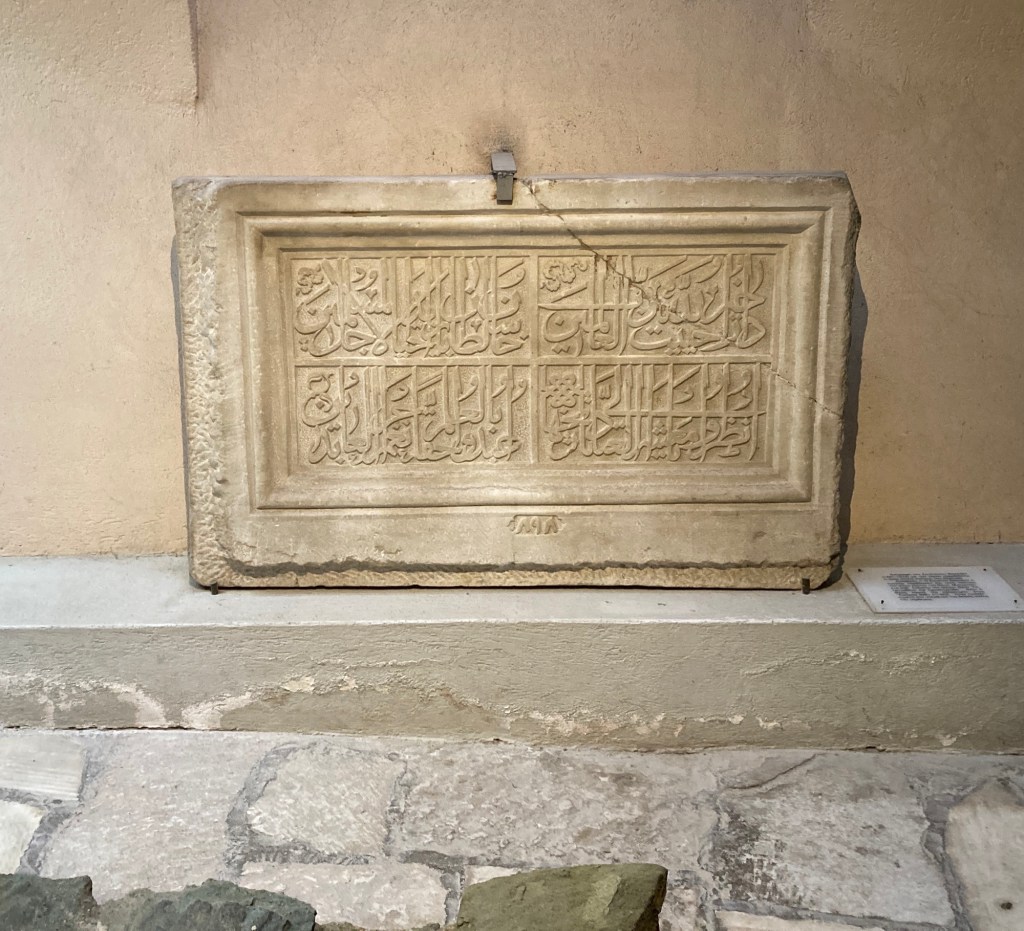
It was the first church in Thessaloniki to be turned into a mosque when the Ottomans conquered the city in 1430, and Sultan Murad II inscribed his name and the date on a pillar.
Murad II’s insignia
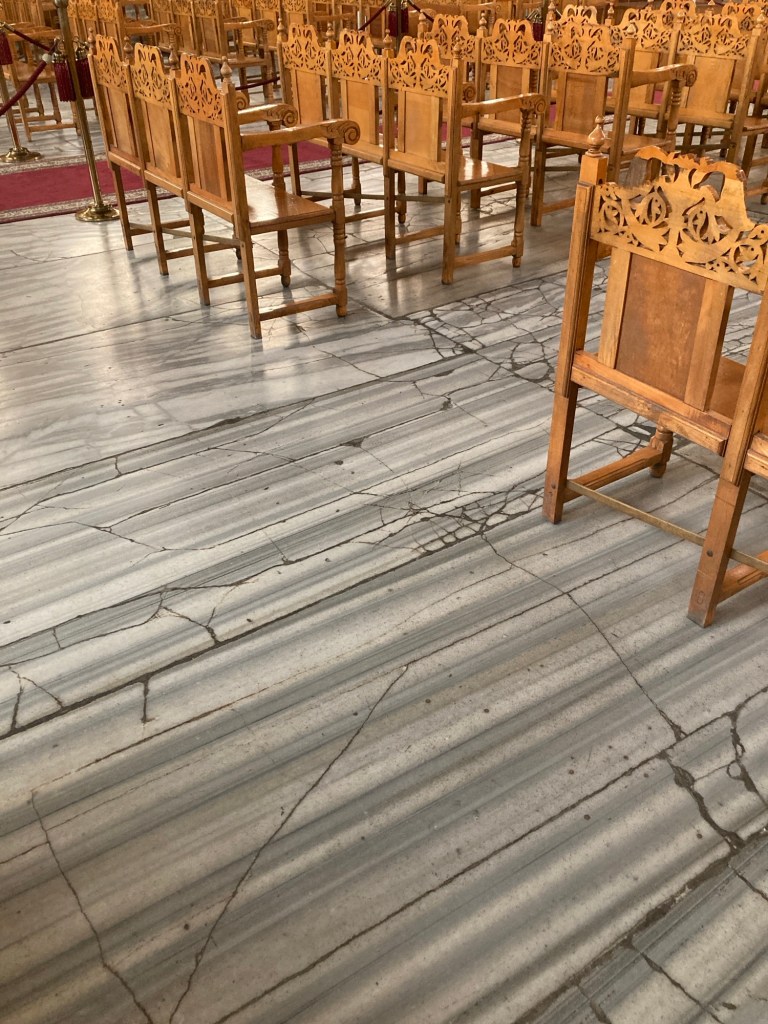
Historians say that the blue-veined marble in the floors and columns of this church was sourced from the island of Proconnesos in the Sea of Marmara. Before the custom of sitting on chairs in church was introduced in the last century, the pattern on the floor imitating rivers would have been more obvious. Near the altar the lines are wavier. The floor is still the most captivating feature of the space for me. How many people have stood, processed, knelt and prostrated on these smooth and cool floors over the centuries?
I joined the ranks of that company this morning, not just to stand but to kneel, because it is Pentecost Sunday, when Orthodox Christians around the world join in three long prayers, in the service of Kneeling Vespers.
The Byzantine Christians built this temple on top of a Roman bath complex. At places in the church see-through panels (easily ignored and walkable for regular parishioners) reveal below, farther down and further back, three previous layers of Roman floor mosaics from that earlier era.
Yesterday I walked a half hour to the northwest corner of what would have been the old walled city. That’s where the Church of the Twelve Apostles is, which I hadn’t seen yet. But I had forgotten some of the things Maria told me about the best time to go, in order to find it open during or just following a service, and it was closed.
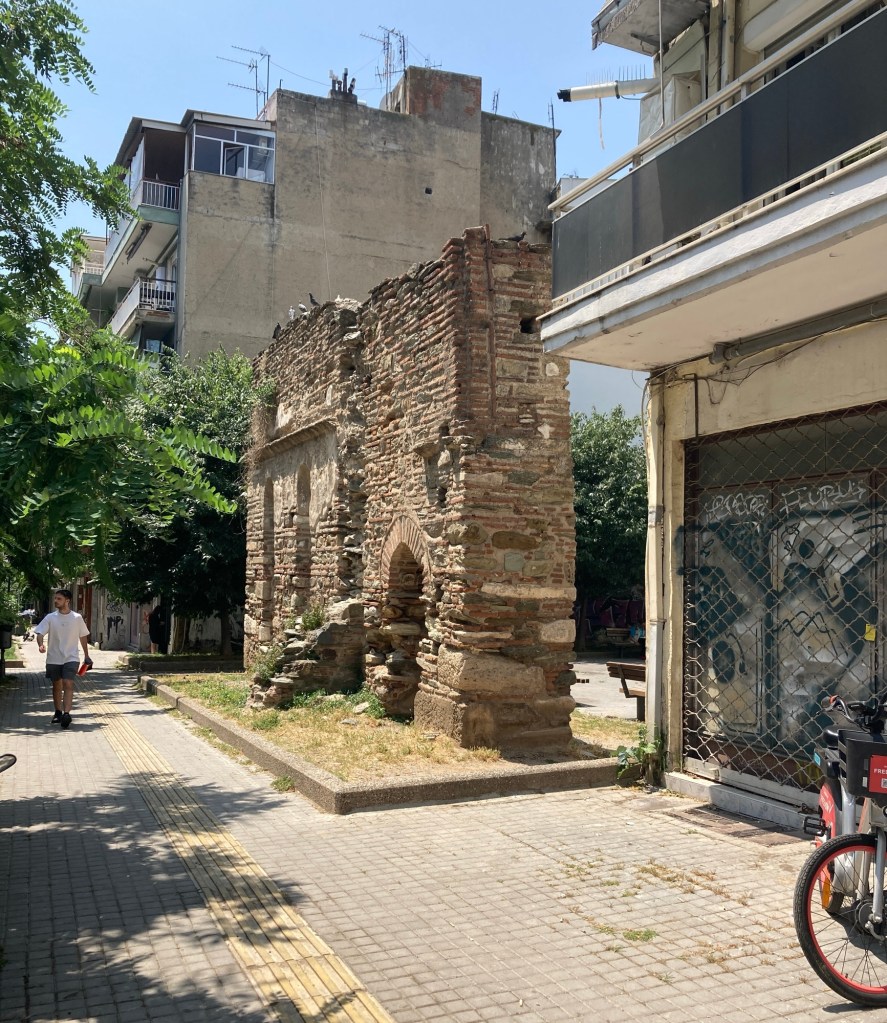
That was okay. I’m pretty much filled to the brim from all of the information and experiences of the last days, and was kind of happy just to have a walk in an area I hadn’t been yet. I came upon one wall portion…
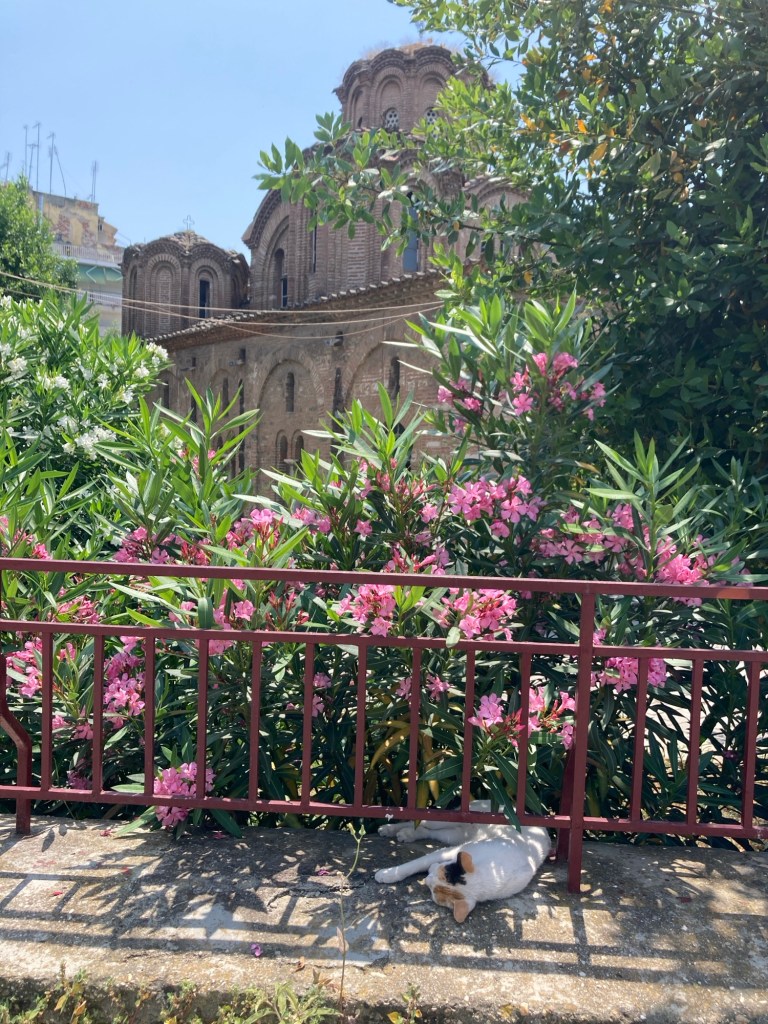
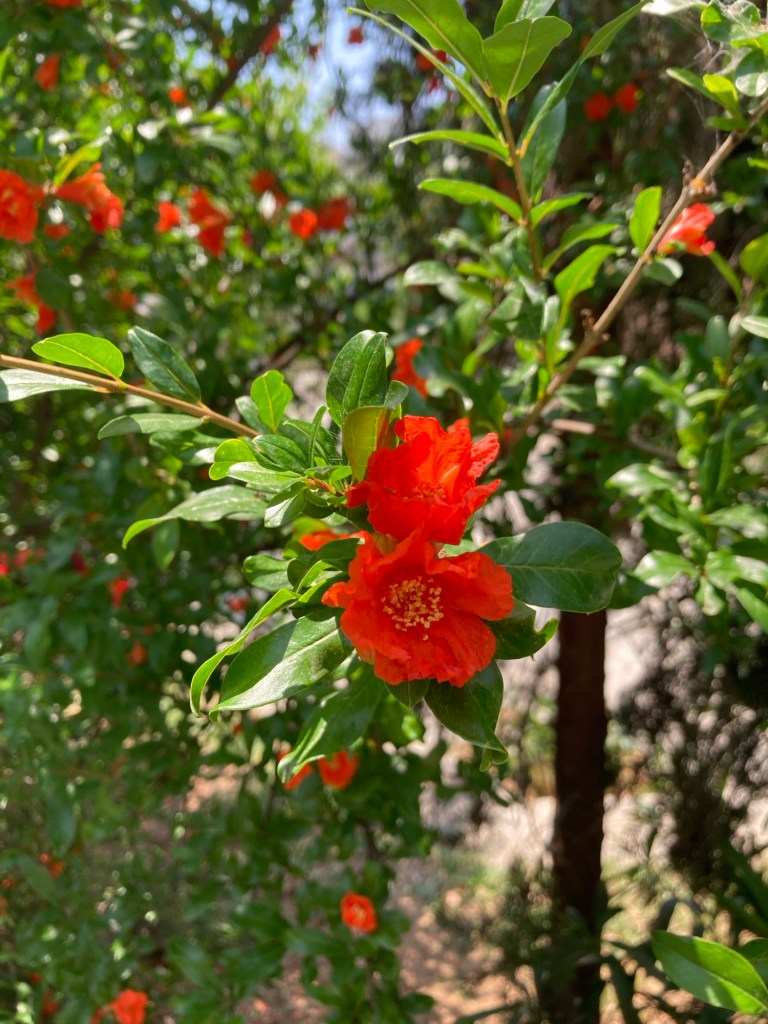
… and as I walked around the church, noting that every gate was locked, I saw a magpie in a tree, a cat trying to stay comfortable in the heat, and the most beautiful pomegranate tree.
The temperature has risen since my arrival in Thessaloniki, and the humidity increased, so that I have needed to walk less briskly, and to return to my hotel in the hottest part of the day to rest for a while before going out in the evening.
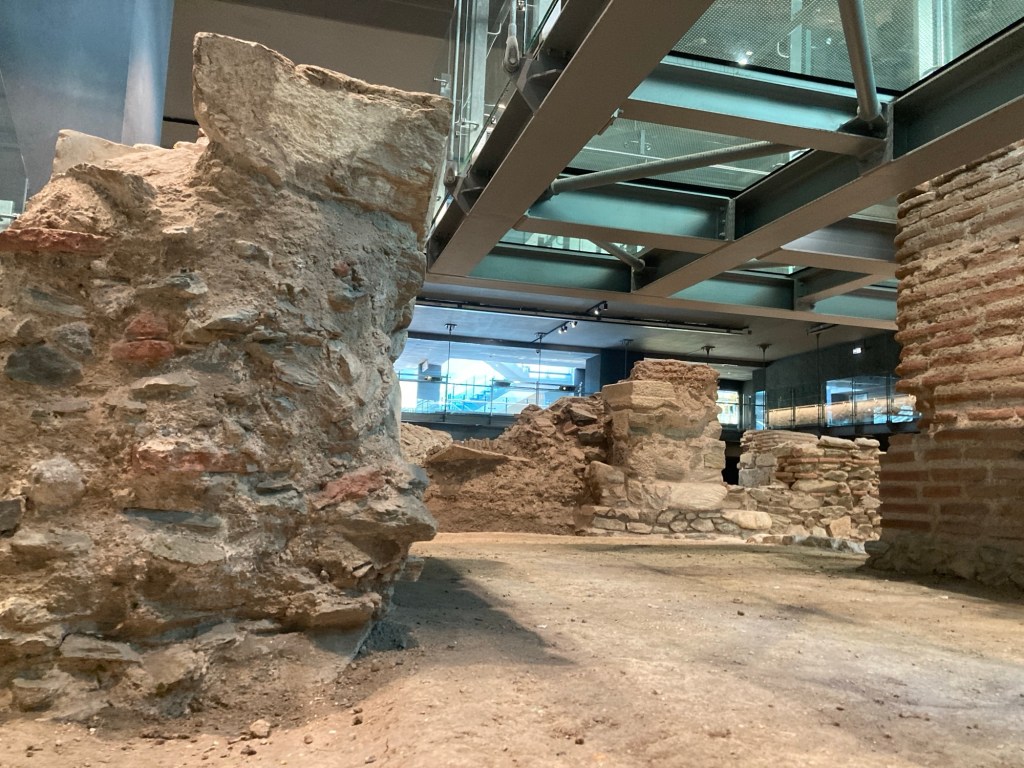
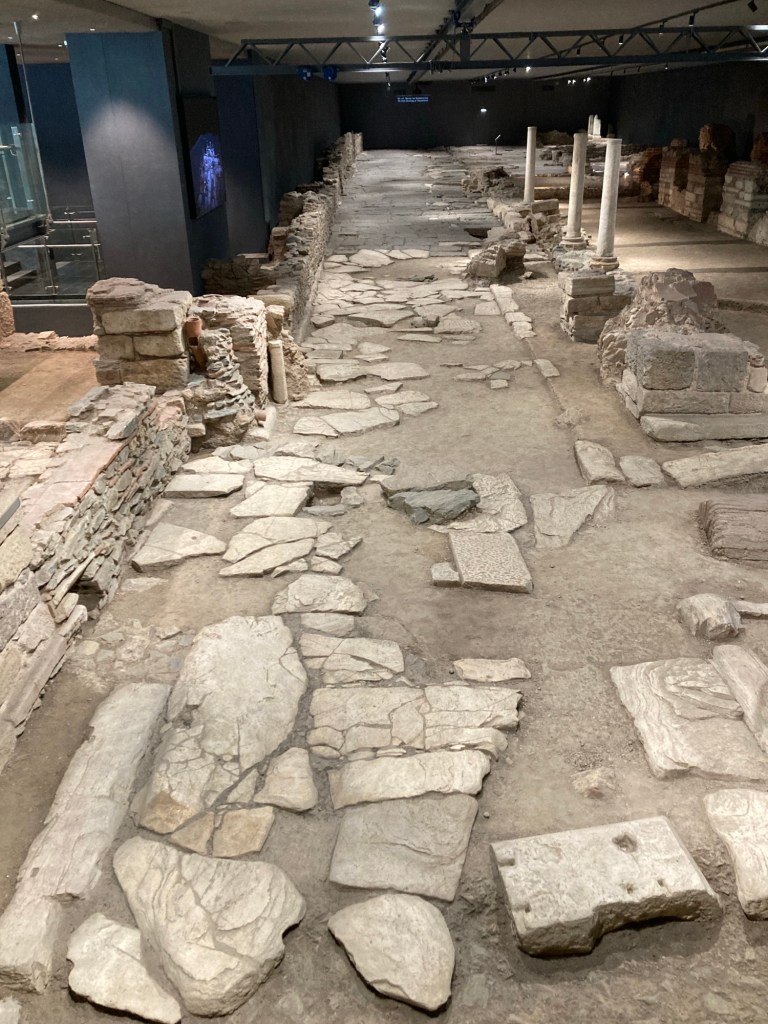
But I enjoyed strolling back through the center of the city, where the new Metro has also been built in such a way as to highlight the ancient civilizations that lie in its lower regions.
Maria gave me a tour of it also, and from all levels of that central station we got different views of the street scenes that have been preserved. It was the vastness of the archaeological discoveries, when excavation began for the project, that demanded a thorough and extended discussion about how to respect these artifacts.
The main road of the Roman city.
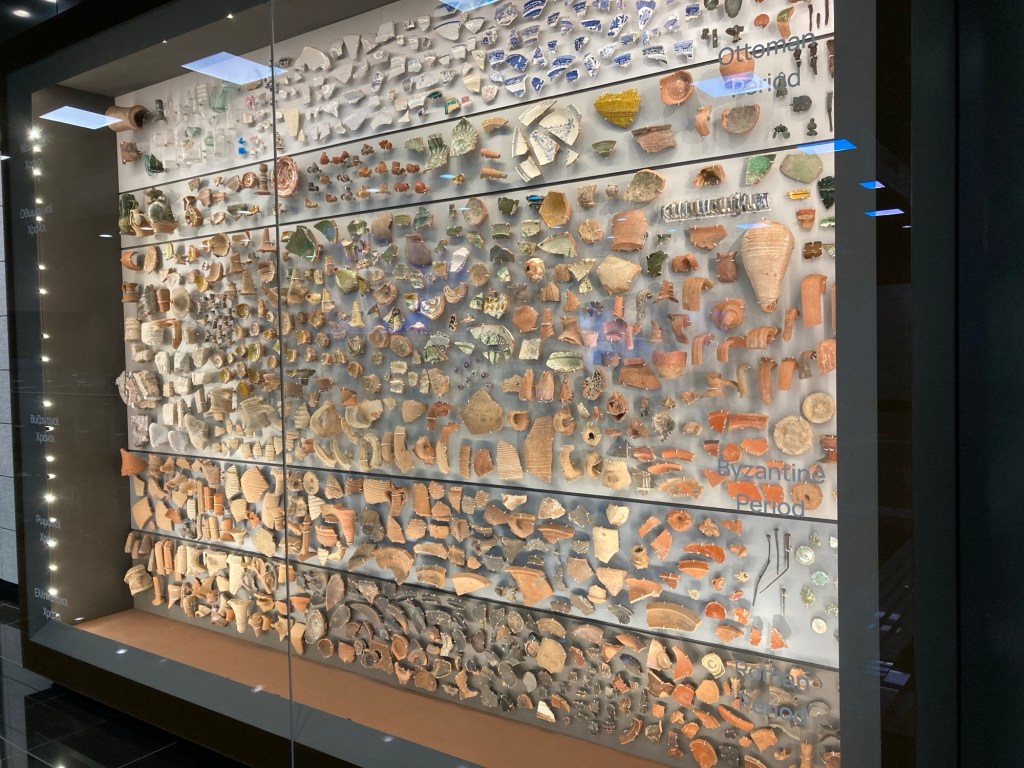
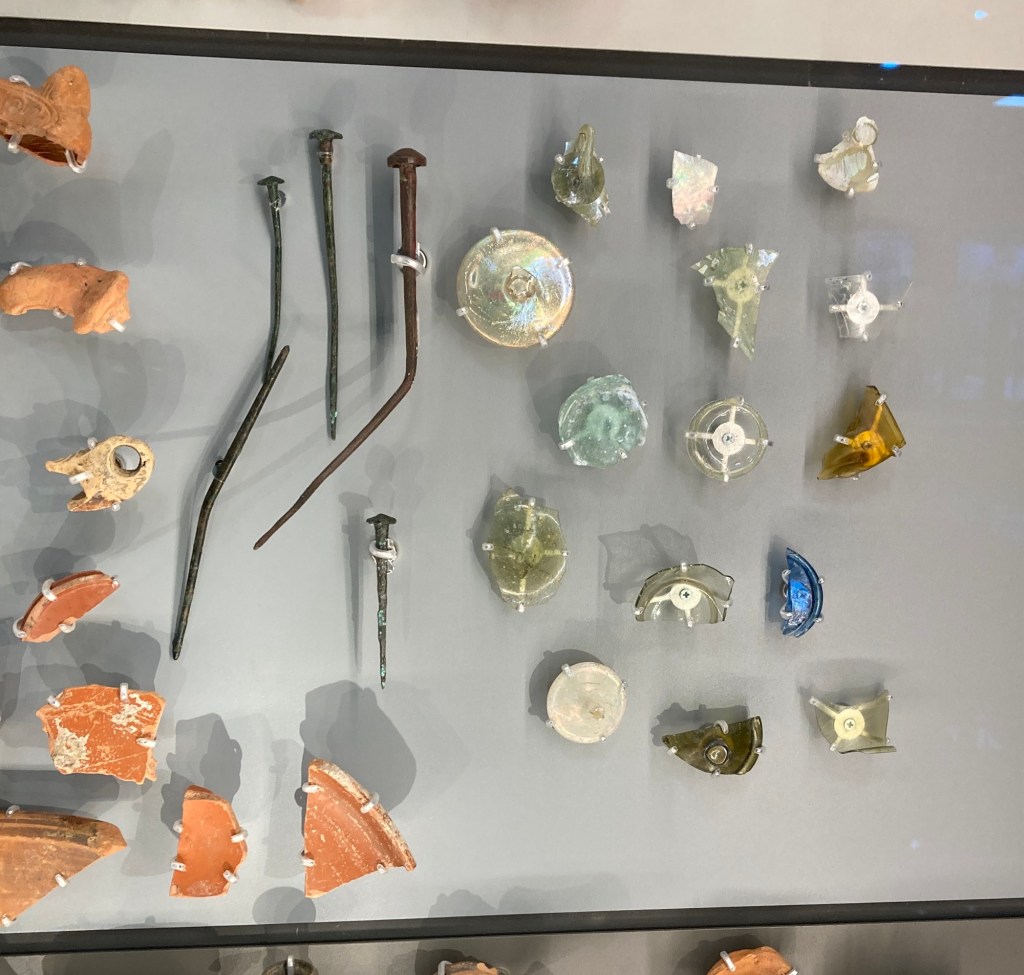
Layers representing Hellenistic, Roman, Byzantine and Ottoman societies were found, and the decision was made to display the Roman city. All of the artifacts will eventually be exhibited in a museum, a foretaste of which makes a wall display in the lower levels of the Metro station.
I am amazed at the vision and scope of this project. History is alive here.
Roman artifacts
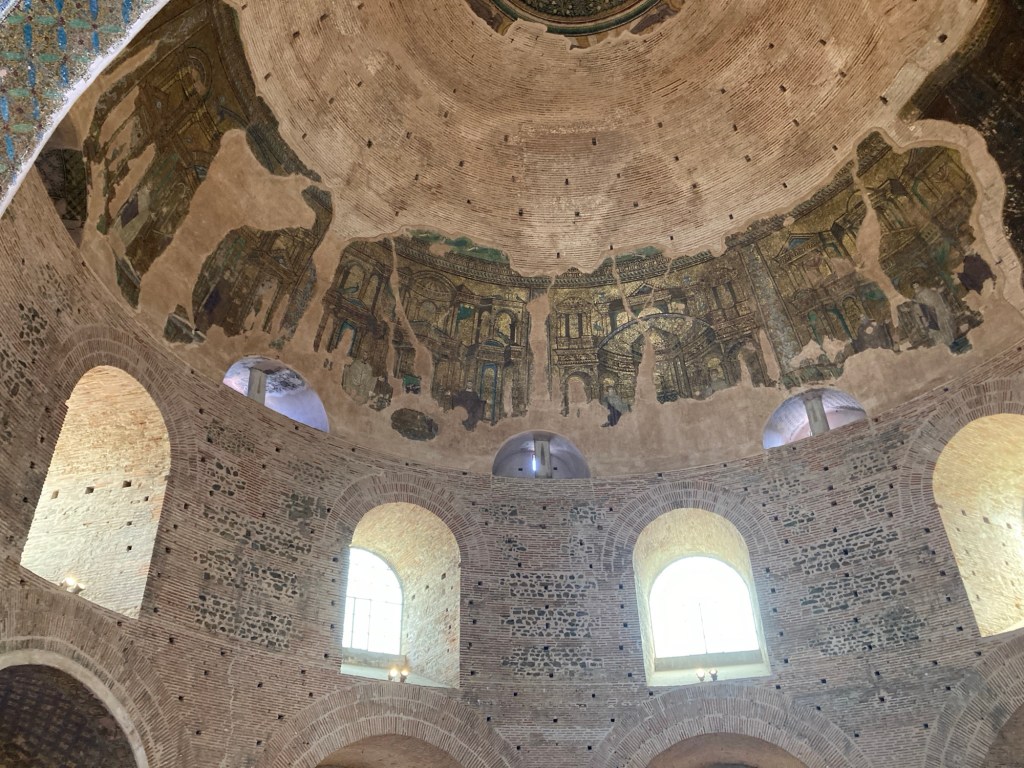
Because my time in Thessaloniki is running out, I need to tell you about the Rotonda now as well. It is the oldest of Thessaloniki’s churches.
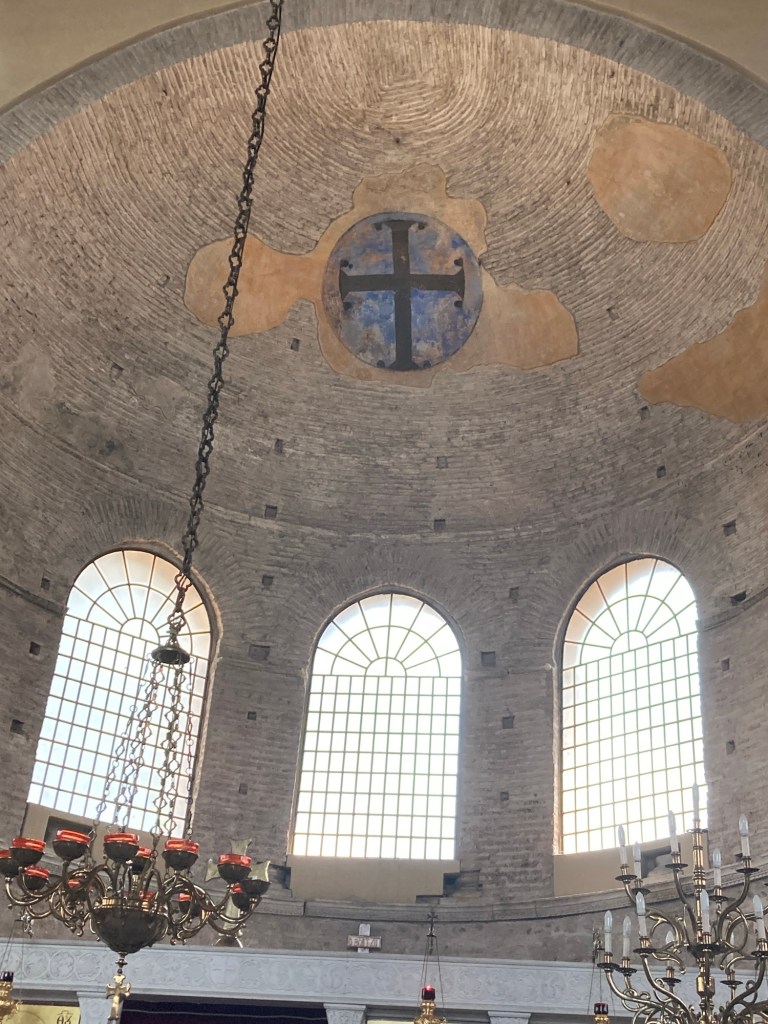
This edifice that was built in the early 4th century by the Emperor Galerius, possibly completed by Constantine when he lived here, has walls six metersthick. As soon as I was inside, I felt the immense presence of the place. The only visitor at that time besides us was a woman sitting on a folding chair and reading, and I knew it would be a blessed place just to sit. But I didn’t want it enough to go back and pay another ten euros to enter.
Some historians think that Galerius built it as a mausoleum, as part of the complex including the Arch of Galerius and the palace. But others think it was built as a temple to a god, possibly Zeus, who was Galerius’s patron god.
Galerius was buried in Serbia in any case, and a few decades later the Emperor Theodosius (probably) was the one who ordered the Rotonda to be made into a church dedicated to St. George.
In 1590 it was converted into a mosque for a few hundred years, and a minaret was added. It’s the only minaret that was not removed when the city was liberated from the Ottomans.
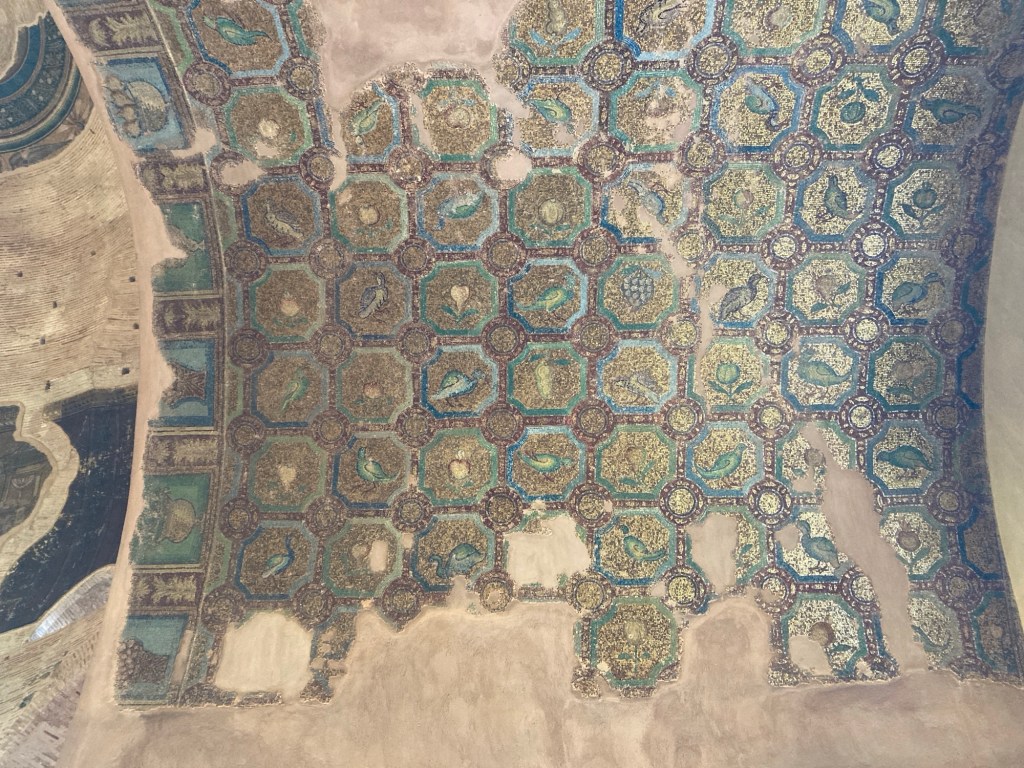
Along with the serenity and hugeness of the church, the remaining ancient mosaics impressed me, with their brilliance and detail. So, so lovely, the art that has survived nearly two thousand years and doesn’t show its age. If my neck were stronger, I’d have craned it longer to feast my eyes on the colors of the birds especially.
I think services are held there on the feast of St. George. One doesn’t have to go down to go back, when the Rotonda is taking you; it sits elevated above the city. You just walk up the hill, walk inside, and there you are.
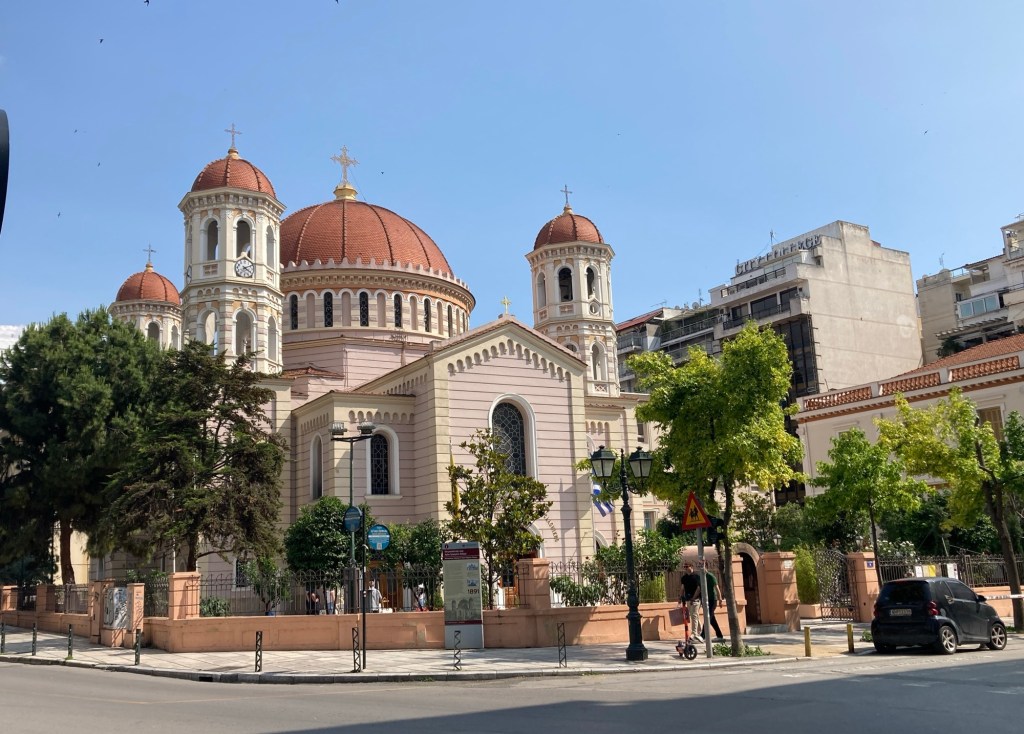
The Metropolitan Church of St. Gregory Palamas is very close to my hotel, and it houses the relics of St. Gregory, who was Archbishop of Thessaloniki from 1350 to 1359 A.D. I really appreciate St. Gregory and for months I’ve been looking forward to visiting his church.
I’m devoting an entire post to the subject because of the relationship of this particular site and temple to other churches in the city, and because of its unique role during the 400 years of Ottoman rule.
It was built in the 13th and 14th centuries and originally was dedicated to the Virgin Mary, but after the Ottoman conquest of the city in 1430, and the conversion of St. Demetrios Cathedral into a mosque in 1491, this church was re-christened after that saint, who is the city’s patron. After the (Rotonda) Cathedral of St. George was also converted into a mosque in 1591, and this temple remained a place of Christian worship, it was designated the cathedral church of Thessaloniki.
The Greeks rose up against Ottoman rule at various times over the centuries; during the revolution of 1821, hundreds of Thessalonians sought refuge in the church, but the Ottomans broke down the doors and massacred them.
The building was entirely destroyed in a fire in 1890, and fully rebuilt by 1909. By the time it was consecrated, the old St. Demetrios church was functioning as a Christian church again, and that’s when the newly rebuilt church was dedicated to St. Gregory Palamas, in 1914. Later in the 20th century it had to be repaired after an earthquake damaged it.
I often think of how buildings have lives. A building that is consecrated for worship has a particular “calling,” if you will, and is often a revered member and bedrock of the community. The Church of St. Gregory Palamas has served for 700 years, and during those centuries has suffered from earthquake, fire, and sword.
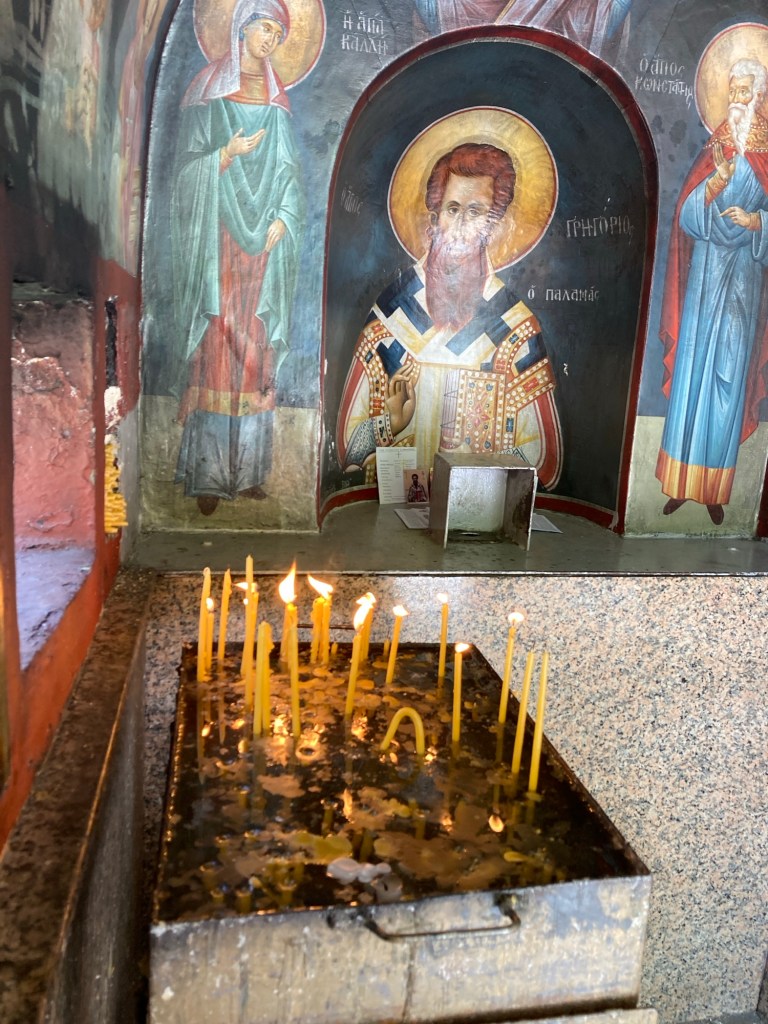
Today when I walked past, I stopped at the little booth shrine outside by the street, where candle fires were symbolizing a whole lake of prayers (sorry about the glare on the face of the icon):
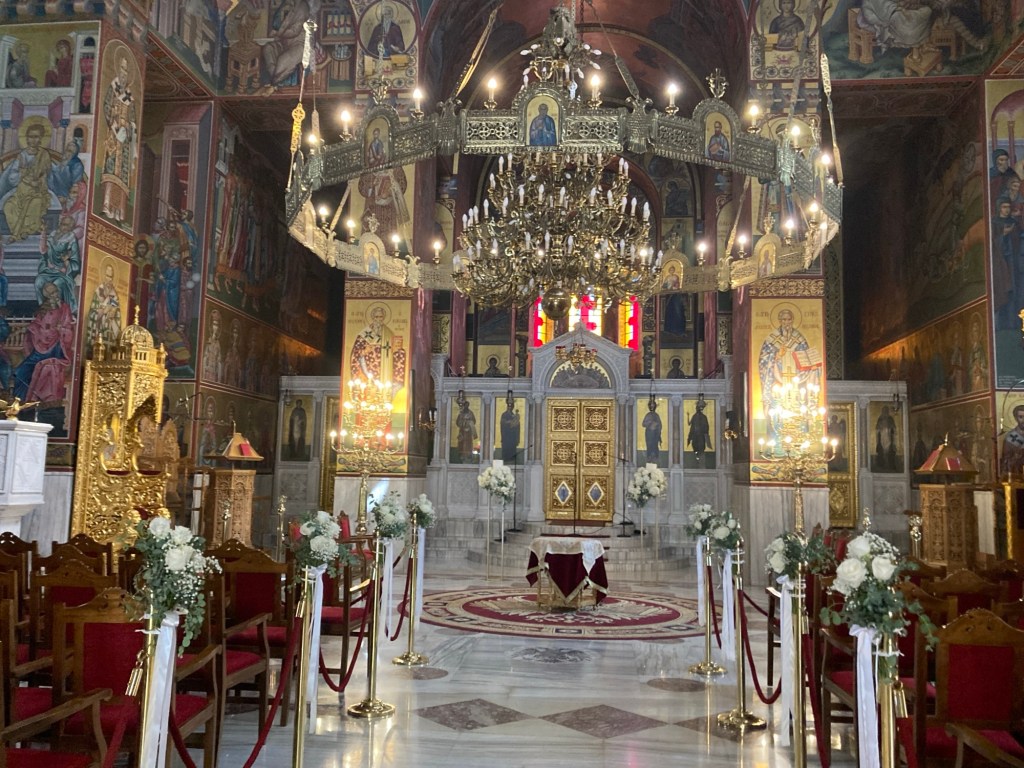
The last fifty years — such a brief span of time in the context of this city — seem to have been peaceful, and if the temple were sentient, it would no doubt be happy that it’s one of the most popular churches in Thessaloniki for weddings. The first day I stopped in, they were getting ready for such an event.
But the presence of the relics of St. Gregory, deposited there in 1914 when the church was dedicated to him, are the greatest blessing to the temple and the people.
May the Lord continue to make His temple a blessing to the city of Thessaloniki.


















 Gladsome Lights