Tag Archives: Tolkien

A song for a journey.

Anke Eismann, Bilbo Baggins

Today is Hobbit Day, that is, the birthday of both Bilbo and Frodo Baggins. Maybe next year I will manage to have a party in their honor. I only thought of it a week in advance this year, and that’s not enough time. Besides, Monday is not the best day for a party.

Has any of you, my readers, ever hosted or attended an event on Tolkien’s birthday or that of his hobbit characters? We had one at our house on January 3rd (Tolkien’s birthday) a long time ago, and it was a lot of fun. But this year, I’ll just post this song (with a musical link below it) from the tale of hobbits and their adventure:

MISTY MOUNTAINS

Far over the misty mountains cold
To dungeons deep and caverns old
We must away ere break of day
To seek the pale enchanted gold.

The dwarves of yore made mighty spells,
While hammers fell like ringing bells
In places deep, where dark things sleep,
In hollow halls beneath the fells.

For ancient king and elvish lord
There many a gleaming golden hoard
They shaped and wrought, and light they caught
To hide in gems on hilt of sword.

On silver necklaces they strung
The flowering stars, on crowns they hung
The dragon-fire, in twisted wire
They meshed the light of moon and sun.

Far over the misty mountains cold
To dungeons deep and caverns old
We must away, ere break of day,
To claim our long-forgotten gold.

Goblets they carved there for themselves
And harps of gold; where no man delves
There lay they long, and many a song
Was sung unheard by men or elves.

The pines were roaring on the height,
The winds were moaning in the night.
The fire was red, it flaming spread;
The trees like torches blazed with light.

The bells were ringing in the dale
And men looked up with faces pale;
Then dragon’s ire more fierce than fire
Laid low their towers and houses frail.

The mountain smoked beneath the moon;
The dwarves, they heard the tramp of doom.
They fled their hall, to dying fall
Beneath his feet, beneath the moon.

Far over the misty mountains grim
To dungeons deep and caverns dim
We must away, ere break of day,
To win our harps and gold from him!

I like the YouTube video of Clamavi De Profundis singing “Misty Mountains”, an expanded-version cover of the original soundtrack of “The Hobbit: An Unexpected Journey.” The song comes from the chapter “An Unexpected Party” of The Hobbit, and this group adds verses from later in the book. It’s not a poem I am likely to memorize, but the tune I can’t get out of my head. That’s okay. Its mood seems to be in harmony with my own daily paths:

The King is come unto his hall
Under the Mountain dark and tall.
The Worm of Dread is slain and dead,
And ever so our foes shall fall!
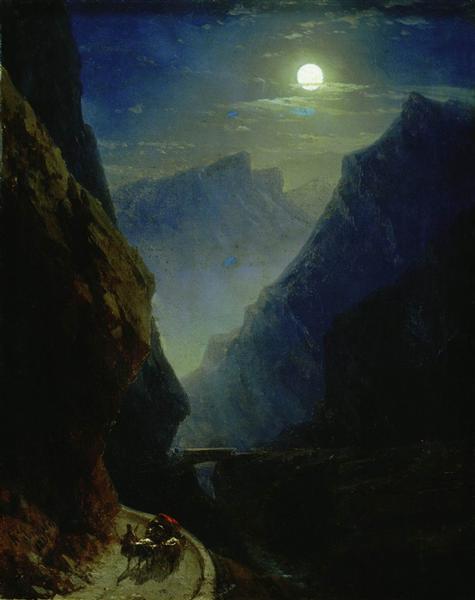
Ivan Aivazovsky, Darial Gorge


Samwise and the swallowtail.

Ladybug on sunflower leaf.

When I woke today, a multitude of urgent tasks filled my mind and sent me off in the wrong direction. Eventually I was rescued by the Jesus Prayer, by Jesus Himself. As I calmed down I realized that a few of the tasks were not that urgent, and when I began to consolidate my lists, one task fell off altogether, being a completely unnecessary outing, and large project that would have followed. That was a drive to the apple ranch to get Gravenstein apples, a variety that I usually miss out on because they are so early. But it won’t hurt to miss out on them again — why change tradition?

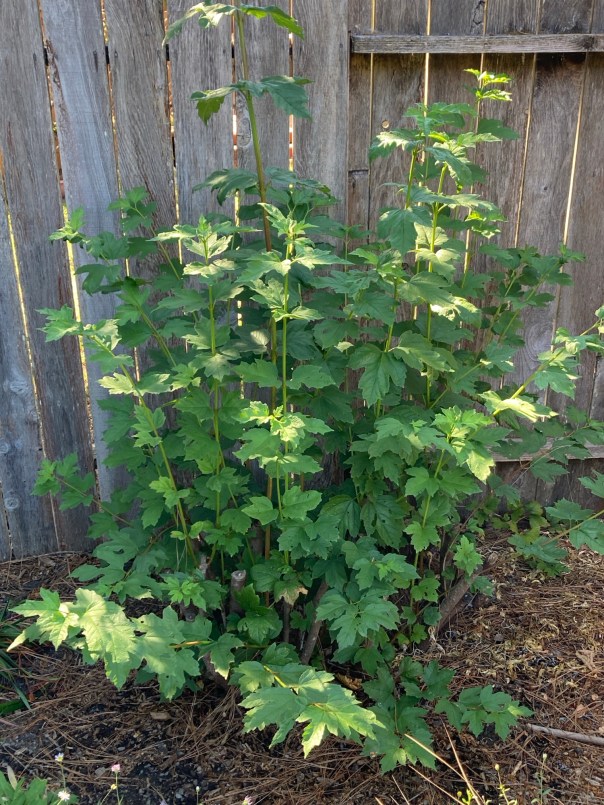
Volunteer Delta Sunflower

I’d wanted to water the garden early, but it ended up being not-so-early, and what do you know, that was not a disaster. Putting the hose on thirsty plants — or were they plants that merely look dry because it is August? — gave me so much joy, I could hardly bear it. I remember when my current garden went in, ten years ago, with its extensive automatic irrigation, my daughter Pearl was concerned and said, “But Mama, you love watering the garden!” Evidently that is true. It’s a great gift to have such work.

Viburnum coming along after hard pruning.

It seems to me that the irrigation system needs some adjusting; my thought is that as the plants are more in number and greater in size than when we first programmed it, and even since the last changes, I should customize it further. That job is a mental challenge for me, as there are six different valves/lines and three programs, for each of which one has to determine how many days per week and how many minutes of run time. As I have done so often, I will have to study the diagram and how to enter the settings via the dials and buttons, because it never sticks with me. If I just give some areas a little more water by hand, that will relieve my anxiety. It will be easier to tackle the problem if I am confident that nothing is dying of thirst right now.

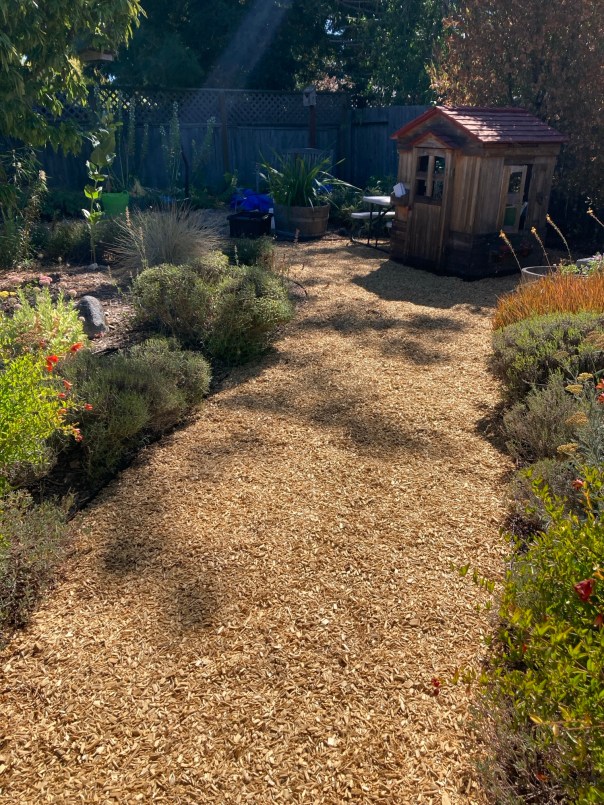
Path mulch reapplied after 9.5 years.
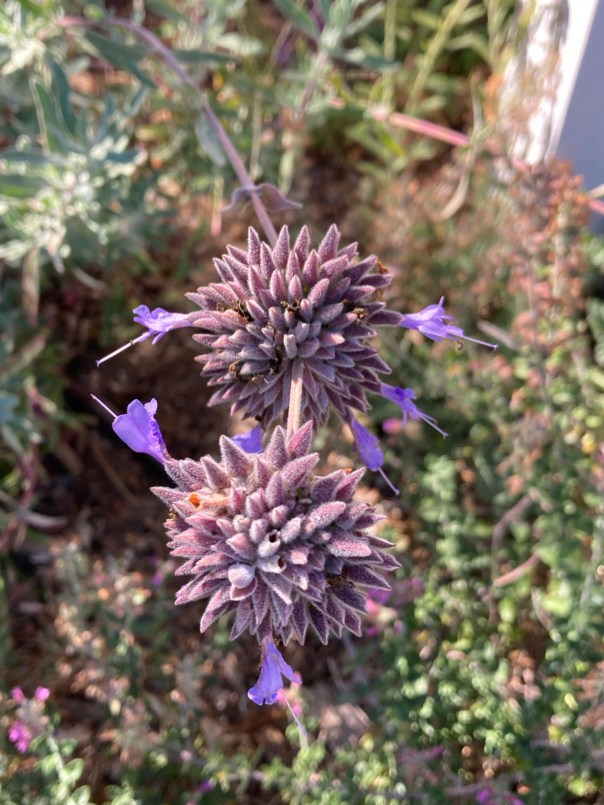
Salvia clevelandii

As I walked around with the hose, noting how many things are alive and obviously growing, happiness filled me. The thoughts of J.R.R. Tolkien that Eugene Terekhin writes about recently in “Why Gardeners Will Save the World” make me think that my garden is helping me while I am tending it:

Quoting a letter Tolkien wrote to a friend: “I think the simple ‘rustic’ love of Sam and his Rosie (nowhere elaborated) is absolutely essential to the study of his (the chief hero’s) character, and to the theme of the relation of ordinary life (breathing, eating, working, begetting) and quests, sacrifice, causes, and the ‘longing for Elves’, and sheer beauty.”

Terekhin: “Mythically speaking, Sam [the character in Lord of the Rings] was ‘down to earth.’ He was a gardener who loved all things that grow — as all hobbits do.”
….
“The most important thing one can do in wartime is to grow a garden. Because when we grow things, they grow us. It takes a long time to grow something, and as we tend our garden we grow together with it.”

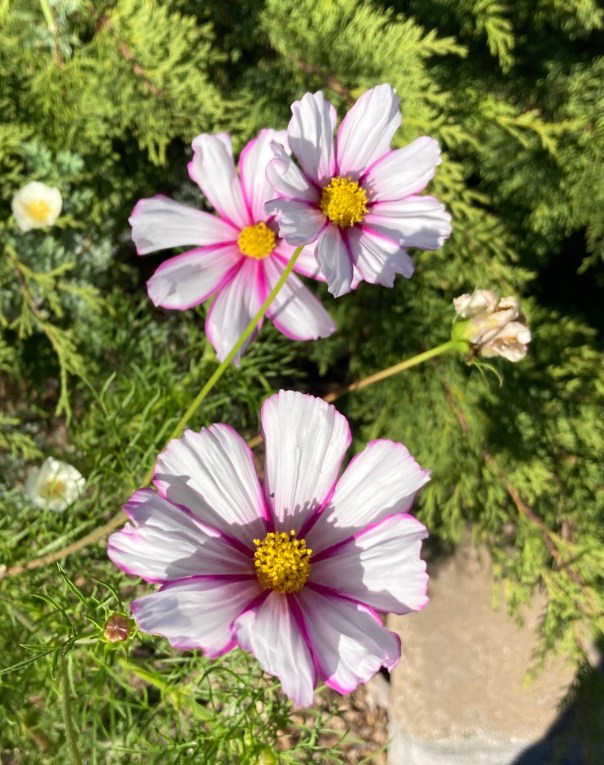
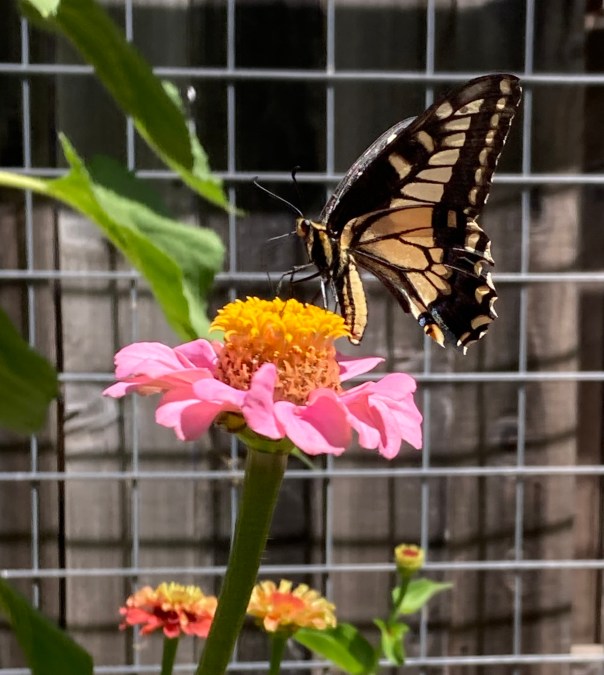
I know for sure that just being out there, soaking up the scents and the colors, watching the bees and butterflies drink from the flowers I tend on their behalf, is to me that most essential, ordinary life such as Tolkien shows us. For quite a while I followed this glorious, common swallowtail in all its glory, a creature that was drinking from just about every zinnia in the planter boxes. He and I were of the same mind about Being, and being down to earth.

Happiness is a butterfly, which, when pursued,
is always just beyond your grasp,
but which, if you sit down quietly,
may alight upon you.

-Nathaniel Hawthorne

I like rain and roasted onions.

Rain… rain… rain… It’s been raining All. Day. It’s night now and still raining. I’ve been exulting in it, because I didn’t have any responsibilities that required my going out. I could tend the fire, chat with my daughters online about their weather, roast onions, read, and even accomplish one housecleaning task that has been hanging over my head for months: cleaning the ceiling exhaust fan in a bathroom. Yippee!

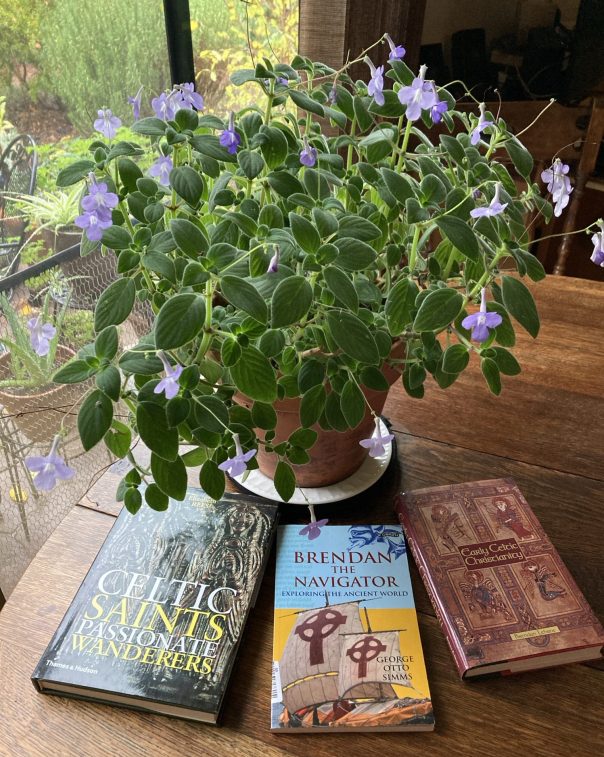
The nodding violet that I brought indoors last week before freezing weather arrived looked so lovely with the rainy light behind it, I had to take its picture.

Sir Gawain by Howard Pyle

On the table by the violet are a few of the books I bought to go with an online course I am taking this fall: “Christian Wonder Tales.” It is taught by Martin Shaw, the mythologist and storyteller whom I met at the Symbolic World Summit last winter. Tolkien’s Sir Gawain and the Green Knight didn’t get in the picture, but is another title he recommended, and I have it upstairs.

Who knows if I will read any of these books to the end — I haven’t even finished The King of Ireland’s Son, by Padraic Colum, which is quite delightful. Also perfect for listening to, because the narrator Gerard Doyle’s Irish brogue, telling the stories-within-stories as is the custom with Irish stories, has me journeying entranced from the Irish cottage to the castle and back again, meeting mysterious characters and challenging assignments around every bend in the road.

Now to the topic of food: Back when my friend Susan was also my housemate, sometimes I would walk in the front door to another sort of captivating story, the aroma of which was the essential part. What are you cooking?? I would ask, drawn immediately into the kitchen, and it took a few repetitions of this encounter before my nose remembered what she had told me: “It’s only roasted onions!” I eventually had to start making them myself.

(Above, onions in my kitchen as it was 28 years ago. Notice bread rising in pans at left. The only thing that is the same now is cast iron pans always on the stove top.)

To keep up with my appetite for them, I’d need to roast a batch of onions once a week, but it ends up being more like twice a year. As soon as they are out of the oven I always serve myself a little bowl of them, which seems to be about one onion’s worth… or two — so I usually double the recipe below. Do you roast onions? You can find many recipes online; here is my version:

ROASTED ONIONS

3 large onions, yellow or red
2 tablespoons olive or other oil
1 tablespoon balsamic or other vinegar
1/2 teaspoon kosher salt
fresh ground black pepper to taste
(1 tablespoon chopped fresh thyme) – I never add this

Cut the onions vertically into quarters or sixths, and then slice those wedges crosswise as thick as you want; I make mine 1/8 to 1/3 inch thick. Toss them in a bowl with the other ingredients and roast in a sheet pan at 375 to 400 degrees for 45 minutes to an hour, stirring occasionally, until they are as brown as looks good to you. I think sometimes, in an effort to get them crispier, I have overcooked them and made them a little tough.

This evening I didn’t use balsamic vinegar, because recently I was given an extra special bottle of “plain” red wine vinegar with a noble heritage. Just as bakers like to pass their sourdough starter around to friends, so chefs and winemakers often share a vinegar mother (also called a vinegar scoby). My vinegar was fermented with a mother whose mother belonged to Alice Waters, and whose grandmother grew in Julia Child’s kitchen. Does that make my onions taste better? You know, I think they might just be the best I’ve ever made!

The victory hovers over our world.

It’s New Year’s Day according to our liturgical calendar, and special prayers for God’s blessing were included in our service this morning. What better time could there be for thinking about progress… or would devolution and even defeat be more realistic? I happened to read this passage today (I didn’t hear it in church) and just realized how it is connected, sort of. From a letter written by the Apostle Paul to his coworker Timothy:

“But know this, that in the last days perilous times will come: For men will be lovers of themselves, lovers of money, boasters, proud, blasphemers, disobedient to parents, unthankful, unholy, unloving, unforgiving, slanderers, without self-control, brutal, despisers of good, traitors, headstrong, haughty, lovers of pleasure rather than lovers of God, having a form of godliness but denying its power.

…Now as Jannes and Jambres resisted Moses, so do these also resist the truth: men of corrupt minds, disapproved concerning the faith; but they will progress no further, for their folly will be manifest to all, as theirs also was. But you have carefully followed my doctrine, manner of life, purpose, faith, longsuffering, love, perseverance, persecutions, afflictions, which happened to me at Antioch, at Iconium, at Lystra– what persecutions I endured. And out of them all the Lord delivered me. Yes, and all who desire to live godly in Christ Jesus will suffer persecution. But evil men and impostors will grow worse and worse, deceiving and being deceived.” (2 Timothy 3:1-13)

Father Stephen Freeman has written over the years about how this passage is in agreement with what J.R.R. Tolkien wrote in a letter many centuries later:

“Actually I am a Christian, and indeed a Roman Catholic, so that I do not expect ‘history’ to be anything but a ‘long defeat’— though it contains (and in legend may contain more clearly and movingly) some samples or glimpses of final victory” (Letters 255).

This narrative of a long defeat was assumed among ancient peoples, Fr. Stephen tells us, and only changed to one of progress in recent centuries, especially during the 19th century. But the defeat of history is not really pessimistic. It is part of the greater story of Christ’s Kingdom that has come, and is coming:

“I would go further and say that the final victory already “tabernacles” among us. It hovers within and over our world, shaping it and forming it, even within its defeat. For the nature of our salvation is a Defeat. Therefore the defeat within the world itself is not a tragic deviation from the end, but an End that was always foreseen and present within the Cross itself.” 

The whole article is here: “Tolkien’s Long Defeat and the Path of History.”

The liturgical calendar doesn’t have much to do with that long defeat. You can go to any timeline of history to see the kingdoms that have risen and fallen, and the many wars and tribulations, the violence and suffering that have filled the earth since the beginning. Taken as a whole it’s hard to see any true progress there, unless you are talking about Wonder Bread or flush toilets.

No, the liturgical New Year begins the commemorations of Great Feasts of the Orthodox Church, following the sequence of events in what is sometimes called our Salvation History. The birth of Christ’s mother, the birth of Christ, the Presentation of Christ in the Temple, and so on. The death and resurrection of Christ are the peak season on that calendar. Christ’s defeat, and death — swallowed up in victory. That is cause to say “Christ is risen!” and “Happy New Year!” God is with us.